

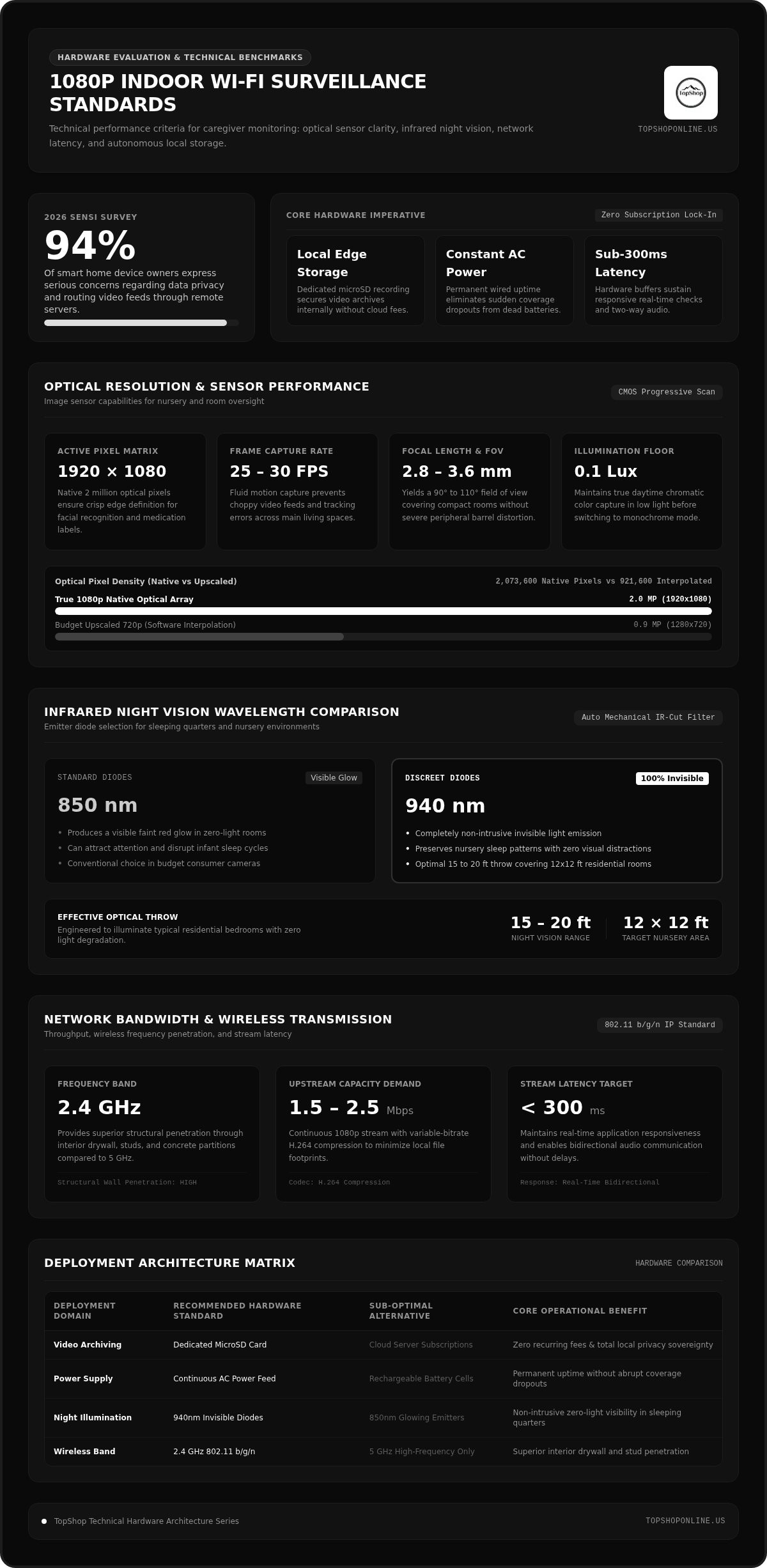
A 2026 Sensi survey reveals that 94% of smart home device owners harbor serious concerns regarding data privacy, yet conventional surveillance systems routinely route video feeds through vulnerable remote servers. When selecting a 1080p wifi indoor camera for nanny monitoring, you shouldn't have to accept dropped connections during live checks, unclear power requirements, or recurring subscription fees just to review recorded playback. You need uninterrupted visibility, solid hardware reliability, and complete authority over your video stream.
Dependable caregiver oversight depends on verifiable optical resolution, low-latency transmission, and local storage sovereignty that keeps your operational data private. This technical hardware evaluation examines image sensor capabilities, infrared night vision ranges, 2.4 GHz wireless bandwidth demands, and direct microSD recording architectures. You'll discover how to assess mounting positions, power supplies, and network encryption standards to deploy a stable, high-performance monitoring setup without subscription lock-in.
Key Takeaways
- Native 1920x1080 resolution running at 25 to 30 frames per second provides necessary facial detail and fluid motion capture across primary living areas.
- Deploying a 1080p wifi indoor camera for nanny monitoring with dedicated microSD local storage eliminates recurring cloud subscription fees and secures your internal video archive.
- Non-intrusive infrared night vision illumination maintains reliable visibility in zero-light conditions without emitting disruptive visual indicators in sleeping quarters.
- Continuous AC power integration ensures permanent hardware uptime and eliminates the sudden coverage dropouts typical of battery-operated surveillance devices.
- Proper positioning balances wide-angle optical coverage with domestic privacy boundaries and state-level audio recording regulations.
Technical Specifications for 1080p Indoor WiFi Surveillance Hardware
High-resolution caregiver monitoring requires hardware built on verifiable optical benchmarks rather than cosmetic casing designs. True 1080p surveillance operates at a native matrix of 1920x1080 active pixels. This pixel count provides sufficient edge definition to identify facial characteristics, read small medication labels, and track hand interactions in a nursery environment. Operating at a minimum capture rate of 25 to 30 frames per second (FPS) prevents choppy video feeds, capturing erratic motions cleanly without dropped intermediate fields.
Modern surveillance relies on CMOS progressive scan sensors paired with fixed-focal optics. These solid-state sensors scan visual rows sequentially, eliminating the motion tearing common in legacy interlaced devices. Integrating efficient H.264 video compression maintains crisp rendering while drastically cutting local file footprints. When selecting a 1080p wifi indoor camera for nanny duties, choosing robust internal hardware ensures consistent video fidelity across extended operating hours.
Optical Resolution and Sensor Performance
Hardware quality dictates whether a video feed remains legible during sudden indoor illumination shifts. Evaluating the core imaging components reveals substantial functional differences:
- Native Optical Array: Authentic 1080p sensors record two million distinct optical pixels. Budget alternatives upscale inferior 720p or VGA sensors via software interpolation, generating pixelated artifacts and blurring fine facial details.
- Focal Length and Edge Geometry: Fixed lenses between 2.8mm and 3.6mm yield viewing angles between 90 and 110 degrees. These short focal lengths capture compact rooms without the severe barrel distortion that warps perimeter walls.
- Illumination Thresholds: High-performance CMOS components operate down to 0.1 lux in daytime chromatic mode before toggling monochrome capture, preserving accurate color reproduction in dimmed nurseries.
Network Bandwidth and Wireless Transmission Standards
Wireless stream reliability relies on proven IP camera technology running across local area networks. Most domestic monitoring devices leverage 2.4 GHz 802.11 b/g/n wireless modules. While 5 GHz channels provide faster burst speeds, 2.4 GHz radio waves offer superior structural penetration through interior drywall, studs, and concrete partitions.
A continuous 1080p stream encoded with variable-bitrate H.264 demands approximately 1.5 to 2.5 Mbps of upstream network capacity. To prevent connection drops on a 1080p wifi indoor camera for nanny surveillance, internal hardware buffers must sustain stream continuity during standard domestic packet fluctuations. System latencies under 300 milliseconds maintain real-time application responsiveness, enabling rapid two-way communication without audio feedback or visual delays.
Critical Hardware Features: Night Vision, Audio, and Storage Architecture
Caregiver monitoring systems require dedicated peripheral hardware to function beyond standard daylight streaming. Reliable nighttime monitoring, bidirectional acoustic capture, and autonomous edge storage separate resilient surveillance equipment from fragile consumer gadgets. When deploying a 1080p wifi indoor camera for nanny oversight, hardware specifications dictate operational stability without relying on continuous internet connectivity.
Infrared Night Vision Wavelengths and Range
Night vision performance hinges on infrared emitter diodes and optical filtering mechanics:
- 850nm vs. 940nm Wavelengths: Common 850nm diodes produce a visible red glow at night that can distract sleeping infants. In contrast, 940nm diodes emit completely invisible illumination, providing discreet monitoring without disrupting sleep routines.
- Effective Indoor Throw: Standard 940nm arrays illuminate up to 15 to 20 feet, which easily covers typical 12x12 foot residential bedrooms.
- Mechanical IR-Cut Filters: Automated mechanical switches alternate between infrared-blocking glass in daylight and open exposure in low light, eliminating daytime chromatic distortions.
Local Storage versus Cloud Subscription Architecture
Relying exclusively on proprietary cloud servers introduces recurring fees and potential service outages. Local storage architectures solve this through integrated micro-SD card slots supporting up to 128GB or 512GB Class-10 media. When card capacity fills, continuous loop recording automatically overwrites the oldest unlocked video blocks, ensuring uninterrupted capture without manual file purging.
Direct local storage guarantees physical data sovereignty. Storing video directly on encrypted local hardware prevents exposure from compromised third-party servers. For detailed hardware benchmarks on standalone local storage configurations, evaluate a dedicated wireless mini security camera with night vision to eliminate recurring subscription dependencies across your indoor spaces.
Audio Integration and Motion Trigger Protocols
Bidirectional audio systems incorporate noise-canceling electret microphones paired with dynamic micro-speakers. Hardware filters isolate human vocal frequencies between 300 Hz and 3.4 kHz, ensuring distinct nursery cries and clear speech playback. Familiarity with established Legal Standards for Domestic Surveillance helps establish compliance regarding electronic acoustic capture during child oversight.
Motion detection relies on either software pixel-differential analysis or passive infrared (PIR) hardware sensors. Pixel-based detection triggers when frame luminance values shift, whereas PIR sensors measure actual thermal signatures from moving bodies. Setting granular sensitivity zones isolates play areas, preventing false alarms from ceiling fans or shifting window light. You can source direct-to-consumer monitoring equipment via TopShop hardware selections designed for efficient, self-contained home surveillance.
Deployment Strategies: Positioning, Angles, and Power Infrastructure
Strategic hardware installation directly dictates optical coverage and stream stability. Even high-performing sensors deliver degraded video if placed incorrectly or starved of continuous electricity. Positioning a 1080p wifi indoor camera for nanny monitoring requires calculating lens geometry, ambient lighting angles, and hardwired power delivery paths to maintain uninterrupted domestic surveillance.
Field of View and Lens Positioning Geometry
Optical coverage depends on lens angle and mounting height. Wide-angle lenses between 110 and 130 degrees provide broad room visibility, but incorrect placement creates severe optical dead zones:
- Elevation and Tilt Angles: Mount cameras between 6 and 8 feet from floor level, tilted downward at approximately 15 to 20 degrees. This elevation delivers a broad downward perspective over active play zones while keeping hardware out of reach of small children.
- Critical Zone Alignment: Orient optics to capture primary transit thresholds, crib perimeters, and changing tables. Position units along corner walls rather than flat center walls to capture maximum square footage without corner blind spots.
- Backlighting Management: Direct sunlight through untinted windows blinds CMOS image sensors, causing severe underexposure across subjects in the foreground. Position lenses perpendicular to window frames rather than facing direct outdoor glare.
Power Delivery and Continuous Operation Safeguards
Battery-powered cameras rely on aggressive sleep cycles that delay stream initiation and cut feeds prematurely during extended monitoring windows. Installing an operational 1080p wifi indoor camera for nanny oversight calls for continuous AC power over regulated micro-USB or USB-C 5V/1A or 5V/2A connections. Hardwired connections maintain constant processor readiness, continuous buffer retention, and instant live view retrieval without power degradation.
Reliable installations require centralizing power distribution for monitoring units alongside network repeaters. Consolidating feeds through a dedicated power strip 6 outlet 6 usb module protects connected surveillance hardware against voltage spikes while providing dedicated direct USB power ports without bulky wall transformers.
Cable management requires structured, surface-mounted raceways or cable tracks anchored to baseboards and door frames. Concealing exposed cords behind fixed furniture prevents accidental unplugging, keeps curious infants safe from strangulation hazards, and stops physical tampering from disrupting continuous video logging.
Legal Standards and Network Security for Domestic Surveillance
Operating home surveillance hardware involves clear legal responsibilities alongside physical installation tasks. Video monitoring inside private residences is governed by both state statutory definitions and federal privacy rights. When setting up a 1080p wifi indoor camera for nanny surveillance, property owners must configure hardware capabilities to comply with regional consent laws while hardening local networks against external intrusion.
Audio Recording Laws and Privacy Boundaries
Domestic monitoring laws draw a sharp technical boundary between silent video capture and integrated audio logging. Non-compliance often stems from audio functionality rather than visual footage:
- Consent Jurisdictions: Federal statute permits audio recording under a one-party consent framework. However, states like California, Delaware, Florida, Illinois, and Maryland enforce strict all-party consent mandates. In these regions, recording conversations without explicit acknowledgement from every participant violates wiretap statutes.
- Reasonable Privacy Zones: Visual recording is legally permissible across shared spaces such as living rooms, kitchens, and dedicated play areas. Placement inside private quarters, bathrooms, or dedicated sleeping rooms assigned to live-in caregivers is strictly illegal under domestic privacy protections.
- Surveillance Disclosure: Drafting a written household agreement detailing camera positions and storage protocols builds operational clarity and secures defensible legal consent for ongoing caregiver monitoring.
WiFi Network Hardening and Stream Encryption
Hardware configuration prevents unauthorized access across your local network infrastructure. According to a 2026 Sensi survey, 59% of smart home device owners would stop using a connected product if they discovered unauthorized data sharing. Safeguarding local video transmissions requires proactive administrative hardening.
Segment domestic router traffic by assigning every 1080p wifi indoor camera for nanny oversight to an isolated 2.4 GHz guest SSID. This prevents a compromised camera from accessing personal computing assets, network drives, or confidential paperwork stored on the primary subnet. Replace factory-default administrator credentials immediately with distinct 16-character alphanumeric passphrases, disabling universal plug and play (UPnP) routing to prevent automated external port mapping.
Verify that transmission hardware enforces WPA2-AES or WPA3 security handshakes alongside TLS/SSL encapsulation for live application viewing. You can explore high-efficiency surveillance hardware through TopShop domestic surveillance options to deploy secure, standalone monitoring hardware across your household network.
Hardware Selection Framework: Compact 1080p WiFi Camera Evaluation
Selecting reliable monitoring equipment requires auditing physical manufacturing quality and firmware design rather than superficial marketing claims. A durable 1080p wifi indoor camera for nanny surveillance must maintain processing performance across continuous operating cycles without thermal throttling, dropped frames, or mandatory cloud subscriptions. Prioritizing standalone functionality preserves local control over your video archive.
Component Quality and Heat Dissipation Assessment
Miniature surveillance housings pack dense computing hardware into compact dimensions. High-definition CMOS sensors, wireless transmitters, and infrared emitters generate continuous internal heat during non-stop monitoring cycles:
- Passive Thermal Convection: High-grade chassis designs feature perimeter ventilation slots that dissipate heat naturally. Enclosures lacking passive vents trap heat, accelerating image sensor degradation and inducing random system reboots.
- Operating Temperature Tolerances: Robust units sustain internal operating ranges from 14°F to 122°F (-10°C to 50°C), preventing processor lockups during summer heat or heavy nursery climate control.
- Mechanical Mounting Integrity: Reliable hardware pairs with high-retention magnetic bases and reinforced ball joints. These articulated brackets resist gravitational sag, holding precise camera angles against the mechanical pull of trailing USB power cords.
Direct Hardware Configuration and Acquisition
Operating an effective domestic monitoring layout means avoiding devices burdened by locked proprietary ecosystems. The standalone 1080P HD Wireless Mini Security WiFi Camera satisfies these technical requirements by combining an uncompressed 1080p optical sensor with onboard infrared arrays and local micro-SD storage slots. This self-contained architecture bypasses monthly platform subscriptions entirely, routing encrypted streams straight to your mobile devices.
Deployment-ready kits supply the necessary baseline hardware components out of the box:
- A dedicated 1080p mini surveillance unit with integrated multi-user administrative access controls
- A recessed physical pinhole reset toggle to quickly restore default network configurations if router settings change
- An adjustable magnetic swivel bracket for shelf, drywall, or metallic surface anchoring
- A regulated micro-USB interface cable delivering steady 5V DC power for continuous capture
You can procure these self-contained monitoring devices directly through the TopShop product catalog, securing streamlined domestic fulfillment on dependable indoor hardware.
Deploying Dependable Indoor Nursery Surveillance Hardware
Securing reliable caregiver oversight requires an engineering-first hardware strategy. Combining native 1920x1080 optical resolution, discreet 940nm infrared night vision, and local microSD edge storage ensures continuous visual documentation without the ongoing overhead of proprietary cloud subscriptions. Pairing continuous AC power delivery with elevated corner mounting eliminates coverage dropouts, while isolated guest network segmentation and strong encryption protect household data from external interception.
Selecting an effective 1080p wifi indoor camera for nanny oversight allows you to maintain direct operational authority while complying with domestic audio consent statutes. Hardware durability, passive thermal venting, and physical mounting stability ultimately determine system longevity in active household spaces. TopShop supports your home surveillance deployment with subscription-free local recording architectures, comprehensive technical specifications verified across inventory lines, and fast nationwide fulfillment across the United States. Explore 1080p WiFi indoor security cameras at TopShop to establish an efficient, dependable, and self-contained monitoring layout today.
Frequently Asked Questions
Can a 1080p WiFi indoor camera record continuously without an active internet connection?
Yes, standalone hardware continues recording video locally to an onboard microSD card even when external internet access drops. An active WiFi connection is necessary only for remote mobile streaming and live app notifications. The physical image sensor, video encoder, and local storage pipeline operate independently on 5V DC power, saving footage locally without interruption.
What is the technical difference between 850nm and 940nm infrared night vision?
The primary distinction lies in visual spectral emission. Standard 850nm infrared LEDs produce a faint, visible red glow that can draw a child's attention in darkened rooms. In contrast, 940nm diodes emit illumination entirely outside the human visible spectrum. This makes 940nm arrays completely invisible while delivering clear monochrome imaging across nursery spaces.
Is it legal to record audio alongside video on an indoor nanny camera in the US?
Visual recording in common domestic living areas is legal nationwide, but audio capture depends on state wiretapping statutes. Federal law allows single-party consent, yet states like California, Florida, and Illinois mandate all-party consent. Enabling audio without clear disclosure in these jurisdictions violates state wiretapping laws, making written household policies essential.
How much home network upload bandwidth does a single 1080p security camera require?
A standard 1080p video feed encoded in H.264 consumes roughly 1.5 to 2.5 Mbps of upstream network capacity during active streaming. If you deploy multiple monitoring units simultaneously, your domestic router must handle cumulative throughput demands. Setting conservative variable bitrates prevents stream buffering and avoids crowding out other household smart devices.
Does continuous indoor camera recording require a paid monthly cloud subscription?
No, choosing a standalone 1080p wifi indoor camera for nanny surveillance eliminates mandatory monthly platform fees. Devices configured with integrated microSD card slots record continuous video loops directly to onboard media. Older files overwrite automatically as storage thresholds fill, giving you direct physical control over your surveillance records without recurring costs.
How do you prevent a WiFi indoor security camera from being hacked or intercepted?
Network isolation and credential management are the most effective safeguards against unauthorized external access. Assign your 1080p wifi indoor camera for nanny monitoring to a dedicated guest network subnet, isolating it from home computers. Disable UPnP port forwarding on your router, apply WPA2 or WPA3 encryption, and change default device passwords to complex alphanumeric passphrases immediately upon initial setup.