

A single false passenger claim can terminate a driver's career regardless of the actual facts. You understand that clear, timestamped video is the only objective defense against liability in the rideshare industry. Selecting a high-performance night vision dash cam for rideshare requires more than basic 1080P specs. It demands dedicated infrared sensors capable of illuminating a dark cabin without distracting the driver. Ambient street lighting is technically insufficient for legal-grade evidence during night shifts.
This technical guide examines the hardware architecture of 3-channel systems like the Guardian 3-Channel 4K Dash Cam. You'll learn how Sony STARVIS 2 sensors and high-endurance microSD storage prevent data corruption during continuous twelve-hour shifts. We detail the hardware specifications for synchronized front, rear, and interior recording to ensure every angle of your vehicle is documented in high resolution. This analysis covers sensor sensitivity, thermal management, and the hardware requirements for reliable loop recording. We also address the 2026 California vehicle code updates regarding safety technology placement to ensure your hardware configuration remains compliant with current regulations.
Key Takeaways
- Identify the technical requirements for active Infrared (IR) LED arrays to achieve clear interior cabin illumination in total darkness.
- Compare 3-channel hardware configurations against dual-lens systems to determine the most effective coverage for passenger dispute resolution.
- Utilize a high-resolution night vision dash cam for rideshare to capture forensic-grade evidence of both traffic incidents and interior passenger behavior.
- Assess the efficiency of H.265 video compression and loop recording mechanics for managing high-volume 4K data streams on high-capacity storage cards.
Functional Requirements for Rideshare Vehicle Monitoring Systems
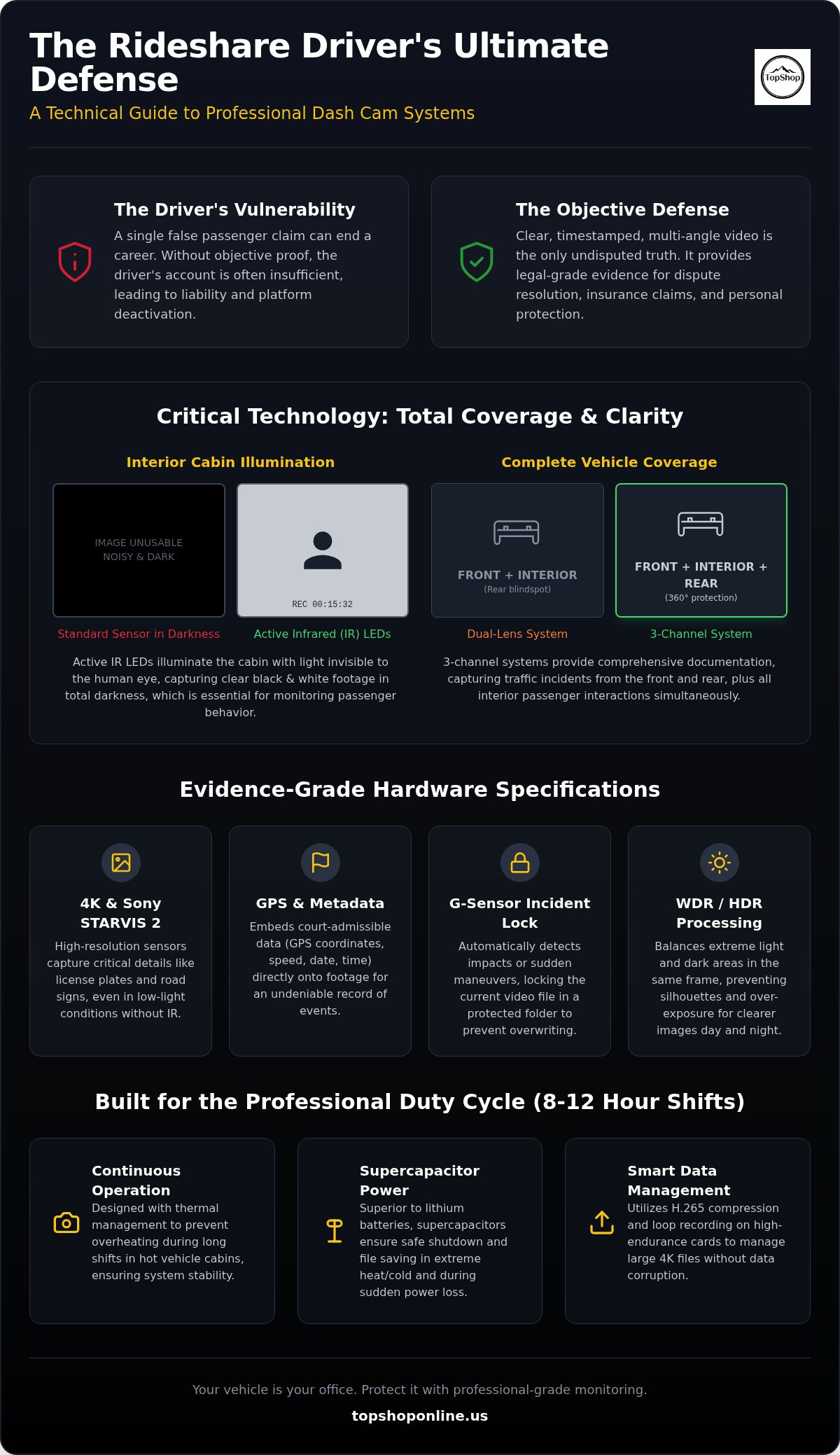
Professional rideshare environments require specialized hardware configurations capable of sustained performance under intensive professional duty cycles. Drivers frequently operate in 8 to 12 hour shifts, necessitating internal thermal management components and heat-dissipating housing materials to prevent processor throttling or total system shutdown in high-temperature vehicle cabins. A high-specification night vision dash cam for rideshare must utilize high-definition synchronized video streams across multiple channels to provide a comprehensive evidentiary record. This hardware-level synchronization ensures that exterior traffic incidents and interior passenger interactions are recorded with unified timestamps, providing objective data for insurance claims or platform dispute resolutions.
Evidence Integrity and Legal Protection
Court-admissible video footage requires precise metadata overlays including GPS coordinates, vehicle speed, and synchronized time-date stamps. Modern Automotive night vision systems and cabin-facing cameras utilize integrated G-sensors to detect physical impacts, sudden deceleration, or aggressive maneuvers. Upon detection, the hardware triggers an automatic incident locking protocol that moves the current recording segment to a protected memory sector, preventing loop-recording overwrites. Drivers must also manage audio recording regulations. Since states like California, Florida, and Illinois require all-party consent, hardware with dedicated physical audio toggle switches or firmware-level disabling features allows for precise legal compliance while maintaining visual recording integrity.
Professional Driver Operational Needs
Operational efficiency depends on automated hardware triggers that synchronize recording states with vehicle ignition. Professional-grade systems, such as the Guardian 3-Channel 4K Dash Cam, utilize auto-start and auto-stop protocols to eliminate manual operation errors during busy shifts. Low-profile, wedge-shaped mounting brackets ensure the hardware remains positioned behind the rearview mirror, preserving the driver's unobstructed field of vision and minimizing passenger distractions. Rapid data retrieval is a mandatory requirement for immediate on-site incident reporting. A reliable night vision dash cam for rideshare featuring high-speed 5GHz Wi-Fi modules or easily accessible side-loading microSD slots facilitates immediate file transfers to mobile devices, providing instant digital proof to law enforcement or platform support representatives. Integrated supercapacitors are preferred over standard lithium-ion batteries to ensure the final file segment saves correctly during sudden power loss, offering superior reliability in extreme climate conditions.
Infrared Night Vision and Low-Light Sensor Specifications
Exterior recording performance in low-light environments depends on the physical size and sensitivity of the CMOS sensor. Modern hardware utilizes back-illuminated sensors, such as the Sony STARVIS 2, which are engineered specifically for high-sensitivity light capture. These sensors operate with a wide aperture, typically f/1.8 or lower, to maximize photon intake during nocturnal operation. This hardware configuration allows a night vision dash cam for rideshare to resolve license plate details and road signage in environments with minimal ambient lighting. Advances in 4K dashcam technology demonstrate how high-resolution sensors manage the heavy data throughput required for clear night imagery without compromising frame rates.
Infrared LED vs. Standard Night Vision
Interior cabin monitoring requires active illumination because standard optical sensors cannot resolve imagery in total darkness. Active Infrared (IR) LED arrays emit light in the 850nm to 940nm wavelength range. This light is invisible to the human eye, preventing driver distraction while allowing the sensor to capture clear black and white footage of the entire cabin. Standard sensors without IR support produce unusable, noisy footage in unlit vehicle interiors. High-end systems like the Guardian 3-Channel 4K Dash Cam feature integrated IR LEDs that automatically activate when cabin light levels drop below a specific lux threshold. This ensures continuous visibility of passenger behavior regardless of external street lighting conditions.
WDR and HDR Processing
Wide Dynamic Range (WDR) and High Dynamic Range (HDR) are hardware-level processing protocols designed to balance high-contrast scenes. At night, headlights from oncoming traffic or bright street lamps often cause sensor "whiteout" in standard cameras. WDR hardware adjusts the exposure for multiple points within a single frame to ensure both the dark shadows and bright highlights remain visible. Digital noise reduction algorithms further refine the image by removing the "grain" common in high-ISO settings. Specialized lens coatings, such as multi-layer anti-reflective films, are applied to the glass elements to prevent ghosting and lens flare from external light sources. Drivers seeking professional-grade interior monitoring can find the Guardian 3-Channel 4K Dash Cam equipped with these specific sensor technologies for reliable night-shift documentation.
3-Channel vs. Dual-Lens Dash Cam Configurations
Rideshare drivers must choose between dual-lens and 3-channel hardware architectures to meet specific monitoring requirements. Dual-lens systems typically offer front and interior recording or front and rear recording; however, they can't monitor all three critical zones simultaneously. A high-performance night vision dash cam for rideshare utilizing a 3-channel array provides 360-degree evidentiary coverage. This configuration includes the road ahead, the rear traffic flow, and the interior passenger cabin. While dual-lens units are simpler to install, they leave significant blind spots that can result in incomplete data during insurance investigations or platform disputes.
The 3-Channel Advantage for Rideshare
Eliminating blind spots is the primary technical objective of a triple-camera system. A 3-channel setup records the vehicle's exterior surroundings while maintaining a constant view of the passenger cabin. This multi-angle approach is essential for event reconstruction. If a rear-end collision occurs, the hardware captures the impact from the rear lens, the vehicle's forward movement from the front lens, and the passenger's physical reaction from the interior lens. For a deeper dive into these systems, consult the 3-Channel 4K Dash Cam: Full Vehicle Monitoring Guide. Synchronized playback allows all three video streams to be viewed on a single timeline, ensuring that every second of an incident is accounted for from every possible perspective.
Hardware Synchronization and Power Management
Managing a triple-stream data array requires significant processing power and robust thermal management. High-resolution systems, such as the Guardian 3-Channel 4K Dash Cam, process 4K video from the front lens alongside dual 1080P streams from the interior and rear lenses. This creates a substantial processor load that generates heat. Hardware units must feature ventilated housings or internal heat sinks to prevent thermal shutdown during long shifts. Power consumption is another factor. Triple-lens arrays often require a hardwire kit to ensure stable voltage; standard cigarette lighter adapters may struggle to provide the 2A or higher current required for peak operation. When mounting these units, drivers must adhere to FMCSA windshield obstruction regulations to ensure the hardware doesn't interfere with the driver's critical field of view.
Installation complexity increases with the number of camera modules. Single-module systems house the front and interior lenses in one chassis, while the rear camera is typically a distributed module connected via a long coaxial or USB cable. This requires careful routing along the vehicle's pillars and roofline to avoid interfering with side-curtain airbags. Professional-grade hardware includes adhesive cable clips and pry tools to facilitate a clean, low-profile installation that meets professional standards.
Data Management: High-Capacity Storage and Loop Recording Protocols
Data management for a night vision dash cam for rideshare is defined by high-bitrate multi-channel recording requirements. H.265 (HEVC) video compression is the technical standard for 2026 hardware. It allows for optimized file sizes while maintaining 4K clarity, offering up to 50 percent better efficiency than older H.264 codecs. Loop recording protocols ensure continuous operation by automatically overwriting the oldest unprotected files. This prevents system recording failures when the storage card reaches capacity. Professional drivers should utilize high-endurance microSD cards with U3 or V30 speed ratings to handle the constant 30MB/s sequential write speeds required for 4K streams. Standard cards often suffer from controller failure or data corruption under the thermal stress of a 12-hour shift.
Storage capacity calculations depend on the total bitrate of all active channels. A 3-channel system recording at 4K (front) and dual 1080P (interior and rear) consumes significant space. A 256GB high-endurance card typically stores 6 to 8 hours of synchronized footage before the loop cycle begins. Upgrading to a 512GB or 1TB card is recommended for drivers who need to preserve an entire shift without overwriting data. These cards utilize specialized NAND flash architecture to survive thousands of write-erase cycles, which is a critical requirement for professional vehicle monitoring hardware.
Bitrate and Video Resolution Trade-offs
Frame rate (FPS) settings directly impact storage consumption and image fluidity. While 30 FPS is sufficient for interior monitoring, 60 FPS on the front lens captures smoother motion and clearer license plate details at highway speeds. Lowering the resolution of secondary channels to 1080P can extend recording time by 25 to 40 percent without sacrificing essential forensic details. For secondary security needs or stationary vehicle monitoring, review the 1080p Wireless Mini Security Camera with Night Vision technical guide to understand the specific trade-offs between resolution and storage longevity.
Emergency File Protection
Manual SOS buttons provide immediate file locking, moving the current video segment to a protected folder that the loop recording protocol cannot overwrite. Parking mode monitoring utilizes low-bitrate or time-lapse recording to minimize storage use while the vehicle is stationary. This mode requires a hardwire kit to monitor battery voltage and prevent vehicle power depletion. Local physical storage remains the primary choice for professional reliability. Cloud-based backups offer remote access but are often limited by cellular data speeds and monthly subscription fees, making local high-capacity cards the more stable option for evidentiary integrity. Drivers can find professional-grade storage solutions and the Guardian 3-Channel 4K Dash Cam at TopShop to ensure reliable data management during every shift.
Guardian 3-Channel 4K Dash Cam: High-Resolution Hardware Overview
The Guardian 3-Channel 4K Dash Cam operates as a unified hardware solution for professional vehicle monitoring. It utilizes a triple-lens configuration to capture 4K resolution (3840 x 2160p) on the forward-facing channel while simultaneously recording dual 1080P streams for the interior and rear zones. This hardware-level integration ensures that a high-performance night vision dash cam for rideshare provides synchronized, multi-angle coverage without the need for secondary recording devices. The wide-angle field of view (FOV) extends to 170 degrees on the front lens, maximizing coverage across multiple traffic lanes and sidewalk perimeters. A high-speed processor manages the simultaneous encoding of these three data streams to prevent frame drops or system latency during critical incident recording.
Guardian Technical Specifications
Hardware durability is achieved through heat-resistant housing materials and a high-speed chipset engineered for sustained triple-channel data throughput. The sensor array features a large aperture stacking for optimal low-light performance on the exterior lenses. Four integrated infrared LEDs provide dedicated interior cabin night vision, illuminating the passenger area in zero-lux environments without emitting visible light that could distract the driver. The user interface utilizes a staccato navigational structure for rapid setting adjustments. Drivers can toggle audio recording, format microSD cards, or lock specific video segments through direct, tactile button inputs or the integrated display menu. The build quality is optimized for professional use, featuring reinforced mounting points to minimize camera vibration on uneven road surfaces.
Rideshare Implementation and Support
TopShop prioritizes operational uptime for independent rideshare operators through fast shipping protocols and competitive pricing structures. Unlike dual-lens systems that require separate hardware for rear coverage, the Guardian provides a comprehensive 3-channel solution in a single inventory SKU. This reduces installation complexity and ensures all video files are stored on a single high-endurance microSD card. Drivers requiring detailed performance metrics can review the 4K Dash Cam Night Vision and Resolution Comparison to evaluate how this hardware compares to standard 1080P arrays. This system supports immediate deployment for drivers seeking to mitigate liability through high-definition visual documentation. The hardware is compatible with standard 12V power ports or can be hardwired for 24-hour parking surveillance, providing a versatile security solution for professional drivers.
Securing Rideshare Operations with 3-Channel Hardware Arrays
Professional vehicle monitoring requires precise hardware specifications to mitigate liability risks effectively. You've identified how active infrared LED arrays and high-sensitivity CMOS sensors provide the necessary illumination for unlit cabins and dark road environments. Implementing a high-resolution night vision dash cam for rideshare ensures comprehensive evidentiary support through synchronized triple-channel recording. This configuration eliminates cabin blind spots and provides objective data for insurance claims and platform disputes.
High-endurance storage cards and H.265 compression protocols manage the substantial data throughput of 4K streams during long shifts. Maintaining these technical standards protects your professional reputation and operational longevity. You can now Purchase the Guardian 3-Channel 4K Dash Cam for Professional Rideshare Protection to access 4K Ultra HD Resolution, Integrated Infrared Night Vision, and 3-Channel Synchronized Monitoring. This investment provides the technical reliability needed for consistent performance during intensive professional driving shifts. Equip your vehicle with professional-grade hardware today.
Frequently Asked Questions
Can a dash cam record inside the car at night?
Yes, dash cams equipped with active infrared (IR) LEDs record interior cabin activity in total darkness. These LEDs emit light in the 850nm to 940nm range, which is invisible to the human eye but detectable by the camera sensor. Standard dash cams without IR hardware fail to resolve images in unlit vehicle interiors. This feature is a core component of a night vision dash cam for rideshare designed for passenger monitoring.
How much storage do I need for a 3-channel 4K dash cam?
A 256GB high-endurance microSD card is the functional minimum for 3-channel 4K systems. A configuration recording 4K front and dual 1080P interior and rear streams consumes approximately 30GB to 40GB of data per hour. A 256GB card provides 6 to 8 hours of footage before the loop recording protocol overwrites the oldest files. Drivers working 12-hour shifts should consider 512GB or 1TB cards to preserve entire shifts.
What is the difference between infrared night vision and standard low-light sensors?
Standard low-light sensors like the Sony STARVIS 2 utilize ambient light from street lamps or headlights to enhance exterior road visibility. In contrast, infrared night vision uses dedicated LED hardware to illuminate the cabin with invisible light. Standard sensors are effective for exterior road recording, but only active IR provides clear black and white footage in the unlit interior of a moving vehicle.
Do I need a special dash cam for Uber and Lyft driving?
Uber and Lyft do not require specific hardware models, but they recommend 3-channel systems for comprehensive liability protection. Using a night vision dash cam for rideshare allows drivers to document passenger behavior and road incidents simultaneously. Drivers must ensure their hardware choice complies with local regulations regarding mounting positions and audio recording consent to maintain platform eligibility and legal standing.
What happens to the video when the SD card is full?
Dash cams utilize loop recording protocols to manage storage automatically. When the microSD card reaches its maximum capacity, the system identifies the oldest unprotected video file and overwrites it with the current recording. This mechanic prevents the camera from stopping during a shift. Only files triggered by the G-sensor or manual SOS button are excluded from this automatic overwriting process.
Can passengers see the infrared lights inside the cabin?
Passengers cannot see the infrared light emitted by the cabin-facing LEDs. Most professional dash cams use 850nm or 940nm wavelengths that fall outside the visible spectrum for humans. The interior remains dark and comfortable for passengers while the camera sensor captures clear imagery. This allows for continuous monitoring without causing eye strain or driver distraction during night shifts.
How do I protect video files from being overwritten during an accident?
Video files are protected through G-sensor technology and manual locking buttons. When the hardware detects a physical impact or sudden deceleration, it automatically moves the current video segment to a protected folder. This prevents the loop recording protocol from overwriting the incident data. Drivers can also manually press the emergency lock button to save footage of non-collision events like passenger disputes.
Is audio recording legal for rideshare drivers in the US?
Audio recording legality depends on state-specific consent laws. In the United States, 12 states require all-party consent for audio recording, including California, Florida, and Illinois. Drivers in these jurisdictions must inform passengers that audio is being recorded or disable the microphone. Visual recording is generally permitted, but audio compliance is mandatory to ensure the footage is admissible in legal proceedings.