

A standard front-and-rear setup often fails to capture side-impact collisions or interior cabin incidents that determine insurance liability. While most drivers prioritize external coverage, the 3 channel dash cam vs dual dash cam debate centers on eliminating the blind cabin vulnerability. You likely want maximum protection without unnecessary hardware complexity or data storage bottlenecks. This technical comparison provides a breakdown of multi-channel hardware configurations to help you determine optimal vehicle security and liability protection. We analyze specific hardware requirements including 4K resolution processing, high-speed microSD card endurance, and infrared interior sensors.
You'll find data-driven insights on field-of-view (FOV) gaps, cabin-view necessity for non-commercial use, and a direct evaluation of the Guardian 3-Channel 4K Dash Cam system. Our guide examines storage capacity for multi-channel 4K footage and technical hardware requirements for 3-channel setups. This information ensures a clear understanding of coverage gaps and assists in a data-driven decision on the best configuration for your specific vehicle type. We focus on measurable attributes like sensor sensitivity and bit-rate demands to provide a functional overview of current 2026 monitoring standards.
Key Takeaways
- Identify the critical coverage gaps in a 3 channel dash cam vs dual dash cam comparison, focusing on side-impact visibility and cabin-interior liability protection.
- Analyze technical hardware requirements for managing simultaneous triple-channel data streams, specifically high-cycle SD card endurance and 4K bitrate processing.
- Assess the strategic utility of interior infrared lenses for gathering forensic evidence in rideshare insurance claims and private vehicle vandalism monitoring.
- Understand the integration of 4K front resolution with dual 1080p secondary channels as featured in the Guardian 3-Channel 4K Dash Cam system.
Understanding Dash Cam Channels: Dual vs. 3-Channel Configurations
Channel architecture in vehicle surveillance hardware defines the number of discrete video signals a device processes and records simultaneously. Each channel requires a dedicated CMOS sensor and a central processor capable of multi-stream encoding. A Dashcam with multi-channel support uses a System-on-Chip (SoC) to manage data from various points of entry. In the 3 channel dash cam vs dual dash cam technical landscape, the primary distinction lies in the hardware's capacity to monitor the vehicle's interior alongside the front and rear exterior environments. Dual-channel systems prioritize external monitoring, while 3-channel setups achieve comprehensive coverage by integrating a cabin-view lens.
The Dual-Channel Standard
The dual-channel configuration serves as the baseline for modern vehicle security. It consists of a primary front-facing camera and a secondary rear-facing module connected via a coaxial or USB-C cable. The front camera typically utilizes 4K or 2K resolution to capture license plate details at a distance. The rear camera operates at 1080p to document tailgating incidents and rear-end collisions. Data throughput for dual-stream setups is significant; recording two high-bitrate files requires high-endurance microSD cards. Most dual systems utilize H.265 compression to manage storage space without compromising image clarity from either sensor.
The 3-Channel Evolution
The transition to 3-channel systems marks a significant hardware evolution. These devices add an interior-facing lens, often equipped with infrared (IR) LEDs for low-light performance. This third channel records driver behavior and passenger activity while providing visibility through side windows. The Guardian 3-Channel 4K Dash Cam exemplifies this architecture by integrating a 4K front sensor with two 1080p channels for rear and interior views. Managing triple video streams places high demands on the main processor. It must handle simultaneous encoding of 4K, 1080p, and 1080p streams without thermal throttling or frame drops. This hardware configuration is essential for users requiring total environmental awareness, as the 3 channel dash cam vs dual dash cam choice determines if the cabin remains a blind spot during side-impact events or interior disputes.
Comparative Analysis of Field of View and Coverage Areas
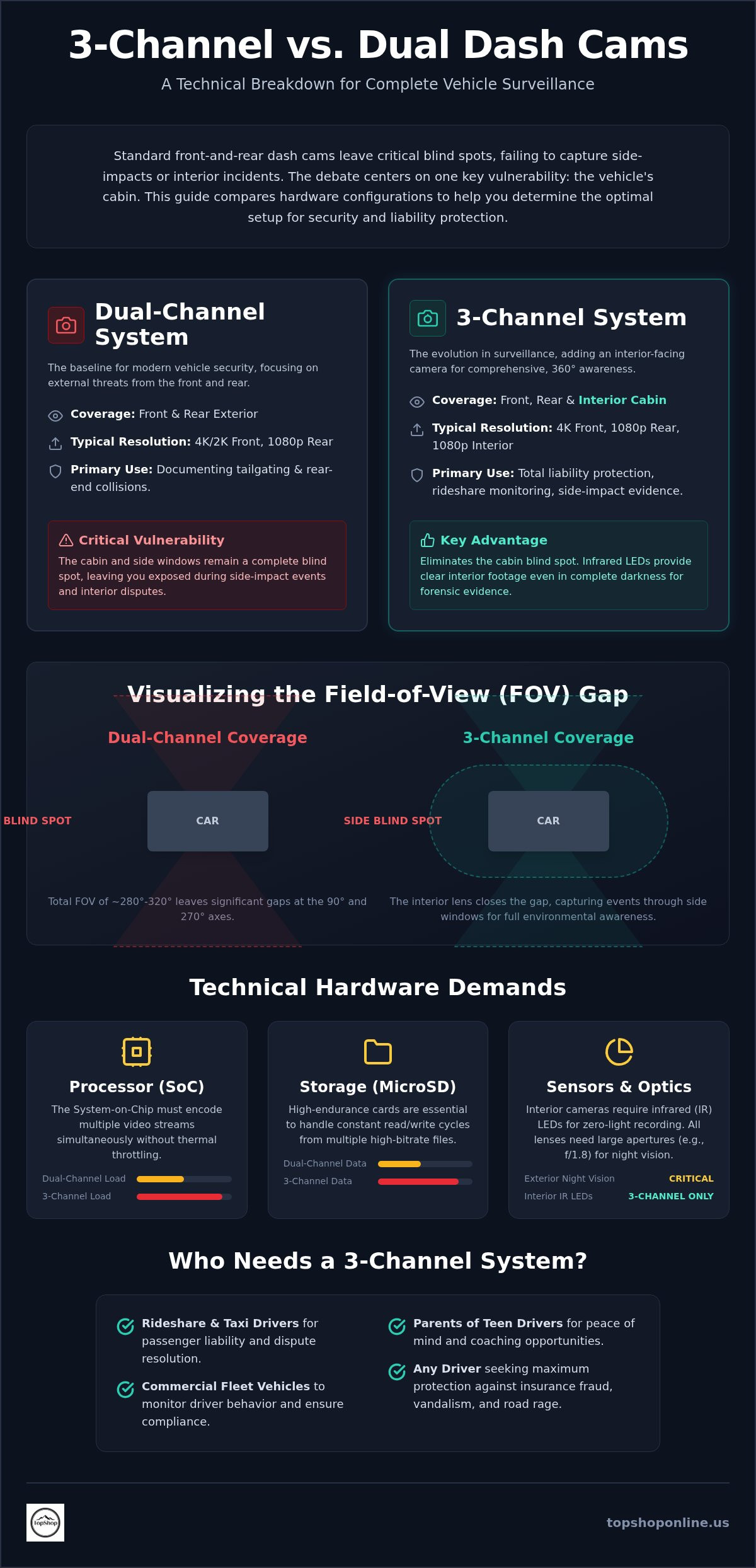
Quantifying spatial coverage requires evaluating the cumulative Field of View (FOV) across all active sensors. A standard dual-channel system provides approximately 280 to 320 degrees of total coverage, leaving significant blind spots at the 90-degree and 270-degree axes. In the 3 channel dash cam vs dual dash cam comparison, the third interior lens acts as a cross-cabin monitor. This configuration captures events through side windows that external lenses miss, effectively closing the gap between front and rear recording zones. Total environmental awareness is a function of FOV overlap and sensor placement.
External Coverage: Front and Rear Lenses
Most front-facing 4K sensors utilize a 140-degree to 170-degree FOV to balance peripheral visibility with image clarity. Wider angles increase the monitored area but introduce fisheye distortion, which reduces license plate readability at the frame edges. Rear-facing units often encounter physical obstructions such as C-pillars, high headrests, or heavy window tints. These factors limit the effective monitoring area of secondary cameras. High-performance external sensors require large apertures, typically f/1.8 or f/1.6, to maintain night vision performance. You can review detailed Technical Hardware Specifications to understand how sensor dimensions influence these FOV variables.
Internal Coverage: The Third Channel Advantage
The interior channel provides a 140-degree to 180-degree FOV dedicated to the vehicle cabin. This sensor integrates four to six infrared (IR) LEDs to ensure high-contrast grayscale recording in zero-light conditions. This channel is critical for documenting side-window interactions, such as law enforcement stops or road rage encounters at the driver-side door. In insurance disputes, interior footage serves as forensic evidence to prove driver attentiveness and hands-on-wheel compliance. For drivers requiring comprehensive protection, the Guardian 3-Channel 4K Dash Cam offers integrated interior monitoring to eliminate common coverage gaps. Hardware requirements for these multi-channel setups include:
- Dual-Channel: Two discrete video streams; standard System-on-Chip (SoC) processing; Class 10 SD card compatibility.
- 3-Channel: Three simultaneous video streams; high-performance multi-core processor; V30 or U3 high-speed microSD card requirements to prevent frame drops.
- Blind Spot Reduction: 3-channel systems increase total coverage to over 420 degrees, providing visual redundancy through side glass.
Lens focal length significantly impacts the utility of the recorded data. A shorter focal length provides the wide-angle coverage necessary for city driving, while a longer focal length prioritizes the pixel density needed for long-distance license plate recognition. 3-channel systems distribute these focal responsibilities across three sensors, ensuring that neither cabin security nor external evidence is compromised by hardware limitations.
Strategic Use Cases: Rideshare Liability vs. Private Commuting
Selection between a 3 channel dash cam vs dual dash cam architecture depends on operational environments and liability risk profiles. While dual-channel systems capture external environmental variables, 3-channel systems record the internal status of the vehicle cabin. This internal data stream is a critical requirement for professional drivers and high-risk commuting scenarios. The primary technical advantage involves the documentation of the internal vehicle environment, which provides a forensic record of driver and passenger status during an incident.
Legal compliance is a mandatory consideration for multi-channel deployments. Audio recording functionality in these devices requires adherence to local wiretapping laws. Many jurisdictions operate under two-party consent regulations; this necessitates visible passenger notification decals when using an interior-facing lens. Drivers must verify local statutes regarding electronic surveillance before activating cabin-view channels in public or commercial settings.
Maximum Protection for Rideshare Drivers
Rideshare operators face specific liability challenges involving Transportation Network Company (TNC) insurance claims. The interior-facing infrared (IR) lens provides objective evidence for resolving disputes regarding passenger behavior or fraudulent accusations. Strategic placement of the internal sensor ensures full backseat visibility, capturing high-contrast grayscale footage in zero-light conditions. This channel documents the driver's physical status; it proves hands-on-wheel compliance and the absence of mobile device distractions during an accident. Simultaneous recording of the cabin environment eliminates the unreliable "he-said-she-said" dynamic often encountered in insurance adjustments.
Value Proposition for Daily Commuters
Private drivers benefit from interior monitoring during side-impact events. Standard dual-channel setups lack the lateral visibility provided by the wide-angle interior lens. This cross-cabin view captures side-swipe collisions through the driver and passenger side windows, providing visual evidence that front and rear sensors miss. For owners of high-value vehicles, the interior channel acts as a theft deterrent and evidence-gathering tool during parking mode operations. Motion-activated interior recording captures identifiable features of individuals attempting vehicle break-ins or vandalism. This configuration offers a significant security upgrade for vehicles parked in high-traffic public areas, ensuring that the 3 channel dash cam vs dual dash cam choice results in total forensic coverage. Documenting the internal condition of the vehicle during an accident also verifies seatbelt usage and passenger counts, which are vital data points for accurate liability assessment in multi-passenger collisions.
Technical Hardware Specifications: Resolution, Storage, and Power
Hardware stability depends on the processor's ability to manage high-bitrate data streams without thermal failure. In the 3 channel dash cam vs dual dash cam technical landscape, the primary differentiator is the cumulative data throughput. A triple-channel system requires a high-performance System-on-Chip (SoC) to encode three simultaneous video signals. This process generates significant thermal loads. Reliable 3-channel units utilize aluminum heat sinks or ventilated chassis designs to prevent processor throttling during extended recording sessions. Dual-channel systems operate with lower thermal footprints but lack the processing overhead required for interior sensor integration.
Storage Capacity and Write Speeds
Managing three video streams significantly increases storage consumption and write-cycle frequency. A configuration featuring 4K front, 1080p rear, and 1080p interior recording produces approximately 18 to 22 GB of data per hour. This high-density output necessitates a U3 or V30 rated high-endurance microSD card. Standard Class 10 cards often fail under the continuous pressure of triple-stream encoding, resulting in corrupted files or frame drops. Loop recording intervals should be set to one or three minutes to manage file sizes and ensure efficient overwriting. Technical documentation for the 3 channel dash cam vs dual dash cam comparison confirms that 256GB or 512GB cards are the functional minimum for 3-channel systems to avoid excessive overwrite cycles that shorten card lifespan.
Installation and Power Requirements
Power management is a critical factor for 24-hour vehicle surveillance. While a 12V cigarette lighter socket provides sufficient power for driving, a hardwire kit is mandatory for parking mode functionality. These kits connect directly to the vehicle fuse box and include a low-voltage cutoff to prevent battery discharge. Cable management for 3-channel setups involves routing two secondary coaxial or USB-C cables through the headliner to the rear and interior modules. Bench testing your hardware before installation ensures all channels are operational. You can facilitate this process using a power strip with USB ports to provide stable 5V/2A power to all modules simultaneously. This allows for firmware updates and FOV calibration in a controlled environment. For a complete surveillance solution with integrated power management, consider the Guardian 3-Channel 4K Dash Cam for your vehicle.
Bitrate analysis reveals that front-channel 4K recording typically requires 25 to 30 Mbps, while secondary channels consume 10 to 12 Mbps each. Total system bitrate often exceeds 50 Mbps. This requires a dedicated high-speed bus on the mainboard to move data from the CMOS sensors to the storage controller. 3-channel systems utilize advanced H.265 (HEVC) compression to maintain image quality at these bitrates while reducing the overall file size compared to older H.264 codecs.
Implementing Full-Vehicle Monitoring with the Guardian 3-Channel 4K Dash Cam
The Guardian 3-Channel 4K Dash Cam provides a technical solution for comprehensive vehicle surveillance by integrating three discrete recording channels. This hardware configuration resolves the 3 channel dash cam vs dual dash cam dilemma by offering simultaneous 4K front, 1080p rear, and 1080p interior monitoring. High-resolution 4K sensors capture license plate alphanumeric characters at high speeds, while the secondary channels document the vehicle's internal and rear environments. Infrared (IR) night vision sensors within the cabin module utilize four 850nm LEDs to produce high-contrast grayscale footage in zero-light conditions. This ensures forensic-grade evidence regardless of ambient lighting. The system utilizes H.265 (HEVC) compression to optimize the storage footprint on high-endurance microSD cards, maintaining a high bitrate of 28 Mbps for the front 4K channel.
Guardian 4K Performance Metrics
Measurable sensor performance is a core attribute of the Guardian system. The primary CMOS sensor features a wide dynamic range (WDR) to balance exposure in high-contrast environments like tunnel exits or direct sunlight. High-density data encoding ensures maximum evidence clarity across all three streams. User interface design prioritizes rapid evidence retrieval; the device supports high-speed Wi-Fi 5GHz data transfers to mobile applications. This allows for immediate file review and download during roadside incidents. The System-on-Chip (SoC) architecture manages the triple-stream workload while maintaining stable operating temperatures through a ventilated chassis design. Dedicated storage controllers prevent frame drops during simultaneous write operations to the V30-rated card, ensuring data integrity during high-impact events.
Comprehensive Vehicle Security Ecosystem
Total security extends beyond the vehicle's operating hours. You can complement the Guardian dash cam with wireless mini security cameras with night vision to monitor garages or private driveways. This creates a multi-layered surveillance network that covers the vehicle during both transit and storage. The utilitarian design of the Guardian series focuses on long-term reliability and high-cycle operation. Purchasing through TopShop provides access to hardware optimized for 2026 technical requirements. Professional-grade DIY installation is facilitated by included adhesive mounts and adjustable lens housings, ensuring optimal FOV alignment for diverse vehicle types. The 3-channel configuration is the established standard for drivers requiring maximum liability protection and environmental awareness. Hardware durability is enhanced by reinforced polycarbonate housings and heat-resistant internal components designed for high-temperature cabin environments.
Optimizing Vehicle Surveillance for 2026 Standards
The technical distinction between a 3 channel dash cam vs dual dash cam centers on total environmental awareness. Dual-channel systems provide essential external coverage, but 3-channel configurations bridge the visibility gap between front and rear sensors by monitoring the vehicle interior. This hardware integration is vital for documenting side-impact collisions and resolving cabin-based liability disputes. Successful deployment requires high-performance processing capable of managing simultaneous triple-stream data without thermal failure. High-endurance storage and stable power management through hardwire kits are mandatory for maintaining data integrity during high-bitrate recording sessions. You can now implement these advanced monitoring standards to ensure full-vehicle security and forensic-grade evidence collection.
4K Ultra HD Primary Resolution, Infrared Cabin Monitoring, and High-Endurance Multi-Channel Recording define the current benchmark for automotive safety. These technical attributes provide the objective data needed for insurance claims and incident resolution. Secure your vehicle with the Guardian 3-Channel 4K Dash Cam to achieve comprehensive coverage. Equipping your vehicle with professional-grade hardware ensures reliable protection for every drive.
Frequently Asked Questions
What is the difference between a 2-channel and a 3-channel dash cam?
The primary difference in a 3 channel dash cam vs dual dash cam setup is the number of discrete video streams processed by the hardware. A 2-channel system monitors the front and rear exterior environments. A 3-channel system integrates an additional interior-facing lens to record the cabin and side-window areas. This configuration requires a more robust processor to manage three simultaneous data streams without thermal throttling.
Does a 3-channel dash cam record the interior of the car?
Yes, the third channel is specifically designed to monitor the vehicle interior. Devices like the Guardian 3-Channel 4K Dash Cam utilize a dedicated cabin lens equipped with infrared (IR) LEDs. These sensors produce high-contrast grayscale footage in zero-light conditions, ensuring clear visibility of passengers and driver behavior during nighttime operation or in low-light parking environments.
Is 4K resolution necessary for a 3-channel dash cam system?
4K resolution is essential for the front-facing primary channel to ensure license plate legibility at high speeds. While 1080p is sufficient for interior and rear monitoring, the front sensor requires the higher pixel density of 4K to capture forensic-grade details. High-resolution sensors provide the necessary clarity for insurance evidence and accident reconstruction in complex multi-vehicle collisions.
How much storage does a 3-channel dash cam require for 24 hours of video?
A 3-channel system recording at 4K front and dual 1080p secondary channels consumes approximately 18 to 22 GB of data per hour. Recording a full 24-hour cycle requires between 432 GB and 528 GB of storage capacity. A 512 GB high-endurance microSD card is the functional minimum for 24-hour retention to prevent loop-recording from overwriting critical files too quickly.
Can a 3-channel dash cam record while the car is parked?
Yes, 3-channel systems support parking mode recording when connected via a hardwire kit. This kit draws power directly from the vehicle fuse box, bypassing the ignition switch. Integrated low-voltage cutoff protection ensures the device shuts down before the vehicle battery reaches a critical discharge level. This allows for motion-activated or time-lapse recording of the exterior and interior while the vehicle is unattended.
Do I need an interior camera if I am not an Uber or Lyft driver?
Interior cameras provide significant value for private drivers by capturing side-impact collisions through the side windows. This "cross-cabin" view provides visual evidence that front and rear lenses miss during side-swipe incidents. Additionally, the interior channel acts as a deterrent against vehicle burglary and provides proof of driver attentiveness during insurance disputes, regardless of your commercial driver status.
How difficult is it to install a 3-channel dash cam compared to a dual-channel?
Installation is marginally more complex due to the requirement of routing one additional cable for the third module. The process involves tucking cables behind the headliner and A-pillars to reach the rear and interior sensors. Most systems, including the Guardian series, use adhesive mounts and standard 12V or hardwire connections, making them accessible for DIY installation with basic tools.
Does an interior-facing camera record through the side windows?
Interior-facing cameras record through the side windows if they feature a wide-angle lens. Most cabin sensors offer a 140-degree to 180-degree Field of View (FOV), which is wide enough to capture interactions at the driver and passenger side glass. This is critical for documenting road rage encounters at the door or gathering evidence of side-impact accidents that occur at the vehicle's midpoint.