

The global market for 360-degree surveillance cameras is projected to reach $2.80 billion in 2026. This expansion is driven by the adoption of specialized hardware that replaces traditional multi-camera arrays with a single high-index fisheye lens and E27 power integration. You've likely identified that fixed-lens cameras present technical limitations, specifically the presence of blind spots and the high cost of complex wiring requirements for standard CCTV. This guide provides a comprehensive technical breakdown of 360 degree panoramic light bulb camera hardware, sensor capabilities, and screw-in installation requirements.
We'll examine the specific physical attributes of the 1080P resolution sensor, the integrated motion detection arrays, and the WiFi 6 connectivity standards that facilitate real-time remote access via smartphone. This article details the transition from ONVIF Profile S to Profile T, the implementation of H.265 video compression, and the mechanical advantages of using existing E27 light sockets for immediate power. You'll gain a thorough understanding of the technical specifications, material composition, and hardware architecture necessary for a functional, zero-wiring home surveillance deployment.
Key Takeaways
- Identify the core hardware components of the 360 degree panoramic light bulb camera, focusing on the durable polycarbonate housing and standard E27 screw base compatibility.
- Analyze the optical performance of ultra-wide-angle fisheye lenses to achieve full-room coverage and eliminate blind spots through strategic ceiling placement.
- Determine the specific wireless connectivity requirements, including 2.4GHz IEEE 802.11b/g/n protocols, necessary for consistent 1080P video streaming and remote access.
- Understand the electrical input parameters and physical installation steps required to deploy a zero-wiring surveillance solution using existing AC 110V-240V light sockets.
- Evaluate advanced detection logic and two-way audio hardware specifications to improve motion sensitivity and facilitate real-time communication via integrated microphones.
360° Panoramic Hidden Light Bulb Wifi Camera Hardware Overview
The 360 degree panoramic light bulb camera is a specialized IoT surveillance device designed for seamless integration into existing electrical infrastructure. This hardware utilizes a standard E27 screw base for both physical mounting and power acquisition. The unit's external shell consists of a high-impact polycarbonate housing. This material provides necessary thermal resistance for the internal processing chips and the integrated LED array. The device functions as a primary light source while maintaining a constant 1080P HD security feed. For users seeking discrete placement in restricted spaces, the 1080p Wireless Mini Security Camera with Night Vision offers a smaller footprint, though it lacks the integrated bulb housing and power-tapping capabilities of the panoramic model.
Optical Sensor and Resolution Parameters
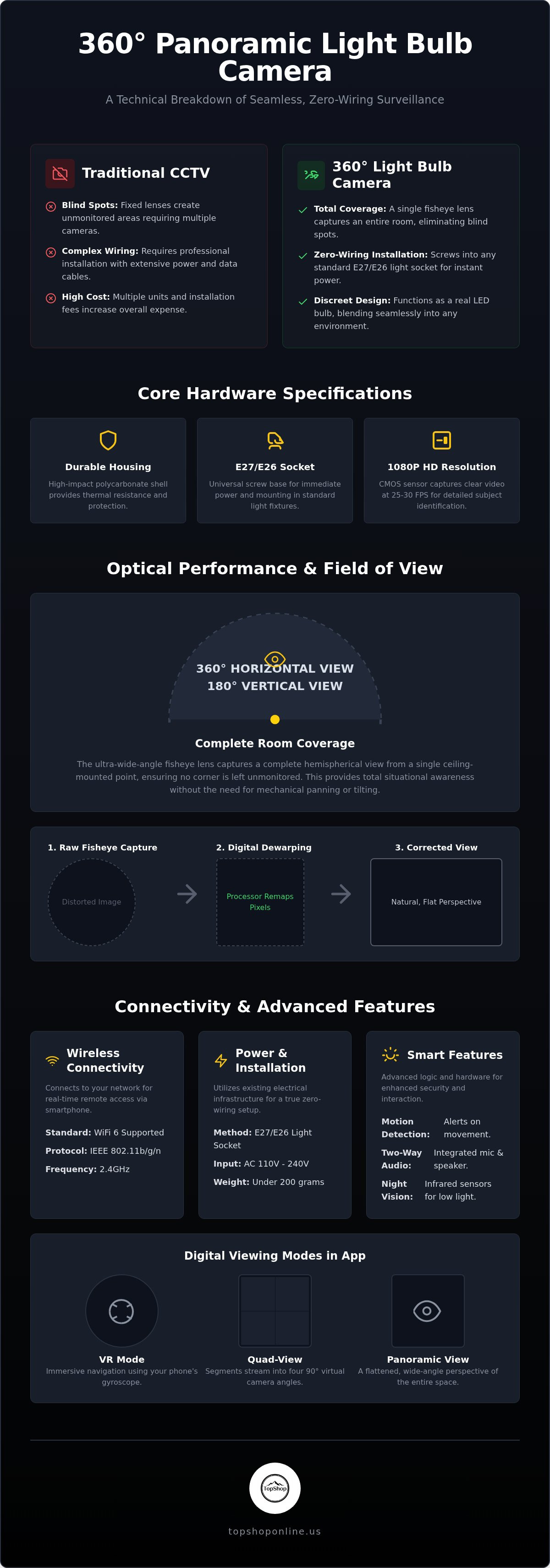
The device captures video at a native 1080P HD resolution. This provides sufficient pixel density for clear identification of subjects within a 20-foot radius. It utilizes CMOS sensor technology calibrated for high dynamic range and low-light performance. Frame rate stability is maintained at 25-30 frames per second through onboard signal processing. Because this is an Omnidirectional (360-degree) camera, the hardware captures a complete hemispherical view. The internal processor handles dewarping for the mobile application. This allows users to apply digital zoom within the panoramic field of view to inspect specific quadrants without losing overall situational awareness.
Form Factor and Socket Compatibility
The hardware adheres to standard E27 and E26 base specifications. This ensures a universal fit for residential and commercial fixtures like pendant lights or recessed ceiling mounts. Total unit weight is kept under 200 grams to prevent mechanical strain on standard ceramic or plastic sockets. The physical dimensions are optimized to match the profile of a standard oversized LED bulb. It fits inside most glass globes or open-faced lamps without requiring modifications. The matte-finish aesthetic integrates into modern decor. This design effectively masks the presence of the hidden camera lens, the surrounding infrared sensors, and the passive cooling vents located around the base. The 360 degree panoramic light bulb camera remains visually indistinguishable from standard high-output LED lighting components.
Optical Performance and 360° Field of View Analysis
The 360 degree panoramic light bulb camera utilizes an ultra-wide-angle fisheye lens to capture a hemispherical field of view. This hardware configuration captures light from all directions simultaneously, effectively eliminating the blind spots common in traditional fixed-lens surveillance units when mounted in a central ceiling location. Horizontal viewing angles achieve a full 360-degree sweep, while vertical viewing angles typically range between 170 and 180 degrees. This extensive coverage ensures that the sensor records every corner of a room, providing total situational awareness from a single installation point. Review the current inventory of the 360 degree panoramic light bulb camera to compare specific optical sensor variants.
Digital dewarping is the critical software process that makes this wide-angle data usable for the human eye. The raw image captured by the lens is circular and heavily distorted. Dewarping algorithms function by assigning each pixel in the circular fisheye frame to a specific coordinate on a 2D rectangular grid. This mathematical remapping corrects barrel distortion, where straight architectural lines appear curved. By executing these calculations in real-time within the mobile application, the system provides a natural, flattened perspective for the viewer without requiring mechanical pan-and-tilt hardware.
Digital Viewing Modes in Surveillance Apps
Integrated surveillance applications offer multiple projection modes to interpret the panoramic data. VR mode utilizes the mobile device's internal gyroscope to enable immersive navigation, allowing users to "look around" the room by moving their phone. Quad-view mode segments the 360-degree stream into four distinct 90-degree virtual camera angles. This configuration facilitates simultaneous monitoring of four room quadrants from a single hardware unit. Users can also select hemispheric or cylinder projection modes, which are optimized for different room layouts like open-plan living areas or narrow hallways.
Image Clarity and Distortion Management
Edge distortion is a physical characteristic of high-index fisheye lenses where image sharpness decreases toward the perimeter. Software correction attempts to normalize these areas, but the highest detail remains at the center of the lens. Indoor light sensitivity is measured in Lux, with modern sensors capable of maintaining color accuracy in standard residential lighting conditions. While 1080P resolution provides high-definition video, the total pixel count is distributed across the entire 360-degree field. This means that distant objects or fine text may appear less sharp compared to a traditional 90-degree lens with the same resolution. Proper ceiling-centered placement maximizes the effective pixel density for the most critical areas of the room.
Wireless Connectivity and Data Management Protocols
The 360 degree panoramic light bulb camera operates exclusively on the 2.4GHz wireless frequency, adhering to IEEE 802.11b/g/n standards. This frequency choice prioritizes signal penetration through architectural barriers like walls and ceilings, which is essential for overhead surveillance fixtures. While 5GHz networks offer higher speeds, 2.4GHz provides the necessary range and stability for consistent connectivity across large floor plans. High-definition 1080P video streaming consumes approximately 1.5 to 2 Mbps of upload bandwidth per active unit. Users with restricted data plans can adjust the bit rate within the application settings to optimize performance. To ensure data integrity, the hardware supports WPA and WPA2 encryption protocols, preventing unauthorized access to the live feed. For comprehensive networking setups, integrating a Power Strip with USB Ports allows for the centralized powering of routers and signal extenders required for stable camera operation.
Local vs. Cloud Storage Specifications
The device features an integrated Micro SD card slot that supports capacities up to 128GB. It's mandatory to use Class 10 or UHS-1 speed rated cards to ensure the hardware can handle sustained 1080P write speeds without data corruption. At standard compression levels, a 64GB card provides approximately 72 to 96 hours of continuous footage. The system employs loop recording protocols, which automatically overwrite the oldest files once the storage capacity is reached. This ensures the 360 degree panoramic light bulb camera never stops recording due to a full disk. For users requiring off-site redundancy, cloud storage options are available through the companion app, providing a secure backup if the physical device is tampered with or stolen.
Remote Monitoring and Multi-User Access
Remote surveillance is managed via dedicated applications compatible with iOS and Android operating systems. The hardware utilizes Peer-to-Peer (P2P) technology to establish a direct, encrypted connection between the camera and the smartphone. This method bypasses the need for complex manual configurations like port forwarding or static IP assignments. The software interface supports the simultaneous management of multiple units, allowing users to monitor different rooms or properties from a single dashboard. Administrative users can grant viewing permissions to secondary accounts, enabling multi-user access for family members or employees while maintaining control over critical system settings and storage formatting.
Installation Procedures and Operational Requirements
Installation of the 360 degree panoramic light bulb camera requires no specialized wiring or external power adapters. The hardware integrates directly into standard E27 or E26 light sockets. The internal power transformer is compatible with AC 110V-240V inputs, ensuring functionality across various international electrical standards. Physical deployment involves rotating the device clockwise into the socket until the base contact points engage. Once the fixture is switched on, the integrated LED array typically provides an audible prompt or a visual light sequence to signal readiness for network pairing. This zero-wiring approach utilizes the existing electrical infrastructure to provide a constant power source for the 1080P HD sensor.
Thermal management is a critical operational requirement for bulb-based electronics. The device features passive cooling vents located around the base of the polycarbonate housing to dissipate heat generated by the internal processor and WiFi chipset. It's designed to operate within a temperature range of -10°C to 50°C (14°F to 122°F). Placing the unit in fully enclosed glass or airtight metal fixtures can lead to heat accumulation, which may degrade the lifespan of the CMOS sensor. Open-air or semi-enclosed fixtures are recommended to facilitate adequate airflow and maintain hardware stability during continuous 24/7 operation.
Fixture Selection and Placement Optimization
For maximum 360° coverage, you should install the camera in a central ceiling fixture at a height of 8 to 12 feet. This elevation provides the optimal balance between the width of the field of view and the pixel density required for subject identification. You must avoid using this hardware in circuits controlled by dimmer switches. Dimmers modulate voltage, which can cause internal power supply failure or intermittent connectivity in the camera's wireless module. Ensure the socket remains powered at all times to maintain the surveillance stream. Orientation is also vital; the lens must point vertically downward to ensure the dewarping software correctly calibrates the room's horizontal plane.
App Pairing and Network Configuration
Configuration begins by downloading the surveillance application on an iOS or Android device. After account initialization, the app generates a unique QR code containing the network credentials. You must hold the smartphone screen approximately 4 to 8 inches from the camera lens to facilitate the pairing handshake. If the connection fails, verify that the smartphone is connected to a 2.4GHz network, as mentioned in previous technical sections. Firmware updates are delivered via the app to optimize hardware performance and patch security vulnerabilities. Secure your home surveillance setup by acquiring the 360 degree panoramic light bulb camera directly from a reliable distributor.
Advanced Security Features and Detection Logic
The 360 degree panoramic light bulb camera utilizes pixel-based motion detection algorithms to identify environmental changes within its hemispherical field of view. The internal processor compares consecutive video frames to detect movement, triggering automated responses based on user-defined sensitivity parameters. Users can adjust these triggers through the mobile interface, selecting from low, medium, or high sensitivity levels to reduce false positives caused by shifting shadows or small pets. When a valid motion event is identified, the system initiates an alarm notification protocol. This process sends a real-time push alert to the synchronized smartphone, often accompanied by a high-resolution snapshot or a short video clip of the triggering event.
Two-Way Communication Hardware
The hardware includes an integrated omnidirectional microphone and a high-decibel micro-speaker. The microphone features a noise-cancellation chipset designed to filter out ambient background hum from HVAC systems or overhead fans, ensuring clear vocal capture. Sensitivity is typically rated to capture audible sound within a 15-foot radius. The speaker output is calibrated for clear communication, allowing users to broadcast voice commands or utilize the unit as a verbal deterrent. Audio latency is a critical factor, generally ranging from 500ms to 2 seconds depending on the 2.4GHz network stability and current bandwidth consumption mentioned in previous sections.
Night Vision and Low-Light Sensors
For low-light environments, the device employs an array of infrared (IR) LEDs and an automatic IR-cut filter. The sensor monitors ambient light levels and switches from full-color mode to monochrome night vision when illumination drops below a specific threshold, usually around 0.1 Lux. The effective IR night vision range covers 15 to 30 feet, which is sufficient for standard residential room dimensions. In addition to IR capabilities, the integrated LED array can be manually or automatically activated to provide supplemental white light illumination. This dual-purpose lighting serves as a functional lamp while simultaneously allowing the 360 degree panoramic light bulb camera to record in full color during nighttime motion events.
Detection logic is managed through the companion application, where users can define specific detection zones within the panoramic view. This prevents the sensor from triggering alerts based on movement in non-critical areas, such as a ceiling fan or a television screen. The firmware supports scheduled arming, enabling the motion sensors only during specific hours of the day or night. All alert data is logged within the app's event history, providing a chronological record of security triggers with associated timestamps and media links for immediate review.
Optimizing Surveillance with Panoramic Hardware Integration
The 360 degree panoramic light bulb camera provides a specialized hardware solution for comprehensive room surveillance through a single E27 socket installation. This technical guide has detailed how the high-index fisheye lens captures 1080P HD resolution video across a full 360° coverage area, successfully removing the blind spots associated with static security sensors. The integrated polycarbonate housing facilitates heat dissipation while supporting advanced features like two-way audio communication and infrared night vision for 24/7 monitoring.
By utilizing existing electrical infrastructure, you can deploy a professional-grade surveillance network without the overhead of complex wiring. The hardware's compatibility with 2.4GHz WiFi networks ensures stable data transmission and immediate remote access via smartphone applications. This easy E27 socket installation allows for rapid deployment in residential or commercial settings. You now have the technical data required to optimize your placement and network configuration for maximum coverage.
Shop the 360° Panoramic Hidden Light Bulb Wifi Camera at TopShop to upgrade your security infrastructure with reliable, high-density optical performance. Implementing this hardware ensures immediate situational awareness and reliable remote monitoring for your specific environment.
Frequently Asked Questions
Do I need a special light fixture for the 360 degree panoramic light bulb camera?
No, the 360 degree panoramic light bulb camera doesn't require specialized fixtures. It's engineered with a standard E27 screw base, which is the universal specification for most residential and commercial ceiling sockets. You can install the unit into any existing pendant or recessed fixture that accepts a standard bulb. Ensure the fixture isn't controlled by a dimmer switch, as voltage fluctuations can damage the internal processor or cause connectivity failures in the WiFi module.
Can this camera work without a WiFi connection?
The camera can record video data to a local Micro SD card without an active WiFi connection once the initial setup is complete. However, you won't have access to real-time remote monitoring, push notifications, or two-way audio communication through the smartphone application. WiFi is mandatory for the initial pairing process and for any remote data management. Without a network, the device functions as a standalone local recorder until the SD card reaches capacity and begins loop recording.
Is the light bulb camera compatible with 5GHz WiFi networks?
This hardware isn't compatible with 5GHz WiFi networks. It operates exclusively on the 2.4GHz frequency, which provides the necessary range and signal penetration for overhead installations. Most modern dual-band routers support both 2.4GHz and 5GHz. You must select the 2.4GHz band during the pairing process in the surveillance app. If your router combines both bands into one SSID, you may need to temporarily separate them in your router settings to complete the initial configuration.
How many hours of video can a 64GB SD card store in 1080P?
A 64GB Micro SD card typically stores between 72 and 96 hours of continuous 1080P HD video footage. This duration varies based on the complexity of the visual environment and the specific compression bit rate used by the camera's firmware. Once the storage limit is reached, the system utilizes an automatic loop recording protocol to overwrite the oldest files. To ensure reliable performance, it's necessary to use a Class 10 or UHS-1 rated card capable of sustained high-speed data writes.
Does the light bulb function independently of the camera?
The integrated LED array can be operated independently of the recording functions via the companion smartphone application. You can manually toggle the light on or off or set it to an automatic mode that activates based on ambient light levels detected by the internal sensors. Even if the light is switched off through the app, the 360 degree panoramic light bulb camera continues to record and stream video as long as the physical power switch remains in the "on" position.
Can multiple people view the camera feed at the same time?
Multiple authorized users can view the live camera feed simultaneously through the shared access feature in the mobile application. The primary account holder grants viewing permissions to secondary accounts by sharing a unique device ID or QR code. While several people can monitor the video stream at once, increased concurrent connections may impact the available upload bandwidth. This can potentially cause minor latency in the video transmission or the two-way audio response time during peak usage.
Is the panoramic camera suitable for outdoor installation?
This panoramic camera is designed primarily for indoor use and isn't rated for direct exposure to moisture, rain, or high humidity. The polycarbonate housing features open vents for thermal management, which makes the internal electronics vulnerable to environmental damage. While you can install the unit in a covered outdoor area like a porch, you must ensure the fixture is fully protected from the elements. Exposure to temperatures outside the -10°C to 50°C operating range will void hardware stability.
What happens to the video if the power switch is turned off?
If the physical power switch is turned off, the camera loses its electrical supply and immediately stops recording, streaming, and detecting motion. Because the device draws power directly from the E27 socket, it requires a continuous AC 110V-240V input to function. Any footage recorded prior to the power loss remains safely stored on the Micro SD card or in the cloud. To maintain 24/7 surveillance, the wall switch controlling the fixture must remain in the "on" position at all times.