

A single fixed-lens camera is mathematically incapable of monitoring a standard indoor environment without leaving critical blind spots in every corner. You likely recognize the operational inefficiency of managing multiple video feeds and the high hardware costs associated with multi-camera installations. Integrating a 360 panoramic wifi camera indoor system eliminates these coverage gaps by utilizing specialized fisheye lenses to capture a full spherical field of view from a central mounting point. This technical guide provides a comprehensive analysis of panoramic surveillance technology, covering 1080p resolution standards, 2.4GHz WiFi connectivity, and local storage support for up to 256GB microSD cards.
You'll learn how digital dewarping software transforms distorted circular images into usable, flat-plane video for remote mobile viewing. We will detail optimal deployment strategies, hardware specifications for light-bulb form factors, and essential legal compliance steps for indoor audio and video recording. This data-driven overview ensures your security infrastructure remains cost-effective, high-performing, and fully transparent.
Key Takeaways
- Eliminate indoor surveillance blind spots by replacing multiple fixed-lens units with a single 360-degree hardware vantage point.
- Analyze fisheye lens light refraction patterns and digital dewarping software requirements for accurate spherical data processing.
- Apply the "Center-of-Room" rule for 360 panoramic wifi camera indoor installation to ensure maximum horizontal field of view (FOV) and situational awareness.
- Reduce infrastructure complexity through single power-point deployment, contrasting hardware purchase price against multi-unit installation labor costs.
- Select optimal hardware form factors, including 1080P high-definition dome or hidden light bulb configurations, based on specific environmental monitoring needs.
What is a 360 Panoramic WiFi Camera Indoor?
A 360 panoramic wifi camera indoor system is a high-density data capture tool designed for comprehensive situational awareness in residential or commercial environments. This hardware utilizes omnidirectional camera technology to provide a 360-degree horizontal field of view from a single ceiling or wall mount. The core architecture consists of ultra-wide fisheye optics, high-resolution image sensors, and integrated WiFi modules for cable-free installation. Indoor units are specifically engineered for interior light environments, featuring compact housing and often incorporating functional elements like light bulb sockets. These devices differ from outdoor units by omitting bulky weather-resistant seals and thermal management systems, focusing instead on discreet placement and high-speed local network integration.
Blind Spot Elimination in Interior Spaces
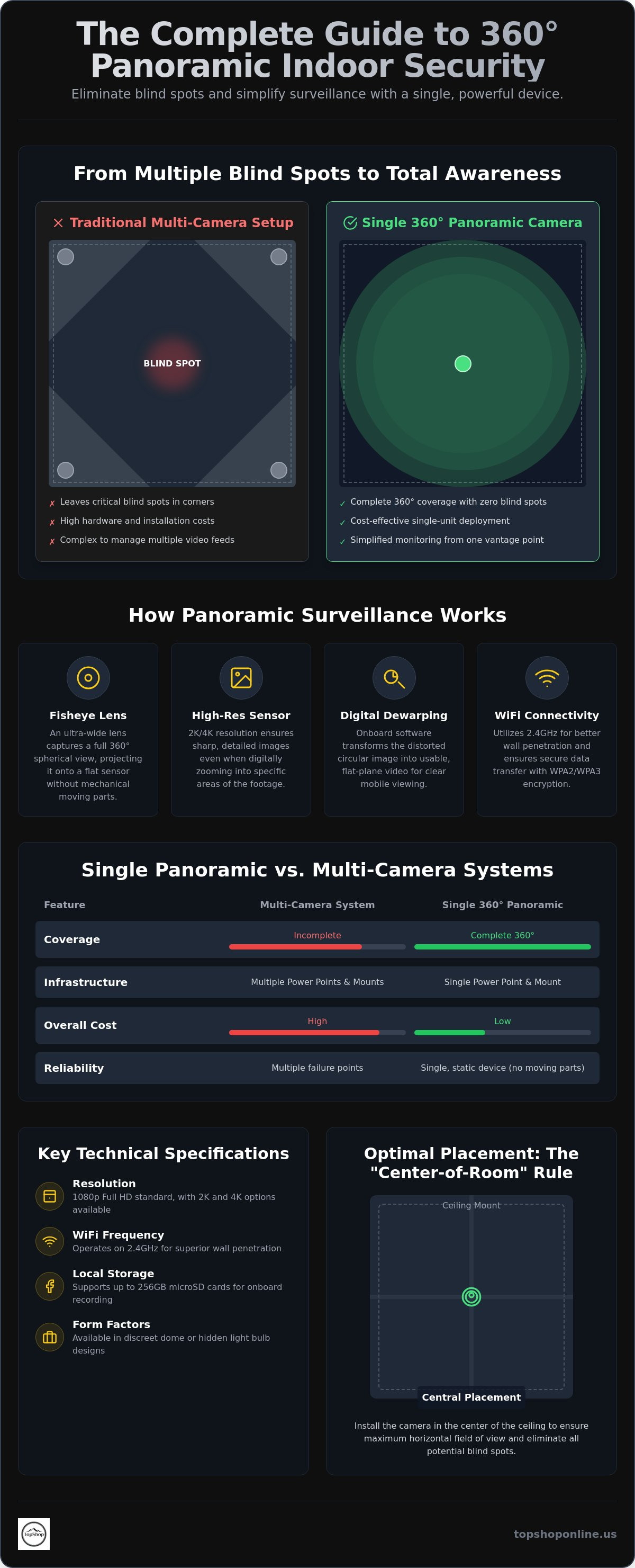
Standard fixed-lens cameras provide a restricted 90-degree to 110-degree field of view. In a rectangular room, this limitation necessitates multiple hardware units to cover every corner, increasing both equipment costs and installation complexity. Ultra-wide panoramic optics solve this by projecting a 360-degree circular image onto the sensor. This captures everything within the room's perimeter simultaneously. While pan-tilt-zoom (PTZ) cameras offer mobility, they suffer from "latency of orientation," where the camera might be pointed away from a critical event. Static panoramic sensors record the entire 360-degree plane at all times, allowing users to zoom into any area of the recorded footage during post-event analysis without losing coverage of the rest of the room.
WiFi Connectivity and Remote Access Requirements
Reliable video transmission depends on robust wireless infrastructure. Most 360 panoramic wifi camera indoor models operate on the 2.4GHz frequency for superior wall penetration, though 2026 standards frequently include 5GHz support for high-bandwidth 2K or 4K streams. Streaming high-definition panoramic video requires a minimum upload bandwidth of 2 Mbps, with 4 Mbps recommended for low-latency remote viewing. Security is maintained through WPA2 or WPA3 encryption protocols, ensuring that the wireless data packets remain inaccessible to external parties. These systems facilitate remote monitoring through mobile applications, where onboard dewarping software converts the raw circular fisheye feed into a standard rectangular perspective for the viewer.
The deployment of a single panoramic unit replaces the need for complex multi-camera grids. This "single vantage point" philosophy reduces the number of IP addresses to manage and simplifies the storage of video data. Whether utilizing a standard dome or a 360° Panoramic Hidden Light Bulb Wifi Camera, the primary objective remains the same: total room visibility with zero unmonitored zones. This hardware is essential for users requiring high-efficiency monitoring without the high labor costs of traditional wired security infrastructure.
Technical Mechanics of Panoramic Surveillance Technology
The operational efficiency of a 360 panoramic wifi camera indoor system depends on the synergy between optical hardware and digital processing. Fisheye lenses serve as the primary capture mechanism, using a single, ultra-wide glass element to project a 360-degree spherical environment onto a flat CMOS sensor. This lens geometry creates a characteristic "barrel distortion" where light from the edges is compressed. High-resolution sensors, typically 2K or 4K in 2026 models, are critical because the raw circular data must be stretched during viewing. A higher megapixel count ensures that when you zoom into a specific corner of the room, the image remains sharp and actionable. This hardware configuration allows for a single device to monitor an entire interior space without the mechanical failure points of moving parts.
Fisheye Lens vs. Multisensor Arrays
Residential indoor panoramic cameras almost exclusively use fisheye lenses due to their compact form factor and seamless image delivery. While multisensor arrays utilize three or four separate lenses to achieve a 360-degree view, they require complex "stitching" software that often leaves visible lines or artifacts where the images meet. Fisheye optics provide a single, continuous stream without these blind spots. This makes them ideal for environments like living rooms or small offices where a single, cost-effective device must replace several fixed-lens units.
Image Dewarping and User Viewing Modes
Raw footage from a panoramic sensor is unviewable in its circular state. Digital dewarping is the process where internal software or a mobile app re-maps the polar coordinates of the circular image into a linear, rectangular perspective. This allows for several viewing modes, including a 360-degree VR mode for immersive swiping, a 180-degree panoramic flat view, and a quad-view that splits the feed into four distinct quadrants. This software-side PTZ (Pan-Tilt-Zoom) allows you to move through recorded footage as if the camera were physically moving, though the hardware remains static.
Data management for these high-bandwidth streams is handled through onboard MicroSD slots, which now support capacities up to 256GB for local, subscription-free recording. This ensures continuous operation even if the WiFi connection fluctuates. For users seeking a streamlined, discreet solution, the 360° Panoramic Hidden Light Bulb Wifi Camera integrates these technical mechanics into a standard lighting fixture, combining power and surveillance in one unit. This integration eliminates the need for external wiring while maintaining the full technical capabilities of a dedicated security sensor.
Single Panoramic Camera vs. Multi-Camera Systems
The total cost of ownership for a surveillance system depends on hardware acquisition, installation labor, and ongoing maintenance. Deploying a single 360 panoramic wifi camera indoor unit replaces the need for four standard fixed-lens cameras in a typical rectangular room. This consolidation reduces the bill of materials and eliminates the requirement for multiple power outlets or extensive cable runs. Infrastructure requirements for a single panoramic device involve one mounting point and one power connection, whereas a multi-camera grid requires four separate installations. This reduction in hardware also minimizes wall clutter, maintaining the aesthetic integrity of residential or professional interior spaces through a single, discreet vantage point.
Management efficiency is significantly higher when monitoring a single panoramic stream. Standard multi-camera systems require users to toggle between four or more video thumbnails to track movement across a room. This process is slow and increases the risk of missing critical events during the transition between feeds. A panoramic sensor provides a continuous, unified data stream that can be dewarped into multiple virtual views simultaneously. This allows for total situational awareness from a single dashboard, simplifying the user interface and reducing the cognitive load on the operator.
Installation Complexity and Hardware Maintenance
Consolidating surveillance into one unit simplifies the initial configuration and long-term upkeep. Users following how to set up wifi security camera protocols find that managing one IP address and one firmware update schedule is more efficient than maintaining a fleet of independent devices. Hardware maintenance is similarly streamlined; cleaning one fisheye lens is faster than servicing four corner-mounted units. Reducing the number of devices also lowers the statistical probability of hardware failure, as there are fewer power adapters, image sensors, and wireless radios that could potentially malfunction.
Data Bandwidth and Storage Efficiency
Modern panoramic cameras utilize H.265 (High-Efficiency Video Coding) to manage the high data density of 360-degree footage. One high-resolution panoramic stream typically consumes less network bandwidth than four independent 1080p streams because it avoids the redundant data capture found in overlapping camera fields. This efficiency reduces home WiFi network congestion, especially during peak usage hours when multiple devices are active. Storage calculations also favor the single-stream approach; a 256GB MicroSD card can hold more days of continuous footage from one optimized panoramic feed than it could from multiple high-bitrate 1080p feeds running concurrently.
The transition from a multi-camera grid to a single panoramic solution represents a shift toward software-defined surveillance. By utilizing digital dewarping and high-resolution sensors, a single 360 panoramic wifi camera indoor provides superior coverage with a lower physical and digital footprint. This approach is particularly effective for users seeking high-performance security without the high infrastructure costs of traditional multi-unit deployments.
Optimal Placement and Indoor Installation Strategies
Achieving maximum situational awareness with a 360 panoramic wifi camera indoor requires adherence to the Center-of-Room rule. Positioning the hardware at the geometric center of the ceiling ensures that the fisheye lens maintains an equidistant relationship with all four walls. This placement minimizes the pixel stretching that occurs at the edges of the sensor's range. Height is equally critical. Mounting at 8 to 10 feet provides a balanced perspective. Consider these height-based variables for your deployment:
- 8 Feet: Optimal for capturing facial details and identifying specific door-level activity.
- 10 Feet: Best for wide-area monitoring in larger residential spaces with high ceilings.
- Above 12 Feet: Results in significant top-down distortion, which reduces the utility of digital zoom for facial recognition.
Light management is essential to prevent image degradation. Placing a panoramic sensor directly adjacent to large windows or high-output interior lamps often results in lens flare or silhouetting. Modern sensors with Wide Dynamic Range (WDR) mitigate this, but physical positioning remains the primary defense. Privacy considerations are also paramount in residential environments. While 360-degree coverage is ideal for entryways, placement should avoid direct views into bathrooms or bedrooms. Under 2026 surveillance regulations, legal expectations of privacy are highest in these zones, and audio recording consent laws vary by state.
Ceiling vs. Wall Mounting Logic
Ceiling mounting is the preferred orientation for 360-degree monitoring because it utilizes the full circular sensor data. Wall mounting is technically possible but effectively reduces the functional field of view to 180 degrees. In long, narrow hallways, a wall mount provides sufficient depth, but in standard square rooms, it results in excessive capture of the ceiling and opposite wall. This wastes sensor resolution. A ceiling-mounted 360 panoramic wifi camera indoor provides a symmetrical perspective that dewarping software processes with much higher accuracy.
Lighting and Obstruction Management
Physical obstructions like hanging chandeliers or ceiling fans create permanent blind spots in a panoramic feed. These shadow zones are often identified during the initial mobile app setup. If a room has complex architecture or significant obstructions, you may need to use a small wireless security camera indoor to provide targeted coverage in those specific areas. Infrared (IR) night vision capabilities are also vital for large indoor spaces. A single panoramic unit must illuminate the entire 360-degree plane to remain effective in zero-light conditions.
For a streamlined installation that utilizes existing infrastructure without the need for new wiring, you can browse high-performance panoramic hardware such as the 360° Panoramic Hidden Light Bulb Wifi Camera. This form factor simplifies placement by using standard E27 light sockets, allowing for rapid deployment in the center of most residential rooms.
Selecting an Indoor Panoramic Solution for 2026
Selecting a 360 panoramic wifi camera indoor solution involves evaluating hardware specifications against specific interior monitoring requirements. 1080P high-definition resolution serves as the functional baseline for residential and small-business applications. This standard provides sufficient pixel density for identifying human subjects and broad room activity while maintaining low bandwidth consumption on 2.4GHz WiFi networks. While higher resolution sensors offer increased digital zoom clarity, 1080P remains the most stable configuration for standard home routers, preventing network congestion during high-bitrate streaming events. Hardware durability and app-side dewarping efficiency are the primary metrics for long-term operational success.
Hidden Light Bulb Panoramic Form Factors
The 360° Panoramic Hidden Light Bulb Wifi Camera is a specialized hardware solution designed for rapid, discreet deployment. These units utilize standard E27 and E26 light sockets for both physical mounting and continuous power supply. This architecture eliminates the need for external wiring, drilling, or dedicated power adapters. The light bulb form factor allows the camera to blend into existing interior lighting fixtures, making it an optimal choice for users who prioritize low-profile surveillance. This hardware provides a central ceiling vantage point, which ensures symmetrical room coverage and maximizes the efficiency of the fisheye lens.
Configuring Mobile Monitoring and Alerts
System utility is maximized through granular mobile application settings. Users can configure motion detection zones within the full 360-degree field of view to ignore routine environmental movement, such as ceiling fans or moving curtains. Real-time push notifications ensure immediate awareness of interior activity, delivered directly to synced smartphones. Storage selection depends on specific data retention and privacy needs. Local MicroSD recording supports capacities up to 256GB for decentralized, subscription-free data management. Conversely, cloud-based recording offers off-site redundancy, ensuring that footage remains accessible even if the physical hardware is damaged or removed.
Integration with existing security layers improves overall infrastructure reliability. A panoramic unit provides comprehensive room visibility, but a wireless mini security camera with night vision is recommended for secondary, targeted coverage in obstructed corners or high-priority zones. This hybrid approach combines the wide-area monitoring of a 360 panoramic wifi camera indoor with the high-contrast, localized detail of a dedicated night vision sensor. Properly configuring these devices within a unified mobile dashboard creates a streamlined, professional-grade indoor security network that replaces complex, multi-camera installations.
Deploying High-Efficiency Panoramic Surveillance
Consolidating indoor security hardware into a single vantage point eliminates traditional blind spots and reduces long-term infrastructure complexity. Effective deployment of a 360 panoramic wifi camera indoor system requires precise center-of-room placement and a 1080P resolution baseline for actionable data capture. These systems provide full spherical visibility through digital dewarping software, replacing expensive multi-camera grids with a single, high-performance sensor and localized 256GB MicroSD storage. You'll maintain continuous monitoring without the high labor costs or technical failures associated with multiple fixed-lens installations.
You can shop the 360° Panoramic Hidden Light Bulb Wifi Camera at TopShop to access 1080P HD resolution, integrated infrared night vision, and standard E27 socket compatibility for rapid, wireless deployment. This hardware ensures secure remote mobile access via encrypted WiFi protocols and streamlined data management for any interior environment. Secure your space with efficient, all-in-one surveillance hardware today.
Frequently Asked Questions
Does a 360 panoramic camera see everything in a room?
A 360 panoramic camera captures a full spherical field of view, monitoring all horizontal angles from a single central mounting point. It eliminates the traditional blind spots found in fixed-lens systems but remains limited by physical obstructions. Hanging light fixtures, tall furniture, and structural pillars create shadow zones where the sensor cannot receive light. Central ceiling placement is required to achieve maximum situational awareness across the entire room perimeter.
Can I view 360 panoramic footage on my phone?
Remote mobile monitoring is available through dedicated smartphone applications. These apps utilize digital dewarping software to convert the raw circular fisheye feed into a linear, rectangular perspective. Users can swipe through the 360-degree field or use quad-view modes to monitor four different areas of the room simultaneously. This secure WiFi connection provides real-time alerts and high-definition video playback from any remote location.
Do 360 panoramic cameras require a subscription?
Subscription fees are optional for many 360 panoramic wifi camera indoor models. These devices frequently include integrated MicroSD card slots supporting up to 256GB of local data storage for continuous, subscription-free recording. Cloud storage services are available for users requiring off-site redundancy, but they aren't mandatory for basic operation. Local storage ensures that video data remains accessible even during temporary network service interruptions.
What is the difference between a fisheye camera and a 360 camera?
A fisheye camera uses a specific ultra-wide lens type to project a circular image onto a sensor, while a 360 camera describes the total horizontal field of view. In the context of indoor surveillance, these terms are often used interchangeably. Fisheye optics are the primary hardware component that enables 360-degree coverage from a single static device, avoiding the mechanical failure points of moving pan-tilt-zoom parts.
Where is the best place to install an indoor panoramic camera?
The geometric center of the ceiling is the optimal installation point for an indoor panoramic camera. Mounting the hardware at a height of 8 to 10 feet ensures a balanced perspective between floor-level detail and ceiling-level coverage. This central orientation allows the fisheye lens to maintain an equidistant relationship with all walls, which maximizes the accuracy of digital dewarping and minimizes image distortion at the room edges.
How much WiFi bandwidth does a panoramic camera use?
A 1080p panoramic camera typically requires an upload bandwidth of 2 Mbps to 4 Mbps for stable high-definition streaming. Using H.265 video compression protocols reduces the data footprint, allowing for smoother remote viewing on 2.4GHz WiFi networks. While a single 360 panoramic wifi camera indoor uses more bandwidth than a standard fixed camera, it consumes significantly less total data than the four separate cameras it replaces.
Can a 360 panoramic camera record in the dark?
Integrated infrared (IR) night vision LEDs allow 360 panoramic cameras to record high-contrast monochrome footage in total darkness. These sensors automatically activate IR illumination when ambient light levels drop below a specific threshold, typically 0.1 lux. The infrared light is invisible to the human eye but provides the image sensor with enough data to maintain clear situational awareness across the entire room during nighttime hours.