

High pixel counts often fail to deliver usable evidence without sufficient sensor light sensitivity and high-speed processor throughput. A 4k dash cam with night vision requires specific hardware benchmarks to remain functional under low-light conditions. You've likely experienced the frustration of grainy nighttime footage rendering license plates unreadable or facing SD card failures during critical recording loops. Reliable 24/7 parking surveillance depends on a precise combination of CMOS sensor architecture, wide aperture lenses, and robust thermal management systems. This technical analysis explores the hardware configurations necessary for clear vehicle identification and efficient data retrieval. We provide a comprehensive breakdown of 4K resolution standards, low-light sensor capabilities, and the multi-channel hardware requirements defined for 2026 automotive security. You'll learn how the Guardian 3-Channel 4K Dash Cam utilizes these specifications to maintain continuous, high-bitrate recording without overheating or data corruption. The following sections detail the exact technical parameters required for professional-grade vehicle monitoring and liability protection. We prioritize measurable attributes such as LUX ratings, bitrates, and frame synchronization across front, rear, and interior channels to ensure total situational awareness.
Key Takeaways
- Identify how high pixel density in 4K UHD sensors allows for digital cropping without loss of critical evidence detail during post-incident analysis.
- Evaluate the performance metrics of a 4k dash cam with night vision by analyzing LUX ratings and sensor aperture for low-light vehicle identification.
- Compare 4K and 1080P frame rates to understand the impact of processor throughput on motion blur during high-speed recording scenarios.
- Analyze the utility of 3-channel hardware configurations for simultaneous front, rear, and interior cabin surveillance to ensure comprehensive liability protection.
- Review power source optimization protocols, including the technical distinctions between 12V socket usage and hardwire kits for 24/7 parking mode activation.
Understanding 4K Resolution and Night Vision in Modern Dash Cams
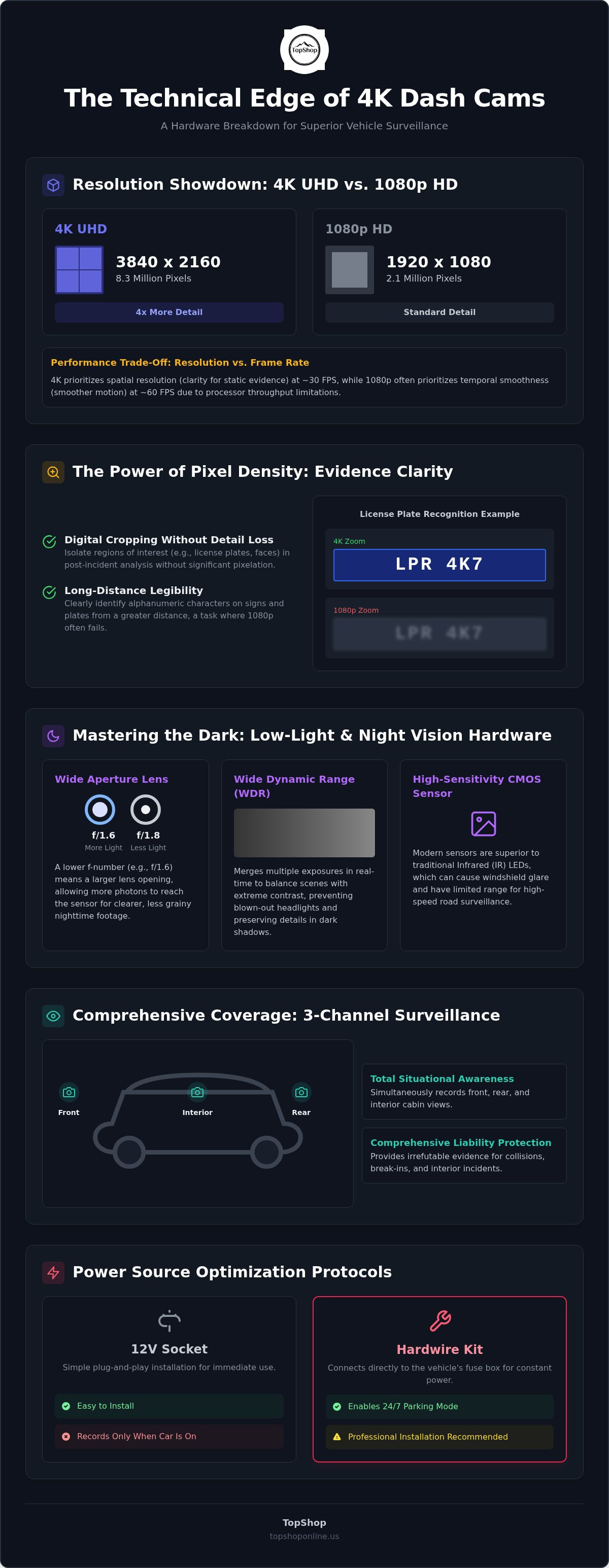
4K UHD resolution in automotive optical sensors refers to a standardized pixel grid of 3840 x 2160. This configuration produces approximately 8.3 million discrete data points per frame, providing four times the detail of traditional 1080p systems. The 2026 standard for forensic evidence requires this high density to ensure that small visual elements remain distinct during post-incident review. A Dashcam equipped with a high-resolution sensor provides the necessary overhead for digital cropping. Unlike lower resolution units, 4K allows users to isolate specific regions of interest without immediate loss of geometric clarity. This capability is essential for identifying vehicle make, model, and driver characteristics from a distance. The 4k dash cam with night vision utilizes this pixel count to maintain structural integrity in the image even when lighting conditions are suboptimal.
Pixel Density and License Plate Recognition
High pixel density directly correlates with the maximum legibility distance for alphanumeric characters on license plates. A 4k dash cam with night vision captures fine-grain details that 1080p sensors typically discard as electronic noise. Digital zoom artifacts are significantly reduced in 4K frames because the initial pixel count is substantially higher. In 1080p footage, zooming into a distant license plate often results in blocky pixelation that renders text unreadable. Motion blur remains a critical performance factor. High-resolution sensors must be paired with processors capable of maintaining high shutter speeds to prevent "smearing" during nighttime captures. Hardware like the Guardian 3-Channel 4K Dash Cam is engineered to handle these high data rates while preserving edge sharpness on moving targets.
Low-Light Sensor Technology and Aperture Ratings
Aperture ratings define the physical capacity of the lens to gather light for the sensor. Hardware with an f/1.6 aperture rating provides a larger opening than f/1.8 units, allowing more photons to reach the CMOS sensor array. This physical advantage reduces the reliance on digital gain, which often introduces "grain" or visual artifacts. Wide Dynamic Range (WDR) technology is integrated into specialized low-light automotive arrays to balance high-contrast environments. WDR functions by merging multiple exposures to resolve details in dark shadows while simultaneously preventing "blooming" from oncoming high-intensity discharge (HID) headlights. Modern 4K systems prioritize these high-sensitivity CMOS sensors over traditional infrared (IR) LEDs. IR illumination often reflects off the windshield or lacks the effective range required for high-speed road surveillance, making advanced sensor architecture the superior choice for 24/7 monitoring.
Comparative Analysis: 4K vs. 1080P Performance Metrics
4K UHD (3840 x 2160) hardware provides a total pixel count of 8,294,400, which is exactly four times the 2,073,600 pixels found in standard 1080P (1920 x 1080) arrays. This specific hardware advantage allows a 4k dash cam with night vision to resolve smaller text strings, such as registration stickers and street signs, at significantly greater distances. While 1080P units often support 60 frames per second (FPS), 4K units typically operate at 30 FPS due to hardware processor throughput limitations. This trade-off prioritizes spatial resolution over temporal smoothness, which is critical for identifying static evidence in high-speed collisions. Higher resolution sensors also demand more power, leading to increased battery draw and thermal output during extended operation.
Dynamic Range and Exposure Balancing
4K sensors possess smaller individual pixels, which can increase electronic noise at high ISO settings. Advanced HDR processing is required to prevent 'white-out' when recording high-intensity light sources against dark backgrounds. In unlit rural environments, 4K night vision relies on photon-efficient CMOS architecture to pull detail from shadows. Conversely, in lit urban environments, the challenge shifts to managing glare from streetlamps and neon signage. Reliable systems like the Guardian 3-Channel 4K Dash Cam utilize multi-exposure balancing to maintain color accuracy and edge definition across these varying light levels.
Storage Requirements and Data Write Speeds
A 4K 3-channel stream generates significantly higher bitrates than single-channel 1080P setups. A typical 4K front-facing channel consumes 25 to 45 Mbps, while interior and rear channels add another 10 to 15 Mbps each. H.265 (HEVC) compression is essential for managing these files, offering approximately 50% better efficiency than the older H.264 standard without sacrificing visual fidelity.
- 128GB SD Card: Approximately 3 to 4 hours of 3-channel 4K footage.
- 256GB SD Card: Approximately 7 to 8 hours of 3-channel 4K footage.
- 512GB SD Card: Approximately 15 to 16 hours of 3-channel 4K footage.
High-endurance U3 or V30 rated cards are mandatory to handle these sustained write speeds and prevent data corruption during continuous loop recording. Standard cards will likely fail under the high-frequency write cycles required by 4K multi-channel surveillance. Reliability in data management is just as critical as the optical resolution itself when building an automotive security profile.
3-Channel vs. Single-Channel Hardware Configurations
3-channel hardware configurations provide a 360-degree surveillance perimeter by integrating front, interior, and rear optical sensors into a single processing unit. This setup is distinct from single-channel units that only monitor the forward path. A 4k dash cam with night vision in a 3-channel configuration must manage three concurrent video streams, typically outputting 4K resolution on the front channel while maintaining 1080P on secondary channels. This simultaneous data capture ensures that incidents occurring inside the cabin or at the rear of the vehicle are documented alongside forward-facing evidence. The Guardian 3-Channel 4K Dash Cam utilizes this architecture to provide comprehensive coverage for liability protection and interior security. These systems multiplex data into separate files while maintaining a unified time-code for simplified event reconstruction.
Cabin and Rear Monitoring for Comprehensive Liability Protection
Interior monitoring requires specific hardware components to remain effective in total darkness. Most 3-channel models incorporate four to six Infrared (IR) LEDs within the cabin-facing lens assembly. These LEDs illuminate the interior space with light invisible to the human eye, allowing the sensor to capture clear monochrome footage of passengers and driver actions. Field of View (FOV) ratings for interior lenses generally range from 140 to 170 degrees to eliminate blind spots within the vehicle frame. Synchronized timestamping across all three channels is a mandatory requirement for legal admissibility. This ensures that a single event is cross-referenced across front, rear, and interior files with millisecond precision, providing an indisputable record of the vehicle's interior and exterior state.
Processor Load and Heat Dissipation in Multi-Channel Systems
Encoding a 4K video stream alongside two 1080P streams places significant stress on the system-on-a-chip (SoC). High-end chipsets are required to handle the massive data throughput without dropping frames or inducing lag. Processor load increases exponentially as the device manages H.265 compression and real-time write cycles to the SD card. Excessive heat is a byproduct of this computational intensity. Compact dash cam housings must feature advanced heat dissipation protocols, such as internal aluminum heat sinks or ventilated chassis designs, to prevent thermal throttling. Continuous high-temperature operation can degrade internal components and reduce the lifespan of the image sensors. Reliable multi-channel systems prioritize thermal management to maintain device longevity and recording stability under extreme automotive temperature fluctuations. This focus on hardware durability prevents common failures such as unexpected reboots or file corruption during long-duration drives.
Hardware Installation and Optimization Protocols
Optical centering and physical alignment are mandatory for maximizing the 140 to 170-degree field of view provided by a 4k dash cam with night vision. Standard mounting positions involve placing the primary unit behind the rearview mirror to ensure an unobstructed forward path while maintaining driver visibility. Centered placement prevents lens distortion at the frame edges, which is critical for accurate distance estimation in 4K footage. Power source selection dictates the operational capacity of the surveillance system. A standard 12V socket provides plug-and-play functionality but limits recording to active ignition cycles. Conversely, hardwire kits integrate the device into the vehicle's fuse box, enabling 24/7 parking mode capabilities. Users must configure G-sensor sensitivity levels to avoid false event locking caused by road vibrations or potholes. Routine firmware updates ensure the onboard processor maintains optimal sensor calibration and data write efficiency.
Power Management and Parking Mode Functionality
24-hour surveillance requires an intelligent power management system to prevent vehicle battery depletion. Hardwire kits feature adjustable voltage cutoff settings, typically ranging from 11.8V to 12.4V, which automatically disconnect the dash cam if the car battery drops below a safe threshold. This protects the vehicle's ability to start after extended parking periods. Parking mode functionality generally offers two primary recording methods: time-lapse and motion-activation. Time-lapse mode records at a reduced frame rate, such as 1 FPS, to minimize storage consumption while providing a continuous visual log. Motion-activation utilizes the image sensor to trigger full-resolution recording only when physical movement or impact is detected. Implementing these protocols ensures the Guardian 3-Channel 4K Dash Cam remains active without compromising vehicle electrical integrity.
SD Card Selection: UHS Speed Classes and Endurance Ratings
Standard SD cards are insufficient for the high-bitrate demands of 4K multi-channel recording. A 4k dash cam with night vision requires 'High Endurance' cards specifically engineered for constant write cycles and high thermal environments. These cards utilize MLC (Multi-Level Cell) or pSLC (pseudo Single-Level Cell) flash memory to withstand thousands of overwrite hours. Technical throughput standards are defined by UHS Speed Classes. For 4K streams, a V30 (Video Speed Class 30) or U3 (UHS Speed Class 3) rating is mandatory to support a minimum sustained write speed of 30MB/s. Maintenance protocols include monthly formatting via the dash cam menu to clear file system errors and optimize NAND flash performance. Failure to use high-endurance media leads to "card full" errors, file corruption, and premature hardware failure. You can purchase the Guardian 3-Channel 4K Dash Cam to secure a hardware platform optimized for these high-performance storage standards.
Guardian 3-Channel 4K Dash Cam: Hardware Overview and Features
The Guardian 3-Channel 4K Dash Cam serves as a high-density surveillance solution designed for comprehensive automotive liability protection. This 4k dash cam with night vision provides a technical benchmark by delivering 3840 x 2160 resolution on the primary front-facing channel. The integrated sensor array supports simultaneous front, rear, and interior monitoring to create a 360-degree digital perimeter around the vehicle. The physical housing utilizes a discreet profile for mounting behind the rearview mirror, utilizing high-bond adhesive hardware to maintain stability during high-vibration driving conditions. This configuration ensures that the primary optical path remains unobstructed while capturing critical forensic data across three distinct viewing angles.
Integrated Sensor Array and Lens Specifications
The Guardian system features a multi-lens architecture optimized for light transmission and edge-to-edge clarity. The front-facing 4K channel utilizes a wide aperture lens to maximize photon capture in low-light environments. Field of View (FOV) ratings are calibrated to cover multiple lanes of traffic without inducing significant fish-eye distortion at the frame boundaries. The interior-facing camera is equipped with dedicated Infrared (IR) LEDs, allowing for clear monochrome recording of the cabin even in total darkness. Lens construction prioritizes glass elements over plastic to prevent thermal warping and maintain focus during extended operation in high-temperature climates. This hardware combination ensures that vehicle identification and passenger activity remain visible under varying LUX levels.
Functional Interface and Mobile Integration
The Guardian unit incorporates an onboard display for real-time monitoring and local menu navigation. Physical controls allow for immediate manual file locking and system status checks without the need for external devices. Wireless connectivity is a standard feature for this 4k dash cam with night vision, facilitating high-speed footage retrieval through a dedicated mobile application. This interface allows users to manage settings, view live streams, and download incident clips directly to a smartphone for rapid insurance processing. The system includes an automatic file protection mechanism driven by a three-axis G-sensor. When the sensor detects a physical impact or sudden deceleration, the current recording loop is moved to a secure directory to prevent overwrite. This ensures that essential evidence is preserved automatically during an emergency event.
Optimizing Automotive Security Through Advanced Hardware Standards
Automotive surveillance standards for 2026 prioritize high-density optical data and continuous multi-channel recording. A 4k dash cam with night vision ensures that critical visual data, such as license plate alphanumeric strings and driver characteristics, remain legible during post-incident analysis. Technical specifications including wide aperture lenses and high-endurance CMOS sensors are mandatory for maintaining performance in unlit environments. A 3-channel monitoring system provides the most robust liability protection by documenting front, rear, and interior cabin activity simultaneously.
Maintaining this level of surveillance requires adherence to hardware optimization protocols, including the use of V30-rated SD cards and hardwire power kits. These components support the high-bitrate demands of 4K video while enabling reliable 24/7 parking mode functionality. The Guardian 3-Channel 4K Dash Cam integrates these features into a stable, high-performance platform suitable for all vehicle types. It offers a standardized solution for drivers requiring technical utility and precise evidence capture across every viewing angle.
Order the Guardian 3-Channel 4K Dash Cam for Full Vehicle Protection to secure your vehicle with advanced surveillance hardware. Fast national shipping is available to ensure your automotive security is upgraded immediately.
Frequently Asked Questions
Is 4K dash cam footage significantly better than 1080p at night?
4K resolution provides four times the pixel density of standard 1080p, which is critical for identifying vehicle details in low-light conditions. While 1080p sensors often struggle with motion blur and pixelation during digital zooming, a 4k dash cam with night vision maintains edge clarity. This allows for forensic-level cropping of license plates at greater distances. The increased data points per frame reduce the electronic noise typically found in high-ISO nighttime captures.
What type of SD card is required for a 3-channel 4K dash cam?
A 3-channel system requires a High Endurance microSD card with a U3 or V30 speed rating. These cards are engineered to handle the sustained 30MB/s write speeds necessary for simultaneous 4K and 1080p streams. Standard SD cards often fail due to the high-frequency overwrite cycles and thermal stress of 4K recording. For the Guardian 3-Channel 4K Dash Cam, utilizing cards with MLC or pSLC flash memory ensures data integrity.
How does the night vision work on the interior cabin camera?
The interior cabin camera utilizes a dedicated array of Infrared (IR) LEDs to illuminate the vehicle interior with light invisible to the human eye. This hardware allows the CMOS sensor to capture clear monochrome footage even in total darkness. Unlike the front-facing lens which relies on wide apertures and WDR for road visibility, the interior lens uses these IR emitters to resolve passenger details and cabin activity without distracting the driver.
Can a 4K dash cam record while the car is parked and turned off?
Recording while the car is parked requires a hardwire kit to provide a continuous power supply from the vehicle fuse box. This enables "Parking Mode," which utilizes motion detection or G-sensor triggers to capture incidents while the ignition is off. The Guardian 3-Channel 4K Dash Cam supports this functionality, featuring a voltage cutoff setting to protect the car battery from depletion. Standard 12V cigarette lighter sockets typically do not support this feature.
How much storage space does one hour of 4K 3-channel footage use?
One hour of synchronized 3-channel footage typically consumes between 25GB and 35GB of storage space. The primary 4K channel accounts for the majority of this data, while the interior and rear 1080p channels use significantly less. Using H.265 (HEVC) compression helps manage these large file sizes by maintaining high visual quality at lower bitrates. Drivers should use a 256GB or 512GB card to ensure several hours of recording before the loop cycle begins.
What happens to the dash cam footage when the SD card is full?
Dash cams utilize loop recording to manage storage by automatically overwriting the oldest unprotected video files once the SD card reaches capacity. This ensures continuous operation without manual data management. However, files locked by the G-sensor during an impact or manually protected via the interface are stored in a separate directory. These emergency files are not overwritten by the loop cycle, ensuring that critical evidence remains available for insurance claims.
Does 4K resolution cause the dash cam to overheat in summer?
High-resolution processing generates significant internal heat due to the computational load on the chipset. To mitigate this, 4K units like the Guardian model feature ventilated chassis designs and internal heat sinks. Operating a 4k dash cam with night vision in direct summer sunlight can trigger thermal protection protocols if temperatures exceed hardware limits. Proper mounting behind the rearview mirror and using high-endurance cards helps maintain stable operating temperatures and prevents unexpected reboots.
Is the Guardian 3-Channel 4K Dash Cam compatible with all vehicle types?
The Guardian 3-Channel 4K Dash Cam is compatible with most passenger vehicles, SUVs, and commercial trucks utilizing a standard 12V or 24V electrical system. The mounting hardware includes adjustable adhesive brackets designed for various windshield angles and interior configurations. While the device is universal, the specific cable lengths for the rear camera should be verified for extra-long vehicles. Users should follow the included technical guide for DIY power and cable routing.