

The highest-capacity adjustable dumbbell set isn’t automatically the best choice for strength progress. An adjustable dumbbell set for progressive strength training needs a usable weight range and increments small enough to support steady increases, not just an impressive maximum. For example, some sets adjust in 2.5-pound steps, while others use 5-pound increments. That difference can affect how manageable the next increase feels for a particular exercise.
It’s easy to compare maximum capacity and miss the details that shape everyday use. Adjustment mechanisms, handling, and storage all matter, especially when you’re changing weights between exercises or choosing a set for future training needs.
This guide compares adjustable dumbbell designs, weight increments, and capacity to help you find a set that fits your routine. You’ll see the trade-offs between selector-pin, dial, and twist-handle mechanisms, how to assess whether a set’s weight range supports continued progression, and how to plan increases around the weights available. The focus is on usable steps and training fit, not maximum capacity alone.
Key Takeaways
- Compare minimum load, maximum capacity, and increment size separately to see whether a set can support your next stages of training.
- Choose an adjustable dumbbell set for progressive strength training that suits your exercises, available space, and preferred adjustment method.
- Compare selector-pin, dial, and plate-based designs by their adjustment steps, handling, storage needs, and how selected plates are secured.
- Build a shortlist by identifying your exercises and required weight range before comparing increments and adjustment mechanisms.
- Track load, repetitions, sets, and perceived effort. Repeat a workload when technique or recovery is inconsistent before increasing weight.
Why adjustable dumbbell sets can fit progressive strength training
Strength progress comes from applying a manageable training challenge consistently and increasing it when your current workload is under control. An adjustable dumbbell set for progressive strength training can support this approach by providing several selectable loads in one home setup. Instead of storing a separate pair for every weight, you change the load to suit each exercise and your training plan.
Equipment gives you options, but it doesn’t guarantee strength or muscle gains. Results depend on the work performed, recovery, consistency, and sound technique. A suitable set makes it possible to adjust resistance; your training decisions determine how you use it.
What progressive overload means in a dumbbell routine
The principle of progressive overload means gradually increasing the demands placed on the body over time. It doesn’t mean lifting heavier every session. Progress may come from increasing load, completing more repetitions or sets, using a greater range of motion, or performing each repetition with improved control.
Where practical, change one variable at a time. For example, keep the dumbbell load and number of sets steady while adding a repetition to each set. Once you can complete the planned repetitions with stable form, consider a small load increase and adjust repetitions if needed. This makes it easier to identify what changed and compare sessions. If your technique deteriorates, the heavier load isn’t a useful progression. Repeat or reduce the workload until you can perform it with control.
Why adjustable dumbbells suit limited home training space
A single adjustable pair can provide several load options without requiring a separate fixed-weight pair for every step. That can reduce the number of weights taking up floor or storage space, while keeping selectable resistance nearby for exercises such as presses, rows, and curls. A storage tray or base also needs a designated place, and you’ll need enough clearance to lift and set down the dumbbells safely.
Think about how you’ll access and change the weights during a session. A set that stores neatly but takes longer to adjust may suit workouts with longer rests better than rapid circuits. The trade-off depends on the mechanism and your routine, so compare the complete setup rather than the dumbbell footprint alone.
Capacity matters too. A compact set may not provide enough load for every exercise or future training goal, and its available weight steps may not suit each stage of progression. Match the range to the movements you plan to do and your realistic training needs. A well-chosen adjustable set offers practical options within its limits, so assess those limits before building your routine.
How weight range and increments shape a dumbbell progression plan
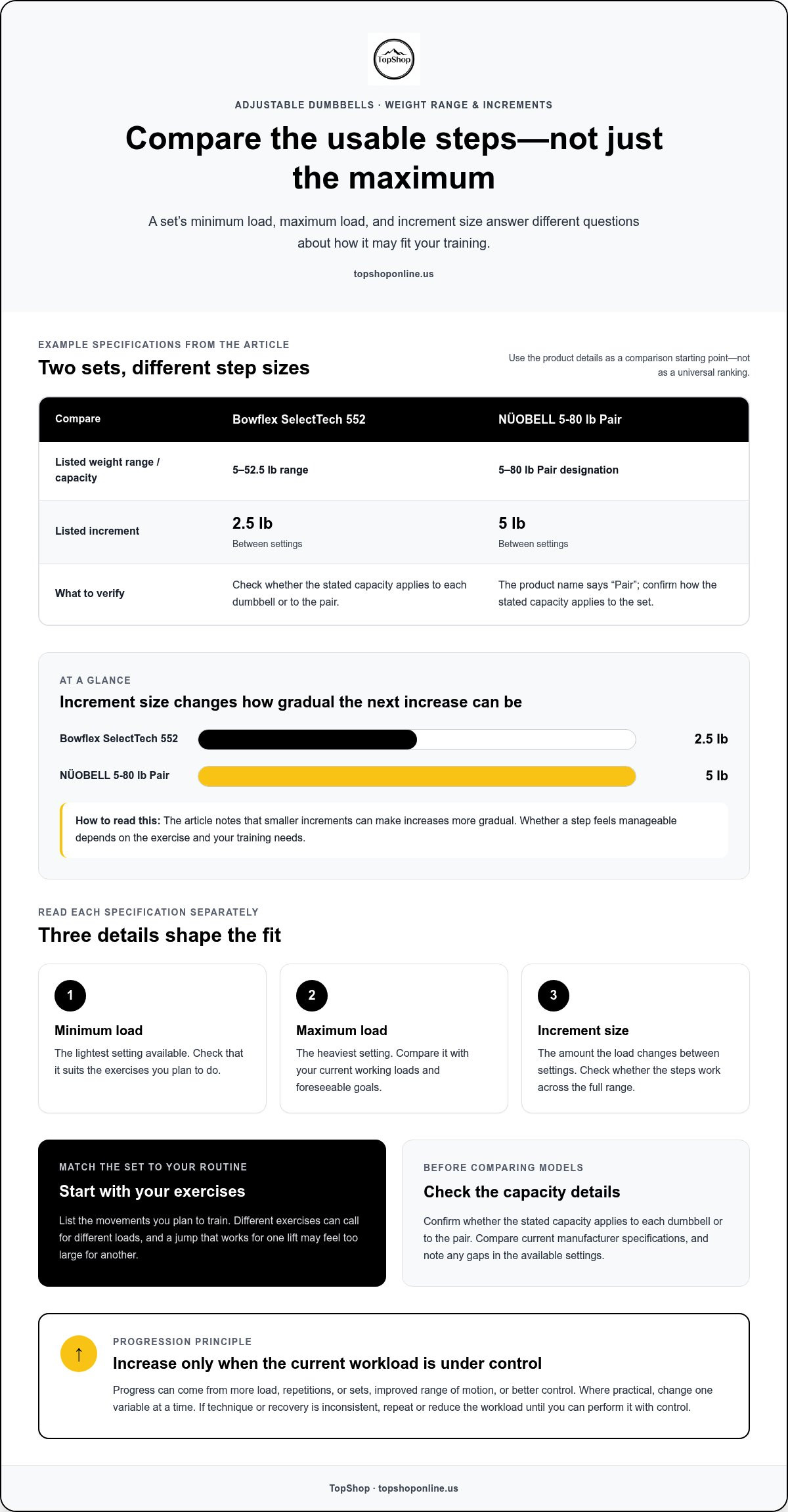
Compare three specifications separately: minimum load, the lightest setting available; maximum load, the heaviest setting; and increment size, the amount the load changes between settings. A wide range can cover more exercises, while smaller increments can make increases more gradual. Neither range nor increment size alone determines whether a set fits your routine.
To assess a set’s usefulness for progression, ask whether its minimum and maximum loads suit your exercises and whether its increments provide workable steps between them. Treat product specifications as separate comparison points, not as a single capacity figure.
Use this simple template to compare models. Record whether the stated capacity applies to each dumbbell or to the pair, and note any gaps in the available settings.
Set or model | Minimum load | Maximum load | Increment size | Capacity applies to | Notes
Model A | ___ | ___ | ___ | ___ | ___
Model B | ___ | ___ | ___ | ___ | ___
For example, the Bowflex SelectTech 552 is listed with a 5 to 52.5-pound range and 2.5-pound increments. The NÜOBELL 5-80 lb Pair is listed with 5-pound increments. These examples show why step size deserves its own column, even when sets offer broad selectable ranges.
Match weight increments to the exercises you plan to train
List your intended exercises before comparing increment patterns. Upper-body movements may require different loads from lower-body movements, and exercises within either group can differ too. If the next available jump feels too large for a particular lift, a smaller increment may provide a more manageable step. Compare settings across the full range, since increments may not be uniform.
Check whether the maximum load leaves room to progress
Compare the upper limit with the loads you currently use and your foreseeable training goals. A maximum-load figure alone can’t establish suitability for every exercise: one movement may approach the limit while another remains well below it. Check whether the stated load is available for each dumbbell or refers to the pair. Before relying on a model’s capacity or increment claims, compare them with current manufacturer specifications.
Use the comparison to identify trade-offs, not a universal “best” range. A lower maximum may be enough for your planned routine but leave less room for heavier future work. A higher maximum may add capacity you don’t need, while its increments may not match your preferred progression. The right balance depends on your exercise list, current working loads, and expected training direction.
For other home and technology essentials, browse TopShop’s home and tech products.
Adjustable dumbbell mechanisms compared: speed, security, and usability
Adjustment design affects how you select a load, handle the dumbbells between exercises, and store the equipment. Selector-pin and dial systems change which plates are engaged through a control. Plate-based designs require you to add or remove plates directly. No mechanism suits every routine. The right fit depends on the adjustment steps, setup space, handling preference, and how often you change loads.
Faster adjustment can reduce pauses between exercises and help preserve workout flow, but it doesn’t determine training results. Compare the adjustment process alongside the set’s weight range. An adjustable dumbbell set for progressive strength training should let you select practical loads and fit the way you move through a workout.
Selector and dial systems: fast load changes
Selector-pin and dial controls can simplify transitions by letting you change the selected load without manually removing each plate. Controls and adjustment sequences vary by model, as do the available weight steps. Don’t infer long-term durability from a selector or dial alone. Check product-specific specifications and instructions for the actual increments and selection process.
Also consider how the dumbbell sits in its storage tray or base during adjustment, whether the control is easy to reach, and how the handle feels at different settings. These details affect everyday use, but a design category alone doesn’t guarantee comfort or reliability.
Plate-based systems: straightforward loading and storage trade-offs
With a plate-based system, you change the load by adding or removing plates and securing them with the system’s collars or locking components. This hands-on process can take longer than selecting a setting on a compact selector-style design. Plates and handles are separate pieces that need organized storage and clear space for loading. Follow the product’s assembly instructions before lifting.
| Mechanism | Potential advantages | Practical trade-offs |
|---|---|---|
| Selector-pin | Load selection through a pin or selector control | Steps and control operation vary by model; check setting and seating instructions |
| Dial | Load selection through a dial control | Available increments and adjustment sequence are model-specific |
| Plate-based | Load changes by adding or removing plates | Requires hands-on loading, plate storage, and secure assembly before use |
Use this comparison to build a shortlist, not a ranking. If your session moves between exercises with different loads, consider how much time and handling each change involves. If storage is limited, account for the dumbbells and any tray, base, spare plates, or collars rather than measuring the handles alone. Read the operating instructions to understand how selected plates are secured and how the equipment should be placed between adjustments.
TopShop offers products across home and technology categories. Browse TopShop’s home and tech products for other household needs.
Build a dumbbell set shortlist around your routine and training space
Compare equipment against your actual workouts, not just headline capacity. Separate essential requirements, such as enough load for planned exercises and usable increments, from preferences, such as faster adjustments or a smaller storage footprint. An adjustable dumbbell set for progressive strength training should suit your current routine while leaving a practical path for future training needs.
- List your exercises. Include the movements you plan to perform and note whether you’ll change loads often between exercises.
- Estimate the needed range. Use your current working loads and foreseeable goals to identify the lightest and heaviest settings your routine may require.
- Assess the increments. Compare the available steps across the range and consider whether the next increase is manageable for your planned movements.
- Compare mechanisms. Decide whether selector-pin, dial, or plate-based adjustment suits your workout transitions and handling preferences.
- Check storage. Measure the space available for the dumbbells, base or tray, and any separate plates. Allow room to pick up and set down each weight.
Prioritize criteria for beginner and intermediate lifters
Beginners benefit from clear specifications and adjustment steps that are easy to understand and use. Intermediate lifters may need a wider usable range or increments suited to their planned exercises. Experience alone doesn’t determine the right capacity: exercise selection, current working loads, goals, and available space all matter. Treat compact storage and faster adjustment as preferences unless they’re important to your routine.
Check product details before comparing listings
Read the stated total weight, capacity per dumbbell, included components, and adjustment instructions. A pair’s combined weight is not the same as the maximum load of one dumbbell. If a listing uses unclear capacity wording or omits an important detail, mark it for verification instead of assuming what the specification means.
Use this checklist to record details consistently across listings. Note anything missing or ambiguous, and separate required features from preferences before making your final comparison.
Printable comparison checklist
- Set or listing: ____________________
- Stated weight range: ____________________
- Increment pattern: ____________________
- Adjustment mechanism: ____________________
- Footprint or storage space: ____________________
- Listed contents, including base, tray, plates, or collars: ____________________
- Capacity wording, per dumbbell or pair: ____________________
- Adjustment instructions reviewed: ____________________
- Missing or ambiguous details to verify: ____________________
- Essential requirements met: ____________________
- Optional preferences met: ____________________
Workout transitions affect usability as well as storage. If you move between exercises that need different loads, consider whether adjustments interrupt your preferred pace. If you use a dedicated training area, storing accessories may be less restrictive. For other household and tech essentials, browse TopShop’s home and tech range.
Use your adjustable dumbbell set consistently and review progression
A useful training log turns each session into information you can compare. Record the exercise, load, repetitions, sets, and perceived effort after your workout. Note relevant changes in technique, range of motion, or recovery too. These details help distinguish a repeatable performance from a one-off increase that may not reflect your usual training capacity.
Track repeatable performance rather than chasing daily increases
Use the same basic log fields each session, and compare similar workouts. For example, record whether you completed the planned repetitions through a consistent range of motion, rather than noting the load alone. If your technique or recovery feels inconsistent, repeat the workload or adjust it to a level you can control before considering an increase. There’s no need to force a heavier setting every workout.
Progress can be gradual and variable. A stable number of repetitions with controlled form may be a more useful foundation than a higher load lifted with shortened movement or loss of control. The log is a record, not a guarantee of strength or muscle outcomes, and fixed progression schedules don’t suit every person or exercise.
Review whether the set still matches your training needs
As your routine or goals change, compare your exercise log with the set’s stated range and available increments. A mismatch may become apparent if a planned movement needs more load than the set provides, or if the next available setting feels too large to use with sound technique. Revisit the specifications against your actual exercises rather than choosing by maximum load alone.
Keep the review practical. Confirm whether the listed capacity applies to one dumbbell or the pair, and use the documented increments to understand the available steps. If your exercise selection changes, the set may suit some movements and limit others. Base equipment decisions on the stated specifications, adjustment instructions, and space available for safe use.
Simple post-session log
- Exercise and variation
- Load used
- Sets and repetitions completed
- Perceived effort
- Technique and range-of-motion notes
- Recovery or other relevant observations
- Next-session decision: repeat, adjust, or progress
An adjustable dumbbell set for progressive strength training is most useful when its settings suit your planned exercises and your records help guide sensible adjustments. If you experience pain, have an injury, or have medical concerns, seek individualized guidance from an appropriate health professional before changing your training.
TopShop offers home and technology products for other everyday needs. Browse TopShop’s online store.
Set a clear starting point for your next training block
Before your next training block begins, choose one exercise and set a practical baseline you can repeat with consistent technique. Use that reference point to make your next adjustment deliberate rather than reactive. An adjustable dumbbell set for progressive strength training is most useful as part of a routine you can measure, review, and adapt as your goals change.
Keep the first step manageable. Focus on performing your planned work with control, then use your session records to decide whether to repeat or adjust it. If your needs change, revisit your equipment criteria and compare them with your actual training demands.
For home and technology essentials, explore TopShop’s online store. TopShop serves shoppers nationwide through its e-commerce store, with fast shipping and competitive prices.
Start with a clear plan, make adjustments based on your training, and build progress one repeatable session at a time.
Frequently Asked Questions
What adjustable dumbbell weight range is best for progressive strength training?
The best range covers the exercises you plan to do now and leaves useful options for later. Compare the loads you currently use across movements rather than choosing by a single maximum figure. For example, a pair might suit pressing and arm exercises but reach its limit for a heavier rowing variation. Match capacity to your routine, not to a universal beginner or advanced label.
Are adjustable dumbbells effective for progressive overload?
Yes, adjustable dumbbells can support progressive overload because you can change resistance as your training develops. They’re useful for routines that need different loads for movements such as presses, rows, and lunges. Their usefulness depends on selecting settings that fit each exercise and performing the work consistently. A dumbbell set doesn’t create progression by itself; the training plan and how you carry it out matter.
How small should adjustable dumbbell weight increments be?
Choose increments that let you make a manageable change for the exercises you perform. A small upper-body movement may be disrupted by a jump that feels reasonable for a larger movement, so consider your own response rather than following a universal increment rule. Check whether step sizes stay consistent throughout the range. A set’s smallest increment matters only if its other settings suit your training too.
Are dial adjustable dumbbells better than plate-loaded dumbbells?
Neither design is automatically better. Dial systems can be convenient for changing settings between exercises, while plate-loaded dumbbells let you assemble the load by adding or removing plates. Think about your workout pace, comfort with handling components, and where you’ll store the equipment. If you often switch loads during a circuit, adjustment time may matter more. For a slower session, hands-on loading may be acceptable.
Can one adjustable dumbbell set train the whole body?
One set can cover many common upper- and lower-body movements, provided its shape, weight range, and available settings suit your exercise choices. It may be less suitable for movements that call for loads beyond its capacity or equipment with a different form factor. List the exercises you intend to perform, including unilateral variations, and compare their requirements with the set’s documented settings.
How do I progress when my adjustable dumbbells do not have the next weight increment?
Keep the current load and build difficulty in another controlled way, such as adding a repetition, using a longer range of motion, or improving your control through the lowering phase. You could also choose a suitable single-arm variation if it allows stable form. Record the change so you can compare sessions. Don’t force a heavier load if it causes pain or makes your technique unreliable.
What should I check before buying an adjustable dumbbell set?
Check the minimum and maximum load, increments across the range, and whether capacity refers to one dumbbell or the pair. Confirm what comes in the box, how the weights are adjusted, and the assembled dimensions, including any storage base or tray. Read the handling instructions and note unclear claims. These checks help you judge whether the set fits your routine, storage area, and practical lifting needs.