

Effective home surveillance relies on hardware optimization rather than high retail price points. Reliable 1080P footage and stable remote viewing are frequently compromised by inferior CMOS sensors, low-quality optics, and congested 2.4 GHz wireless bands. These technical failures result in grainy night vision, high-latency streams, and inconsistent signal strength. Selecting an affordable wireless mini security camera requires a precise understanding of internal component specifications, sensor lux ratings, and data transmission protocols to ensure consistent performance.
This guide provides a comprehensive technical analysis of mini camera hardware, focusing on resolution standards, connectivity stability, and compact form factor engineering. It's designed to clarify the specific hardware requirements for clear low-light imaging, smartphone integration, and durable USB-C power configurations. By breaking down the technical attributes of 1080P HD wireless mini security WiFi cameras, this resource enables informed procurement decisions based on measurable data points and functional utility. We'll examine specific hardware benchmarks including diagonal field of view, H.264 compression efficiency, and MicroSDXC local storage capacities.
Key Takeaways
- Identify essential hardware components including 1080P image sensors and high-clarity optics required for reliable facial identification.
- Assess Field of View (FOV) benchmarks between 110° and 150° to maximize surveillance coverage within compact indoor environments.
- Understand power management specifications by comparing mAh battery capacities against continuous USB-powered hardware configurations for 24/7 monitoring.
- Utilize integrated magnetic mounting and swivel hardware for flexible placement and precise post-installation angle adjustments.
- Analyze the price-to-performance ratio when sourcing an affordable wireless mini security camera to ensure technical compliance with 2026 hardware standards.
Technical Overview of Mini Security Camera Hardware
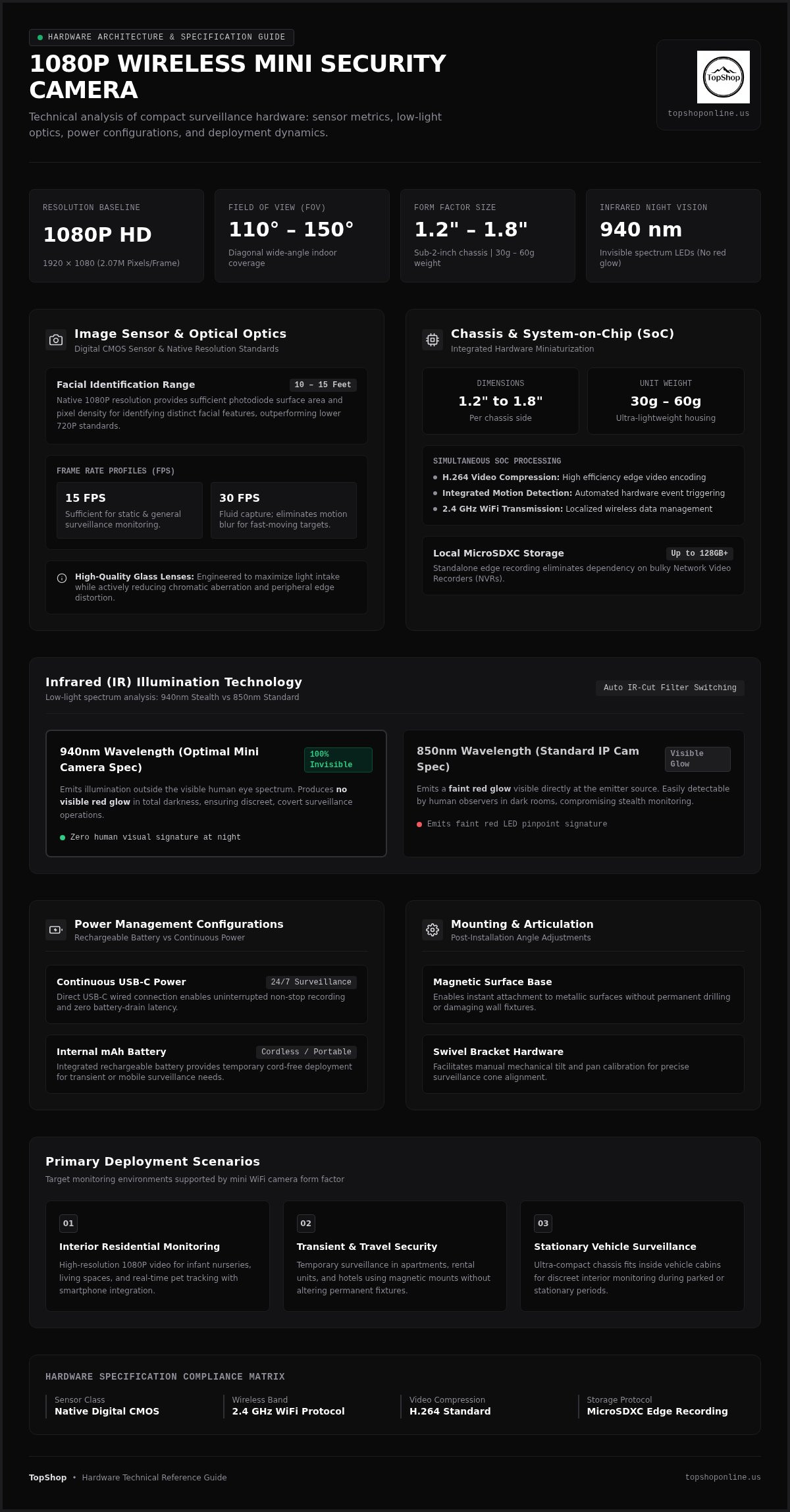
Mini security cameras are specialized, compact wireless surveillance nodes engineered for localized data capture. The primary hardware architecture integrates a fixed-focal lens, a digital CMOS image sensor, a low-power WiFi module, and a rechargeable battery. These units differ from standard IP cameras through the omission of bulky weatherproof enclosures and external high-gain antennas. Selecting an affordable wireless mini security camera involves assessing this physical footprint against sensor capabilities. Typical dimensions for these portable units range from 1.2 to 1.8 inches per side, with total weights often falling between 30 and 60 grams. Evaluating wireless security camera hardware and transmission standards provides technical context for how these devices manage 2.4 GHz frequency bands and signal attenuation in indoor environments.
The Evolution of Compact Surveillance Sensors
Advancements in semiconductor manufacturing have facilitated the transition from low-resolution analog sensors to high-density digital CMOS hardware. Circuit miniaturization enables 1080P video processing within sub-2-inch housings by utilizing integrated System-on-Chip (SoC) architectures. These SoCs manage video compression, motion detection algorithms, and wireless networking simultaneously. Hardware configurations for an affordable wireless mini security camera now standardly include internal microSDXC slots for local storage, supporting capacities up to 128GB or higher. This edge-recording capability eliminates the requirement for centralized network video recorders (NVRs) while maintaining a high-definition 1080P output in sub-2-inch devices.
Common Use Cases for Portable WiFi Cameras
The utilitarian design of portable WiFi cameras supports diverse deployment scenarios where traditional wired cameras are impractical. These devices function as versatile monitoring tools for various environments:
- Interior Residential Monitoring: High-resolution sensors allow for precise pet tracking and infant monitoring within nursery environments.
- Transient Security: Short-term renters and travelers utilize the magnetic mounting hardware for temporary hotel or apartment security without permanent fixtures.
- Stationary Vehicle Surveillance: Compact chassis designs permit discreet placement within vehicle cabins to monitor interiors during parking periods.
The 1080P HD Wireless Mini Security WiFi Camera serves as a reliable hardware choice for these applications. It offers a functional balance of resolution, connectivity, and discreet physical dimensions for users requiring immediate surveillance deployment. The integration of 1080P optics into such a small form factor ensures that identifying features remain visible even in compact interior spaces.
Key Specifications: Resolution, Field of View, and Night Vision
Hardware performance in an affordable wireless mini security camera depends on the synergy between lens aperture and the CMOS sensor. 1080P (1920 x 1080) is the baseline standard for identifying facial features at distances of 10 to 15 feet. Lower resolutions, such as 720P, lack the pixel density needed for forensic evidence. Frame rates typically range from 15 to 30 frames per second (FPS). While 15 FPS is sufficient for general surveillance, 30 FPS provides the fluidity required to capture fast-moving subjects without motion blur.
Understanding Image Sensor Resolution
Native resolution refers to the physical pixel count on the CMOS sensor, whereas interpolated resolution uses software algorithms to upscale lower-quality images. Native 1080P hardware ensures superior light intake and color accuracy by maximizing the surface area of each individual photodiode. A standard 1080P resolution equates to 2.07 million pixels per frame. High-quality glass lenses further enhance this by reducing chromatic aberration and distortion at the edges of the frame. This distinction is vital when evaluating an affordable wireless mini security camera for high-traffic areas.
Night Vision Capabilities and Range
Effective low-light performance relies on integrated Infrared (IR) LEDs. Most compact units utilize 940nm wavelength IR LEDs, which are invisible to the human eye; this differs from 850nm LEDs that emit a faint red glow. This "invisible" illumination is critical for discreet monitoring in total darkness. These units feature an automatic IR-cut filter that switches between day and night modes when ambient light drops below specific lux levels, typically 0.1 lux. The effective night vision range for compact hardware generally spans 15 to 30 feet, providing clear grayscale imagery within standard room dimensions.
Field of View (FOV) measurements between 110° and 150° are optimal for small rooms, as they allow for corner-to-corner coverage without the heavy "fisheye" distortion found in 180° lenses. When configuring these settings, consult the FTC guidance on securing home security cameras to ensure your remote access protocols and data feeds remain encrypted. For reliable hardware that meets these technical benchmarks, consider the 1080P HD Wireless Mini Security WiFi Camera as a baseline for home surveillance. This model integrates the necessary sensor density and IR hardware for consistent 24/7 performance.
Power Management and Connectivity Protocols
Power management for an affordable wireless mini security camera involves balancing internal battery capacity against the energy demands of continuous WiFi transmission. Integrated lithium-ion batteries in these devices typically range from 300mAh to 1000mAh. These compact power cells support short-duration active recording or extended standby periods when utilizing motion-detection triggers. Continuous 24/7 surveillance setups require a dedicated 5V/1A or 5V/2A USB power supply to bypass battery depletion. Active power consumption typically fluctuates between 200mA and 400mA depending on the status of infrared illumination and processor load.
Battery Life and Charging Cycles
Internal battery performance depends on hardware power draw during active data streaming and IR LED activation. Standard lithium-ion configurations provide approximately 60 to 180 minutes of continuous high-definition recording before requiring a recharge via micro-USB or USB-C interfaces. Power-saving modes utilize passive infrared (PIR) sensors or pixel-change algorithms to maintain low-power standby states, which significantly extends operational life for intermittent monitoring. For mobile deployments or areas without AC outlets, compatibility with external 10,000mAh or 20,000mAh power banks allows for multi-day field use. Users should monitor charging cycles, as lithium-ion cells generally maintain peak capacity for 300 to 500 full discharge-recharge sequences.
WiFi Signal Stability and Bandwidth
Connectivity reliability relies on the 2.4GHz WiFi frequency standard. This band offers superior wall penetration and signal range compared to 5GHz alternatives, making it ideal for indoor surveillance through multiple partitions. Streaming high-definition 1080P video requires a stable upload bandwidth of approximately 2 to 4 Mbps per camera node. Packet loss and video lag often result from co-channel interference in high-density residential areas or proximity to microwave ovens and cordless phones. Optimizing router settings, such as selecting non-overlapping channels (1, 6, or 11), ensures consistent data throughput for remote smartphone viewing and cloud synchronization. Advanced hardware modules also support WPA2 or WPA3 encryption protocols to safeguard wireless data packets from interception.
Secure remote access utilizes dedicated applications featuring end-to-end encryption for video feeds. Adhering to CISA IoT device security recommendations is essential for mitigating unauthorized access to private footage. This includes the immediate modification of default administrative credentials and the implementation of regular firmware updates provided by the manufacturer. Network segmentation, such as placing cameras on a dedicated guest WiFi network, provides an additional layer of hardware isolation from primary computing devices. Implementing these protocols ensures that an affordable wireless mini security camera remains a viable security asset without compromising overall network integrity.
Installation and Mounting Configuration for Indoor Environments
Effective installation of an affordable wireless mini security camera relies on versatile mounting hardware designed for rapid deployment. Magnetic mounting bases allow for immediate attachment to metallic surfaces such as refrigerator panels, metal shelving, or window frames. These bases typically integrate a high-strength neodymium magnet to maintain stability during active operation. For non-metallic surfaces, hardware kits include adhesive metal plates or screw-in brackets. Swivel and tilt mechanisms permit 360-degree rotation and 90-degree vertical adjustment, facilitating precise viewing angle calibration post-installation.
Placement height significantly impacts the effective field of view and sensor trigger accuracy. Positioning the camera at a height of 7 to 8 feet provides a comprehensive top-down perspective while remaining out of the immediate line of sight. This elevation reduces the likelihood of tampering and ensures the lens captures facial details rather than the top of a subject's head. When selecting a mounting location, prioritize proximity to a 5V USB power source if continuous recording is required, as discussed in the 1080p Wireless Mini Security Camera with Night Vision: Technical Specifications and Buying Guide.
Discreet Placement Strategies
Discreet surveillance utilizes existing room geometry and interior decor to mask the camera chassis. Placing the unit on high bookshelves or within entertainment centers provides a clear line of sight to primary entry points without drawing attention to the lens. It's essential to ensure that decorative objects don't obstruct the infrared LEDs or the peripheral edges of the wide-angle lens. Maintaining a 2 to 3-foot clearance from reflective surfaces like mirrors or glass prevents IR glare from washing out night vision footage.
Configuring Motion Detection Zones
Software-based motion detection requires calibration to minimize false alerts from pets or environmental changes. Most dedicated applications provide sensitivity settings categorized as low, medium, or high. Precision is achieved by defining specific detection zones within the frame, focusing on high-value areas like doorways or safes while ignoring windows where exterior movement might trigger the sensor. Real-time push notifications enable immediate remote viewing via smartphone apps whenever the hardware detects movement within these defined parameters. For professional-grade hardware that supports these advanced configuration options, you can purchase the 1080P HD Wireless Mini Security WiFi Camera directly.
Selecting an Affordable Wireless Mini Security Camera for Home Use
The selection process for an affordable wireless mini security camera requires a technical evaluation of hardware durability and sensor reliability. Evaluating the price-to-performance ratio involves comparing the cost of procurement against the specific longevity of the CMOS sensor and the stability of the WiFi module. Procuring hardware from a distributor that provides granular technical data ensures compatibility with existing network infrastructure. Utilitarian buyers prioritize measurable attributes over marketing descriptors to ensure the device maintains consistent 1080P output during long-term operation. Before finalizing a purchase, users should execute a hardware verification checklist to confirm the unit meets minimum surveillance requirements.
- Resolution Verification: Confirm native 1080P (1920 x 1080) output rather than upscaled 720P.
- Connectivity Standard: Ensure 2.4GHz WiFi compatibility for optimal signal penetration through interior walls.
- Storage Capacity: Verify the presence of a MicroSDXC slot supporting at least 128GB for local edge recording.
- Power Configuration: Check for USB-C or micro-USB inputs to facilitate continuous 24/7 power supply.
- Night Vision Hardware: Confirm the integration of 940nm IR LEDs for invisible low-light monitoring.
TopShop Mini Camera Features
The TopShop 1080P HD Wireless Mini Security WiFi Camera provides a high-density hardware configuration within a compact chassis. This unit features native 1080P resolution, integrated infrared night vision, and stable WiFi connectivity for remote smartphone access. For environments requiring a broader surveillance radius, the 360° Panoramic Hidden Light Bulb Wifi Camera serves as a high-altitude surveillance node. It replaces standard light fixtures to provide a complete overhead view of a room without the requirement for separate mounting hardware. Direct purchase from TopShop ensures access to competitive pricing and US-based e-commerce reliability, focusing on the technical utility of the device rather than excessive packaging or software bloat.
Conclusion: Building a Cost-Effective Security Layer
Mini cameras function as a critical, discreet layer within a broader home security strategy. These devices provide localized monitoring in areas where standard IP cameras are too conspicuous or difficult to power. By focusing on technical specifications such as 1080P resolution, IR range, and WiFi stability, users can implement a professional-grade surveillance network at a lower cost point. Selecting hardware based on these functional attributes ensures the system remains reliable for years. For users seeking a balance of high-specification components and direct-to-consumer value, the selection of 1080P mini units is a practical decision. View the full range of security electronics at TopShop to compare hardware configurations and deployment options.
Optimizing Home Surveillance with High-Specification Hardware
Implementing an effective surveillance layer depends on the precise integration of 1080P HD resolution, reliable WiFi remote access, and compact hardware design. This technical guide has detailed how hardware selection determines the functional utility of a modern security system. Specifically, the deployment of an affordable wireless mini security camera allows for high-definition monitoring without the spatial requirements of traditional IP hardware. Users must prioritize units featuring 940nm IR LEDs for invisible night vision and stable 2.4GHz connectivity for consistent data transmission to mobile devices. Maintaining a continuous power supply via standardized USB interfaces ensures 24/7 operational reliability for interior residential spaces and transient security applications.
Selecting high-specification electronics from direct-to-consumer distributors minimizes procurement costs while maintaining essential technical standards. You can verify these hardware attributes and specific performance metrics through our specialized inventory catalog. Browse the 1080P HD Wireless Mini Security WiFi Camera at TopShop to upgrade your hardware configuration today. Professional-grade monitoring is achievable through informed hardware selection and strategic placement. Establishing a secure environment starts with utilizing reliable, high-density surveillance components.
Frequently Asked Questions
How long does the battery last on an affordable wireless mini security camera?
Battery capacity in an affordable wireless mini security camera typically ranges from 300mAh to 1000mAh. This hardware supports active recording for approximately 60 to 180 minutes on a single charge. For extended surveillance, users should connect the device to a continuous 5V USB power source. Standby times are significantly longer when utilizing motion detection triggers rather than continuous recording modes. This ensures the device remains operational for targeted security events.
Can I view the footage from my mini camera on my phone while away from home?
Remote viewing is a standard feature enabled through WiFi connectivity and a dedicated smartphone application. Users can access live video feeds and recorded footage from any location with an active internet connection. The camera hardware must be connected to a local 2.4GHz WiFi network to transmit data to the cloud or direct to the app. This configuration allows for real-time monitoring of interior spaces while the user is away from the premises.
Do mini security cameras require a subscription for cloud storage?
Mini security cameras from TopShop don't require a monthly subscription for basic operation. These devices utilize local storage via internal microSD card slots to save video data directly to the hardware. While some third party apps offer optional cloud storage services, the primary utility of these units is based on non-subscription edge recording. This approach provides a cost-effective surveillance solution without recurring fees for data retention or remote access features.
What is the maximum microSD card capacity for a 1080P mini camera?
The 1080P HD Wireless Mini Security WiFi Camera typically supports microSD card capacities up to 128GB. This storage volume allows for several days of continuous 1080P video footage or weeks of motion-triggered clips. Users should select high-endurance, Class 10 or higher cards to ensure reliable write speeds and data integrity. Once the card reaches full capacity, the hardware is programmed to overwrite the oldest files automatically through a loop recording protocol.
Does the mini camera record audio as well as video?
Integrated microphones in mini camera hardware allow for synchronized audio and video recording. The internal audio sensor captures environmental sounds within a specific radius, typically 10 to 15 feet. This feature enhances the utility of the footage for identifying specific events or interactions. Users must ensure compliance with local regulations regarding audio surveillance in private or public spaces. Audio data is compressed and stored alongside the 1080P video stream on the local storage media.
Can these cameras work without a WiFi connection?
Mini security cameras can function without an active WiFi connection by recording data directly to an inserted microSD card. In this offline mode, the hardware operates as a localized digital video recorder. Remote viewing and real-time push notifications will be disabled until the device is reconnected to a wireless network. This configuration is useful for environments with limited connectivity or for users who prioritize local data isolation over remote access capabilities.
How do I reset the WiFi settings on my mini security camera?
Resetting the WiFi settings involves using the physical reset button located on the camera chassis. Users should press and hold this button for approximately 5 to 10 seconds until the status LED indicator flashes. This action clears the existing network credentials and returns the hardware to its default factory state. Following a reset, the camera enters pairing mode, allowing for reconfiguration through the mobile application using a new 2.4GHz WiFi SSID and password.
Are mini cameras difficult to set up for non-technical users?
These devices are engineered for rapid, non-technical deployment through a plug-and-play setup process. Configuration typically involves scanning a QR code via a smartphone app to link the hardware to a local wireless network. The inclusion of magnetic mounting bases and adhesive plates eliminates the requirement for complex tools or professional installation. Most users complete the initial synchronization and physical placement within 10 to 15 minutes by following the provided technical instructions.