

A 4K resolution specification does not guarantee legible nighttime evidence. Many high-resolution sensors produce grainy, unusable footage or suffer from headlight glare that obscures license plates in dark environments. Identifying the best dash cam for night vision requires an objective analysis of hardware components like sensor surface area and aperture diameter. You've likely encountered the technical limitations of standard cameras when trying to capture interior cabin activity or rear-end collisions after sunset. This guide provides a comprehensive technical analysis of low-light imaging sensors, f/1.6 aperture specifications, and 3-channel hardware configurations designed for optimal nighttime vehicle surveillance. We examine the performance of the Sony STARVIS 2 IMX678 and IMX675 sensors in high-contrast lighting scenarios. You'll learn the specific trade-offs between high pixel density and light sensitivity. The following sections detail how 360-degree coverage is achieved through multi-channel systems. We prioritize measurable data points, including infrared LED counts and dynamic range processing capabilities. This includes an evaluation of the Guardian 3-Channel 4K Dash Cam as a primary solution for comprehensive nighttime monitoring.
Key Takeaways
- Prioritize Sony Starvis 2 hardware architecture to maximize low-light sensitivity and dynamic range for clear nighttime evidence.
- Evaluate technical trade-offs between 4K resolution and sensor thermal management to prevent nighttime image degradation.
- Identify the best dash cam for night vision by verifying physical aperture sizes of f/1.8 or lower and large sensor dimensions.
- Implement 3-channel configurations with integrated infrared (IR) LEDs for complete interior and exterior visibility in zero-light environments.
- Utilize high-performance hardware like the Guardian 3-Channel 4K Dash Cam for 4K UHD front monitoring and 4-LED infrared cabin surveillance.
The Technical Mechanics of Dash Cam Night Vision
Dash cam night vision is defined by the hardware's ability to convert minimal photon counts into visible digital signals. This process relies on high-sensitivity image sensors and wide-aperture optics. Understanding The Technical Mechanics of Night Vision is essential for selecting the best dash cam for night vision, as software interpolation cannot compensate for poor physical light collection. Modern 2026 systems utilize Sony STARVIS 2 technology, specifically the IMX678 and IMX675 sensors. These sensors improve dynamic range and low-light sensitivity compared to standard CMOS units by utilizing a larger physical surface area for each pixel. Hardware like the Guardian 3-Channel 4K Dash Cam integrates these high-sensitivity sensors to ensure reliable nighttime surveillance.
Aperture ratings determine the volume of light reaching the sensor. An f/1.6 lens provides a significantly larger opening than an f/2.0 lens, allowing more light to pass through the optical stack. This hardware difference is critical in unlit environments where sensor gain alone would produce excessive digital noise. High Dynamic Range (HDR) hardware further optimizes performance by capturing multiple exposures simultaneously to balance bright headlights and dark shadows. This differs from Wide Dynamic Range (WDR), which often relies on software-based tone mapping that can result in motion blur at high speeds. Hardware-level HDR processing in 2026 models prevents the "blown out" effect common when license plates are illuminated by high-beam headlights.
Understanding Image Sensor Sensitivity
Sensor performance depends on the physical dimensions of individual pixels, measured in micrometers. Larger pixels capture more photons, which reduces graininess in low-light footage. Back-illuminated sensor architecture relocates the wiring layer behind the photodiode to maximize the light-sensitive area. A lux rating for an automotive camera sensor is a standardized measurement of the minimum light intensity required to produce a usable image, with lower values indicating superior dark-environment performance. High-end sensors in 2026 models maintain clarity at near-zero lux levels. This ensures the best dash cam for night vision provides forensic-grade evidence even on unlit rural roads.
Lens Hardware and Light Throughput
Optical clarity depends on material composition. Multi-layer glass lenses offer superior thermal stability and light transmission compared to plastic alternatives, which can warp or cloud under extreme windshield temperatures. Anti-reflective coatings are applied to these glass elements to minimize internal reflections and "starburst" effects from oncoming headlights. While a wide Field of View (FOV) provides comprehensive coverage, excessive width can dilute pixel density. A balanced 140 to 170 degree FOV ensures the camera captures both peripheral activity and legible license plate details without significant fisheye distortion.
Comparing 4K Resolution and Low-Light Performance
4K resolution provides 8.3 million pixels for maximum image detail. However, high pixel density on standard sensors can reduce individual pixel size, which limits light-gathering capacity. This creates a technical challenge for nighttime recording. High-performance hardware must manage the thermal strain of processing 4K data streams. Excess heat generates electronic noise, which appears as grain in dark areas. Researching How Night Vision Works shows that sensor surface area is as important as pixel count. The best dash cam for night vision utilizes large-format sensors to maintain high signal-to-noise ratios in high-contrast scenes.
Nighttime output varies significantly across resolution standards:
- 1080p: Low data load but often lacks the pixel density to resolve plates beyond 15 feet.
- 2K (1440p): A balanced middle ground offering improved clarity without extreme thermal issues.
- 4K UHD: Maximum forensic detail but requires superior sensors like the Sony Starvis 2 to avoid nighttime "blackout."
Frame rate selection also affects light exposure. 60fps provides smoother motion but halves the exposure time for each frame compared to 30fps. On unlit roads, 30fps is the optimal setting. It allows the shutter to remain open longer, capturing more photons. This prevents the dimming effect common in high-frame-rate nighttime video.
Bitrate and Video Compression Standards
Video bitrate determines the amount of data recorded per second. 4K nighttime footage requires high bitrates, typically exceeding 30 Mbps, to prevent compression artifacts. These artifacts often blur the sharp edges of license plate characters. H.265 (HEVC) encoding is the standard for 2026 hardware. It offers 50% better compression efficiency than H.264 without sacrificing detail. Users should verify that their microSD cards support V30 or higher write speeds to handle these data loads. Multi-channel systems recording 4K front and 1080p rear streams can consume 64GB of storage in under four hours of driving.
Nighttime Motion Blur Management
Motion blur occurs when the shutter speed is too slow to freeze a moving vehicle. Advanced firmware utilizes the "Starvis Effect" to maintain fast shutter speeds by boosting sensor gain with minimal noise. This technology allows for legible capture at highway speeds. For stationary monitoring or secondary vehicle points, a 1080p Wireless Mini Security Camera with Night Vision provides a compact alternative for interior or auxiliary surveillance. Efficient auto-exposure algorithms prioritize shutter speed over ISO to ensure license plate legibility. You can find high-performance hardware options at TopShop to secure your vehicle.
3-Channel Configurations for Full Nighttime Security
A 3-channel hardware architecture provides 360-degree vehicle surveillance by integrating front, rear, and interior camera modules. This setup is the gold standard for identifying the best dash cam for night vision because it eliminates blind spots in low-light environments. The Guardian 3-Channel 4K Dash Cam utilizes this configuration to maintain synchronized recording across all channels. This synchronization ensures that a single timestamped file contains evidence from every angle, which is critical for legal and insurance documentation. High-speed chipsets manage these simultaneous data streams to prevent frame loss during high-contrast nighttime transitions.
System designers must navigate the trade-off between resolution and low-light sensitivity when configuring multi-channel setups. While the front camera prioritizes 4K resolution, rear and interior channels often utilize 1080p sensors with larger physical pixels to maximize photon capture. This hardware balance ensures that the interior cabin and rear perimeter remain visible even when external street lighting is unavailable. Shielded internal wiring is used to maintain signal integrity across the vehicle's length, preventing the electronic interference that often plagues cheaper multi-camera systems.
Interior Cabin Monitoring with Infrared
Interior cameras rely on Infrared (IR) LED arrays to record in total darkness. Most 2026 hardware uses either 850nm or 940nm wavelengths. 850nm LEDs provide superior illumination range but produce a faint red visible glow. 940nm LEDs offer completely invisible illumination, which is ideal for covert security. Integrated ambient light sensors trigger these LEDs automatically when cabin lux levels drop below a specific threshold. This hardware provides essential liability protection for rideshare drivers and commercial operators by capturing clear facial details and occupant behavior in unlit cabins.
Rear-Facing Camera Low-Light Optimization
Rear-facing modules face unique challenges, specifically headlight glare from trailing vehicles and light obstruction from window tints. High-quality rear hardware employs High Dynamic Range (HDR) to prevent "whiteout" from high beams. Installation location significantly impacts performance. Internal mounting keeps the lens clean but forces the sensor to shoot through glass that may have 5% to 30% light transmission due to factory tinting. External mounting bypasses glass obstruction but requires IP67-rated weatherproofing and regular lens maintenance. Shielded coaxial cables are mandatory for rear channels to prevent signal degradation over the typical 20-foot cable run.
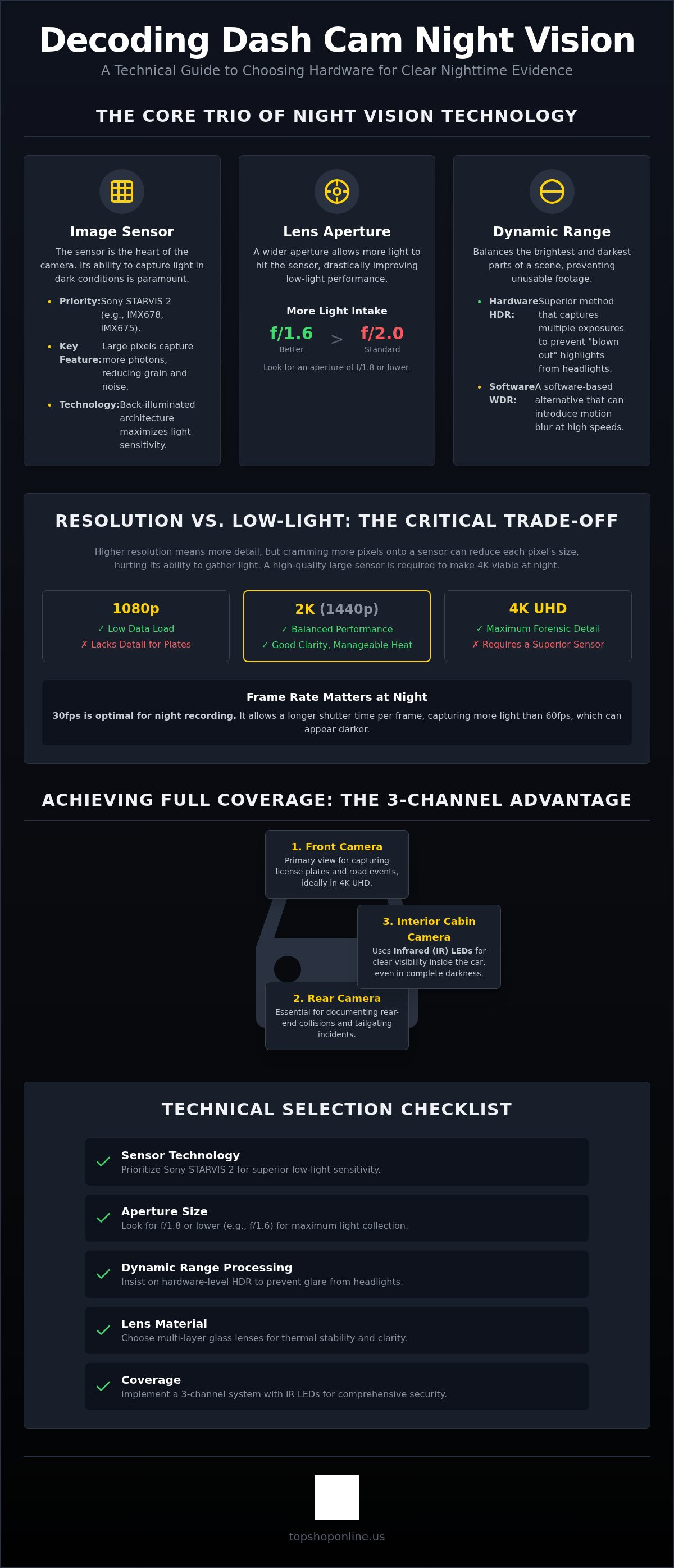
Technical Selection Framework for Night-Optimized Hardware
The hardware selection process for high-speed highway environments follows five technical priorities. Identifying the best dash cam for night vision requires verifying the physical sensor model first. Prioritize the Sony STARVIS 2 IMX678 for 4K front channels or the IMX675 for 2K configurations. These sensors feature larger physical dimensions that maximize photon collection. Second, verify the lens aperture. An aperture of f/1.8 or lower is mandatory; f/1.6 is preferred for unlit rural roads. Third, the System on a Chip (SoC) must possess the computational power to render real-time HDR. Without a high-performance processor, 4K nighttime footage will suffer from frame drops and digital artifacts. The Guardian 3-Channel 4K Dash Cam meets these criteria by balancing sensor size with high-speed processing.
Data integrity depends on storage compatibility. 4K multi-channel systems require U3 or V30 rated microSD cards with high endurance specifications. Standard cards will fail under the sustained write speeds of nighttime 4K streams. Finally, power management is critical for stationary security. Reliable hardware includes adjustable voltage cutoff settings to prevent vehicle battery depletion during extended parking. This framework ensures the device remains operational during the most vulnerable hours of vehicle ownership.
Parking Mode and Low-Power Night Surveillance
Nighttime vehicle security relies on either G-sensor triggers or time-lapse recording. G-sensor modes remain in a low-power state until an impact is detected; time-lapse provides a continuous but compressed record of the surroundings. Hardwiring the camera to the vehicle's fuse box is necessary for 24/7 operation. This setup bypasses the cigarette lighter and utilizes the car's main battery. Integrated voltage protection ensures the camera shuts down before the battery reaches a critical discharge level. This prevents the common issue of a dead battery after overnight monitoring.
Firmware and Post-Processing Quality
Hardware performance is optimized through firmware. Over-the-air (OTA) updates allow manufacturers to refine image processing algorithms and improve HDR balance as new lighting challenges are identified. Mobile app integration facilitates immediate footage review and settings adjustment without removing the microSD card. For a complete installation overview, refer to the 3-Channel 4K Dash Cam Full Vehicle Monitoring Guide. You can acquire professional-grade surveillance hardware at TopShop dash cam collections to secure your vehicle tonight.
Guardian 3-Channel 4K Dash Cam: Hardware Specifications
The Guardian 3-Channel 4K Dash Cam serves as a comprehensive hardware solution for high-contrast nighttime environments. It features a 4K UHD front-facing camera powered by a high-sensitivity sensor designed to resolve granular details like license plate characters in low-light conditions. This primary channel utilizes a large aperture lens configuration to maximize photon intake, ensuring the sensor receives sufficient light on unlit roads. The 3-channel architecture includes a dedicated rear camera and an integrated interior camera, providing 360-degree surveillance coverage. This hardware combination makes it a primary candidate for the best dash cam for night vision by addressing front, rear, and cabin security simultaneously.
The interior camera module is equipped with 4 infrared (IR) LEDs. These LEDs provide zero-light visibility, capturing clear footage of the vehicle cabin without needing ambient light or distracting the driver with visible illumination. This utilitarian design prioritizes evidence reliability over aesthetic fluff. The rear camera module completes the security perimeter, recording trailing vehicle behavior and managing headlight glare through hardware-level processing.
Core Hardware Components
The system is anchored by a high-speed processor capable of managing simultaneous 3-channel data streams without frame degradation. This SoC ensures that 4K front, 1080p interior, and 1080p rear footage are recorded with perfect synchronization. The wide-angle lens array covers the immediate proximity of the vehicle, reducing blind spots during nighttime maneuvers. A built-in G-sensor provides automated incident locking. This sensor detects sudden physical impacts or abrupt deceleration, immediately flagging the current recording as protected evidence to prevent it from being overwritten during loop recording cycles.
Operational Reliability
Continuous 4K recording generates significant internal heat. The Guardian 3-Channel 4K Dash Cam incorporates advanced thermal management hardware to dissipate this heat, preventing sensor noise and system shutdowns during long-duration nighttime operation. The device features a user-friendly interface that allows for immediate on-device playback, enabling drivers to review footage at the scene of an incident. This direct access is critical for rapid evidence verification. For complete technical details, View the Guardian 3-Channel 4K Dash Cam Specifications at the official store. This hardware is built for durability and consistent data capture in the most challenging lighting scenarios.
Secure Your Vehicle with Night-Optimized Hardware
Nighttime vehicle security requires a transition from generic resolution claims to specific hardware metrics. Successful low-light evidence capture depends on large-format image sensors, wide-aperture optics, and efficient thermal management. High-performance 3-channel systems provide the necessary 360-degree surveillance for comprehensive liability protection. Integrated infrared (IR) LED arrays are essential for recording interior cabin activity in zero-light environments. Identifying the best dash cam for night vision involves verifying these technical specifications before deployment. High-speed processors and V30-rated storage compatibility ensure that 4K data streams remain stable without corruption. Don't settle for grainy footage when current sensor technology allows for forensic-grade capture.
The Guardian 3-Channel 4K Dash Cam provides a direct solution through its 4K resolution front sensor, integrated infrared LEDs for interior night vision, and simultaneous front, rear, and cabin monitoring. This hardware configuration ensures consistent data capture across all light levels. You can secure your vehicle by selecting equipment built for measurable performance and long-term durability. Purchase the Guardian 3-Channel 4K Dash Cam for maximum night visibility to maintain reliable evidence 24/7. It's achievable to maintain total vehicle security with the correct technical selection and high-end imaging sensors.
Frequently Asked Questions
What is the most important spec for dash cam night vision?
Image sensor model and physical pixel size are the most critical specifications. Sony STARVIS 2 sensors like the IMX678 are industry standards in 2026 for low-light sensitivity. Larger sensors capture more photons, which reduces digital noise and graininess in dark environments. A wide aperture, such as f/1.6, is also critical for light throughput. Hardware like the Guardian 3-Channel 4K Dash Cam prioritizes these high-sensitivity components to ensure reliable evidence capture.
Does 4K resolution improve night vision quality?
4K resolution provides higher pixel density but requires a high-quality sensor to avoid poor nighttime performance. While 8.3 million pixels offer superior detail during the day, nighttime clarity depends on the sensor's ability to handle low-light signal-to-noise ratios. A 4K camera with a small sensor may perform worse than a 2K camera with a larger sensor. The best dash cam for night vision balances high resolution with advanced hardware-level HDR processing.
How do infrared (IR) cameras work inside a car?
Infrared cameras utilize dedicated IR LED arrays to illuminate the vehicle cabin with light that is invisible to the human eye. Most automotive systems use 940nm or 850nm wavelengths. When ambient light sensors detect low lux levels, the LEDs activate automatically. This allows the sensor to record clear, monochrome footage of passengers and interior activity in total darkness. The Guardian 3-Channel 4K Dash Cam includes four integrated IR LEDs for this purpose.
Can a dash cam see through tinted windows at night?
Dash cams can record through tinted windows, but image quality decreases as tint darkness increases. A 5% "limo" tint significantly restricts the number of photons reaching the sensor, which can lead to dark or unusable footage. High-sensitivity sensors with adjustable gain can compensate for some light loss, but visibility remains limited compared to clear glass. Exterior-mounted rear cameras avoid this issue by bypassing the tinted glass entirely for better nighttime perimeter monitoring.
What is the difference between WDR and HDR in dash cams?
Wide Dynamic Range (WDR) is often a software-based method of balancing exposure, whereas High Dynamic Range (HDR) is a hardware-level process. HDR captures multiple exposures for every frame and merges them to preserve detail in both bright highlights and deep shadows. This hardware approach prevents license plates from appearing as white blurs when hit by headlights. 2026 models prioritize HDR to maintain clarity in high-contrast nighttime driving scenarios.
Does parking mode record all night in total darkness?
Parking mode can record all night if the camera is hardwired to the vehicle's battery or an external power pack. Most systems use G-sensors to trigger recording upon impact or time-lapse modes to save storage space. In total darkness, cameras without IR LEDs require some ambient light, such as streetlamps, to produce usable images. Systems with interior IR illumination can monitor the cabin in zero-light conditions continuously throughout the night.
How many channels do I need for full nighttime protection?
Three channels are necessary for comprehensive nighttime protection, covering the front, rear, and interior cabin. A 3-channel configuration ensures that rear-end collisions, side-swipe attempts, and interior passenger interactions are documented simultaneously. This setup eliminates blind spots that single-lens cameras miss. The best dash cam for night vision provides this multi-angle coverage, ensuring that timestamped evidence is available for all areas of the vehicle proximity in low-light environments.
What microSD card is required for 4K night recording?
4K nighttime recording requires high-endurance microSD cards with a U3 or V30 speed rating. These cards support the sustained write speeds of approximately 30 Mbps to 45 Mbps necessary for high-bitrate 4K video. Standard cards often fail or corrupt data under the thermal and data load of multi-channel 4K streams. It's recommended to use cards specifically labeled for dash cam use to ensure the longevity and reliability of recorded nighttime evidence.