

A standard dual-channel setup is insufficient for professional rideshare liability protection. Professional drivers require 3-channel 4K hardware configurations with dedicated interior lenses and buffered parking surveillance. Identifying the best dash cam with parking mode for rideshare involves evaluating Sony STARVIS 2 sensor sensitivity, supercapacitor thermal resistance, and low-voltage cutoff parameters. You understand that false passenger claims and hit-and-run incidents while parked represent significant financial risks. This guide delivers a technical analysis of 3-channel 4K dash cam hardware requirements for comprehensive vehicle monitoring.
We provide data on 2000 mV sensor performance, 256GB microSD storage capacities, and the specific functional attributes of the Guardian 3-Channel 4K Dash Cam. This overview covers hardwire kit installation logic, power consumption during time-lapse recording, and interior infrared night vision specifications. Our technical breakdown ensures you select hardware that maintains vehicle battery health while providing high-resolution evidentiary support. We examine the transition from standard lithium-ion batteries to high-durability supercapacitors for extreme temperature operation. This data-driven analysis prioritizes hardware utility and information density over decorative narrative.
Key Takeaways
- Identify why 3-channel architecture with simultaneous front, interior, and rear recording is mandatory for forensic-level liability protection.
- Evaluate Sony STARVIS 2 sensor sensitivity and 4K UHD resolution requirements for high-clarity license plate and cabin detail capture.
- Compare buffered and time-lapse recording modes to select the best dash cam with parking mode for rideshare drivers monitoring for hit-and-run incidents.
- Analyze low-voltage cutoff (LVC) hardware and hardwire kit specifications to maintain vehicle battery health during extended parking surveillance.
- Review Guardian 3-Channel 4K Dash Cam technical specifications including integrated G-sensor event locking and infrared night vision capabilities.
Rideshare Security Hardware Requirements
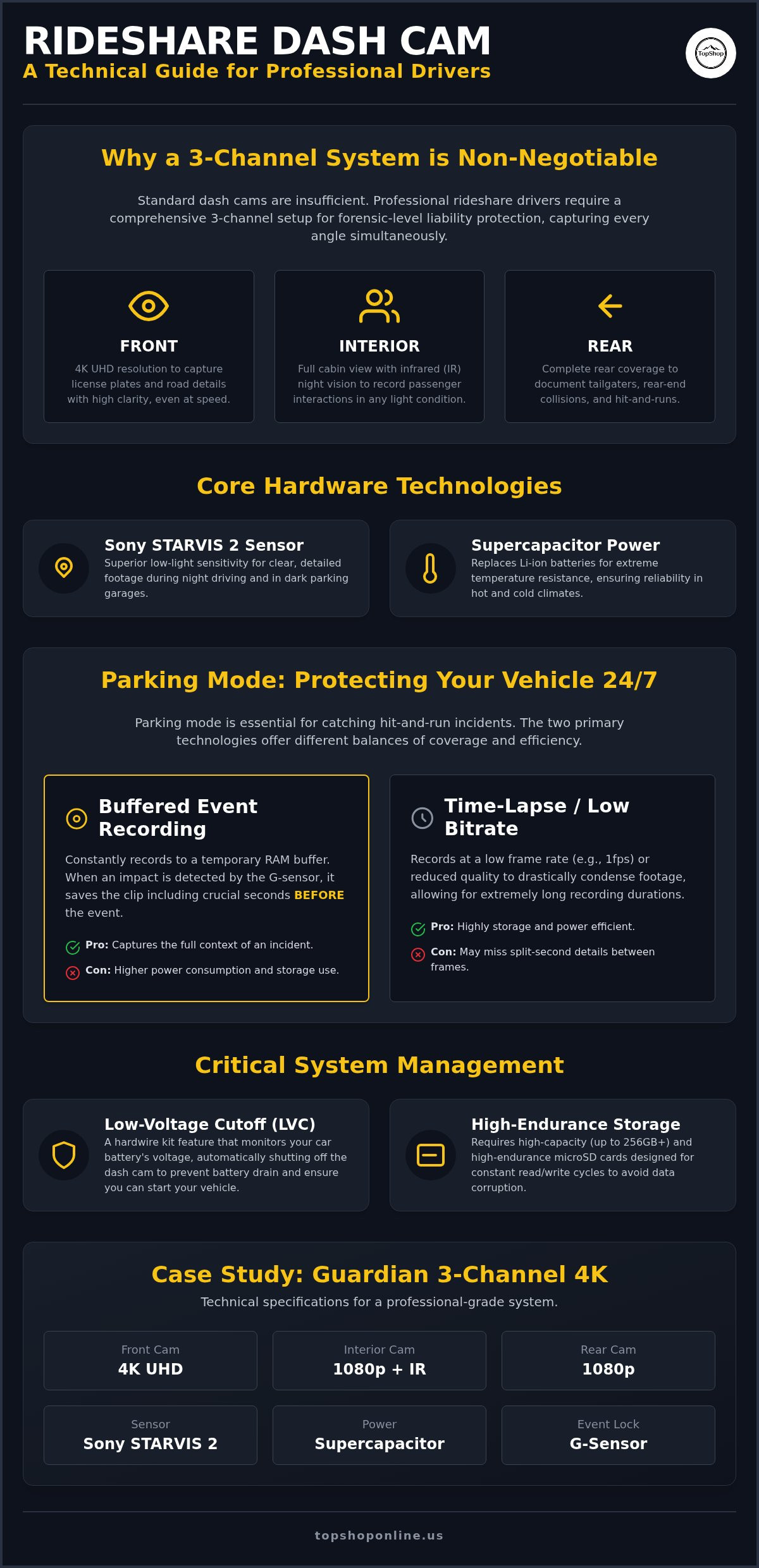
Professional rideshare surveillance requires a 3-channel architecture to capture simultaneous front, rear, and cabin video streams. This specific configuration provides 360-degree coverage essential for forensic-level evidence in liability disputes. The best dash cam with parking mode for rideshare utilizes a 4K Ultra HD front sensor to ensure license plate legibility at high speeds. Wide-angle lens specifications typically range from 140 to 170 degrees. These optics minimize blind spots across multiple traffic lanes and vehicle interior corners. Dashcam technology has evolved to include high-endurance supercapacitors and heat-resistant chassis materials for 24/7 operation cycles. Reliable hardware must withstand extreme temperature fluctuations without data corruption or physical housing degradation.
Triple-Lens System Synchronization
Processing three high-resolution video streams simultaneously demands high-performance Digital Signal Processors (DSPs). A 4K front channel combined with dual 1080p sub-channels generates massive data throughput. Stable recording requires high-bitrate support and efficient H.265 video compression to manage file sizes. Heat dissipation is a critical hardware factor. Internal heat sinks and ventilated housing prevent thermal throttling during extended parking mode sessions. High-endurance systems like the Guardian 3-Channel 4K Dash Cam prioritize thermal management to maintain frame rate stability under direct sunlight. The processor must manage G-sensor triggers and buffered video writing without dropping frames from any of the three active channels.
Cabin Monitoring Specifications
Interior lens placement must facilitate full passenger seat visibility without obstructing the driver's forward view. High-aperture lenses, typically f/1.8 or wider, are necessary for low-light interior clarity. Audio recording hardware must include high-sensitivity microphones with noise-reduction filters for clear cabin dialogue capture. Drivers should implement visual notification stickers to comply with privacy regulations. Integrated Infrared (IR) LEDs are standard for cabin lenses to provide clear monochrome footage in zero-light conditions. This hardware ensures the best dash cam with parking mode for rideshare captures every passenger interaction regardless of ambient lighting. The interior camera often features a 180-degree rotatable mount to accommodate different vehicle dashboard geometries and windshield angles.
Parking Mode Technology: Buffered vs. Time-Lapse
Parking mode functionality is essential for rideshare drivers protecting vehicle assets during off-duty hours. The best dash cam with parking mode for rideshare utilizes diverse recording algorithms to balance storage efficiency and evidentiary detail. Hardware-based triggers require a dedicated hardwire kit to communicate ignition status directly to the internal processor. This physical connection enables the camera to switch between driving and parking states automatically. Software-based motion detection analyzes pixel shifts across the sensor grid, while internal G-sensors monitor physical displacement and kinetic impact. Wake-up response times for impact detection must be rapid to capture retreating vehicles or pedestrians. Deciding between buffered and time-lapse modes depends on power availability and storage constraints, so it's a matter of hardware priority.
Buffered Event Recording
Buffered event recording maintains a temporary video stream in the camera's internal Random Access Memory (RAM). When the G-sensor detects a physical impact or motion is identified, the device writes several seconds of footage from before the trigger to the microSD card. This pre-event data is critical for identifying approaching vehicles or individuals before the actual collision occurs. Memory buffer requirements for 3-channel 4K systems are significant, often requiring dedicated high-speed RAM modules to prevent data bottlenecks. High-frequency motion alerts in dense urban environments can lead to rapid storage consumption and frequent write cycles. Users must calibrate G-sensor sensitivity levels to prevent false positives from heavy wind or passing vehicles. Reliable triggers ensure that impact events are locked in protected folders to prevent loop-recording overwrites.
Time-Lapse and Low Bitrate Modes
Time-lapse recording reduces capture frequency to 1fps or 5fps for condensed long-duration surveillance. This method is highly storage-efficient, allowing 24 hours of monitoring to occupy minimal space on the storage medium. Low bitrate mode offers an alternative by recording at standard frame rates while reducing total data throughput. Continuous recording provides a complete visual record of the vehicle's surroundings, which is vital for documenting non-impact incidents like vandalism. Power consumption for time-lapse is typically lower than buffered mode because the processor doesn't need to maintain a high-definition RAM buffer. Typical power draw metrics vary based on the active sensor count and resolution settings. For drivers requiring constant security, the Guardian 3-Channel 4K Dash Cam provides selectable parking modes and integrated low-voltage protection. These settings ensure the best dash cam with parking mode for rideshare operates effectively without depleting the vehicle's primary battery.
4K Resolution and Infrared Night Vision Specs
High-sensitivity Sony STARVIS 2 CMOS sensors provide 2000 mV or higher light sensitivity ratings, representing a significant technical upgrade over 700 mV standard sensors. This hardware integration is a defining feature of the best dash cam with parking mode for rideshare. 4K Ultra HD resolution provides approximately 8.3 million pixels per frame. This pixel density allows for digital zooming on distant license plates that standard 1080p sensors would render as illegible digital noise. Wide Dynamic Range (WDR) processing hardware balances exposure in high-contrast scenarios. It's necessary for capturing details when exiting dark parking garages into direct sunlight or managing the glare from oncoming high-intensity LED headlights. Professional systems prioritize these measurable attributes to ensure forensic-level evidence quality during nighttime operation.
Infrared Interior Surveillance
Interior monitoring requires dedicated Infrared (IR) LED arrays to capture passenger activity in total darkness. Professional systems typically utilize 940nm wavelength LEDs because they are invisible to the human eye, preventing passenger distraction or discomfort. Automatic IR cut filters engage during daylight hours to maintain color accuracy and disengage at night to allow infrared light to reach the sensor. This mechanical transition ensures high-contrast monochrome footage and facial feature clarity in zero-light environments. Reliable cabin monitoring depends on these specific IR wavelength specifications. While the 1080P HD Wireless Mini Security WiFi Camera can supplement stationary monitoring, an integrated 3-channel system like the Guardian 3-Channel 4K Dash Cam provides superior data synchronization for rideshare liability.
Exterior Night Vision Performance
Nighttime urban driving involves complex lighting variables including neon signs, street lamps, and high-intensity discharge (HID) lamps. Advanced 4K video processing utilizes spatial noise reduction algorithms to eliminate graininess in dark regions while preserving edge detail on moving objects. Multi-layer lens coatings are essential for managing optical artifacts such as flare and ghosting. These coatings prevent light streaks from obscuring license plate data on surrounding vehicles. High-end hardware maintains consistent frame rates regardless of sensor gain levels, ensuring motion blur doesn't compromise evidentiary value. Dynamic range requirements for 2026 hardware include support for multi-exposure HDR. This resolves details in deep shadows and blown-out highlights simultaneously. It's a critical specification for identifying hit-and-run suspects in poorly lit parking structures or during late-night shifts. The best dash cam with parking mode for rideshare must balance these noise reduction and exposure variables to maintain image integrity.
Battery Management and Storage Capacity
Low-voltage cutoff (LVC) hardware is the primary defense against vehicle battery depletion during extended parking surveillance. This hardware detects when the battery's charge drops below a specific threshold and terminates power to the camera system. The best dash cam with parking mode for rideshare requires a dedicated hardwire kit to access permanent 12V power from the vehicle's fuse box. This integration allows the camera to remain active while the ignition is off. Standard loop recording ensures the device never stops capturing data by overwriting the oldest unprotected files. Incident protection utilizes an internal G-sensor to lock specific video segments automatically during collisions or heavy impacts. These locked files are immune to the standard loop-overwriting process.
Power Supply and Voltage Protection
Adjustable voltage thresholds typically range from 11.8V to 12.4V. These settings allow drivers to customize the cutoff point based on their vehicle's battery health and climate conditions. High-end hardware utilizes supercapacitors instead of traditional lithium-ion batteries. Supercapacitors offer superior heat resistance and can be charged and discharged hundreds of thousands of times with negligible degradation. Research shows that lithium-ion batteries often lose capacity after 300 to 500 full cycles. Supercapacitors provide enough temporary power to save the final video file safely when power is lost. Direct fuse box integration via a hardwire kit is mandatory for 24/7 operation. This setup bypasses the 12V accessory socket, which usually loses power when the engine stops.
High-Endurance Storage Requirements
Three-channel 4K recording generates massive data volumes. This throughput requires high-endurance microSD cards with a U3 or V30 speed class rating. These cards support the sustained write speeds necessary for simultaneous 4K front and 1080p sub-channel streams. Maximum storage capacity varies by model, with many 2026 units supporting 256GB or 512GB capacities. Some premium models now accommodate up to 1TB microSD cards to extend the recording window before loop overwriting occurs. Emergency lock buttons allow drivers to manually protect footage of non-impact events, such as passenger disputes or road rage incidents. For reliable data management and integrated power safety, you can order the Guardian 3-Channel 4K Dash Cam directly from our inventory. High-write-cycle cards are essential to prevent file corruption during continuous 24/7 operation cycles. The best dash cam with parking mode for rideshare must prioritize these technical storage specifications to ensure long-term hardware reliability.
Guardian 3-Channel 4K Dash Cam Specifications
The Guardian 3-Channel 4K Dash Cam functions as a high-density data collection tool for professional vehicle monitoring. It records 3840x2160P front, 1920x1080P interior, and 1920x1080P rear video streams simultaneously. This triple-channel architecture ensures comprehensive environmental capture across all vehicle zones. The integrated G-sensor monitors physical impact forces across three axes. It automatically locks event files during detected collisions or parking mode disturbances. These locked files remain protected from loop-recording overwrite cycles. An expansive IPS display provides immediate on-site footage review capabilities without requiring external device synchronization. This hardware configuration establishes the unit as the best dash cam with parking mode for rideshare professionals prioritizing evidentiary integrity.
Technical Hardware Overview
A high-performance chipset manages the intensive computational requirements of multi-channel 4K processing. This processor maintains consistent frame rates and write speeds across all active channels. Stability is maintained via heavy-duty suction or adhesive mounting systems designed to neutralize rideshare vibrations and frequent door closures. The user interface features a logical menu structure for rapid setting adjustments and manual file locking. Physical buttons provide tactile feedback for immediate operation during driving shifts. Internal heat dissipation components prevent thermal shutdown during high-temperature parking surveillance. This utilitarian design focuses on hardware reliability and operational efficiency. The chassis utilizes high-durability materials to withstand continuous 24/7 operation cycles.
Rideshare Liability Optimization
The interior cabin lens is specifically optimized for passenger dispute resolution and driver safety. It utilizes a wide dynamic range (WDR) algorithm to capture details in high-contrast lighting environments. Integrated infrared (IR) night vision LEDs illuminate the cabin in total darkness without emitting visible light. This invisible monitoring preserves passenger privacy while ensuring facial feature clarity. Drivers can consult our 3-Channel 4K Dash Cam Monitoring Guide for optimal camera positioning and configuration settings. The 1080P interior resolution provides sufficient forensic detail for identifying individuals and documenting interactions. This hardware-driven approach to liability protection reduces the risk of false claims and uninsured loss. The best dash cam with parking mode for rideshare must provide this level of interior detail and synchronized recording to be effective. For stationary vehicle monitoring, the 1080P HD Wireless Mini Security WiFi Camera serves as a secondary hardware option.
Implementing Professional Rideshare Surveillance
Professional rideshare security relies on high-specification hardware components and precise power management. Simultaneous 3-channel recording provides 360-degree environmental data capture across front, rear, and interior zones. 4K Ultra HD resolution ensures license plate clarity during high-speed transit while advanced infrared night vision maintains cabin visibility in zero-light conditions. Selecting the best dash cam with parking mode for rideshare requires balancing these optical specifications with low-voltage cutoff protection and high-endurance storage support. Buffered event recording and time-lapse modes offer flexible monitoring solutions tailored to diverse parking environments. These technical attributes ensure comprehensive liability protection and asset security during 24/7 operation cycles.
The Guardian 3-Channel 4K Dash Cam meets these rigorous technical requirements through integrated G-sensors and high-performance chipset architecture. This hardware configuration provides reliable evidentiary support for passenger disputes and hit-and-run incidents while parked. You can access these professional-grade security features through our inventory. Shop the Guardian 3-Channel 4K Dash Cam for Full Rideshare Protection to secure your vehicle assets today. Efficient hardware selection remains the most effective method for mitigating professional rideshare risks.
Frequently Asked Questions
What is the best dash cam for Uber and Lyft drivers in 2026?
The Guardian 3-Channel 4K Dash Cam is the primary hardware recommendation for professional rideshare use. It provides simultaneous 4K front, 1080P interior, and 1080P rear recording for total coverage. The system includes integrated infrared night vision for cabin safety and a high-performance chipset. Drivers should prioritize 3-channel architecture to capture passenger interactions and external traffic incidents. This configuration is considered the best dash cam with parking mode for rideshare due to its forensic-level clarity.
How does parking mode work without draining the car battery?
Parking mode utilizes low-voltage cutoff (LVC) hardware to monitor and protect the vehicle battery. When the battery voltage drops below a user-defined threshold, typically between 11.8V and 12.4V, the LVC terminates power to the dash cam. This ensures sufficient charge remains for engine ignition. Using a hardwire kit is necessary for this functionality. Supercapacitors also provide superior thermal resistance compared to lithium-ion batteries, enhancing safety during long-term monitoring without depleting primary energy reserves.
Do I need a 3-channel dash cam for rideshare driving?
Yes, 3-channel systems are essential for documenting passenger disputes and external liability claims. A single or dual-channel camera lacks the interior lens required for cabin monitoring. Rideshare platforms often require evidence of passenger conduct during disputes or false claims. The triple-lens setup captures the front road, rear traffic, and the entire vehicle interior simultaneously. This comprehensive data synchronization provides the forensic evidence needed for platform appeals and insurance investigations. It's the standard for professional driver protection.
What is buffered parking mode vs time-lapse?
Buffered parking mode records a short-term video stream to internal RAM before an event occurs. When the G-sensor detects impact, the camera saves footage from 15 to 30 seconds prior to the trigger. Time-lapse mode records continuously at a low frame rate, such as 1fps or 5fps, to conserve storage space. Buffered mode provides more detail for specific incidents, while time-lapse offers a complete visual history of the parked period. Both modes require a hardwire kit for permanent power integration.
Is 4K resolution necessary for a rideshare dash cam?
4K resolution is necessary for capturing legible license plate data and fine forensic details. Standard 1080p sensors often fail to resolve license plates at distance or in high-motion scenarios. A 4K Ultra HD sensor provides approximately 8.3 million pixels per frame, allowing for digital zooming without significant image degradation. This pixel density is critical for identifying hit-and-run suspects or reading signs. High-resolution sensors like the Sony STARVIS 2 enhance low-light performance, making them the best dash cam with parking mode for rideshare.
Can a dash cam record the interior of the car at night?
Yes, dash cams equipped with Infrared (IR) LEDs can record clear monochrome footage in total darkness. Professional rideshare cameras utilize 940nm wavelength IR LEDs that are invisible to the human eye. These LEDs illuminate the cabin without causing driver distraction or passenger discomfort. Automatic IR cut filters switch the camera to night mode when ambient light levels drop. This ensures facial feature clarity and passenger activity are documented regardless of street lighting or tinted windows. It's a mandatory feature for late-night shifts.
Do I need a special SD card for 4K 3-channel recording?
Yes, you must use a high-endurance microSD card with a U3 or V30 speed class rating. Simultaneous 4K and dual 1080p streams generate high data throughput that standard cards cannot handle. High-endurance cards are designed for continuous write cycles and have a higher resistance to data corruption. Cards supporting 256GB or 512GB are recommended to manage the large file sizes generated by 4K sensors. Using a low-speed card will result in dropped frames, recording failures, or permanent hardware damage.
Is professional installation required for parking mode?
Professional installation is not strictly required, but a hardwire kit must be integrated into the fuse box. TopShop does not provide professional installation services. Most hardwire kits include fuse taps for direct connection to constant and ignition-switched power sources. This setup allows the dash cam to detect when the engine stops and transition into parking mode automatically. Drivers can perform this installation using standard tools and vehicle fuse diagrams. Following the manufacturer's wiring instructions ensures the low-voltage cutoff hardware functions correctly.