

Standard 1080P resolution is frequently insufficient for court-admissible license plate identification during high-speed impacts or low-light parking events. You recognize that a dash cam with parking mode is a baseline requirement for vehicle security, yet the risk of insurance fraud remains if the footage lacks necessary detail. This guide identifies the mandatory technical hardware, sensor types, and multi-channel configurations required to capture high-definition evidentiary footage. We detail the specific performance metrics of the Guardian 3-Channel 4K Dash Cam, focusing on 360-degree coverage and G-sensor calibration for reliable file locking during impact events.
Effective accident recording requires a 3-channel 4K hardware configuration with calibrated sensors and hardwired power to capture the totality of an incident. You'll learn how to distinguish between nominal resolution and actual optical clarity to ensure your vehicle remains protected. This technical overview prioritizes measurable attributes like H.265 compression efficiency, physical sensor dimensions, and high-bitrate recording over generic marketing claims. We provide the data points needed to secure reliable, high-density video evidence for every parking incident.
Key Takeaways
- Identify why calibrated G-sensor sensitivity and protected file partitions are required for automated accident detection and admissible evidence.
- Differentiate between native 4K UHD and software-interpolated resolution when selecting a dash cam with parking mode to ensure license plate clarity.
- Evaluate the data coverage of 3-channel systems that monitor the front, rear, and interior cabin to mitigate side-impact liability.
- Compare hardwire kit installation with standard power sources to maintain continuous operation and reliable data writing on high-endurance SDXC cards.
- Review the technical specifications of the Guardian 3-Channel 4K Dash Cam for comprehensive vehicle monitoring and high-definition detail capture.
Essential Features for Reliable Accident Recording and Evidence
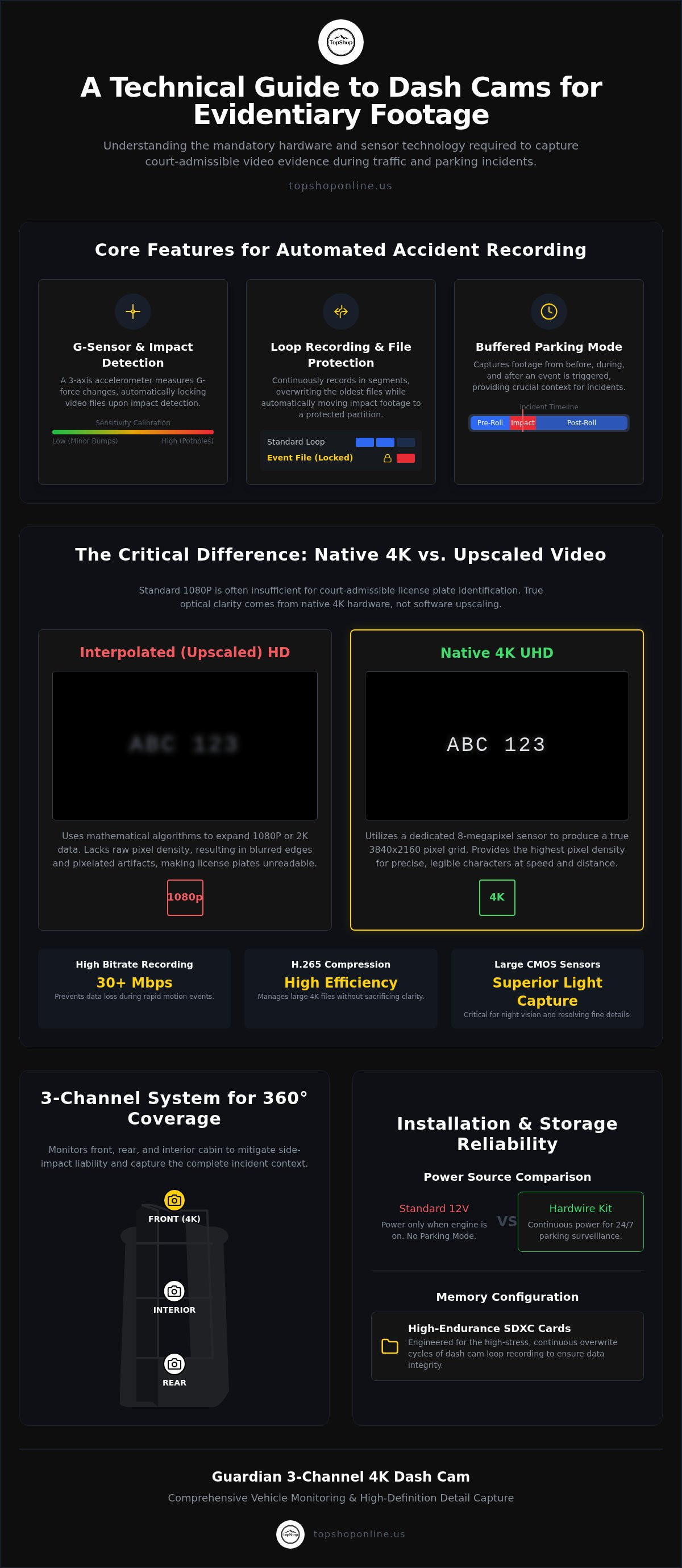
Reliable accident documentation requires a specific combination of physical sensor hardware and firmware-level file management. A high-quality dash cam with parking mode functions as an automated digital witness by utilizing internal accelerometers to detect and preserve critical data. Without these integrated systems, standard video files are subject to deletion during the continuous overwrite process, rendering the device useless for insurance claims or legal proceedings.
G-Sensor Calibration and Impact Detection
The G-sensor is a 3-axis accelerometer that measures gravitational force changes across lateral, longitudinal, and vertical planes. When the sensor detects a force spike exceeding a pre-set threshold, the device automatically flags the current recording as an "Event" file. This hardware-driven trigger is the primary mechanism for capturing hit-and-run incidents while the vehicle is unattended. Sensitivity settings are critical for performance; high sensitivity may cause false positives from potholes, while low sensitivity might fail to record minor side-impacts. Proper calibration ensures that the device provides a reliable record of the exact moment of contact.
- 3-Axis Integration: Enables detection of impacts from any direction, including rear-end collisions and side-swipes.
- Automated Emergency Locking: Moves active video segments to a protected folder partition immediately upon impact detection.
- Sensitivity Adjustment: Allows users to fine-tune trigger thresholds based on vehicle suspension and local road conditions.
Loop Recording and Overwrite Protection
Loop recording manages limited storage by dividing video data into 1, 3, or 5-minute segments. When the SDXC memory card reaches its maximum capacity, the dash cam firmware overwrites the oldest unprotected files to ensure uninterrupted operation. Loop recording serves as a fail-safe for continuous evidence gathering by maintaining a constant stream of recent data. To prevent the loss of accident footage, the system relies on protected file partitions. These partitions isolate G-sensor-triggered events from the standard loop, ensuring that the most vital evidence remains on the card until it's manually reviewed or exported.
Buffered Parking Mode and Optical Breadth
Buffered parking mode offers superior evidence compared to simple motion detection. It maintains a continuous temporary stream in the device's RAM; when a trigger occurs, the dash cam saves the 10-15 seconds prior to the event along with the subsequent 20-30 seconds. This pre-roll footage is essential for identifying the approach of a suspicious vehicle or the lead-up to a collision. Wide-angle lenses with a Field of View (FOV) between 140 and 170 degrees complement this by providing peripheral visibility. This optical breadth captures vehicles entering from side lanes or pedestrians approaching from the curb, which is often lost on narrow-angle cameras. High-density evidence relies on this combination of temporal context and spatial coverage to provide a complete narrative of any incident.
4K Resolution and Night Vision Hardware Specifications
Native 4K Ultra High Definition (UHD) hardware utilizes a dedicated 8-megapixel image sensor to produce a 3840 x 2160 pixel grid. This hardware configuration is distinct from software-interpolated resolution, which uses mathematical upscaling to expand 1080P or 2K data. Interpolated video lacks the raw pixel density required to render legible license plate characters at high speeds, often resulting in blurred edges and pixelated artifacts. A high-performance dash cam with parking mode requires high bitrate recording, typically 30 Mbps or higher, to prevent data loss during rapid motion events. Efficient H.265 video compression is necessary to manage these large data streams without sacrificing optical clarity or quickly exhausting storage capacity.
CMOS Sensors and License Plate Recognition
Physical CMOS sensor dimensions determine the device's ability to resolve fine details in challenging environments. Larger sensors facilitate better light collection, which is critical for identifying alphanumeric characters on reflective plates at distances exceeding 20 feet. While 60fps (frames per second) recording provides smoother motion, it frequently requires a trade-off in total resolution. For evidentiary purposes, a 30fps native 4K output provides the highest pixel-per-inch density, allowing for precise frame-by-frame analysis during collision reconstruction. The Guardian 3-Channel 4K Dash Cam integrates these high-specification sensors to maintain optical precision across front, rear, and interior channels simultaneously.
Night Vision and Low-Light Performance
Low-light evidence quality is governed by lens aperture and sensor dynamic range capabilities. An aperture of f/1.8 or lower increases the volume of light reaching the sensor, which minimizes the digital noise and graininess common in nighttime recordings. Wide Dynamic Range (WDR) and High Dynamic Range (HDR) technologies are essential for managing high-contrast lighting. HDR specifically combines multiple exposures into a single frame to prevent "whiteout" from oncoming LED headlights or streetlamps. This ensures that license plates remain visible even when hit by direct light sources. For interior cabin monitoring, the integration of Infrared (IR) LEDs is mandatory. These LEDs emit light outside the visible spectrum to provide clear grayscale footage of the vehicle interior in total darkness, documenting passenger or intruder activity during parking incidents.
Bitrate stability during these recording cycles is a primary indicator of hardware reliability. Inexpensive units often throttle bitrates to prevent overheating, which leads to "motion blur" during a hit-and-run. High-endurance hardware maintains a consistent data flow, ensuring that every frame of a 4K stream remains sharp enough for legal identification. This technical synergy between sensor size, aperture, and processing power defines the difference between a simple recording and actionable evidence.
Comparing 3-Channel Systems vs. Traditional Single Dash Cams
Traditional single-channel cameras monitor only the forward-facing path, which leaves the majority of the vehicle perimeter vulnerable to undocumented incidents. A 3-channel dash cam with parking mode addresses these blind spots by integrating front, rear, and interior cabin monitoring into a unified recording system. This hardware configuration is necessary for capturing evidence during side-impact collisions or rear-end accidents where a front-facing lens provides zero visibility. For rideshare drivers and commercial fleet operators, the addition of an interior-facing lens provides a critical layer of liability protection against passenger disputes or false claims of driver negligence.
Total Vehicle Coverage for Insurance Claims
Insurance adjusters prioritize objective data when determining fault in multi-vehicle accidents. Rear-channel footage serves as irrefutable proof in rear-end collisions, documenting the following vehicle's speed and license plate before the point of contact. Interior cameras are equally vital for disproving distracted driving allegations; they provide a clear record of the driver's hands and eye movements during an event. 3-channel systems provide a 360-degree evidentiary shield by capturing synchronized data from the front, rear, and interior of the vehicle simultaneously. This comprehensive coverage ensures that side-swipe incidents, which are often "your word against theirs" scenarios, are documented through the combined peripheral view of the front and interior lenses.
Hardware Integration and Multi-Lens Management
Simultaneous recording of three high-definition data streams imposes a significant processing load on the device's chipset. While a standard dash cam manages a single video feed, a 3-channel system must synchronize 4K front-facing data with secondary 1080P streams from the rear and cabin. This high-bitrate operation generates substantial thermal energy, requiring advanced heat dissipation hardware like internal aluminum heat sinks or ventilated chassis designs to prevent system failure. Reliable multi-lens units use high-speed coaxial or shielded USB cables to maintain signal integrity over the distance from the windshield to the rear window. Proper cable management involves routing these wires through the vehicle's pillars and headliner to ensure a secure, permanent connection to the primary processing unit. High-performance hardware like the Guardian 3-Channel 4K Dash Cam is engineered specifically to handle these concurrent processing demands without dropping frames or overheating during extended parking mode cycles.
Installation and Storage Configuration for Maximum Reliability
High-density evidence recording requires stable power delivery and robust storage media to function effectively in extreme environments. Vehicle cabins often reach temperatures exceeding 140 degrees Fahrenheit, which causes standard lithium-ion batteries to swell or fail. Capacitor-based power systems are the technical standard for a dash cam with parking mode because they offer superior heat resistance and a longer operational lifespan. GPS logging adds a critical layer of metadata by embedding real-time speed and geographical coordinates into every video file. This data provides secondary verification of vehicle location and movement during hit-and-run incidents or insurance disputes.
Selecting High-Endurance Storage Media
Native 4K multi-channel recording creates an intensive high-bitrate environment that quickly exhausts standard consumer-grade SD cards. These standard cards utilize flash memory designed for intermittent use; constant 4K write cycles lead to "write exhaustion" and permanent data corruption. High-endurance SDXC cards are mandatory for 24/7 monitoring. These cards must meet U3 (Ultra High Speed Class 3) and V30 (Video Speed Class 30) requirements to guarantee a minimum sequential write speed of 30MB/s. Maintaining file system integrity requires a strict maintenance protocol; formatting the card every 30 to 60 days prevents the accumulation of logical errors that can cause the system to stop recording at critical moments.
Power Management and Hardwiring for Parking Mode
Standard cigarette lighter adapters only provide power when the vehicle ignition is active, which is insufficient for stationary protection. A hardwire kit is required to enable continuous 24/7 parking monitoring by connecting the device directly to the vehicle's fuse box. These kits include integrated voltage cutoff protection, typically adjustable between 11.8V and 12.4V. This hardware fail-safe ensures the dash cam draws power until the car battery reaches a pre-set threshold, preventing total battery depletion. When performing bench testing or configuring multi-lens systems before a permanent installation, using a power strip with usb ports provides a stable, multi-point power source for simultaneous lens calibration.
Effective hardware configuration is the final requirement for securing court-admissible evidence. Without high-endurance storage and a hardwired power source, even the most advanced sensors cannot provide reliable protection. For a complete hardware solution designed for multi-channel 4K monitoring, view our technical specifications for vehicle security systems. This rigorous approach to installation ensures that your recording system remains operational during every parking incident and high-speed collision.
Guardian 3-Channel 4K Dash Cam: Comprehensive Vehicle Monitoring
The Guardian 3-Channel 4K Dash Cam serves as a high-density data logging platform for comprehensive vehicle security. It integrates the mandatory technical requirements for court-admissible evidence, including native 4K resolution and multi-channel synchronization. This dash cam with parking mode utilizes advanced H.265 video compression to manage high-bitrate streams without compromising optical clarity. The hardware design focuses on utilitarian efficiency, providing a stable recording environment during high-speed transit and stationary monitoring. This unit functions as the primary hub for all video data, managing concurrent streams from the front, rear, and cabin lenses without frame drops.
Guardian Hardware Specifications
The primary front-facing lens utilizes a native 4K UHD sensor with a 170-degree field of view to maximize peripheral visibility. This wide-angle configuration captures traffic signals, lane markings, and license plates with high pixel density. The secondary interior and rear lenses provide 1080P resolution at 30fps, ensuring smooth motion capture across all three channels. For cabin security, the interior camera features four Infrared (IR) LEDs that activate automatically in low-light conditions. These IR sensors allow the unit to record clear grayscale images of the vehicle interior even in zero-visibility environments. The system is compatible with high-capacity, high-endurance SDXC media, allowing for extended incident logs and reducing the frequency of storage overwrites. An integrated G-sensor provides adjustable sensitivity levels to ensure that minor impacts trigger the emergency file locking mechanism.
Utility and Reliability for US Drivers
Retrieving evidence after an incident is streamlined through a logical, data-driven menu system. Users can access protected file partitions directly from the device to review time-stamped G-sensor events. Some drivers supplement their security with a 1080p wireless mini security camera for monitoring blind spots or external cargo, but the Guardian unit serves as the primary evidentiary shield. The hardware is built for the US climate, featuring a heat-resistant chassis and capacitor-based power system to prevent failure during extreme temperature fluctuations. This focus on physical durability and technical precision ensures that the device remains operational when it's most needed. The physical installation process is simplified through the use of standardized connectors and high-speed signal cables. View technical specs for the Guardian 3-Channel 4K Dash Cam to see the full list of hardware attributes and mounting options.
Securing High-Density Evidence for Total Vehicle Protection
Achieving court-admissible evidence requires a hardware-first approach to vehicle security. You've identified that native 4K UHD resolution and high-endurance SDXC storage are the baseline requirements for capturing legible license plates and maintaining file integrity. A 3-channel configuration extends this protection across the entire vehicle perimeter, using front, rear, and cabin lenses to eliminate evidentiary blind spots. This technical synergy between sensor size and high-bitrate recording ensures that every frame remains sharp and actionable for insurance claims or legal proceedings.
Implementing a professional-grade dash cam with parking mode ensures your vehicle remains protected during unattended incidents through calibrated G-sensors and automated file locking. The Guardian 3-Channel 4K Dash Cam provides this specific combination of 4K optical clarity and 360-degree monitoring for comprehensive documentation. Shop the Guardian 3-Channel 4K Dash Cam for maximum liability protection to ensure your data remains secure and accessible during any collision event. With the correct hardware configuration, you can maintain a reliable digital record of every incident on the road or in the parking lot.
Frequently Asked Questions
Does a dash cam reduce my insurance premiums in the US?
Dash cams don't typically result in a direct discount on US insurance premiums. Most major carriers prioritize actuarial data over individual hardware installations. However, a dash cam with parking mode provides irrefutable evidence that can expedite claim processing and prevent premium hikes caused by "at-fault" misattributions. By proving you aren't responsible for a collision, you avoid the long-term financial penalties associated with a degraded driving record and maintain your existing rate structure.
Will a dash cam record if my car is turned off?
A dash cam will record while the vehicle is off only if it's equipped with a hardwire kit or an external battery pack. Standard cigarette lighter ports usually lose power when the ignition is killed. Hardwiring connects the device to a constant 12V fuse, allowing the parking mode firmware to monitor for impacts or motion. This configuration ensures 24/7 surveillance without relying on the vehicle's accessory power cycle or draining the battery below starting levels.
How much 4K footage can a 128GB SD card hold?
A 128GB SD card typically stores between 2 and 4 hours of native 4K UHD footage at a 30 Mbps bitrate. When using a multi-channel system like the Guardian 3-Channel 4K Dash Cam, the storage duration decreases because the card must simultaneously write data for front, rear, and interior streams. Utilizing H.265 compression efficiency helps maximize this capacity, but high-bitrate settings for evidentiary clarity will always prioritize detail over total recording time.
Is audio recording legal in all states during an accident?
Audio recording legality varies by state based on "one-party" or "two-party" consent statutes. In states with two-party consent laws, recording a conversation without the knowledge of all participants may be illegal. Most dash cams allow users to disable the internal microphone through the settings menu to comply with local privacy regulations. You should verify your specific state requirements regarding the expectation of privacy within a vehicle before enabling continuous audio capture for legal evidence.
What happens to the footage if the dash cam is destroyed in a crash?
Footage usually remains intact on the microSD card even if the dash cam's exterior housing is destroyed. The memory card is a solid-state component with no moving parts, making it highly resistant to physical impact and vibration. Unless the card is physically crushed or subjected to extreme thermal damage, the final "Event" file locked by the G-sensor is typically retrievable using a standard card reader on a secondary computer or mobile device.
Can I use a dash cam to prove I was not distracted during an accident?
You can prove a lack of distraction by using a 3-channel system that includes an interior-facing lens. This camera documents your hands on the steering wheel and your eyes on the road during the moments leading up to an impact. This visual evidence is critical for refuting claims of mobile phone use or other negligent behaviors. Synchronized interior and exterior footage provides a complete narrative that validates your driving performance during insurance investigations.
How often should I format my dash cam SD card?
You should format your dash cam SD card every 30 to 60 days to maintain file system stability. Constant write-and-overwrite cycles from 4K recording can lead to logical errors or data fragmentation over time. Regular formatting clears the card's file allocation table and ensures the firmware can continue writing new data without interruption. Always use the "Format" function within the dash cam's own menu to ensure the correct file structure and speed are maintained.
Does the Guardian 3-Channel 4K Dash Cam require professional installation?
The Guardian 3-Channel 4K Dash Cam doesn't require professional installation and is designed for user-led setup. The primary unit mounts via adhesive to the windshield, while secondary lenses connect via included signal cables. While a basic setup using the 12V accessory port is fast, enabling the full dash cam with parking mode functionality requires a hardwire kit. This involves basic fuse box access, which most users can complete using the provided technical documentation and standard tools.