

61% of U.S. households now operate at least one residential surveillance device, yet many installations fail due to detectable hardware profiles and inconsistent signal throughput. Successful deployment requires more than simple placement. Identifying the best places to hide a mini security camera involves a precise technical alignment between lens focal length, 2.4GHz or 5GHz WiFi stability, and power supply proximity. You likely recognize that an obvious hardware design often becomes a target for tampering or provides insufficient evidence when grainy night vision obscures critical details.
This guide provides a rigorous breakdown of 1080P HD hardware specifications, H.265 video compression standards, and multi-diode infrared LED configurations for 2026. You will gain the data necessary for stable 24/7 remote monitoring and high-definition evidence capture. We evaluate the performance metrics of the 1080P HD Wireless Mini Security WiFi Camera and the 360° Panoramic Hidden Light Bulb Wifi Camera to ensure seamless WiFi integration, reliable low-light performance, and efficient MicroSD storage management. This overview prioritizes measurable hardware attributes and functional utility to facilitate immediate technical decision-making for covert residential monitoring.
Key Takeaways
- Analyze essential hardware components including CMOS sensors, wireless modules, and integrated MicroSD storage slots for reliable local data logging.
- Evaluate 1080P HD resolution and Field of View (FOV) differences between standard wide-angle optics and 360° panoramic lenses for maximum evidence clarity.
- Identify optimal network configurations using 2.4GHz or 5GHz WiFi protocols and H.265 video compression to minimize bandwidth consumption.
- Apply tactical deployment strategies to determine the best places to hide a mini security camera while maintaining facial identification angles and avoiding lens flare.
- Compare physical dimensions and concealment potential between standalone 1080P HD Wireless Mini Security WiFi Cameras and zero-clutter 360° Panoramic Hidden Light Bulb Wifi Cameras.
Understanding Discreet Home Surveillance WiFi Camera Hardware
Discreet surveillance cameras are compact, low-profile wireless monitoring devices built for high-resolution residential data acquisition. These units function as modern iterations of Closed-circuit television (CCTV), replacing bulky analog equipment with high-density digital components. The internal architecture consists of a CMOS sensor, a wireless transmission module, and an integrated MicroSD storage slot. Modern hardware splits into two distinct categories. "Mini" cameras, like the 1080P HD Wireless Mini Security WiFi Camera, prioritize a reduced physical footprint for versatile mounting. "Hidden" cameras, such as the 360° Panoramic Hidden Light Bulb Wifi Camera, use functional disguises to blend into existing decor. Remote management occurs via a dedicated mobile application, which facilitates real-time configuration, motion sensor sensitivity adjustments, and encrypted data retrieval.
Surveillance Objectives and Hardware Alignment
Effective deployment requires matching hardware specifications to specific environmental constraints. Lens selection depends on the target area; a narrow Field of View (FOV) provides high detail for entry points, while 360-degree lenses provide total room coverage. Power requirements dictate installation longevity. Battery-operated units offer placement flexibility but require periodic charging, whereas continuous AC power ensures uninterrupted 24/7 monitoring. It's critical to match the 1080P HD resolution to the monitoring zone for facial identification, especially when evaluating the best places to hide a mini security camera to avoid obstructed views or low-light interference.
Legal and Ethical Considerations for Residential Monitoring
Federal regulations generally permit video surveillance on private property, provided there is no "reasonable expectation of privacy" in the area, such as bathrooms or guest bedrooms. State-level statutes regarding audio recording are more restrictive. Many jurisdictions across the nation require all-party consent for capturing audio data, making it crucial for users to verify local ordinances before activating recording features. Ethical monitoring involves transparency with domestic employees and adherence to data privacy standards. A 2026 report indicates that 37% of users worry about unauthorized access to their footage, so secure app configuration is mandatory. Determining the best places to hide a mini security camera must coincide with these legal boundaries to ensure captured evidence remains admissible and compliant with local privacy laws.
Technical Specifications: Resolution, Optics, and Sensor Performance
1080P HD resolution (1920 x 1080 pixels) provides the necessary pixel density for high-definition residential data capture. This resolution standard facilitates facial identification and high-contrast detail recognition at distances up to 5 meters. Internal image processing relies on high-sensitivity CMOS sensors to maintain signal-to-noise ratios in varying environments. Field of View (FOV) specifications dictate placement logic. Wide-angle lens assemblies, such as those in the 1080P HD Wireless Mini Security WiFi Camera, offer 110-degree to 150-degree coverage for directional monitoring. In contrast, the 360° Panoramic Hidden Light Bulb Wifi Camera uses specialized fisheye optics for complete room oversight. When determining the best places to hide a mini security camera, lens focal length and FOV must align with room dimensions to prevent dead zones. Ethical deployment also requires consideration of privacy and abuse of CCTV systems as outlined by civil liberties groups.
Optical Performance and Image Processing
Image processing units handle frame rates, digital zoom, and light compensation. Standard 25-30 FPS (frames per second) capture ensures fluid motion recording without excessive bandwidth consumption. Auto-white balance and automatic exposure control prevent image washout in high-contrast scenes. Digital zoom functions allow for 4x magnification, though image clarity depends on the native pixel count of the sensor. High-performance monitoring requirements are met through our 1080P camera hardware inventory, which features optimized image signal processors for rapid light adjustment.
Night Vision and Low-Light Hardware
Nighttime monitoring efficiency is measured by lux ratings and infrared (IR) LED wavelength. A 0.0 lux rating indicates full darkness capability via active IR illumination. Discreet surveillance hardware utilizes 940nm "no-glow" IR LEDs, which remain invisible to the human eye, unlike standard 850nm LEDs that emit a faint red light. This concealment is vital when selecting the best places to hide a mini security camera in bedrooms or nurseries where light pollution must be zero. Integrated IR-cut filters switch automatically between color and monochrome modes based on ambient light levels. Effective night vision range for compact hardware typically reaches 5 to 10 meters, providing adequate coverage for standard residential interiors.
Connectivity Standards and Data Management Protocols
Reliable data transmission for residential surveillance depends on specific WiFi frequency selection and bandwidth management. Most discreet hardware, including the 1080P HD Wireless Mini Security WiFi Camera, operates on the 2.4GHz frequency band. This protocol provides superior signal penetration through drywall, brick, and wooden structural elements compared to 5GHz alternatives. While 5GHz offers higher data transfer rates, its shorter wavelength results in significant signal attenuation when passing through barriers. Identifying the best places to hide a mini security camera doesn't just involve concealment; it requires assessing these signal limitations to prevent dropped connections during 24/7 monitoring. Secure data handling is maintained through P2P (Peer-to-Peer) technology, which allows direct communication between the camera and the mobile application without complex router port forwarding. To ensure network integrity, users should follow FTC guidelines on camera security by implementing WPA2 or WPA3 encryption and utilizing unique device passwords.
Video data management utilizes H.264 or H.265 compression standards to balance image quality and network load. H.265 (High Efficiency Video Coding) offers approximately 50% better compression than H.264, allowing for 1080P HD streaming with lower bandwidth consumption. It's particularly relevant when operating multiple devices on a single residential network. Encrypted wireless transmissions protect against unauthorized interception, ensuring that evidence capture remains private and accessible only to authorized users via the remote mobile interface. This technical infrastructure ensures that high-definition video remains fluid and accessible even in high-traffic wireless environments.
Wireless Stability and Signal Range
Structural materials like concrete or metal significantly degrade WiFi signal strength. If the best places to hide a mini security camera are distant from the primary router, dedicated WiFi extenders or mesh network nodes are necessary to maintain a stable bit rate. Managing network congestion involves assigning static IP addresses to surveillance hardware and ensuring the router can handle the simultaneous data streams from multiple connected smart devices without latency spikes. Stability is the priority for consistent evidence logging.
Storage Solutions: Local vs. Cloud
Local data logging requires high-speed MicroSD cards, specifically Class 10 or UHS-I specifications, to handle continuous 1080P video write speeds. Loop recording functionality ensures the device continues operating by overwriting the oldest saved footage when the card reaches capacity. While cloud storage offers off-site redundancy, it typically requires monthly subscription fees. In contrast, local storage on the 360° Panoramic Hidden Light Bulb Wifi Camera utilizes one-time hardware costs and provides immediate access to high-definition evidence without relying on external server uptime.
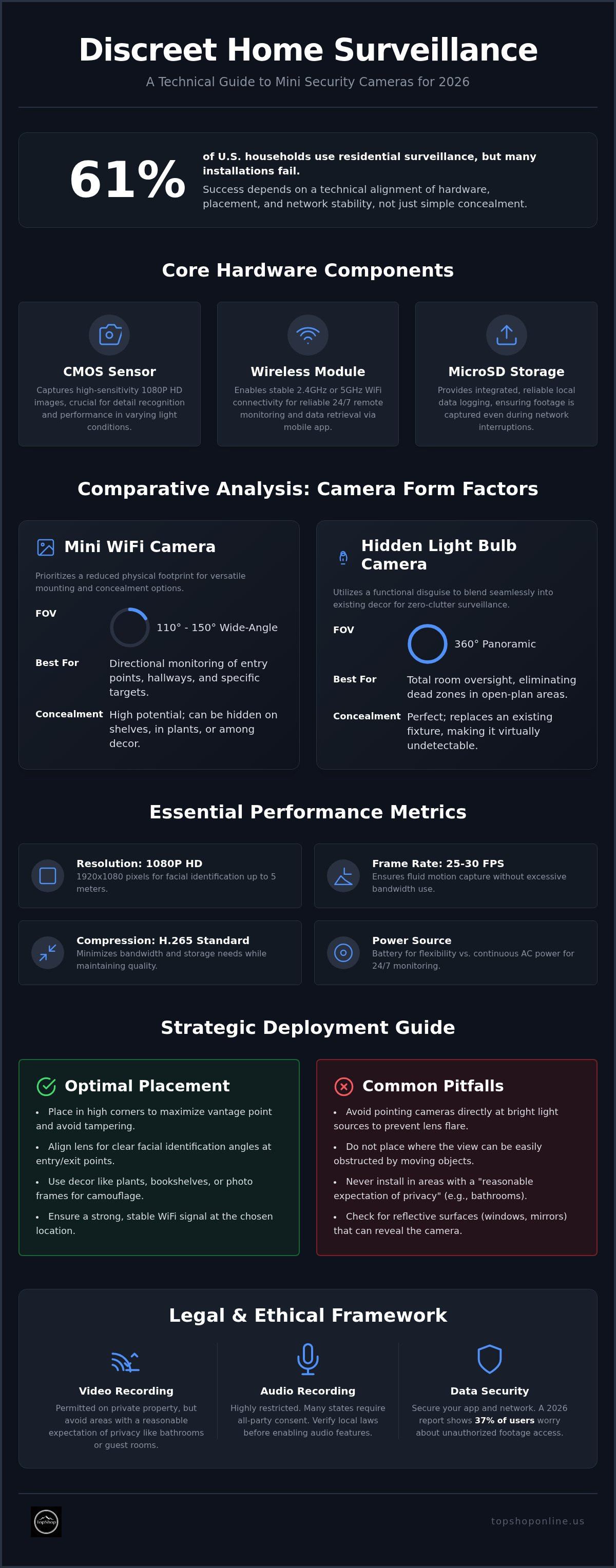
Comparative Analysis: Mini WiFi vs. Hidden Light Bulb Cameras
Discreet surveillance hardware bifurcates into two primary form factors: compact standalone units and socket-integrated devices. Mini WiFi cameras prioritize a minimal physical footprint for high-density concealment in non-standard locations. Light bulb cameras leverage existing residential electrical infrastructure for continuous operation and zero-clutter integration. Determining the best places to hide a mini security camera requires an evaluation of these physical dimensions alongside the desired coverage area and power availability. While mini cube cameras offer superior mounting versatility, light bulb cameras provide a 360-degree vantage point that eliminates traditional blind spots associated with fixed-lens optics.
Installation complexity varies significantly between these categories. Standalone mini cameras function as plug-and-play devices that require either internal battery power or a micro-USB connection. Socket-integrated hardware utilizes standard E27 light sockets, providing a permanent power source without visible wiring. This distinction is critical for long-term monitoring where battery maintenance is impractical. For comprehensive residential protection, you can browse our professional-grade surveillance collection to compare specific hardware dimensions and sensor capabilities.
1080P HD Wireless Mini Security WiFi Camera Overview
The 1080P HD Wireless Mini Security WiFi Camera is designed for high-precision placement in tight spaces. Its mounting versatility allows for deployment inside bookshelves, HVAC vents, or behind wall-mounted decor. Internal battery life supports short-term monitoring, while continuous USB power enables 24/7 data logging. This hardware profile is ideal for directional surveillance of entry points or safes. Technical details regarding sensor sensitivity and IR distance are available in our guide on the wireless mini security camera with night vision. When identifying the best places to hide a mini security camera, users must ensure the lens remains clear of physical obstructions that could trigger false motion alerts or degrade image clarity.
360° Panoramic Hidden Light Bulb Wifi Camera Overview
The 360° Panoramic Hidden Light Bulb Wifi Camera functions as a zero-clutter surveillance solution. It integrates directly into standard ceiling or lamp sockets, drawing continuous AC power to bypass battery limitations. The specialized fisheye lens provides total room coverage, capturing high-definition video from a high-altitude perspective. This hardware also serves as a functional LED light source, controlled via the same mobile application used for video monitoring. This dual-utility design ensures the device remains undetected in plain sight, making it a primary choice for large common areas where a single fixed-lens camera would provide insufficient coverage.
Deployment Strategies and Product Selection Framework
Strategic deployment of surveillance hardware determines the utility of captured evidence. Optimal facial identification requires a mounting height between 2.1 and 2.4 meters; this elevation provides a clear view of facial features while remaining above the standard human line of sight. Identifying the best places to hide a mini security camera involves more than simple concealment. Users must account for backlighting from windows or high-intensity lamps. Direct light sources cause lens flare and trigger the auto-exposure sensor to darken the foreground, which obscures critical details. Testing WiFi signal strength at the intended installation point is mandatory before final mounting. Most mobile applications provide a real-time signal percentage; a minimum of 70% signal integrity is recommended for stable 1080P HD streaming without frame drops.
The product selection framework depends on room volume and lighting variables. For high-traffic common areas requiring comprehensive oversight, the 360° Panoramic Hidden Light Bulb Wifi Camera is the superior technical choice due to its overhead vantage point and continuous power. Conversely, for targeted monitoring of entry points or specific assets, the 1080P HD Wireless Mini Security WiFi Camera offers the directional precision needed for high-contrast evidence capture. Selecting the best places to hide a mini security camera requires a balance between these hardware capabilities and the physical constraints of the environment.
Installation and Initial Configuration
Initial configuration begins with syncing the device to the local network via a QR code displayed on the mobile interface. This handshake protocol establishes the encrypted P2P connection for remote access. Once connected, motion detection sensitivity must be calibrated based on environmental traffic. High sensitivity settings are suitable for restricted zones, while lower settings prevent false push notifications from pets or shifting shadows. Regular firmware updates through the application ensure the device maintains current encryption standards and operational stability against emerging network vulnerabilities.
Maintaining Surveillance Hardware Longevity
Long-term hardware reliability depends on routine maintenance of optical and storage components. Lens surfaces require periodic cleaning with microfiber cloths to remove dust buildup that degrades night vision clarity and IR reflection. Integrated MicroSD cards undergo high-volume write cycles; regular formatting every 30 to 60 days via the app prevents file corruption and maintains write speeds. For installations requiring 24/7 uptime, utilizing a power strip with usb ports provides a centralized, surge-protected power source for multiple cameras. This infrastructure ensures that your chosen surveillance points remain functional without the data gaps caused by battery depletion or power surges.
Optimizing Residential Surveillance Infrastructure
Successful residential monitoring depends on the technical alignment of high-density hardware specifications and strategic installation protocols. 1080P HD resolution standards and high-sensitivity CMOS sensors ensure critical evidence clarity for facial identification. Efficient data management requires H.265 video compression and stable 2.4GHz wireless connectivity to maintain uninterrupted remote access via mobile applications. Identifying the best places to hide a mini security camera is a data-driven process involving signal strength verification, lens focal length assessment, and ambient light management. These technical variables ensure that your surveillance deployment provides maximum coverage without detectable hardware footprints or signal degradation.
TopShop provides competitive pricing on professional 1080P surveillance hardware and integrated monitoring solutions. We offer fast nationwide shipping on all tech accessories and provide direct customer support for detailed hardware specifications. To secure your property with reliable, high-definition hardware, Shop the 1080P HD Wireless Mini Security WiFi Camera at TopShop. It's the practical choice for 24/7 residential oversight and high-definition evidence capture. Deploy your monitoring system with technical confidence today.
Frequently Asked Questions
Do discreet home surveillance WiFi cameras require a subscription?
Discreet home surveillance WiFi cameras don't require a subscription for standard operation. These devices utilize integrated MicroSD card slots for local data logging and storage management. Loop recording functionality automatically overwrites the oldest files once the card reaches its maximum capacity. While some manufacturers offer optional cloud storage services for off-site redundancy, the 1080P HD video remains accessible via a direct P2P connection without recurring monthly fees.
Can I view the footage from my discreet camera on multiple devices?
Footage is accessible on multiple devices through a centralized mobile application. Users can share device access by providing login credentials or using an app-based invitation system for secondary users. This allows simultaneous monitoring from various smartphones and tablets. The hardware supports multi-user viewing protocols to ensure real-time oversight for all authorized parties without compromising the 1080P HD signal integrity or transmission speed.
How long does the battery last on a wireless mini security camera?
Battery life for a wireless mini security camera typically ranges from one to two hours of continuous 1080P recording. Standby time increases when motion detection triggers are activated, as the device only consumes peak power during active data transmission. For 24/7 monitoring, these cameras should be connected to a continuous USB power source. Identifying the best places to hide a mini security camera often involves proximity to an AC outlet to bypass internal battery limitations.
Do these cameras work if the internet goes down?
These cameras continue to record video locally to the MicroSD card if the internet connection is interrupted. The internal CMOS sensor and storage module function independently of the WiFi signal for offline data capture. However, remote live viewing and push notifications via the mobile application will be disabled until the network connection is restored. Once reconnected, users can retrieve and review the offline footage stored during the network outage.
What is the difference between a hidden light bulb camera and a standard security camera?
The primary differences involve the form factor, power delivery, and field of view. A 360° Panoramic Hidden Light Bulb Wifi Camera utilizes an E27 socket for continuous AC power and a specialized fisheye lens for total room coverage. Standard security cameras often feature a fixed lens with a narrower FOV and require visible mounting hardware or external wiring. The light bulb variant functions as a zero-clutter solution that blends into existing residential lighting fixtures.
Is it difficult to set up a 1080P HD wireless mini security WiFi camera?
Setting up a 1080P HD wireless mini security WiFi camera is a streamlined, plug-and-play process. Configuration involves downloading the dedicated mobile application and scanning a QR code on the camera body to establish a network handshake. The app-guided interface handles WiFi frequency pairing and motion sensor calibration. Most users complete the initial technical configuration and cloud binding within five minutes without requiring professional installation services or complex network hardware.
Does the night vision on a discreet camera emit a visible red glow?
No-glow night vision is achieved using 940nm infrared LEDs which don't emit a visible red light. This wavelength is completely invisible to the human eye, ensuring the hardware remains undetected in total darkness. When researching the best places to hide a mini security camera for nighttime use, ensure the lens isn't placed behind glass, as IR reflection can cause image washout. This "invisible" IR technology is standard for high-density covert hardware.
Can I record audio with these discreet surveillance cameras?
These cameras include integrated microphones for synchronized audio and video recording. Audio data is captured alongside the 1080P HD video stream and stored on the internal MicroSD card. Users must verify local and state regulations regarding audio recording consent, as laws vary significantly between jurisdictions. Federal law generally permits recording if one party consents, but several states require all-party consent for capturing private conversations.