

Most consumer-grade vehicle gadgets fail when internal cabin temperatures reach 60 degrees Celsius. You've likely encountered the frustration of hardware lag, adhesive mounting bracket failure, or cable connector incompatibility during peak summer heat. Finding truly essential car accessories requires a strict focus on thermal resistance, voltage stability, and hardware interoperability. This guide prioritizes functional utility over aesthetic fluff. It focuses on measurable performance data and industrial-grade material composition to ensure long-term hardware reliability.
You'll gain a technical understanding of the hardware necessary to maintain a productive and secure vehicle environment. We provide a detailed overview of 4K multi-channel optical monitoring, high-capacity power distribution, and ergonomic structural supports. Our analysis covers the Guardian 3-Channel 4K high-resolution dash cam for comprehensive surveillance, the Deskpro XL adjustable ergonomic laptop workstation for stability, and high-density power strips for multi-device charging. We also address driver recovery through specialized health and wellness integration. This technical overview ensures your vehicle operates as a streamlined, efficient, and protected mobile asset.
Key Takeaways
- Evaluate 2160p high-resolution monitoring requirements to ensure comprehensive liability protection and multi-channel vehicle surveillance.
- Identify high-capacity power distribution hardware capable of managing high-draw electronics without compromising voltage stability.
- Utilize ergonomic structural supports like the Deskpro XL to establish stable, functional mobile workspaces within the vehicle interior.
- Mitigate driver fatigue through specialized physical recovery tools and environmental management strategies for long-duration transit.
- Apply technical selection criteria to identify essential car accessories that prioritize hardware interoperability and thermal resistance.
Essential Car Accessories Categories and Technical Selection Criteria
Categorizing vehicle hardware requires a functional hierarchy that prioritizes structural integrity and electronic stability over aesthetic value. Standard automotive accessory categories include safety surveillance systems, high-draw power distribution units, ergonomic workspace stabilizers, and environmental wellness tools. Selecting essential car accessories involves analyzing hardware specifications against operational demands such as continuous voltage load and high-temperature exposure. Equipment must be evaluated based on its ability to integrate into the vehicle's electrical and physical architecture without causing interference or structural damage.
Primary Safety Hardware vs. Interior Gadgets
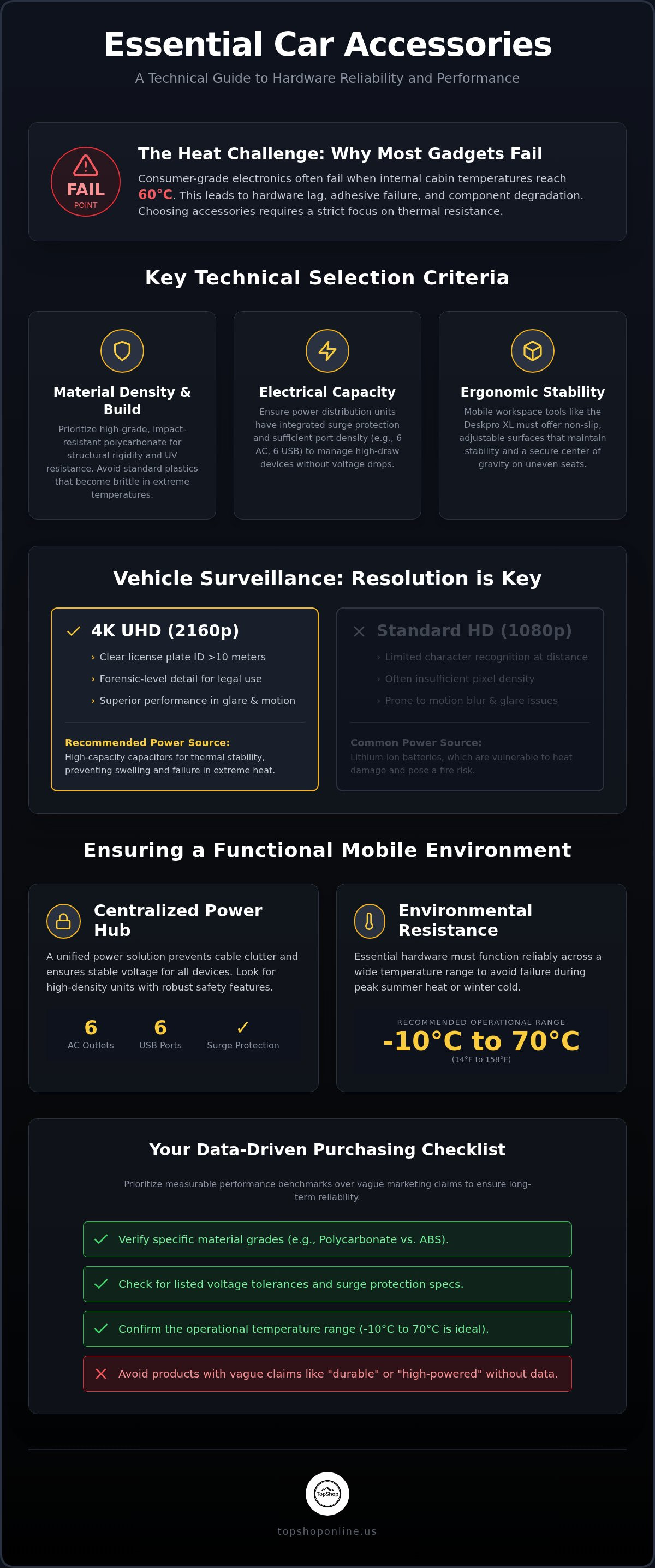
Baseline vehicle essentials prioritize liability protection and situational awareness. Critical safety tools, specifically multi-channel dash cams like the Guardian 3-Channel 4K Dash Cam, provide immutable video evidence for insurance claims and legal defense. These differ from convenience gadgets like ambient lighting or decorative trim which lack functional utility. Dash cams are the baseline for modern vehicle safety due to their role in incident documentation. Hardware durability is vital; internal components must maintain operational stability during long-duration recording cycles. High-capacity capacitors are preferred over lithium-ion batteries for dash cams to prevent swelling and failure during extreme temperature fluctuations. Low-quality gadgets often experience component degradation or housing deformation when exposed to direct sunlight for extended periods.
Evaluating Build Quality and Material Composition
Material selection directly impacts the lifespan of mobile hardware. Impact-resistant polycarbonate housings offer superior structural rigidity and UV resistance compared to standard recycled plastics used in budget car mounts. High-performance electronic accessories require advanced thermal management features like integrated passive heat sinks or ventilated enclosures to prevent processor throttling during high-draw operations. Essential car accessories must meet rigorous manufacturing standards to ensure component longevity in high-vibration environments.
Technical hardware selection should focus on these measurable attributes:
- Material Density: High-grade polycarbonate prevents structural brittleness and mounting bracket failure.
- Electrical Capacity: Power strips must feature integrated surge protection and sufficient AC/USB port density to manage multiple high-draw devices simultaneously.
- Ergonomic Stability: Workspace tools like the Deskpro XL provide a non-slip, adjustable surface that maintains its center of gravity on uneven vehicle seating.
- Environmental Resistance: Hardware should be rated for operational temperatures between -10 and 70 degrees Celsius to ensure reliability.
- Physical Recovery: Wellness tools help manage driver fatigue during long-duration commutes by providing ergonomic relief and promoting circulation.
The hardware ecosystem should function as a unified technical suite. Power solutions with 6 AC outlets and 6 USB ports allow for centralized energy management, reducing cable clutter and improving cabin ergonomics. Prioritize hardware that lists specific material grades, voltage tolerances, and measurable performance benchmarks rather than vague marketing claims. This data-driven approach ensures the vehicle remains a functional, protected, and efficient mobile environment.
Dash Cams and Vehicle Surveillance: Technical Specifications to Compare
Optical clarity and multi-angle coverage constitute the primary performance metrics for surveillance hardware. Integrated systems like the Guardian 3-Channel 4K Dash Cam utilize a 2160p front-facing sensor to capture high-density visual data. This resolution level is necessary for identifying license plate alphanumeric characters and vehicle make/model details at distances exceeding 10 meters. While standard 1080p units are common, they often lack the pixel density required for forensic-level analysis during legal disputes. High-resolution sensors ensure that environmental variables like glare or motion blur don't compromise the integrity of the footage.
Resolution and Channel Configurations for Full Coverage
Three-channel configurations represent the current standard for essential car accessories focused on comprehensive liability protection. These systems simultaneously record the forward trajectory, the interior cabin, and the rear perimeter. Mapping blind spots requires wide-angle lenses, typically featuring a 140 to 170-degree field of view. Frame rates are equally critical; a minimum of 30 frames per second (fps) is required to capture fluid motion, though 60 fps is preferred for high-speed highway transit. For those seeking modular interior monitoring, the wireless mini security camera with night vision provides a compact alternative for secondary cabin surveillance or cargo area monitoring.
Interior cabin monitoring is a non-negotiable requirement for rideshare operators and commercial drivers. It provides a timestamped record of passenger interactions and driver behavior, which is vital for insurance mitigation. Integrating these systems often requires specialized mounting, similar to the installation of automotive adaptive equipment designed for specific vehicle modifications. Rear-view camera integration completes the 360-degree monitoring loop, ensuring that rear-end collisions and parking lot incidents are documented with the same precision as forward-facing events.
Night Vision and Data Storage Requirements
Low-light performance depends on the presence of Infrared (IR) sensors and a wide aperture (f/1.8 or lower). IR LEDs allow the camera to record clear interior footage in total darkness, which is essential for overnight security or nighttime rideshare shifts. Data management is handled through loop recording and G-sensor triggers. The G-sensor detects sudden decelerations or impacts, automatically locking the current video file to prevent it from being overwritten. Because 4K video generates high data volumes, users must utilize U3 or V30 rated SD cards with high write speeds to prevent frame drops or file corruption. You can find high-spec surveillance hardware and technical support at TopShop to ensure your vehicle remains protected.
Optimizing the Mobile Workspace and Passenger Ergonomics
Professionals utilizing vehicles as secondary work environments require hardware that addresses the ergonomic deficits inherent in standard automotive seating. While general consumer guides for the best car accessories prioritize aesthetic comfort, technical workspace optimization requires structural stability and precise adjustability. Mobile office configurations must account for restricted cabin dimensions and uneven support surfaces. Integrating high-spec furniture into a vehicle interior transforms the passenger area into a functional workstation capable of supporting long-duration productivity without compromising physical health.
The Deskpro XL Ergonomic Adjustable Laptop Bed Desk functions as a primary foundation for in-car computing. It features a reinforced surface area specifically engineered to accommodate 15-inch and 17-inch professional laptops. Stability is maintained through a balanced weight distribution system that prevents seat indentations or hardware tipping during minor vehicle shifts. When selecting essential car accessories for work, professionals must prioritize hardware that maintains a neutral wrist position and reduces cervical spine strain. This setup allows for continuous operation during transit or while stationary at job sites.
Laptop Desks and Stability for In-Vehicle Use
Surface dimensions for the Deskpro XL provide sufficient clearance for peripheral devices, including external mice or mobile hotspots. The unit utilizes impact-resistant materials and a high-friction surface coating to ensure mobile stability. Technical selection criteria should focus on the adjustability range; the Deskpro XL allows for height and tilt modifications to align the screen with the user's natural eye line. Proper weight distribution is essential to prevent hardware from sliding off center consoles or contoured passenger seats.
Mounting Solutions and Space Management
Space management in compact cabins requires folding mechanisms that allow for quick storage when the workstation is not in use. Multi-purpose stands and adjustable mounts reduce clutter and maximize available legroom. Efficient organization involves adapting cable management for home office techniques to the vehicle environment. Routing power cables from centralized hubs prevents interference with vehicle controls and maintains a professional interior appearance. This methodical approach to essential car accessories ensures that the mobile workspace remains organized, ergonomic, and safe for daily professional use.
Hardware interoperability remains a key factor in workspace design. The integration of ergonomic laptop desks with high-capacity power solutions, discussed in the following section, creates a cohesive technical ecosystem. By focusing on measurable adjustability ranges and material durability, users can mitigate the risks of repetitive strain injuries associated with poorly configured mobile offices. High-density foam padding and non-slip edge protection further enhance the stability of professional peripherals within the moving vehicle.
Power Distribution and Charging Infrastructure for Modern Vehicles
Establishing a reliable power grid within a vehicle requires hardware capable of converting DC power to stable AC output. Most stock vehicle ports provide limited amperage, often insufficient for the high-draw demands of professional mobile offices. A Power Strip with 6 AC Outlets & 6 USB Ports serves as a critical bridge. It enables the use of standard AC plugs alongside high-speed USB interfaces. These are essential car accessories for users operating the Guardian 3-Channel Dash Cam and the Deskpro XL workstation simultaneously. Voltage conversion from 12V to 110V AC requires efficient inverter technology to minimize energy loss as heat. Users must calculate the total wattage of their hardware ecosystem to ensure it falls within the strip's peak load capacity. This calculation prevents circuit breaker tripping and ensures a steady current flow to sensitive motherboards. Surge protection is a non-negotiable feature, rated in Joules, to absorb electrical transients that occur during vehicle ignition cycles.
USB Port Density and Voltage Regulation
Managing total amperage across multiple active ports prevents thermal throttling and charging delays. High-spec power strip with usb ports configurations utilize smart-chip technology for optimized power allocation. This circuitry identifies the specific draw requirements of connected hardware, such as 65W for laptops or 15W for mobile handsets. USB-C Power Delivery (PD) standards are critical for rapid charging cycles. Integrated safety standards include over-voltage, over-current, and short-circuit protection, ensuring operational safety in the confined, high-temperature environment of a vehicle interior. High-output charging in confined spaces generates significant heat; therefore, the material composition must include heat-resistant ABS or polycarbonate plastics.
- Total Amperage Management: Prevents thermal throttling and port failure across 6 active USB connections.
- Smart-Chip Technology: Dynamically allocates 65W PD or standard 15W outputs based on device handshake.
- Safety Standards: Integrated over-voltage, over-current, and short-circuit protection protocols for fire-retardant safety.
Cable Management and Portability Factors
Centralized power hubs eliminate the need for multiple disparate adapters. This organization improves ergonomics and reduces the risk of cable interference with vehicle pedals or gear shifters. Technical portability factors include the physical dimensions of the strip and the flexibility of the power cord. Heavy-duty 14 AWG wiring ensures minimal voltage drop over the length of the cable. Placing the hub in a ventilated area, such as a seat pocket or a dedicated organizer, ensures optimal thermal performance during high-load periods. Compact housing designs allow the power strip to fit within existing glove boxes or under-seat storage bins. This portability ensures the hardware remains out of sight when the vehicle's unattended, reducing the risk of theft. Efficient cable routing maintains the structural integrity of the workspace while providing reach to rear passengers.
Secure your mobile power infrastructure with high-capacity power distribution solutions available now.
Enhancing Driver Wellness and Interior Environment
Technical vehicle optimization remains incomplete without addressing the biological maintenance of the human operator. Driver fatigue represents a primary risk factor during long-duration commutes and professional transit. Integrating essential car accessories designed for physical recovery ensures the driver maintains the cognitive focus and structural health required for safe operation. This transition from mechanical utility to physical wellness addresses the repetitive strain injuries associated with prolonged sedentary posture. Biological maintenance requires a systematic approach to muscle recovery, hydration levels, and nutritional stability.
Ergonomic Support and Physical Recovery Tools
Prolonged seating leads to "commuter back," characterized by lumbar compression and reduced blood flow to the lower extremities. Utilizing percussive massage tools or heat-based recovery hardware during stop-overs helps mitigate muscle density issues and promotes circulation. Yoga and fitness equipment designed for compact storage allow for quick structural resets during long-distance travel. Nutrition and supplement strategies should focus on maintaining stable blood glucose levels to prevent the cognitive decline associated with high-sugar snacks. Electrolyte-enriched hydration ensures neurological efficiency and prevents the muscle cramping common in high-vibration environments.
Curated Selection: Standout Wellness Accessories
Physical therapy and rehabilitation products are now categorized alongside traditional hardware as essential car accessories for professional drivers. These tools focus on myofascial release and targeted muscle tension relief. High-stress environments require wellness accessories that address both physical strain and environmental stressors like poor air quality or extreme cabin temperatures. Post-commute recovery is facilitated through specialized equipment that transitions the driver from a high-focus state to a state of physical restoration. This holistic approach ensures the driver's physical capacity matches the vehicle's technical capabilities.
Maintaining a high-performance vehicle environment requires consistent attention to the driver's physical state. You can browse the complete Health & Wellness collection for driver recovery to identify the recovery tools that fit your specific commute profile. These products are selected for their durability, portability, and measurable impact on physical health. Proper integration of wellness hardware reduces the long-term health risks of professional driving and improves overall transit efficiency. It's a necessary investment for any driver spending more than four hours daily within a vehicle cabin.
Technical hardware and biological wellness tools must function as a unified ecosystem. By prioritizing high-resolution surveillance, ergonomic workspaces, and physical recovery equipment, you establish a vehicle interior that is secure, productive, and health-conscious. Don't overlook the human component of the driving equation; technical specifications for driver wellness are just as critical as dash cam resolution or power strip wattage.
Integrating High-Performance Vehicle Hardware for Operational Efficiency
Implementing a technical vehicle ecosystem requires precise hardware integration across safety, power, and ergonomic categories. High-resolution surveillance via the Guardian 3-Channel 4K Dash Cam provides the necessary optical density for forensic-level liability protection. Workspace stability is achieved through the Deskpro XL Ergonomic Desk, which maintains structural integrity and provides a non-slip surface for professional peripherals. Centralized power distribution through high-capacity hubs ensures voltage stability and surge protection for high-draw electronics. Selecting these essential car accessories based on measurable performance data transforms a standard vehicle into a secure, high-utility mobile environment.
Prioritize hardware with high thermal resistance and industrial-grade material composition to ensure long-term operational reliability. Maintaining driver health through specialized physical recovery tools is the final component of a functional transit strategy. This technical approach mitigates the risks of hardware failure, cable clutter, and physical fatigue. It's an efficient transition to a fully optimized cabin that supports both high-speed transit and professional productivity. Optimize your driver wellness with our curated Health & Wellness collection to complete your vehicle's technical infrastructure and maintain peak operational performance on the road.
Frequently Asked Questions
What is the most essential car accessory for safety in 2026?
High-resolution multi-channel dash cams are the primary safety hardware for liability protection. The Guardian 3-Channel 4K Dash Cam provides 2160p front-facing resolution and interior cabin monitoring. This setup ensures forensic-level evidence for insurance claims and legal defense. It constitutes a baseline requirement for modern vehicle surveillance and incident documentation. Optical clarity and wide-angle coverage are non-negotiable specifications for 2026 safety standards.
Do I really need a 3-channel dash cam for my vehicle?
A 3-channel system is necessary for full 360-degree perimeter and interior coverage. It captures simultaneous footage of the forward path, the cabin interior, and the rear environment. This configuration eliminates blind spots and provides critical documentation for rideshare operators and commercial drivers. Single-channel systems fail to capture passenger interactions or rear-end collision details, leaving gaps in your legal protection.
Can I use a standard power strip in my car with an inverter?
Yes, provided the power strip features integrated surge protection and the inverter matches the total wattage draw of connected hardware. A Power Strip with 6 AC Outlets & 6 USB Ports allows for centralized energy management of high-draw devices. Users must verify the peak load capacity of the vehicle's electrical system to prevent circuit failure. This setup is one of several essential car accessories for maintaining a productive mobile workspace.
What technical specs should I look for in a car laptop desk?
Prioritize adjustable height ranges, non-slip surface materials, and structural weight distribution. The Deskpro XL Ergonomic Adjustable Laptop Bed Desk accommodates 15-inch and 17-inch laptops while maintaining stability on uneven seating. Technical selection should focus on impact-resistant polycarbonate construction and a secure center of gravity. These specifications prevent hardware tipping and reduce cervical spine strain during long-duration work sessions.
How do car accessories impact driver wellness and fatigue?
Ergonomic supports and recovery tools mitigate the physical strain of prolonged sedentary posture. Driver wellness is maintained through myofascial release tools and percussive massage hardware that promote circulation. These essential car accessories address "commuter back" and cognitive decline by improving physical comfort. Maintaining nutritional stability and hydration levels further prevents the fatigue associated with long-distance transit and high-vibration environments.
Are wireless security cameras suitable for car interior monitoring?
Compact 1080P HD Wireless Mini Security WiFi Cameras are suitable for secondary cabin surveillance or cargo area monitoring. These units provide flexible placement options and night vision capabilities for low-light environments. While they don't replace primary dash cams for road incident logging, they offer supplemental security for stationary vehicles. Wireless connectivity allows for remote monitoring via mobile interfaces during overnight parking.
What are the best recovery tools for long-distance drivers?
High-density foam rollers, portable percussive massagers, and lumbar support cushions are primary recovery tools. These items facilitate physical restoration during stop-overs and post-commute periods. Integrated health and wellness hardware focuses on targeted muscle tension relief and structural alignment. Utilizing these tools consistently reduces the long-term health risks associated with professional driving and helps maintain the physical focus required for safe operation.
How do I manage multiple electronic devices without draining my car battery?
Utilize centralized power hubs with smart-chip technology to optimize energy allocation per device. These systems prevent over-draw by identifying specific wattage requirements for laptops, tablets, and handsets. Drivers should only operate high-draw hardware while the engine is running or via a dedicated secondary battery system. Monitoring voltage output ensures the vehicle's primary starter battery remains at operational levels for ignition.