

Relying on a standard two-channel system creates a significant data gap in vehicle cabin monitoring and side-impact documentation. A high-specification 3 channel dash cam with night vision provides the necessary 360-degree coverage through synchronized front, rear, and interior sensor arrays. Standard dual-channel configurations fail to document cabin activity and rear-quarter blind spots. This technical overview analyzes the hardware architecture, sensor requirements, and power management protocols of triple-lens systems to ensure optimal surveillance performance.
You'll learn about the Guardian 3-Channel 4K Dash Cam specifications, infrared sensor capabilities for low-light cabin recording, and high-capacity storage demands. We examine the integration of 4K resolution, 1080P interior monitoring, and G-sensor triggers for a unified digital witness solution. This guide provides the technical data needed to evaluate multi-lens hardware for professional or personal vehicle security requirements. It covers essential power consumption metrics, SD card write-speed requirements, and mounting configurations for maximum field-of-view efficiency and data integrity. The analysis focuses on measurable hardware attributes and functional requirements for 2026 vehicle safety standards.
Key Takeaways
- Define the technical architecture of 3-channel systems where a central processor manages simultaneous front, rear, and interior cabin video streams.
- Identify critical sensor specifications for a 3 channel dash cam with night vision, including f/1.6 high-aperture lenses and Sony STARVIS technology for low-light clarity.
- Evaluate functional use cases for rideshare and commercial fleet applications to document passenger conduct and ensure driver adherence to safety protocols.
- Determine necessary hardware requirements such as V30 or U3 UHS-I high-endurance SD cards to maintain data integrity during high-density triple-stream recording.
- Review the technical capabilities of the Guardian 3-Channel 4K Dash Cam, featuring integrated 4K front-facing resolution and dedicated interior monitoring sensors.
Understanding 3-Channel Dash Cam Architecture and Components
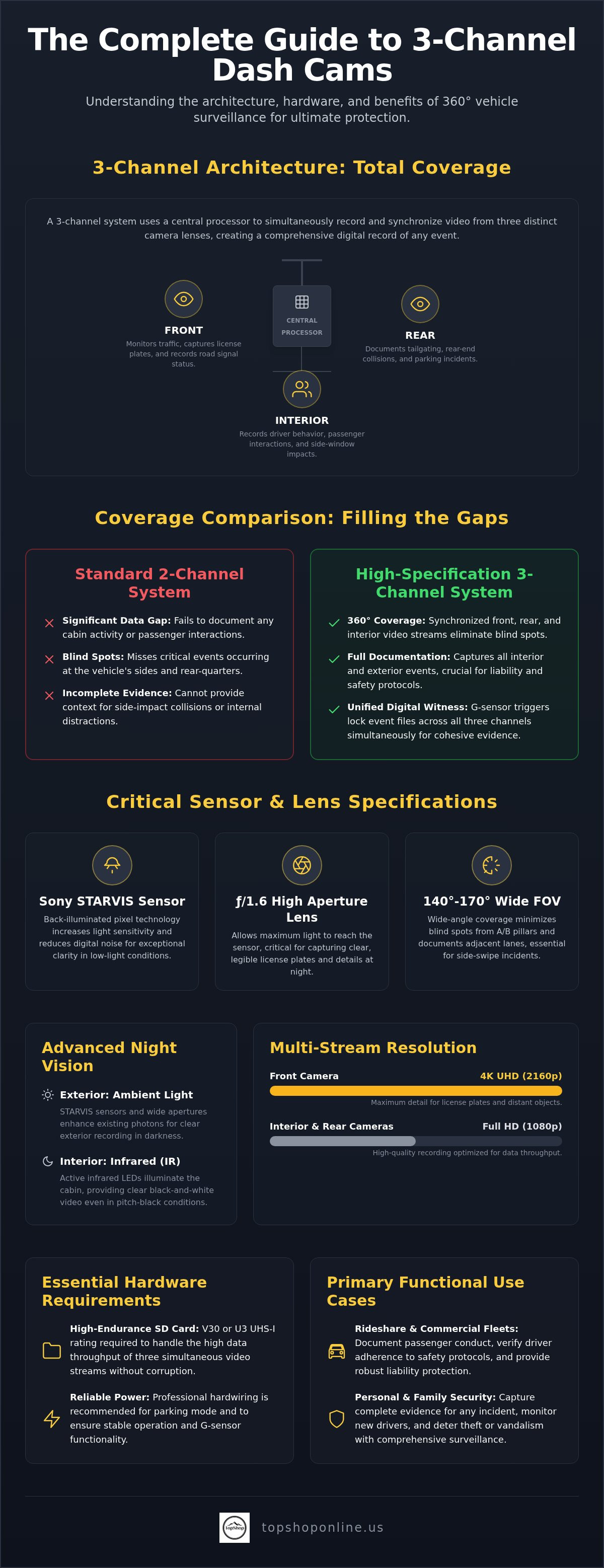
A 3-channel (3CH) dash cam system provides simultaneous recording of the vehicle's front exterior, rear exterior, and interior cabin environments. This hardware architecture relies on a primary control unit, usually mounted on the front windshield, which integrates the main processor, the front-facing lens, and a cabin-facing lens. A secondary satellite unit, often referred to as the rear camera, connects to this primary housing through a dedicated coaxial or USB interface. A Dashcam technology overview confirms that centralized processing is the industry standard for maintaining synchronized timestamps across multiple video streams. This synchronization is vital for reconstructive analysis of traffic incidents. The primary unit acts as the hardware hub, managing power distribution to the satellite camera and housing the SD card slot for centralized storage. Coaxial cables are preferred for rear camera connections due to their low-interference properties and reliable signal transmission over longer vehicle lengths.
A 3 channel dash cam with night vision requires specific sensor hardware to manage the high data throughput of triple-stream recording without frame degradation. The system architecture prioritizes data integrity by funneling all three streams into a single high-speed processor. It's this centralized logic that allows for real-time file management and event-locking across all channels during a G-sensor trigger event. Without a 3 channel dash cam with night vision, drivers often lack the necessary infrared illumination required for clear interior recording during nocturnal operation.
Front vs. Rear vs. Interior Lens Roles
Front-facing lens functionality includes traffic flow monitoring, license plate identification, and road signal status capture. It typically utilizes the highest resolution sensor, such as the 4K sensor found in the Guardian 3-Channel 4K Dash Cam. Rear-facing satellite lens roles include monitoring tailgating, rear-end collisions, and parking lot proximity incidents. Interior-facing lens roles involve recording driver behavior, passenger interactions, and side-window impacts. This triple-lens configuration eliminates the coverage gaps inherent in standard 1-channel or 2-channel systems, providing a unified digital record of the vehicle's entire perimeter and interior.
Field of View (FOV) Optimization
Hardware specifications for 3-channel systems prioritize wide-angle coverage, typically ranging from 140° to 170°. These lenses use specialized multi-layer optical glass elements to minimize fish-eye distortion while maintaining peripheral visibility. Strategic placement is necessary to eliminate blind spots created by vehicle A-pillar or B-pillar structures. Optimal installation ensures the interior lens covers both the driver and passenger sides, while the exterior lenses provide a comprehensive view of the surrounding traffic lanes. High FOV ratings are essential for documenting side-swipe accidents that occur outside the range of standard narrow-angle cameras.
Night Vision Technology and Sensor Specifications
High-performance exterior imaging in a 3 channel dash cam with night vision depends on specific lens aperture ratings and sensor architecture. An f/1.6 or lower aperture allows maximum photon collection for the CMOS sensor. This hardware configuration is essential for documenting low-light traffic environments where ambient light is minimal. Sophisticated night vision technology utilizes image enhancement to amplify existing photons, while Sony STARVIS back-illuminated pixel technology increases light sensitivity. These sensors reduce digital noise in dark frames, ensuring license plate legibility at highway speeds. Achieving this level of clarity requires a balance of sensor size and pixel density to prevent motion blur during nocturnal operation.
Interior monitoring requires a different technical approach than exterior recording. While exterior lenses rely on high aperture and ambient light, interior lenses utilize active illumination. This distinction is critical because standard glass optics cannot resolve images in a pitch-black cabin without an auxiliary light source. Dynamic range management allows the processor to balance dark cabin corners with bright streetlights visible through the side windows. For those requiring professional-grade hardware, the Guardian 3-Channel 4K Dash Cam integrates these specialized sensors into a unified surveillance package.
Infrared (IR) Interior Monitoring
Interior lenses utilize 4 to 6 IR LEDs to illuminate the cabin in total darkness. These LEDs emit light at a wavelength invisible to the human eye, ensuring the driver isn't distracted during night operation. Ambient light sensors trigger an automatic switch between standard color mode and IR-cut monochrome mode. This transition is necessary to maintain high resolution for identifying facial features and passenger actions in low-light settings. High-end systems ensure the IR array covers the entire cabin volume, including the rear passenger bench.
High Dynamic Range (HDR) for Road Recording
HDR functionality processes multiple exposure levels for every single frame to prevent overexposure from oncoming headlights. This technology is vital for reading reflective license plates that would otherwise appear as white blurred rectangles. By combining short and long exposure data, the processor maintains detail in both the brightest and darkest parts of the image. This capability is a core component of modern 4K dash cam with night vision standards, where pixel density must be supported by accurate exposure management to be effective.
Liability Protection and Functional Use Cases
Establishing a comprehensive digital witness profile requires more than exterior footage. A 3 channel dash cam with night vision provides a synchronized data set that bridges the gap between road incidents and cabin activity. This integration is essential for maintaining a clear legal chain of evidence. In court, the dash cam with inside cabin view proves driver attentiveness and passenger conduct during the exact moment of impact. It eliminates the "he-said, she-said" dynamic common in accident litigation. Insurance adjusters prioritize multi-angle footage because it documents side-impact collisions and interior cabin dynamics that single-channel systems miss. High-density data capture ensures that all variables of an incident are documented for forensic analysis.
Professional security applications extend to vehicle break-ins and theft. While the vehicle is parked, G-sensor triggers activate all three lenses to capture the perpetrator's face through the interior lens and their escape route via the exterior lenses. This triple-stream evidence significantly increases the probability of identification. For commercial operators, this hardware serves as a primary tool for liability mitigation and asset protection. It's a functional requirement for modern fleet management and high-liability transport services. The Guardian 3-Channel 4K Dash Cam serves as a reliable hardware platform for these specific security demands.
Rideshare and Professional Driver Requirements
Rideshare drivers utilize interior monitoring to prevent fraudulent claims regarding passenger safety or vehicle cleanliness. Most 3 channel dash cam with night vision systems include high-sensitivity microphones for audio recording. Drivers must adhere to state-specific two-party consent laws; this often requires visible disclosure decals. Impact-triggered file locking ensures that critical incident footage isn't overwritten during subsequent loop recording cycles. The visible presence of an interior lens acts as a behavioral deterrent for aggressive or intoxicated passengers. It provides a documented record of passenger-to-driver interactions that is vital for platform-level appeals.
Teen Driver and Fleet Management
Fleet managers use interior footage to monitor driver fatigue and adherence to safety protocols. GPS logging integration provides a data overlay showing vehicle speed, heading, and exact coordinates alongside the video stream. This allows for precise reconstruction of driving events for coaching purposes. Remote monitoring via cloud-connected systems provides real-time access to vehicle status for logistics coordinators. For parents of teen drivers, these systems offer a method to verify safe driving habits and seatbelt compliance without physical presence. Using interior views for coaching helps reduce insurance premiums for commercial fleets by demonstrating proactive safety management.
Technical Hardware Requirements and Installation
Simultaneous triple-stream recording generates high data throughput. A 3 channel dash cam with night vision requires specialized storage media to manage the continuous write cycles of three concurrent video files. High-endurance microSD cards utilizing multi-level cell (MLC) or triple-level cell (TLC) flash architecture are mandatory for maintaining data integrity. Standard SD cards often fail under the thermal stress and high-frequency overwriting required by 4K and dual 1080P streams. To prevent frame drops and file corruption, users must select cards with a Video Speed Class of V30 or a UHS Speed Class of U3. These ratings guarantee a minimum sustained write speed of 30MB/s, which is the baseline requirement for synchronized triple-channel capture.
Hardware stability depends on precise G-sensor calibration. This internal accelerometer detects physical impacts to trigger emergency file locking. Setting the sensitivity too high results in "false positives" from speed bumps or potholes, quickly filling the protected memory segment. Conversely, low sensitivity might fail to lock footage during minor side-impacts. Optimal configuration ensures that legitimate incident data is preserved in a read-only folder, separate from the standard loop recording directory. Reliable operation in high-stress environments is a core feature of the Guardian 3-Channel 4K Dash Cam hardware suite.
Hardwiring vs. Cigarette Lighter Power
Standard cigarette lighter adapters only provide power while the ignition is active. A 3 channel dash cam with night vision requires a dedicated hardwire kit to access 3 channel dash cam parking mode functionality. Hardwire kits connect directly to the vehicle's fuse box, providing a constant 12V/24V power supply. These kits include integrated battery discharge prevention modules. These modules monitor vehicle battery voltage and terminate power to the dash cam if levels drop below a specific threshold, typically 11.8V or 12V. This prevents the high power draw of a triple-lens system from draining the starter battery. Installation involves routing coaxial or USB-C cables through the vehicle headliner and pillar trim to maintain a clean aesthetic and prevent driver obstruction.
Loop Recording and File Management
Loop recording ensures continuous operation by automatically overwriting the oldest unprotected files when storage capacity is reached. Modern systems utilize H.265 (High-Efficiency Video Coding) compression standards to maximize storage efficiency. H.265 provides superior detail density at lower bitrates compared to older H.264 codecs, which is vital for managing large 4K front-facing files. Emergency protection can be triggered manually via a dedicated "lock" button or automatically by the G-sensor. Efficient file management protocols ensure that these locked files do not exceed 30% of total card capacity, maintaining enough space for ongoing loop recording functions.
Guardian 3-Channel 4K Dash Cam: Technical Specifications
The Guardian 3-Channel 4K Dash Cam represents a unified hardware solution for comprehensive vehicle monitoring. The primary housing integrates a 4K Ultra HD front-facing lens, a high-speed image processor, and a dedicated interior-facing sensor. A separate remote rear camera unit provides the third stream through a high-bandwidth coaxial connection. This 3 channel dash cam with night vision utilizes advanced low-light sensors across all three recording channels to ensure detail density in nocturnal environments. The hardware construction incorporates high-temperature resistant supercapacitors, providing operational durability across national US climate variations from 150°F cabin interiors to sub-zero external temperatures. High-density 4K front-facing resolution, integrated infrared interior monitoring, and secondary rear-window satellite camera units define the core architecture.
Guardian System Integration
The system architecture enables seamless 3-way synchronization for a comprehensive digital record of any traffic event or security breach. Centralized processing ensures that every video frame from the front, rear, and interior lenses shares an identical, non-modifiable timestamp. The user-friendly interface supports quick file retrieval through a high-resolution display and intuitive button navigation. A compact form factor minimizes driver obstruction by utilizing a vertical wedge design that fits behind most rearview mirrors. This low-profile physical footprint maximizes the field of view while maintaining a discreet interior presence. The integrated G-sensor provides automatic event locking for all three channels simultaneously during detected impact events. It doesn't require manual intervention to preserve critical data during a collision.
Installation and Support
Installation hardware includes secure 3M adhesive mounts and adjustable brackets for precise lens alignment across varying windshield angles. The system supports bench testing and initial configuration via a standard power strip with usb ports, enabling users to verify firmware versions and sensor sensitivity before final hardwiring. TopShop provides direct logistics and technical support for all Guardian hardware units, including national US shipping for rapid deployment. The package includes all necessary cables, mounting accessories, and a detailed technical manual for professional or DIY installation. This comprehensive support structure ensures that the 3 channel dash cam with night vision remains operational and correctly calibrated for long-term vehicle surveillance. High-endurance mounting and reliable power management protocols ensure the system remains active throughout the vehicle's operational lifespan.
Advancing Vehicle Surveillance with Integrated 3-Channel Hardware
Implementing a 3 channel dash cam with night vision provides the necessary hardware redundancy for professional liability protection and comprehensive vehicle security. This technical analysis has detailed the transition from standard dual-channel systems to integrated triple-lens architecture. Reliable data capture depends on synchronized timestamps across front, rear, and interior streams. High-endurance storage media and precise G-sensor calibration ensure that critical incident footage is preserved during impact events. Triple-stream recording facilitates a complete digital record of the vehicle perimeter and cabin interior simultaneously.
The Guardian 3-Channel 4K Dash Cam meets these 2026 safety standards by offering 4K Ultra HD resolution and simultaneous 3-way recording. Integrated night vision sensors across all channels maintain image clarity in low-light environments, ensuring facial features and license plates remain legible. This system acts as a unified digital witness for rideshare drivers, fleet managers, and personal vehicle owners. It provides the technical density required for forensic incident reconstruction and insurance claim verification. Purchase the Guardian 3-Channel 4K Dash Cam at TopShop to secure high-specification surveillance hardware for your vehicle today. Establish total vehicle coverage with reliable, multi-channel recording technology.
Frequently Asked Questions
What is a front rear and interior dash cam?
A front, rear, and interior dash cam is a triple-lens surveillance system designed for 360-degree vehicle coverage. It utilizes a primary windshield-mounted unit for forward and cabin views plus a secondary satellite unit for rear-facing recording. This hardware configuration eliminates blind spots and documents passenger behavior alongside external traffic events for total liability protection.
Does a 3-channel dash cam record all three views at the same time?
Yes, a 3 channel dash cam with night vision performs simultaneous triple-stream recording through a centralized image processor. The hardware architecture synchronizes all three video files with a unified timestamp for precise incident reconstruction. This multi-channel capability ensures no monitoring gaps occur during driving or parked states.
How much storage does a 3-channel 4K dash cam use?
A 3-channel 4K system generates approximately 30GB to 45GB of data per hour of footage depending on bitrate and compression standards. The high data throughput of 4K front resolution combined with dual 1080P streams requires high-capacity storage media. Users should expect loop recording cycles to overwrite files more frequently than standard single-channel systems due to the increased file density.
Can I use a 3-channel dash cam for Uber and Lyft?
This hardware is the industry standard for rideshare and professional driving applications. It provides essential liability protection by documenting passenger conduct and driver attentiveness. Most systems include high-sensitivity microphones for audio recording. Drivers must comply with local two-party consent regulations regarding cabin monitoring by using visible disclosure decals.
Does the interior camera work in total darkness?
The interior camera utilizes an array of 4 to 6 infrared (IR) LEDs to provide visibility in pitch-black cabin conditions. These LEDs emit light at a wavelength invisible to the human eye to prevent driver distraction. The system automatically toggles an IR-cut filter to capture clear monochrome footage when ambient light levels drop below the sensor threshold.
How is a 3-channel dash cam powered for parking mode?
Parking mode functionality requires a dedicated hardwire kit connected to the vehicle's fuse box for constant 12V or 24V power. These kits feature integrated voltage monitoring to prevent battery discharge by terminating power if the vehicle battery drops below a set limit. Standard cigarette lighter adapters don't provide the necessary continuous power for stationary surveillance.
Is professional installation required for a 3-channel dash cam?
Professional installation isn't mandatory but is recommended for clean cable management and secure hardwiring. Users can perform DIY installation by routing cables through headliners and pillar trim using included pry tools. Secure adhesive mounting ensures the Guardian 3-Channel 4K Dash Cam remains stable during high-vibration driving conditions.
What is the best SD card for a 3-channel dash cam?
High-endurance microSD cards with a Video Speed Class of V30 or UHS Speed Class of U3 are required for 3 channel dash cam with night vision hardware. These cards utilize MLC or TLC flash architecture to withstand constant write cycles and thermal stress. Standard SD cards lack the sustained write speeds necessary for simultaneous 4K and dual 1080P data streams.