

Standalone mini cameras fail at the exact moment you need them most because battery depletion cuts feeds short, and narrow lenses leave critical blind spots. Deploying a hidden camera light bulb with audio resolves these hardware limits by converting an ordinary overhead socket into a permanent surveillance point. You likely already know how frustrating it is to deal with muffled microphone feeds, constant battery recharging, and complex wall-drilling just to monitor an indoor space.
Integrated socket power combined with panoramic acoustics makes the light bulb form factor an exceptionally reliable continuous monitoring tool. This technical guide examines hardware parameters, acoustic sensor behavior, and network protocols required to maintain clear 24/7 video and audio streams. We analyze socket compatibility, two-way audio components, lens field angles, and mobile application setups to ensure full interior coverage without hardware failure.
Key Takeaways
- Explore how an integrated hidden camera light bulb with audio draws continuous AC power directly through standard light fixtures to eliminate battery maintenance cycles.
- Examine acoustic sensor hardware, chassis microphone positioning, and integrated audio filtering designed to capture clear sound without electrical hum.
- Understand optical configurations that process raw 360-degree panoramic fisheye video into dewarped, split-view real-time surveillance streams.
- Review 2.4 GHz wireless bandwidth requirements, local microSD storage limitations, and network configurations for stable remote app access.
- Identify mechanical clearance requirements, downward angle calibration, and state consent laws governing domestic audio and video surveillance installations.
Acoustic Hardware and Sensor Architecture in Light Bulb Surveillance Cameras
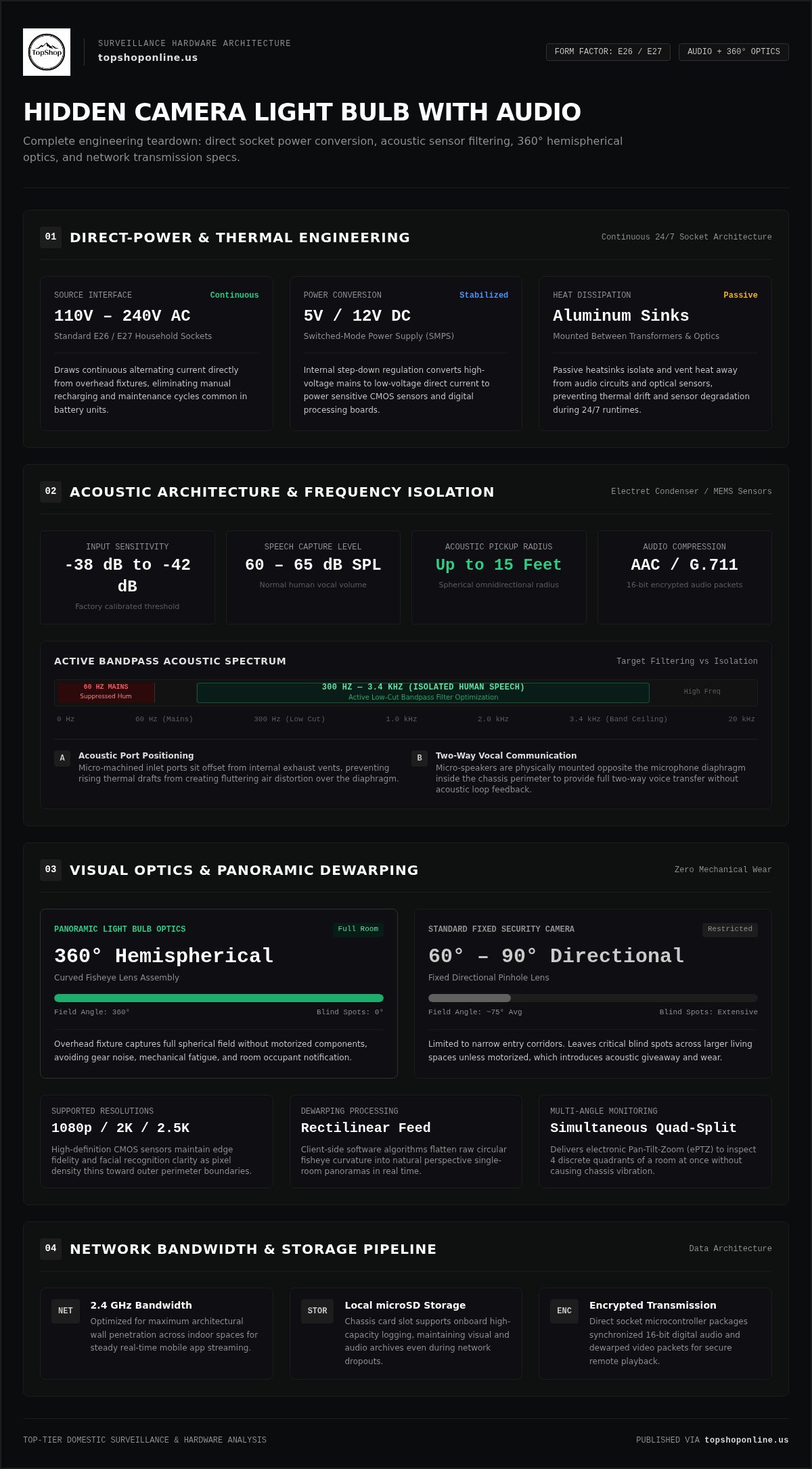
Consumer surveillance hardware relies heavily on miniature electret condenser or MEMS microphones embedded directly into the lower perimeter ring of the device chassis. Unlike commercial Closed-circuit television (CCTV) systems that depend on external audio lines and bulky pre-amplifiers, an integrated hidden camera light bulb with audio consolidates sensor capture, filtering, and transmission inside an ordinary lamp profile. The primary engineering challenge involves managing low-frequency acoustic noise generated by high-voltage socket electronics. Embedded pre-amplifiers utilize active low-cut bandpass filters to isolate human speech frequencies (300 Hz to 3.4 kHz) while actively suppressing 60 Hz electrical mains hum. Micro-speakers mounted opposite the microphone diaphragm facilitate two-way vocal communication through mobile app channels.
Omnidirectional Microphone Integration and Acoustic Pickup Radius
Microphone pickup assemblies inside light socket units use omnidirectional polar patterns designed to capture equal sound pressure levels across a spherical radius. Practical hardware capabilities include:
- Decibel Sensitivity: Factory calibrations target an input sensitivity of -38 dB to -42 dB, capturing normal human speech (60 to 65 dB SPL) clearly up to fifteen feet from the mounting point.
- Acoustic Port Positioning: Micro-machined sound inlet ports sit offset from internal exhaust vents to prevent rising thermal drafts from generating fluttering air distortion across the diaphragm.
- Codec Compression: Integrated microcontrollers apply AAC or G.711 compression algorithms, turning analogue sound waves into lightweight 16-bit digital audio packets for encrypted network transmission.
E26 and E27 Socket Direct-Power Engineering
A hidden camera light bulb with audio bypasses battery depletion problems by pulling continuous current directly from standard E26 or E27 household sockets. Internal switched-mode power supply (SMPS) assemblies convert 110V to 240V alternating current directly into stabilized 5V or 12V direct current. This steady supply maintains uninterrupted surveillance without scheduled maintenance cycles. Aluminum passive heatsinks sit between the step-down transformers and optical boards to vent heat away from sensitive image and audio components, preventing sensor degradation during extended 24/7 runtimes.
Optical Resolution and 360-Degree Panoramic Visual Specifications
Panoramic light bulb hardware captures visual data using wide-angle fisheye lens assemblies paired with high-definition CMOS image sensors. Standard pinhole security devices record fixed directional angles between 60 and 90 degrees, but a hidden camera light bulb with audio uses a curved panoramic lens to capture a full hemispherical field of view. The resulting circular image requires client-side digital dewarping algorithms via the mobile monitoring application. This software-level processing flattens the spherical distortion into recognizable rectilinear perspective feeds, displaying either single-room panoramas or simultaneous quad-split camera angles without mechanical movement.
Optical clarity depends directly on sensor pixel count. Because panoramic lenses spread light across an expansive optical plane, effective pixel density decreases toward the outer perimeter of the frame. Sensor resolutions of 1080p, 2K, and 2.5K maintain structural edge detail, facial recognition features, and object identification within active indoor areas. For targeted perimeter surveillance where wide panoramic coverage is unnecessary, fixed-lens hardware such as a 1080p wireless mini security camera with night vision provides a directed line of sight for narrow entry points.
Fisheye Lens Dewarping Versus Fixed Directional Lenses
Eliminating motorized components improves long-term hardware reliability in overhead installations. Mechanical pan-tilt heads generate mechanical noise and suffer gear wear over prolonged operation. Panoramic fisheye lenses remain entirely stationary while delivering software-driven electronic pan-tilt-zoom (ePTZ). Users inspect distinct quadrants of the room simultaneously in real time without creating chassis vibration or alerting room occupants. While legal standards for visual capture are governed by the Fourth Amendment and state privacy statutes regarding reasonable expectations of privacy, overhead omnidirectional visual mapping provides complete physical coverage of open living spaces without mechanical telltales.
Infrared Night Vision Arrays and Concealed LED Lighting
Lighting socket units integrate low-profile illumination hardware into the outer chassis ring to handle low-light conditions:
- Dual-State Illumination: Arrays pair visible white LEDs (functioning as domestic room lights) alongside 850nm or covert 940nm infrared emitters for completely invisible surveillance in total darkness.
- Mechanical IR-Cut Filters: An electromechanical switch engages daylight color filtering during lighted hours, then disengages to allow full infrared transmission to the monochrome sensor plate at night.
- Thermal Isolation: Sensor boards sit isolated from the high-output LED emitters, preventing image degradation from excessive heat exposure.
Users looking to install comprehensive overhead surveillance can browse dedicated hardware models directly at topshoponline.us to match base socket threads and room layouts.
Wireless Protocols, Network Transmission, and Local Storage Architecture
Operating a hidden camera light bulb with audio requires dependable RF transmission and storage throughput. Because these units screw directly into existing ceiling fixtures, running physical Ethernet cabling is rarely an option. Manufacturers deploy integrated Wi-Fi chips optimized for 2.4 GHz 802.11b/g/n wireless standards. Although 5 GHz bands deliver faster theoretical burst rates, the 2.4 GHz frequency features significantly longer physical wave cycles. These longer waves penetrate domestic structural barriers such as wood framing, drywall partitions, and plaster ceilings much more reliably, preserving real-time packet delivery across interior layouts.
Video encoding relies on H.264 or advanced H.265 (HEVC) compression codecs to package high-resolution streams efficiently. H.265 compression cuts data transmission overhead by up to 50 percent compared to legacy codecs while maintaining pixel fidelity. This efficiency reduces transmission latency when broadcasting audio and video packets to paired mobile client apps. As legal scholars observe in discussions like The Dangers of Surveillance, managing data capture and retention carries profound privacy responsibilities. Secure transmission frameworks prevent external eavesdropping on sensitive household feeds.
2.4 GHz Network Configuration and Bandwidth Demands
Stable streaming demands sufficient continuous upload headroom on local wireless access points. Key network performance metrics include:
- Throughput Requirements: Continuous 1080p streaming at 15 to 20 frames per second demands 1.0 to 2.0 Mbps of uninterrupted upload bandwidth per camera.
- Latency Management: Ping latency to the central router should stay below 80ms to prevent perceptible audio-video sync lag during two-way app communications.
- Static IP Reservation: Configuring router DHCP settings to assign a dedicated static IP prevents connection dropping during automatic router reboots or network address lease renewals.
MicroSD Edge Storage Architecture Versus Encrypted Off-Site Archiving
Recording architecture split between localized edge memory and remote networks ensures footage preservation. A hidden camera light bulb with audio typically features a spring-loaded micro-slot accommodating Class 10 UHS-I microSD cards up to 128GB or 256GB. A 128GB card holds one to three weeks of motion-triggered event clips before cyclical overwrite protocols replace the oldest non-locked video blocks. Edge storage isolates domestic visual feeds entirely from external servers, reducing unauthorized interception risks. Hybrid firmware also allows transmission of brief, 10-second encrypted event clips to secure offsite cloud servers, ensuring proof retention if the light fixture is manually turned off or physically damaged.
Legal Regulations Governing Audio Surveillance and Domestic Privacy Compliance
Operating a hidden camera light bulb with audio introduces strict statutory obligations that do not apply to silent video cameras. United States federal law under Title III of the Omnibus Crime Control and Safe Streets Act (18 U.S.C. 2511(2)(d)), commonly known as the Federal Wiretap Act, prohibits the interception of oral communications without the consent of at least one participating party. Capturing private conversations in your home when you aren't physically present in the room can violate federal eavesdropping statutes. While optical surveillance alone is subject primarily to state voyeurism laws, integrating acoustic recording hardware shifts the legal framework directly under wiretapping statutes.
Domestic property boundaries do not grant absolute recording authority. State laws establish clear lines regarding acoustic consent and reasonable privacy expectations. Users must configure surveillance hardware to remain fully compliant with regional requirements.
Consent Classifications: One-Party Versus All-Party Consent Jurisdictions
State audio recording legislation divides into two distinct legal frameworks:
- One-Party Consent: In the majority of states, recording oral conversations is legal if at least one participant consents. You can record conversations you actively participate in within your own premises.
- All-Party Consent: Several states, including California, Florida, Illinois, Maryland, and Massachusetts, enforce all-party consent laws. Every person within acoustic range of the microphone must explicitly consent to being recorded.
- Implied Consent Protocols: In semi-public domestic spaces, commercial settings, or home offices, posting visible written notices at property entryways establishes legally defensible implied consent.
Permissible Domestic Deployment Zones and Privacy Boundaries
The fourth amendment and state privacy codes establish that individuals retain a reasonable expectation of privacy in specific domestic zones. Installing an overhead hidden camera light bulb with audio inside bathrooms, guest bedrooms, dressing areas, or designated private living quarters is strictly illegal, regardless of property ownership. Permissible residential areas include common entry foyers, open-concept living rooms, storage garages, and hallways where privacy expectations are absent.
Tenants and landlords face additional restrictions. Property owners cannot deploy covert monitoring equipment inside rented domestic dwellings without signed lease disclosures. For users operating inside all-party consent states, companion mobile applications allow administrators to toggle microphone recording functions completely off while keeping the 360-degree video feed active. You can order compliant indoor surveillance hardware configured for flexible audio and visual settings directly from topshoponline.us to ensure operational compliance across any residential setting.
Hardware Selection Criteria, Socket Deployment, and System Calibration
Physical fixture compatibility dictates surveillance performance before software pairing begins. Deploying a hidden camera light bulb with audio requires an unshaded fixture orientation with an unobstructed downward sightline. Recessed ceiling cans, deep pendant shades, or frosted glass enclosures clip optical fields and muffle acoustic capture. Verify that the destination fixture accepts standard E26 or E27 base threads with enough vertical clearance to accommodate the camera housing length. For households building out multi-room surveillance systems, check hardware inventories at TopShop to evaluate base fixtures and complementary gear before installation.
Provisioning continuous power requires circuit management. Standard residential light fixtures shut down completely when someone flips the wall switch. Installing clear switch guards over toggle plates locks the circuit in the "on" state, eliminating accidental system blackouts without modifying electrical junction boxes.
Physical Socket Installation and Wall Switch Locking Protocols
Socket integration takes only minutes when following strict mechanical guidelines:
- Thread Alignment: Shut off circuit power, then thread the bulb clockwise into the socket until the contact pin seats firmly against the brass base. Avoid over-torquing the composite chassis.
- Socket Extenders: Use rigid ceramic socket extenders if deep recessed downlight fixtures block the camera lens or pinch the perimeter microphone ports.
- Initial Power-Up: Restore wall power. The unit runs a self-check cycle, flashes an indicator LED behind the lens housing, and emits an audio confirmation chime.
Motion Detection Sensitivity and Decibel Trigger Calibration
Tuning onboard analytics prevents unnecessary alert fatigue on paired mobile devices. Digital masking tools let you trace active detection zones in the app interface, cutting out recurring motion from ceiling fan blades, curtains, or window reflections. Edge AI algorithms differentiate between pets and humans, filtering out routine background movement.
Calibrating acoustic sensors involves setting decibel activation limits. Positioning the trigger threshold between 70 dB and 80 dB isolates genuine domestic disturbances, such as shattered window glass, forced doors, or shouting, while ignoring ambient HVAC hums. Setting up an automated recording schedule coordinates these triggers with work shifts or overnight hours. Completing this configuration delivers reliable, real-time alerts from your hidden camera light bulb with audio directly to your phone.
Upgrading Domestic Security with Direct Socket Surveillance
Replacing battery-dependent cameras with an integrated hidden camera light bulb with audio establishes permanent, maintenance-free indoor monitoring. Sourcing direct alternating current through standard ceiling fixtures completely eliminates charging downtime, while wide-angle fisheye optics and embedded electret microphones capture synchronized panoramic video and two-way audio without mechanical wear. Aligning digital detection zones and adhering to domestic audio consent regulations ensures seamless legal compliance alongside crisp data retention.
Deploying dependable continuous surveillance starts with selecting verified hardware matched to your fixture layout. Equip your space with smart surveillance hardware at TopShop to browse an extensive inventory of functional consumer devices backed by rapid direct shipping across the United States. Take control of your property monitoring with reliable 24/7 continuous socket-powered security hardware today.
Frequently Asked Questions
Can a hidden camera light bulb record continuous audio when the wall switch is turned off?
No, cutting power at the physical wall switch completely shuts down the internal hardware. A hidden camera light bulb with audio relies entirely on continuous alternating current delivered through the lamp socket. Without an active electrical flow, the internal step-down transformer ceases operation, which immediately deactivates the microphone, image sensor, and wireless radio. Using a switch guard keeps the circuit open permanently.
Do hidden camera light bulbs require a monthly subscription fee to store recorded footage?
No mandatory monthly subscription is required if you use on-device storage. Most units support local recording by saving continuous or motion-triggered video files directly onto an internal microSD card. While optional encrypted cloud storage plans exist for off-site data redundancy, standalone memory cards provide full video playback, cyclic recording, and mobile file retrieval without recurring service fees or mandatory vendor contracts.
Will a light bulb security camera function on a 5 GHz wireless home network?
Most standard light bulb surveillance cameras will not function on a standalone 5 GHz network band. The hardware uses integrated 2.4 GHz 802.11b/g/n Wi-Fi modules to achieve greater transmission range and better wall penetration. If you use a modern dual-band router, you must split the network bands or connect the camera to the dedicated 2.4 GHz SSID during the initial mobile setup process.
Is it legally permissible to record audio inside a private home using a bulb camera?
Audio recording legality depends directly on jurisdiction and room placement. Federal law requires one-party consent, but several states require all-party consent before capturing spoken conversations. Additionally, deploying an overhead hidden camera light bulb with audio in zones with a reasonable expectation of privacy, like bathrooms or guest rooms, is strictly illegal nationwide. Installing devices in open common areas remains permissible under applicable consent rules.
How far can the integrated microphone clearly capture spoken conversations indoors?
The integrated electret or MEMS condenser microphone reliably captures normal conversational decibels up to fifteen feet in an enclosed indoor space. Sound pickup clarity degrades if the fixture is positioned near loud air vents, television sets, or heavy kitchen appliances. High ceiling placements above ten feet slightly reduce acoustic sensitivity, making quiet speech harder to distinguish during live streaming and playback.
Does the light bulb camera still illuminate the room while actively recording video?
Yes, the device functions as both a security camera and a standard light source. Built-in white LEDs provide functional room illumination, which you can schedule, dim, or toggle via the companion smartphone application. When you turn off the visible white LEDs through the app, the camera continues recording uninterrupted by automatically activating its concealed infrared emitters for night vision capture.
What happens to the video files when the internal micro-storage card reaches capacity?
The device initiates an automated loop-recording cycle when the microSD card reaches full storage capacity. Firmware protocols automatically overwrite the oldest unprotected video blocks to make room for new footage. Crucial incident clips tagged by motion detection or acoustic triggers can be locked within the application, preventing the camera from deleting important event files during standard overwrite passes.