

A 4K video file with a verified SHA-256 cryptographic hash represents the current technical threshold for forensic authentication in 2026 US litigation. Whether dash cam footage is admissible in court depends on specific hardware capabilities, data integrity protocols, and adherence to state-level mounting and audio consent laws. Drivers often face disputed liability in multi-vehicle accidents where low-quality footage or data overwriting risks evidence dismissal. This technical guide provides a comprehensive analysis of the legal admissibility requirements and hardware standards necessary for successful liability establishment and insurance fraud protection.
You'll learn the precise data protocols required to ensure evidence meets Federal Rules of Evidence 901 and 902 standards. We examine the impact of 4K Ultra HD resolution, Sony STARVIS night vision sensors, and 3-channel recording configurations on identification accuracy for license plates and road signals. This overview covers current windshield mounting restrictions and critical all-party consent audio recording regulations, acknowledging their varied application across different jurisdictions. We detail how high-specification hardware like the Guardian 3-Channel 4K Dash Cam ensures a clear chain of custody through GPS logging and secure file formats for insurance carrier portals.
Key Takeaways
- Identify the 2026 Federal Rules of Evidence requirements for digital authentication and chain of custody documentation.
- Establish technical benchmarks for license plate legibility and nighttime signal clarity using 4K resolution and High Dynamic Range (HDR) specifications.
- Examine how 3-channel configurations provide comprehensive multi-angle liability protection for rear-end and side-impact collisions.
- Determine the specific protocols for disabling loop recording and exporting raw data to ensure is dash cam footage admissible in court during insurance disputes.
- Implement hardware-level data protection strategies using capacitor technology and heat-resistant components to prevent file corruption during critical incidents.
Legal Admissibility Standards for Dash Cam Footage in the US
The legal admissibility of digital video files in United States judicial proceedings requires strict adherence to authentication protocols and relevance standards. Digital evidence in US civil and criminal courts is primarily governed by the Federal Rules of Evidence (FRE). Specifically, FRE 901 and FRE 902 dictate how digital files are authenticated and identified. Determining if is dash cam footage admissible in court requires a technical review of the video's metadata and its compliance with local recording statutes. Dashcam technology and usage has evolved to include automated metadata logging, providing the court with concrete data points including GPS coordinates, vehicle velocity, and synchronized timestamps. This objective data serves to override conflicting eyewitness testimonies, which are often subject to human memory decay or perspective bias.
Foundational Admissibility Requirements
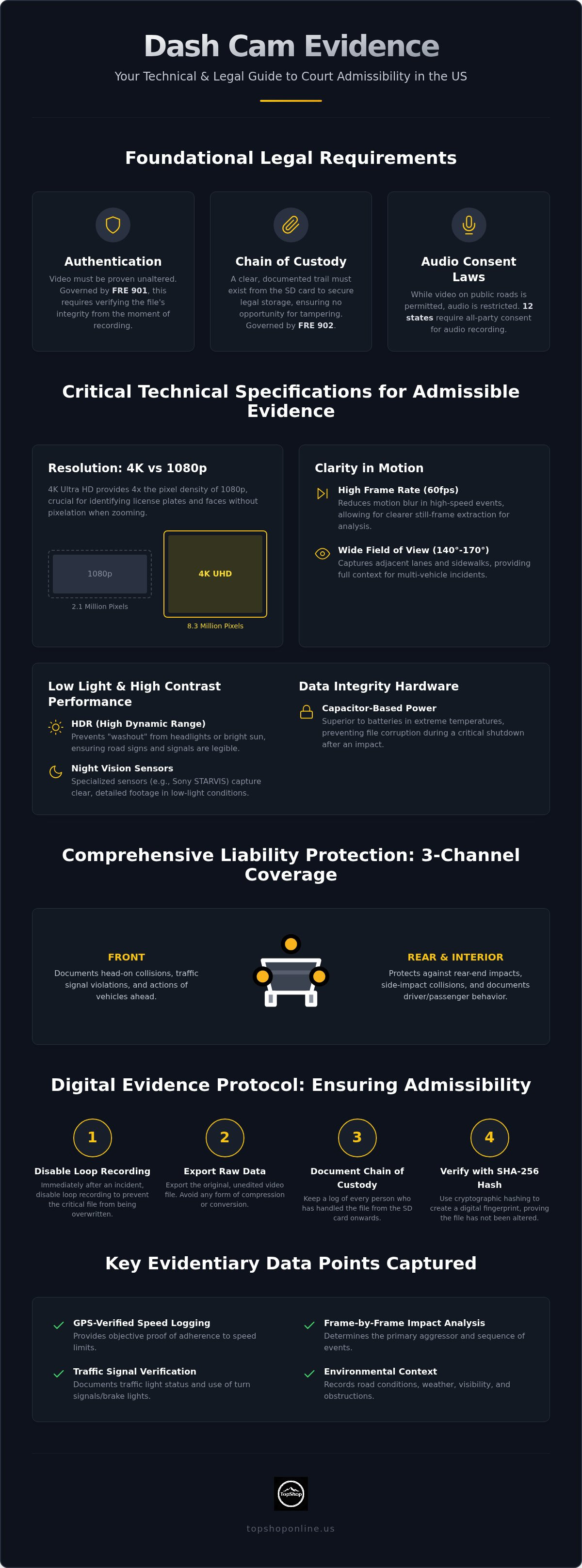
Authentication requires proving that the video file has not been altered since the moment of recording. In 2026, legal experts prioritize cryptographic hashing, such as the NIST-recommended SHA-256 standard, to verify file integrity. A clear chain of custody must be established from the high-speed SD card to the legal representative's secure storage system. Privacy laws impact admissibility significantly. While recording on public roads is a protected right, audio recording is subject to state-level wiretapping statutes. Twelve states, including California, Florida, and Illinois, require all-party consent for audio capture. Footage recorded in violation of these specific statutes may be suppressed or lead to civil penalties, making the manual toggle for microphones a critical hardware feature for legal compliance.
Evidentiary Weight in Liability Disputes
High-resolution video provides definitive proof in multi-vehicle accident litigation by establishing a factual timeline. It identifies specific traffic signal statuses and right-of-way violations that static photos cannot capture. Continuous recording data from systems like the Guardian 3-Channel 4K Dash Cam effectively counters "staged accident" insurance fraud by documenting the pre-impact behavior of all involved parties. This technical evidence facilitates faster deductible recovery and protects insurance premium ratings by clearly establishing non-fault status. Key evidentiary data points include:
- Real-time speed logging: Verified via GPS metadata to prove adherence to local limits.
- Impact point analysis: Frame-by-frame visual data to determine the primary aggressor.
- Signal verification: Documentation of turn signal activation and brake light functionality.
- Environmental context: Recording of road conditions, weather-related visibility, and third-party obstructions.
Establishing the admissibility of dash cam footage is a technical process that relies on the quality of the hardware and the integrity of the data storage. Clear, high-definition files with embedded metadata provide the most reliable protection against disputed liability and fraudulent claims.
Technical Specifications for Admissible Video Evidence
High-resolution video capture serves as the primary technical requirement for forensic identification in legal proceedings. Whether is dash cam footage admissible in court often depends on the clarity of specific identifiers, such as license plate alphanumeric characters and driver facial features. 4K Ultra HD resolution (3840 x 2160) provides 8.29 million pixels per frame, which is four times the pixel density of standard 1080P hardware. This increased density allows for digital zooming during post-incident analysis without significant pixelation. Lens parameters are equally critical; a wide-angle lens between 140° and 170° captures peripheral data from adjacent lanes and sidewalks, ensuring that the full context of a multi-vehicle collision is documented. High frame rates, specifically 60fps (frames per second), reduce motion blur during high-speed incidents compared to the standard 30fps, providing sharper still-frame extraction for evidentiary use.
Optical performance in high-contrast environments requires High Dynamic Range (HDR) technology. HDR processes multiple exposure levels for each frame to prevent "washout" from direct sunlight or oncoming LED headlights. For those seeking insurance-ready hardware, the Guardian 3-Channel 4K Dash Cam utilizes these technical benchmarks to provide consistent, high-bitrate recording across front, rear, and interior channels.
Sensor Technology and Low-Light Performance
Nighttime incidents require specific image sensor hardware to maintain admissibility. Sensors with a large physical size and an aperture of f/1.8 or wider maximize light intake in low-illumination environments. Advanced sensors, such as the Sony STARVIS series mentioned in the 2026 technical standards, utilize back-illuminated pixel technology to increase sensitivity beyond the visible light spectrum. Interior cabin documentation for rideshare liability relies on Infrared (IR) LED arrays, which illuminate the vehicle interior in total darkness without distracting the driver. These technical components ensure that is dash cam footage admissible in court remains a factual certainty rather than a point of technical dispute due to poor visibility or sensor noise.
Metadata Integration and G-Sensor Functionality
Authentication of digital evidence requires synchronized metadata that confirms the time, location, and physical forces involved in an incident. Integrated GPS modules log precise coordinates and vehicle velocity directly into the video file metadata, fulfilling the requirements for "self-authenticating" evidence under FRE 902. G-sensor technology detects sudden changes in gravitational force, such as those caused by impacts or hard braking. When a specific G-force threshold is exceeded, the device automatically triggers an incident lock, moving the current file to a protected folder to prevent overwriting by the loop recording function. Technical experts at dash cam footage in court emphasize that accurate timestamps and uncorrupted file headers are essential for establishing a reliable timeline during legal discovery.
Multi-Angle Coverage: 3-Channel Dash Cam Liability Protection
Triple-channel vehicle monitoring systems provide a 360-degree data envelope by capturing front, rear, and interior cabin views simultaneously. This high-specification configuration addresses the technical limitations of standard single or dual-channel hardware by documenting side-impact collisions and lane-change violations that occur outside the primary forward field of view. When investigating if is dash cam footage admissible in court, legal professionals prioritize synchronized multi-angle data that eliminates blind spots. The Guardian 3-Channel 4K Dash Cam utilizes these three distinct optical paths to generate a comprehensive evidence package, ensuring that metadata timestamps and GPS coordinates remain uniform across all video files for forensic-grade consistency.
Comprehensive Incident Documentation
Rear-facing hardware is a critical requirement for establishing liability in rear-end collisions, providing visual proof of following distances and pre-impact driver behavior. Interior cameras offer essential protection for commercial and rideshare operators by documenting cabin activity, which serves as a primary defense against allegations of distracted driving or passenger misconduct. Recent judicial developments, including the Legality of Public-Submitted Dashcam Footage, indicate a growing reliance on high-bitrate video to resolve complex road crime disputes. Integrating multi-channel data into a single insurance evidence package allows for a frame-by-frame analysis of lane-merging incidents, where front-only footage often fails to capture the initial point of contact.
Continuous Monitoring and Hardware Integration
Advanced 3-channel systems feature parking mode functionality, which utilizes G-sensors and motion detection to record stationary hit-and-run incidents. This continuous monitoring requires stable power delivery, typically achieved through a 12V hardwire kit or high-capacity internal capacitors designed for extreme temperature resistance. For users managing multiple electronic accessories within the vehicle cabin, a high-quality power strip with usb ports ensures organized cable management and consistent voltage for auxiliary devices. Whether is dash cam footage admissible in court depends heavily on the continuity of the recording; systems that provide 360-degree coverage ensure that the entire sequence of events is preserved without gaps in the visual narrative.
- Front Channel: Captures 4K Ultra HD data for license plate and traffic signal identification.
- Rear Channel: Documents tailgating and rear-impact force vectors.
- Interior Channel: Records driver attentiveness and cabin environment using Infrared (IR) sensors.
- Synchronized Metadata: Embeds speed, time, and location data across all three streams.
Digital Evidence Protocol: Submitting Data to Insurance and Legal Entities
Immediate post-incident preservation requires the manual termination of loop recording functions to prevent the overwriting of critical data segments. Determining if is dash cam footage admissible in court often hinges on the presence of unedited, raw original files that maintain their initial metadata structures. Forensic verification processes require these raw files rather than compressed versions shared via social media or messaging applications. High-speed data export from the device to a secure, secondary storage medium ensures that the evidence remains isolated from potential hardware failure or subsequent recording cycles. Original files must be preserved in their native bitrates to allow for forensic enhancement if the court requires clarification of distant license plates or low-light details.
Data Handling and Storage Management
Managing high-bitrate 4K video requires U3-rated SD cards with minimum sustained write speeds of 30MB/s. These technical specifications prevent dropped frames and file corruption during high-resolution data capture. In the event of emergency hardware power-downs, internal capacitors provide the necessary temporary energy to finalize and close the current video file safely. For reliable incident documentation and secure file management, the Guardian 3-Channel 4K Dash Cam offers the necessary hardware architecture for insurance-ready data capture. Cloud-based evidence sharing provides a secure method for transmitting large video files to adjusters and legal counsel, maintaining the file's original resolution and hash value.
Communication with Insurance Adjusters
Disclosure of dash cam existence should occur during the initial claims report to establish transparency and immediate evidentiary availability. Providing specific timestamps and granular descriptions of critical segments allows adjusters to focus on the relevant frames, such as the moment of impact or signal state changes. Most major US insurance carriers now utilize secure mobile applications or direct file transfer portals that support MP4 and MOV formats. Adherence to these technical submission protocols ensures that is dash cam footage admissible in court remains a straightforward process during the discovery phase of a liability dispute.
- File Format Standards: Utilize MP4 or MOV containers for maximum compatibility with legal and insurance portals.
- Unedited Originals: Retain the master file on the original SD card until the claim is fully resolved.
- Metadata Preservation: Do not use video editing software that strips GPS or G-sensor data from the file header.
- Redundant Backups: Store copies on both physical external drives and encrypted cloud services to prevent data loss.
Maintaining unedited original files is a fundamental requirement for forensic verification. Any modification, including trimming or color correction, can invalidate the file's digital signature. Secure storage management involves creating multiple backups on diverse physical media to prevent data loss from hardware degradation. This redundant approach ensures that the original file is always available for court-ordered forensic analysis if the authenticity of the evidence is challenged by opposing counsel.
Ensuring Data Integrity with High-Resolution Dash Cam Hardware
Hardware reliability serves as the final technical hurdle for forensic data preservation. The Guardian 3-Channel 4K Dash Cam integrates high-capacity internal supercapacitors to replace standard lithium-ion batteries. Supercapacitors offer critical advantages in extreme thermal environments, maintaining operational integrity in temperatures from -20°C to 70°C. This stable power source ensures the device successfully finalizes the current video file header during sudden power interruptions or high-impact collisions. Whether is dash cam footage admissible in court often depends on this final file closure process. Corrupted or unreadable file headers caused by abrupt power loss frequently lead to the exclusion of vital evidence in civil and criminal proceedings.
Interface logic and display resolution determine the speed of on-site evidence presentation. The Guardian system features a high-density LCD interface for immediate playback during police reporting, allowing for real-time verification of license plates and road signals. Storage capacity management utilizes a staccato loop recording protocol, dividing footage into 1, 3, or 5-minute segments. Integrated G-sensors automatically migrate incident-related files to a read-only directory, preventing the loop recording function from overwriting critical evidence. This automated file protection system ensures that high-resolution 4K data remains accessible for forensic extraction and insurance portal submission.
Optimizing Evidence Utility with TopShop Hardware
High-bitrate recording ensures detail retention during rapid motion, preventing pixelation of fast-moving identifiers like license plates or street signs. Precise mounting solutions facilitate optimal field-of-view alignment, ensuring that the camera's 170° wide-angle lens covers the entire roadway without obstruction from vehicle A-pillars or rearview mirror housings. For comprehensive security beyond the vehicle, a wireless mini security camera with night vision provides home-based monitoring for parked vehicles, extending the liability protection envelope to residential driveways. These hardware specifications collectively ensure that is dash cam footage admissible in court by providing the clarity and continuity required for forensic authentication.
Routine Maintenance and Functionality Verification
Continuous data integrity requires strict maintenance protocols to prevent recording failures. Monthly SD card formatting using the FAT32 or exFAT file systems prevents write errors and long-term data fragmentation. Periodic firmware updates optimize sensor performance and ensure metadata accuracy for GPS and G-sensor logging. Regular verification of lens clarity and hardware alignment prevents obstructed views caused by road debris, condensation, or mounting vibration. This proactive maintenance schedule ensures the hardware remains in a court-ready state for any future incident.
- Supercapacitor Technology: Ensures file finalization in high-heat environments and during sudden power loss.
- G-Sensor Incident Locking: Automatically protects critical impact files from loop recording deletion.
- High-Bitrate 4K Capture: Maintains forensic detail for license plate and driver identification.
- System Maintenance: Regular formatting and firmware updates prevent file corruption and metadata drift.
Secure Your Legal Protection with Forensic-Grade Evidence
Admissibility in 2026 requires high-bitrate video capture and synchronized metadata to meet Federal Rules of Evidence standards. Determining if is dash cam footage admissible in court depends on the technical integrity of the file and the hardware's ability to document the full 360-degree environment. Implementing a 3-channel monitoring system ensures that side-impact and rear-end collisions are recorded with the same forensic clarity as forward-facing incidents. High-specification components, including internal supercapacitors and G-sensors, prevent data loss during high-impact events and extreme thermal conditions. Maintain your technical advantage on the road with reliable data capture and verified evidence protocols.
Purchase the Guardian 3-Channel 4K Dash Cam for Full Vehicle Protection to access 4K Ultra HD resolution, 3-channel monitoring for front, rear, and interior coverage, and automatic incident locking via integrated G-sensor technology. This hardware provides the necessary data density for insurance-ready evidence capture and liability establishment. Equip your vehicle with the technical specifications required for successful legal and insurance outcomes today.
Frequently Asked Questions
Will a dash cam lower my car insurance premiums in 2026?
Most major US insurance carriers do not provide direct premium discounts for dash cam installation. However, high-specification hardware offers indirect financial protection by establishing non-fault status in multi-vehicle accidents. This evidence prevents the premium increases typically associated with at-fault claims and facilitates the rapid recovery of deductibles through successful subrogation. Reliable video data serves as a safeguard against fraudulent claims and staged accidents.
How do I send dash cam footage to my insurance company after an accident?
Transfer the digital files to a computer and submit them via the insurance carrier’s secure mobile application or direct file transfer portal. Carriers generally prefer MP4 or MOV file formats for maximum compatibility. Always maintain the original raw footage on the high-speed SD card for forensic verification. Provide adjusters with specific timestamps and a technical description of the critical incident segments to accelerate the liability review process.
Is it legal to use dash cam audio in an insurance claim?
The legality of audio evidence depends on state-level wiretapping and consent statutes. Twelve states require all-party consent for recording verbal conversations, meaning audio captured without passenger knowledge may be inadmissible or lead to civil penalties. In one-party consent states, audio is generally admissible and can provide critical context, such as verbal admissions of fault or the sound of mechanical failures immediately preceding a collision.
What happens if my dash cam footage proves I was partially at fault?
Video evidence establishing partial fault will likely result in a comparative negligence determination. Under these legal statutes, the insurance settlement or court award is reduced by your specific percentage of responsibility. Whether is dash cam footage admissible in court remains a matter of judicial discretion, but all parties must disclose relevant evidence during the discovery phase, even if the footage contradicts the driver’s initial account.
Can an insurance company refuse to look at my dash cam video?
Insurance adjusters are not legally mandated to prioritize video evidence, but they generally review it to resolve disputed liability. If a carrier refuses to view the footage, provide a detailed written summary of the visual facts and request a formal explanation for the omission. High-resolution 4K video often serves as the definitive data point for overriding conflicting eyewitness testimonies or inaccurate police reports during the claims adjustment phase.
What SD card is best for capturing 4K dash cam insurance evidence?
Forensic-grade evidence capture requires a U3-rated, Class 10 microSD card with a minimum sustained write speed of 30MB/s. High-endurance cards using MLC or pSLC NAND flash technology are necessary to withstand the continuous write cycles of 4K loop recording. Using the correct technical specifications ensures that is dash cam footage admissible in court by preventing file corruption, dropped frames, or playback errors during legal and insurance reviews.
Should I tell the other driver that I have a dash cam at the scene?
There is no legal requirement to disclose the presence of a dash cam to the other driver at the accident scene. Immediate disclosure can sometimes lead to aggressive behavior or attempts to tamper with the hardware. Inform the responding police officer of the camera to ensure its existence is documented in the official report. Provide the raw data directly to your insurance company or legal representative to maintain a secure chain of custody.
Does a dash cam record when the car is parked and turned off?
Recording while the vehicle is stationary requires a dash cam with parking mode functionality and a continuous power source. This is typically achieved through a hardwire kit connected to the vehicle’s fuse box or an external battery pack. Integrated G-sensors and motion detectors trigger the camera to record when they detect physical impacts or movement near the vehicle, providing essential evidence for hit-and-run incidents and vandalism.