

The hardware architecture of a surveillance system determines its operational longevity and blind-spot mitigation. Selecting a light bulb camera vs mini security camera requires an objective assessment of E26 or E27 socket availability versus the deployment of standalone, battery-operated modules. Most users recognize that power source stability and mounting location are the primary failure points in residential monitoring. You likely want a system that integrates seamlessly with current wiring without sacrificing resolution or connectivity stability.
This technical guide evaluates hardware specifications, power requirements, and night vision capabilities to ensure compatibility with your existing home infrastructure. It provides a detailed breakdown of field-of-view differences, wireless range limitations, and mounting requirements. We analyze the 360° Panoramic Hidden Light Bulb Wifi Camera alongside the 1080P HD Wireless Mini Security WiFi Camera to define which form factor fits your specific security environment. This comparison covers sensor performance, data storage options, and installation complexity to facilitate an informed hardware selection for 2026 security standards.
Key Takeaways
- Differentiate between E27 socket power stability for bulb cameras and the portable battery/USB flexibility of mini modules.
- Compare 360° panoramic fisheye lenses against fixed wide-angle lenses to optimize coverage based on room geometry.
- Evaluate the light bulb camera vs mini security camera trade-offs regarding stealth requirements versus high-visibility deterrent features.
- Assess 2026 connectivity standards including 2.4GHz and 5GHz dual-band support for stable data transmission across different home infrastructures.
- Determine optimal mounting hardware by matching device form factors to specific indoor or outdoor surveillance zones.
Technical Definitions: Light Bulb Cameras vs. Mini Security Cameras
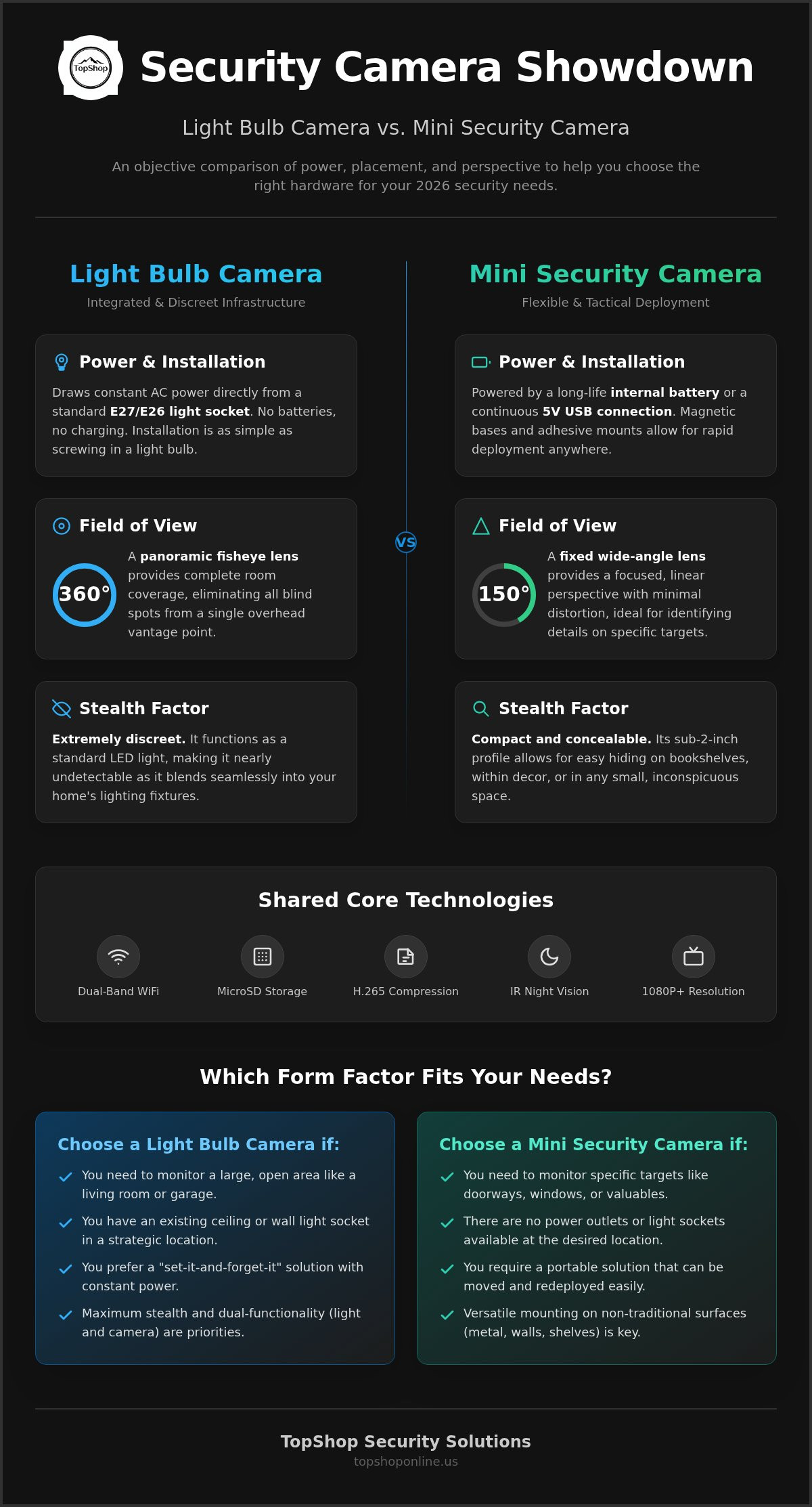
Surveillance hardware selection depends on the intended installation environment and power availability. When comparing a light bulb camera vs mini security camera, the primary technical distinction lies in the mounting interface and power delivery method. Light bulb units function as integrated infrastructure components, whereas mini cameras operate as modular, tactical devices. Both categories fall under the broad technical umbrella of Closed-circuit television (CCTV), utilizing digital signal processing to transmit data over local networks. These systems prioritize high-density data collection while maintaining a small physical footprint for residential or commercial monitoring.
The E27 Light Socket Form Factor
The E27 light bulb camera utilizes a standard Edison screw base for both physical mounting and electrical supply. This hardware configuration integrates high-definition optical sensors, such as the 360° Panoramic Hidden Light Bulb Wifi Camera, directly into the lighting infrastructure. It draws constant AC power from the socket, which removes the operational risks associated with battery depletion. These devices often feature 360-degree panoramic lenses, providing hemispherical coverage from a single overhead point. Installation requires zero tools or specialized wiring; the unit threads into existing indoor or outdoor light fixtures. It's an efficient multi-use hardware component that provides LED illumination while recording video.
The Mini WiFi Camera Form Factor
Mini security cameras prioritize concealment through sub-2 inch profiles and lightweight plastic or metallic housings. These units are standalone modules powered by internal lithium-ion batteries or a 5V USB connection. Mounting versatility is high. They utilize magnetic bases or adhesive brackets for placement on non-traditional surfaces like bookshelves, walls, or metal frames. The optical system typically uses a fixed-focus lens with a horizontal field of view ranging from 90 to 150 degrees. This provides a focused, directional perspective rather than a full room scan. Devices like the 1080P HD Wireless Mini Security WiFi Camera are designed for rapid deployment in areas where a standard light socket is unavailable.
Both device types share a common internal hardware stack despite their external differences. They utilize CMOS (Complementary Metal-Oxide-Semiconductor) image sensors to convert light into digital signals. Integrated WiFi modules facilitate real-time data transmission to mobile applications. For localized recording, both form factors include MicroSD card slots for edge storage, often supporting capacities up to 128GB. This technical overlap ensures that the choice between a light bulb camera vs mini security camera is based on deployment logistics and mounting constraints rather than fundamental imaging technology. Understanding these architectural differences is essential for selecting a device that matches your specific surveillance strategy.
Hardware Specifications: Resolution, Field of View, and Night Vision
Hardware specifications for 2026 consumer models prioritize sensor density and efficient data compression. When evaluating a light bulb camera vs mini security camera, the optical architecture dictates the surveillance utility. Light bulb units typically feature fisheye lenses for 360-degree panoramic coverage, while mini cameras utilize wide-angle fixed lenses for higher pixel density on specific targets. Both device types integrate H.265 hardware-level compression to maintain high-frame-rate WiFi streaming without saturating local network bandwidth. Hardware-level noise reduction and high ISO sensitivity are standard across both categories to ensure image clarity in variable lighting conditions.
- Resolution: 1080P HD baseline; 4K UHD for high-end panoramic models.
- Compression: H.265 High Efficiency Video Coding (HEVC).
- Illumination: 850nm/940nm IR and white LED arrays.
Optical Performance and CMOS Sensors
Light bulb cameras utilize large-format CMOS sensors optimized for panoramic rendering. This hardware configuration, found in the 360° Panoramic Hidden Light Bulb Wifi Camera, eliminates blind spots in high-traffic areas like entryways or garages. However, the fisheye geometry results in peripheral image warping. Conversely, the 1080P HD Wireless Mini Security WiFi Camera provides a linear perspective with minimal distortion. This fixed-lens approach offers superior facial recognition clarity at distances exceeding 15 feet. Digital zoom performance is generally more effective on mini cameras due to the concentrated pixel distribution across a narrower 90 to 150-degree horizontal field of view. Users must consider legal definitions of electronic surveillance when positioning these high-resolution sensors in private or semi-private spaces.
Illumination and Night Vision Hardware
Night vision capabilities differ based on the physical housing and power capacity of the device. Light bulb cameras often incorporate dual-source lighting systems. These include standard Infrared (IR) LEDs for grayscale monitoring and high-intensity white LEDs for full-color night vision. This visible light also serves as a proactive deterrent. Mini cameras prioritize tactical concealment, frequently utilizing 940nm stealth IR LEDs. These emitters are invisible to the human eye, preventing the faint red glow associated with 850nm hardware. Both form factors typically provide an effective IR illumination range of 30 feet, though light bulb cameras benefit from higher mounting points for broader light dispersion.
For high-resolution monitoring solutions with integrated night vision, you can browse the full security camera catalog to compare specific sensor data. Image processing engines in these 2026 models include advanced noise reduction algorithms. These maintain image integrity at high ISO settings, which is critical for low-light environments without active illumination. While 1080P resolution is standard for entry-level mini units, high-end light bulb cameras increasingly adopt 4K UHD sensors to compensate for the digital cropping required in panoramic viewing modes. Selecting between a light bulb camera vs mini security camera ultimately requires balancing the need for total room coverage against the requirement for high-detail tactical imaging.
Power and Connectivity: E27 Socket vs. USB/Battery Operation
The power architecture defines the operational reliability of the light bulb camera vs mini security camera comparison. Bulb cameras utilize the E27 screw-in interface for continuous 110V-240V AC power, whereas mini cameras rely on internal 3.7V lithium-ion batteries or 5V USB inputs. Continuous power eliminates the maintenance cycle required for battery-operated devices, ensuring the 360° Panoramic Hidden Light Bulb Wifi Camera remains online during critical monitoring periods. Conversely, the 1080P HD Wireless Mini Security WiFi Camera offers tactical portability, allowing for placement in environments devoid of electrical infrastructure, provided the user manages the recharge cycles or utilizes a permanent USB power bank connection.
Electrical Requirements and Socket Compatibility
Light bulb cameras are designed for universal voltage compatibility, typically supporting 110V to 240V ranges found across national US power grids. The hardware consumes between 5W and 10W during peak operation, which includes both the LED illumination and the WiFi camera module. Users must verify socket depth before installation; recessed lighting fixtures or narrow outdoor lanterns may prevent the bulb from seating fully into the E27 base. If the socket is deeply recessed, the camera's panoramic field of view is often obstructed by the fixture housing, necessitating a socket extender for optimal lens clearance.
Wireless Signal Integrity
Wireless performance in 2026 hardware relies on dual-band support for 2.4GHz and 5GHz frequencies. The 2.4GHz band provides superior signal penetration through drywall and masonry, which is essential for light bulb cameras mounted in external porch fixtures. Mini cameras often utilize internal PCB antennas to maintain their compact profiles, which can result in higher latency if placed far from the router. Latency metrics for modern modules aim for sub-500ms response times for real-time remote monitoring via smartphone applications. H.265 encoding is essential for maintaining 1080P streaming quality while reducing total bandwidth consumption on crowded home networks.
Data storage and app integration form the final layer of the connectivity stack. Both device categories support local microSD card storage, often up to 128GB, providing a physical backup that functions independently of internet stability. Encrypted cloud storage options are available through common firmware ecosystems like Tuya and SmartLife, offering off-site data redundancy. These third-party apps provide a unified interface for motion alerts, two-way audio, and remote playback. When choosing between a light bulb camera vs mini security camera, the stability of the WiFi signal at the mounting location is as critical as the power source itself. High-bandwidth 5GHz connections are preferable for 4K streaming, while 2.4GHz remains the standard for long-range outdoor deployments.
Strategic Use Cases: Indoor Stealth vs. Outdoor Visibility
Deployment strategy bifurcates based on the desired psychological impact and physical constraints of the monitoring site. A light bulb camera vs mini security camera decision often hinges on whether the user seeks an active deterrent or covert documentation. Light bulb units serve as overt surveillance markers, signaling to intruders that the area is under 24/7 monitoring. Conversely, mini modules prioritize tactical concealment, capturing high-resolution footage without altering the visual profile of the room. Each configuration offers specific advantages depending on the mounting height and available power infrastructure.
Best Environments for Light Bulb Cameras
Overhead mounting points provide the optimal vantage for the 360° Panoramic Hidden Light Bulb Wifi Camera. These devices excel in high-traffic zones such as residential porches, detached garages, and commercial warehouse entry points. By replacing standard floodlights or porch bulbs, users integrate security into existing lighting hardware. This dual-purpose setup provides 360-degree coverage, eliminating the blind spots common in fixed-position cameras. In retail environments, overhead placement allows for comprehensive floor monitoring from a single E27 socket, which reduces the total hardware count required for full-room visibility.
Optimal Scenarios for Mini Security Cameras
Tactical placement requires the compact dimensions of the 1080P HD Wireless Mini Security WiFi Camera. These units are ideal for eye-level monitoring, which is critical for capturing high-detail facial identification that overhead cameras might miss. Common use cases include nanny monitoring, asset protection in home offices, and temporary security in hotel rooms or vacation rentals. Because these devices utilize magnetic or adhesive mounts, they are the primary choice for renters in apartments where permanent drilling is prohibited. See our 1080p wireless mini security camera guide for more placement tips and mounting strategies.
Surveillance effectiveness is also influenced by the deterrence factor. Visible light bulb cameras can prevent unauthorized entry by their mere presence. If an intruder is aware of camera locations, they might attempt to bypass them. This is where a secondary, hidden mini camera provides a redundant layer of protection. For apartment dwellers, the non-permanent nature of both form factors ensures that security can be relocated during a move without damaging property. Understanding the deployment trade-offs of a light bulb camera vs mini security camera is vital for multi-layered defense. To secure your perimeter with professional-grade hardware, you can purchase high-definition security cameras here for immediate deployment.
Choosing Your Device: TopShop Security Solutions
Finalizing a surveillance strategy requires a technical comparison of the 360° Panoramic Hidden Light Bulb Wifi Camera and the 1080P HD Wireless Mini Security WiFi Camera. The optimal selection between a light bulb camera vs mini security camera depends on the specific mounting infrastructure and the desired level of concealment. Light bulb cameras provide high-visibility deterrence and overhead panoramic coverage through existing electrical sockets. Mini security cameras offer modular flexibility and tactical placement for high-detail identification at eye level. Both hardware types utilize CMOS sensors and integrated WiFi modules for reliable remote monitoring via smartphone applications.
TopShop Hardware Comparison
The 360° Panoramic Light Bulb Camera utilizes a standard E27 screw base for continuous AC power. It features a fisheye lens that delivers 360-degree hemispherical coverage, making it suitable for large rooms, garages, or porches. The 1080P Mini Security Camera utilizes a sub-2 inch profile for discreet installation in sensitive indoor areas. It relies on a 3.7V internal battery or a 5V USB connection, allowing for placement on bookshelves, walls, or metal frames via magnetic brackets. For more hardware options, explore our buying guide for mini cameras.
Final Procurement Checklist
Before deployment, verify the wireless environment and storage requirements to ensure operational uptime. High-definition video streaming requires a stable 2.4GHz WiFi signal with sufficient upload bandwidth at the installation point. Localized data storage is managed via MicroSD slots, which typically support up to 128GB capacities for high-density edge recording. Smartphone application compatibility is standardized across both models, providing a unified interface for motion alerts and two-way audio communication. Follow this hardware checklist to confirm site readiness:
- WiFi Strength: Test signal dBm at the specific mounting height and location.
- Power Source: Confirm E27 socket depth for bulb cameras or USB cable reach for mini units.
- Storage Capacity: Install a Class 10 MicroSD card for reliable 1080P data writing.
- App Setup: Ensure the smartphone is connected to the same 2.4GHz network during initial pairing.
Choosing the correct hardware involves balancing permanent infrastructure integration against modular placement flexibility. To select the device that fits your specific security environment, Browse all TopShop Wireless Security Cameras for comprehensive technical specifications and inventory availability. Each model is designed for rapid setup and high-resolution data collection to maintain a secure residential or commercial perimeter.
Optimizing Your 2026 Surveillance Infrastructure
The technical evaluation of a light bulb camera vs mini security camera highlights the critical need to match device form factors with specific environmental constraints. Light bulb cameras utilize the E27 socket for continuous AC power and 360-degree panoramic coverage, serving as an effective deterrent in high-traffic zones like entryways. Conversely, mini security cameras prioritize tactical concealment through sub-2 inch profiles and magnetic mounting, capturing high-detail facial identification at eye level. Both hardware categories integrate 1080P HD resolution, infrared night vision, and H.265 compression for high-efficiency data transmission across 2.4GHz WiFi networks. Selection depends on verifying local signal strength and ensuring compatibility with existing lighting fixtures or mounting surfaces. Utilizing local microSD storage provides data redundancy for continuous monitoring without reliance on cloud stability. You can now establish a robust security perimeter by selecting the hardware that balances infrastructure integration with modular flexibility. Secure your home with TopShop's 1080P HD Wireless Security Cameras and leverage 360° panoramic coverage with fast US shipping. These specifications ensure a professional-grade surveillance environment for any residential or commercial application.
Frequently Asked Questions
Do light bulb cameras work when the light switch is turned off?
No, light bulb cameras require a continuous AC power supply from the E27 socket to function. When the wall switch is turned off, the electrical circuit is broken and the camera loses power immediately. To ensure 24/7 surveillance, the switch must remain in the on position. Users can still turn the integrated LED light on or off independently through the smartphone application without interrupting the camera power.
Can mini security cameras record without a WiFi connection?
Mini security cameras maintain recording functionality to local microSD storage media during WiFi outages. While remote viewing and real-time motion alerts require an active internet connection, the 1080P HD Wireless Mini Security WiFi Camera continues to capture and store footage on the physical card. This makes them reliable for remote monitoring in areas with unstable networks. Users can retrieve the SD card later to view files on a computer.
How many hours of footage can a 128GB SD card hold for 1080P video?
A 128GB microSD card typically stores between 280 and 320 hours of 1080P HD video footage. The exact duration depends on the bitrate and the efficiency of the H.265 compression hardware. Most modern surveillance modules utilize loop recording technology. This process automatically overwrites the oldest files on the card once the 128GB capacity is reached, ensuring the device never stops recording due to lack of storage space.
Are light bulb security cameras weatherproof for outdoor use?
Standard light bulb cameras are generally designed for indoor use or protected outdoor environments. They lack the high IP ratings required for direct exposure to rain or heavy moisture. When deploying the 360° Panoramic Hidden Light Bulb Wifi Camera outdoors, it must be installed inside a weatherproof light fixture or under a deep eave. This protection prevents water from entering the E27 socket and damaging the internal CMOS sensor and WiFi module.
What is the difference between a panoramic camera and a PTZ camera?
Panoramic cameras utilize a fixed fisheye lens to capture a 360-degree field of view without moving parts. PTZ cameras use mechanical motors to pan, tilt, and zoom the lens toward specific targets. The decision between a light bulb camera vs mini security camera often involves choosing between the total room coverage of a panoramic bulb and the fixed, directional focus of a mini module. Panoramic units eliminate blind spots without mechanical wear.
Do I need a subscription to view recorded footage on these cameras?
No, a paid subscription is not required to view or manage recorded footage when using local microSD storage. Both light bulb and mini cameras feature integrated card slots for edge recording. Users access these files through the free Tuya or SmartLife mobile applications. Optional cloud storage subscriptions are available for those who require off-site data redundancy, which protects video evidence if the physical camera is stolen or the SD card fails.
Can multiple users access the camera feed simultaneously?
Yes, the firmware for these wireless security devices supports multi-user access through account sharing features. The primary administrator can grant viewing permissions to other smartphones via the mobile app. Most systems allow up to five users to view the live 1080P feed simultaneously. This requires sufficient upload bandwidth at the camera location to prevent lag. Each user must have the compatible application installed on their mobile device.
What is the typical battery life of a wireless mini security camera?
Typical battery life for a wireless mini security camera is between 1 and 4 hours during continuous recording. In low-power standby mode with motion detection enabled, the battery can last for several days depending on the frequency of triggers. For long-term surveillance, these devices are usually connected to a permanent 5V USB power source. This bypasses the limitations of the internal lithium-ion battery and ensures the camera remains online indefinitely.