

The primary failure point in residential surveillance deployment is infrastructure incompatibility rather than raw sensor resolution. You likely require high-definition monitoring but face the technical hurdle of running coaxial or Ethernet cables through structural walls or locating available power outlets in elevated positions. This technical guide provides a data-driven comparison of light bulb camera vs traditional security camera hardware to identify the optimal form factor for your specific environment. You'll determine if socket-integrated hardware meets your 1080P resolution requirements and if the 360-degree panoramic field-of-view compensates for the lack of traditional fixed-point mounting.
We analyze specific hardware specifications including E26 socket power draw, WiFi signal attenuation in hybrid housings, and local MicroSD storage capacities. This comparison evaluates the 360° Panoramic Hidden Light Bulb Wifi Camera against the 1080P HD Wireless Mini Security WiFi Camera to establish a clear hierarchy of installation speed versus surveillance redundancy. We provide the technical data necessary to select a form factor that matches your existing electrical footprint and your specific monitoring objectives. This analysis prioritizes measurable hardware attributes to ensure your chosen device functions within the constraints of your physical site.
Key Takeaways
- Analyze structural differences between E26/E27 socket-integrated units and standalone systems requiring dedicated Power over Ethernet (PoE) or external AC wiring.
- Contrast 1080P HD optical sensor performance and 360° panoramic field-of-view capabilities within the light bulb camera vs traditional security camera hardware comparison.
- Assess the installation efficiency of zero-wiring socket deployment against the technical requirements of permanent, hardwired surveillance mounting.
- Review decentralized data management options including local MicroSD card slots supporting up to 128GB for independent video storage.
- Implement a selection framework to align hardware form factors with specific environmental needs such as rental property limitations or covert monitoring goals.
Technical Architecture: Light Bulb Cameras vs. Traditional Fixed Units
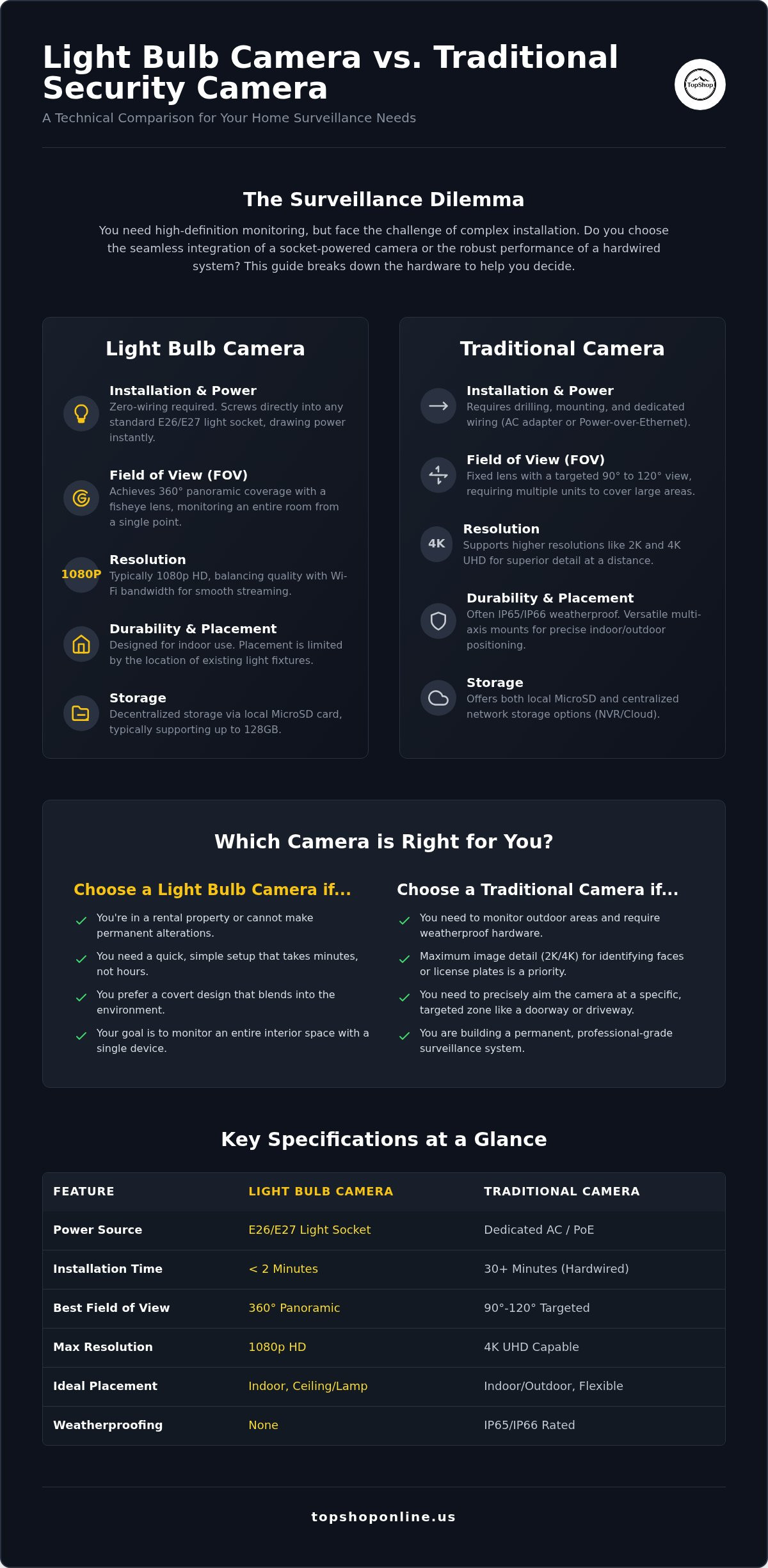
A light bulb camera functions as an integrated IoT surveillance device drawing power directly from a standard E26 or E27 light socket. This architecture eliminates external wiring. Conversely, traditional fixed units operate as standalone hardware requiring dedicated power cables or Power over Ethernet (PoE) connections. The primary technical differentiation in the light bulb camera vs traditional security camera debate lies in power delivery and chassis integration. Light bulb models utilize internal AC-to-DC converters to power the CMOS sensor, image signal processor (ISP), and wireless transmission modules within a singular A19 or BR30 form factor.
Core hardware components remain consistent across both categories but vary in physical arrangement. CMOS sensors capture raw optical data, which the ISP then converts into compressed digital video streams. Integrated Wireless Security Camera Technology allows these devices to transmit 1080P HD video over 2.4GHz or 5GHz bands. Traditional cameras often utilize larger, specialized chassis such as bullet, dome, or turret designs to accommodate larger heat sinks and interchangeable lens assemblies. Hybrid bulb units must consolidate these functions into a footprint compatible with existing lighting fixtures.
Socket-Integrated Hardware Design
The 360° Panoramic Hidden Light Bulb Wifi Camera integrates high-intensity LED arrays alongside camera optics within a standard lamp base chassis. This hybrid configuration creates specific heat dissipation challenges. Engineers utilize thermally conductive plastics and vented housing to manage the thermal output of both the illumination LEDs and the ISP. Internal circuitry performs the step-down conversion from 110V-240V AC line voltage to the low-voltage DC required for stable sensor operation. This design prioritizes rapid deployment in existing electrical infrastructure over the modularity found in industrial-grade systems.
Standalone Traditional Camera Construction
Traditional hardware prioritizes environmental durability and mounting versatility. Most outdoor units carry IP65 or IP66 weatherproofing ratings, featuring sealed gaskets and metal housings that resist moisture ingress and dust. The 1080P HD Wireless Mini Security WiFi Camera offers a compact, standalone alternative for targeted monitoring where a bulb socket is unavailable. Traditional systems allow for precise physical positioning via multi-axis mounting brackets; bulb cameras are constrained by the fixed orientation of the lamp holder. High-end traditional units often feature larger physical sensors, providing superior low-light performance compared to the miniaturized sensors found in most multi-functional bulb hardware.
Optical Performance and Sensor Specifications
The optical differentiation in the light bulb camera vs traditional security camera comparison centers on sensor density and lens geometry. While 1080P HD serves as the baseline resolution for entry-level hardware, 4K resolution is the 2026 baseline for new professional-grade security installations. Higher pixel counts enable effective digital zoom by maintaining image clarity at greater distances. Traditional units often support 2K or 4K UHD sensors that provide superior detail for license plate recognition or facial identification at ranges exceeding 20 feet. Conversely, many socket-integrated models prioritize efficient data transmission, utilizing 1080P sensors to balance video quality with WiFi bandwidth constraints.
Field of view (FOV) represents a significant hardware divergence. Traditional fixed-lens cameras typically offer a horizontal FOV between 90 and 120 degrees, requiring multiple units to cover a single large room. Modern panoramic hardware utilizes fish-eye optics to achieve a full spherical perspective. This geometry allows a single device to monitor an entire interior space from a central ceiling mount. You can evaluate high-resolution options like the 360° Panoramic Hidden Light Bulb Wifi Camera to eliminate the blind spots common in fixed-angle deployments.
360° Panoramic Coverage vs. Targeted Surveillance
Panoramic lenses provide total situational awareness by capturing a circular image that covers all quadrants simultaneously. This hardware requires software-side dewarping to convert the distorted fish-eye footage into a flat, viewable perspective. While excellent for central room placement, panoramic optics suffer from lower pixel density at the edges of the frame compared to traditional lenses. Traditional fixed-angle cameras are more effective for targeted perimeter monitoring where high-detail capture of a specific entry point is the primary security objective. These units deliver consistent pixel-per-foot ratios across the entire image area.
Night Vision and Illumination Hardware
Low-light performance depends on the integration of Infrared (IR) and white LED arrays. Traditional security cameras often feature large IR rings capable of illuminating subjects up to 100 feet in total darkness. Light bulb cameras utilize dual-light source technology, combining IR LEDs for stealthy black-and-white monitoring with high-output white LEDs for full-color night vision. The compact chassis of a bulb unit limits the size of the IR array, typically resulting in an effective night vision range of 30 to 50 feet. Advanced firmware allows these devices to switch automatically between infrared mode and active illumination when motion is detected, providing both a visual deterrent and high-contrast video evidence.
Power Supply and Installation Logistics
Installation friction serves as the primary differentiator in the light bulb camera vs traditional security camera selection process. Light bulb hardware utilizes existing E26 or E27 screw-in sockets for immediate power acquisition, effectively bypassing the need for new electrical runs. Traditional units require professional hardwiring, typically involving 12V DC transformers or Power over Ethernet (PoE) injectors. While traditional systems provide superior power stability, they necessitate structural modifications such as drilling and cable fishing through wall cavities or specialized conduit installation.
A critical operational constraint for bulb-integrated hardware is the "Continuous Power" requirement. Because the camera draws current from the light fixture, the controlling wall switch must remain in the "ON" position at all times. If the switch's toggled off, the camera loses connectivity and stops recording immediately. You can mitigate this by installing physical switch guards or utilizing smart bypass modules. Traditional hardwired systems don't suffer from this vulnerability because they connect directly to unswitched electrical circuits, ensuring 24/7 uptime regardless of room lighting status.
E26/E27 Socket Compatibility
Standardized E26 (North America) and E27 (Europe/Asia) sockets provide a universal mounting interface. However, physical clearance within recessed "can" fixtures or decorative enclosures can obstruct the camera lens or impede the 360-degree rotation of the chassis. Stable operation of socket-based WiFi cameras requires a consistent input voltage between 110V and 240V AC. If a fixture's too deep, you can utilize rigid socket extenders to lower the camera below the trim line for an unobstructed field of view. Socket splitters also allow for the simultaneous use of a standard LED bulb and a surveillance unit in a single terminal.
Hardwired vs. Wireless Deployment
Traditional systems often rely on PoE, which transmits both data and power over a single Cat6 cable for maximum reliability. This eliminates the signal interference issues sometimes associated with wireless transmission. In scenarios where light sockets are unavailable, the installation of wireless mini security cameras in locations without light sockets offers a functional compromise. These compact units can be placed on shelves or mounted to walls using small-footprint brackets. Unlike bulb cameras, standalone wireless units don't always require a socket but may need proximity to a standard wall outlet or the use of high-capacity battery packs, necessitating a plan for cable concealment or periodic recharging cycles.
Connectivity, Storage, and Data Management
Network architecture represents a fundamental technical divergence in the light bulb camera vs traditional security camera comparison. Most socket-integrated units utilize 2.4GHz WiFi protocols to prioritize signal penetration through interior walls, while professional traditional systems often employ hardwired Ethernet for zero-latency data transfer. Local storage in bulb cameras is decentralized, typically utilizing internal MicroSD card slots that support up to 128GB of data. This allows for one-time hardware costs without mandatory monthly fees, but it doesn't offer the centralized redundancy of a Network Video Recorder (NVR) found in traditional multi-camera arrays. SD cards are vulnerable to physical theft of the camera unit itself, whereas NVR systems store data in a separate, hardened location for superior evidence protection.
Choosing a specific form factor dictates the psychological strategy of the surveillance deployment. Traditional bullet or dome cameras serve as visible deterrence, signaling active monitoring to potential intruders. Conversely, the 360° Panoramic Hidden Light Bulb Wifi Camera provides a stealth advantage, capturing 1080P HD footage from an inconspicuous housing that blends into existing fixtures. This hidden approach is effective for internal monitoring where visible hardware might be intrusive or subject to tampering. It's an optimal choice for high-traffic residential areas where you need to maintain a natural aesthetic while ensuring full-room coverage.
WiFi attenuation occurs when light fixture materials like metal or thick glass act as Faraday cages, degrading wireless signal strength. Compact bulb housings limit internal antenna size, making router proximity essential for maintaining stable 1080P streams. You'll need to minimize structural barriers between the access point and the camera socket to prevent frame drops or connectivity timeouts. While 2.4GHz bands offer greater range, they're more susceptible to interference from household appliances; 5GHz bands provide higher bandwidth for high-resolution video but struggle with wall penetration in larger properties.
Integrated software provides the primary command center for remote management, offering real-time motion alerts and two-way audio communication. Security protocols utilize AES encryption for all wireless transmissions to prevent unauthorized data interception. Multi-user settings allow the primary administrator to share viewing permissions, ensuring comprehensive property oversight for all authorized stakeholders. Cloud storage options are also available for those who require off-site redundancy, though these services typically involve recurring monthly subscription fees that vary based on the provider and the required duration of video history.
Selection Framework: Matching Hardware to Use Case
Selecting the appropriate surveillance form factor requires an objective assessment of property ownership rights, installation capability, and environmental exposure levels. The light bulb camera vs traditional security camera decision often hinges on whether the user has the authority to perform structural modifications. Apartment renters or short-term residents benefit from non-invasive hardware that utilizes existing E26 sockets, avoiding the drilling and cable management required for permanent mounts. Homeowners with perimeter security requirements typically prioritize the environmental durability and high-frame-rate recording capabilities of dedicated outdoor units that connect directly to unswitched electrical circuits.
Surveillance psychology also dictates hardware choice. Visible traditional cameras serve as active deterrence by indicating a fortified perimeter. Conversely, socket-integrated models offer a stealthier profile for interior monitoring where a visible camera chassis might disrupt the aesthetic or indicate surveillance to guests. Budget considerations must account for the initial equipment acquisition and recurring storage expenses. While light bulb cameras offer lower entry costs and decentralized MicroSD storage, traditional multi-camera arrays often necessitate centralized NVR hardware and professional-grade cabling for long-term reliability. You'll need to balance the $20 to $50 cost of entry-level bulb units against the $200 to $800 total first-year investment required for professional-grade systems.
Environmental factors significantly impact hardware longevity. Indoor climate-controlled areas are suitable for the hybrid plastic housings of bulb cameras. However, exposed outdoor perimeters require the ruggedized aluminum or polycarbonate chassis found in traditional IP66-rated units. These traditional systems resist dust ingress and moisture, ensuring operational stability during severe weather events. Socket-based units deployed outdoors should be restricted to covered porches or enclosed fixtures to prevent circuit failure from direct rain exposure.
When to Choose a Light Bulb Camera
Light bulb hardware is optimal for interior environments where central ceiling sockets are available for 360° panoramic indoor coverage. These units are effective for:
- Rental Properties: Zero-wiring installation allows for removal without leaving structural damage or needing professional restoration.
- Short-Term Monitoring: Rapid deployment for temporary security needs such as vacation home oversight or nursery monitoring.
- Entry Point Surveillance: Replacing standard porch lights with a 1080P HD unit provides immediate visibility of deliveries and visitors without new electrical runs.
When to Choose a Traditional Camera
Traditional standalone units are required for high-security perimeters and locations lacking pre-existing electrical fixtures. These devices are suitable for:
- Exposed Outdoor Perimeters: Hardware with IP65 or IP66 ingress protection ratings withstands extreme temperature fluctuations and direct moisture contact.
- Remote Fence Lines: Locations without light sockets require dedicated PoE or DC power runs to ensure continuous operation.
- Integrated Workspaces: Incorporating cameras into smart home office setups allows for centralized data management and multi-channel recording via local NVR systems.
Optimizing Your Surveillance Hardware Deployment
The light bulb camera vs traditional security camera comparison highlights a fundamental trade-off between rapid, zero-wiring deployment and permanent, high-redundancy infrastructure. Technical data confirms that socket-integrated hardware provides a functional 1080P HD surveillance solution for renters and homeowners seeking 360-degree panoramic coverage without structural modifications. Traditional units remain the standard for high-security perimeters requiring weather-resistant IP66-rated housings and centralized NVR data management. Each form factor serves specific environmental needs based on power availability and required sensor density.
Selecting the correct hardware ensures your monitoring goals align with your property's existing electrical footprint and connectivity range. High-resolution hardware is now accessible for every installation skill level, whether you prioritize hidden monitoring in central living spaces or visible deterrence for high-traffic entry points. You can effectively mitigate property risks by matching sensor specifications and power requirements to your specific environmental constraints. Reliable surveillance depends on choosing the device that functions within your site's physical limitations.
Browse the TopShop Security Camera Collection to access competitive pricing on 1080P HD wireless hardware and specialized 360° panoramic hidden camera options. We ensure fast shipping across the United States to facilitate immediate surveillance upgrades. Secure your environment today with hardware engineered for technical precision and operational reliability.
Frequently Asked Questions
Do light bulb cameras work when the light switch is turned off?
Light bulb cameras don't function when the controlling wall switch is in the "OFF" position. These devices require a continuous 110V-240V AC power supply to maintain the WiFi connection and sensor operation. Turning off the switch breaks the electrical circuit, resulting in immediate hardware shutdown and loss of remote access. You must keep the switch "ON" at all times or utilize a physical switch guard to prevent accidental power interruption to the surveillance unit.
Can I use a light bulb camera outdoors in an open fixture?
Operation in open outdoor fixtures isn't recommended due to limited weatherproofing. Most bulb cameras lack the IP65 or IP66 ingress protection ratings found in traditional outdoor units. Exposure to direct rain, high humidity, or dust can cause internal circuit failure. When comparing a light bulb camera vs traditional security camera for exterior use, the bulb-based unit should be restricted to covered porches or enclosed, moisture-resistant fixtures to ensure hardware longevity.
Do light bulb cameras record 24/7 or only when motion is detected?
Most socket-integrated cameras support both 24/7 continuous loop recording and motion-triggered event capture. Users can configure these settings within the mobile application to prioritize storage efficiency or comprehensive monitoring. Continuous recording provides a complete video history but consumes MicroSD card capacity rapidly. Motion detection mode records only when the CMOS sensor identifies movement, which extends the storage duration of the local memory card and simplifies the process of reviewing security events.
What is the maximum MicroSD card size supported by most bulb cameras?
The majority of modern bulb-integrated surveillance units support MicroSD cards with capacities up to 128GB. This decentralized storage allows for localized data management without recurring cloud subscription fees. A 128GB card typically stores several days of 1080P HD video before the loop recording feature begins overwriting the oldest files. You should utilize high-endurance, Class 10 or UHS-I cards to ensure stable write speeds and reliable performance during continuous high-definition video data transmission.
Is a light bulb camera as bright as a regular LED bulb?
Light bulb cameras generally provide lower lumen output compared to dedicated high-wattage LED bulbs. The internal chassis must balance power delivery between the LED array, the camera sensor, and the WiFi transmission module. While the built-in white LEDs offer sufficient illumination for full-color night vision and basic area lighting, they aren't intended to serve as the primary light source for large rooms. The illumination hardware prioritizes visibility for the 1080P optical sensor.
Do I need a subscription to use a light bulb security camera?
A subscription isn't required for basic operation and local data storage. Most hardware includes a MicroSD card slot for decentralized recording, allowing users to avoid monthly service fees. Optional cloud storage subscriptions are available for users who require off-site data redundancy and extended video history. When evaluating the light bulb camera vs traditional security camera cost structure, the ability to utilize local storage represents a significant reduction in the total long-term ownership expense.
How do I reset a light bulb camera if it loses WiFi connection?
Resetting the device requires a physical interaction with the reset pinhole located on the camera chassis. Insert a reset pin or similar tool into the designated opening and hold the internal button for approximately 5 to 10 seconds until the device emits a voice prompt or status tone. This action restores the hardware to factory default settings, clearing previous WiFi credentials and allowing for a new pairing process via the mobile application.
Can multiple light bulb cameras be viewed in the same app?
Multiple units can be integrated into a single mobile application for centralized property management. Most surveillance apps support multi-channel viewing, enabling users to monitor different rooms or entry points from a unified dashboard. You can group cameras by location and share access permissions with other authorized users. This software architecture provides scalable oversight for both residential and commercial environments, allowing for the addition of new hardware as monitoring requirements expand over time.