

Hardware limitations in legacy projection units have been superseded by integrated Android OS architectures and high-speed wireless protocols. Many users currently struggle with significant latency during wireless mirroring or find their devices unable to run modern streaming applications due to outdated firmware. It's clear that a standard mini projector wifi android setup requires specific technical benchmarks to remain functional in a high-density data environment. Achieving stable 1080P output and direct app access depends entirely on the underlying hardware composition and connectivity standards.
This reference guide provides a comprehensive breakdown of the technical specifications required for 2026 hardware performance. You'll find detailed information on processor requirements, dual-band WiFi 6 integration, and the optical engine standards necessary for native 1080P resolution. We'll examine how the Smart Projector Wifi Portable 1080P model utilizes these components to deliver a portable yet high-performance viewing experience. This analysis covers the transition from simple screen mirroring to standalone Android functionality, ensuring your hardware selection supports professional-grade stability and direct streaming capabilities without the need for external adapters.
Key Takeaways
- Identify essential hardware components like LED light sources and internal processors that enable seamless Android OS integration.
- Distinguish between native 1080P resolution and supported input to ensure high-definition visual clarity in various environments.
- Compare standalone mini projector wifi android functionality against external media players for direct streaming app access.
- Implement network optimization strategies to minimize latency during wireless screen mirroring from mobile devices.
- Review the specific hardware dimensions and technical performance metrics of the Smart Projector Wifi Portable 1080P.
Technical Overview of Mini Projector WiFi and Android Integration
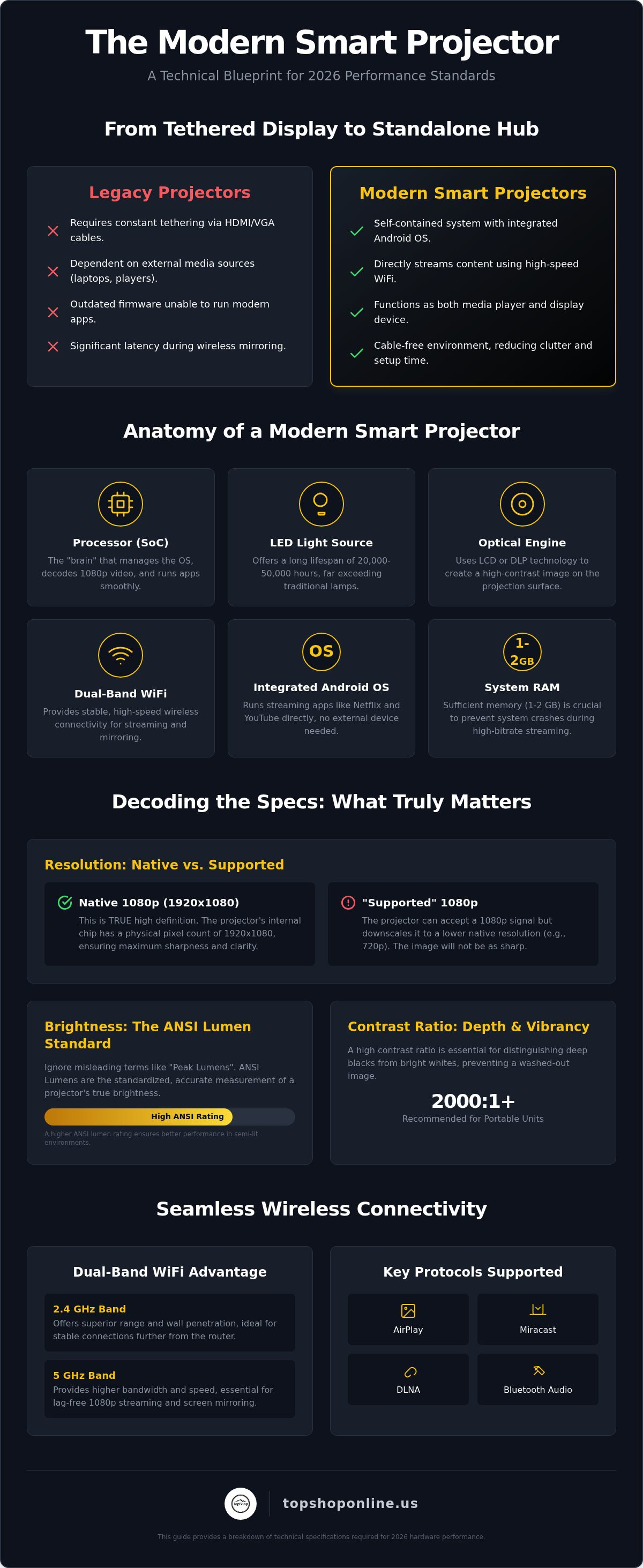
A mini projector wifi android device is a self-contained optical projection system featuring an integrated operating environment and wireless networking hardware. These units represent a significant departure from legacy hardware that required constant tethering to external media sources via VGA or HDMI cables. Modern Handheld projector technology has evolved into standalone smart hardware capable of processing, decoding, and displaying high-definition content autonomously. The primary hardware architecture consists of a long-life LED light source, a digital imaging chip, and an internal processor coupled with dedicated RAM and flash storage. This integration allows for a cable-free environment where the projector functions as both the media player and the display device.
The transition from passive display peripherals to active smart systems like the Smart Projector Wifi Portable 1080P relies on high-density internal component placement. The LED light source typically offers a lifespan between 20,000 and 50,000 hours, which reduces maintenance compared to traditional halogen lamps. Imaging chips use liquid crystal panels or Micro-Electromechanical Systems to modulate light and produce images. The internal SoC (System on a Chip) acts as the central hub, managing input signals from the mini projector wifi android wireless module and directing them to the projection engine. Eliminating physical cables reduces setup time and physical clutter in mobile environments, allowing users to access cloud-based documents and streaming libraries directly through the projector interface.
The Role of Android OS in Modern Projection
The internal operating system typically utilizes either a dedicated Android TV interface or a standard Android mobile wrapper. Android TV provides a remote-optimized UI with native support for major streaming platforms like YouTube and Netflix. Conversely, mobile wrappers offer broader app compatibility but may require external navigation peripherals for efficient use. It's essential for the processor to manage background OS tasks while simultaneously handling the high-speed data throughput required for 1080P video decoding. Stable performance depends on sufficient RAM, typically 1GB to 2GB in standard portable units, to prevent system crashes during high-bitrate streaming.
Wireless Connectivity Standards
Connectivity is managed through internal WiFi modules supporting dual-band frequencies. The 2.4GHz band offers superior range and wall penetration, while the 5GHz band provides the high-bandwidth capacity necessary for lag-free 1080P mirroring. Standard protocols include AirPlay for iOS devices, Miracast for Android-based screen mirroring, and DLNA for network-attached storage access. Integrated Bluetooth chips allow for wireless synchronization with external audio hardware, such as soundbars or headphones, bypassing the limitations of small internal speakers. These standards ensure that the hardware remains compatible with modern mobile devices and high-speed home networks.
Core Specifications: Resolution, Brightness, and Optical Hardware
Achieving high-definition clarity in a compact form factor requires precise alignment of resolution and brightness metrics. Native 1080P resolution refers to a physical pixel array of 1920x1080 on the internal imaging chip. This differs from 1080P supported hardware, which may only possess a native 720P output but can decode higher-resolution input files. For a consistent visual experience, the mini projector wifi android must maintain a high ANSI lumen rating. Standard marketing terms like peak lumens or lux often fail to reflect actual brightness at the projection surface. ANSI lumens provide a standardized measurement of light output across nine specific zones, ensuring accurate expectations for performance in low-light and semi-lit environments.
Optical hardware usually relies on specific projector display technologies like LCD or DLP to manage light modulation. High contrast ratios, often exceeding 2000:1 in portable units, are necessary to distinguish between deep blacks and bright whites, preventing a washed-out appearance. Thermal management is equally critical; high-intensity LED lamps generate significant heat within a small chassis. Hardware configurations include high-speed internal cooling fans, aluminum heat sinks, and dust-resistant optical engines to prevent image degradation over time. These components ensure the LED lamp maintains its standard life expectancy of 30,000 to 50,000 hours without color shifting or brightness loss. The Smart Projector Wifi Portable 1080P serves as a reference for these standards, balancing native resolution with thermal efficiency.
Optical Performance and Projection Ratios
Throw ratio determines the relationship between projection distance and screen size. A standard 1.2:1 throw ratio allows for a 100-inch image from approximately 2.6 meters away. Focus mechanisms vary between manual dial adjustments and digital motorized focus controlled via remote. Advanced mini projector wifi android hardware includes 4D digital keystone correction, allowing for horizontal and vertical image alignment even when the projector is placed at an angle to the wall. This flexibility is essential for portable use in diverse environments where centered placement isn't possible.
Input and Output Port Configuration
Physical connectivity remains a vital backup to wireless systems. HDMI 2.0 ports support high-bandwidth signals from gaming consoles or laptops, while USB ports provide power for streaming sticks or direct playback of local media files. Audio output is typically handled through a 3.5mm jack or integrated speakers. While internal speaker wattage usually ranges from 3W to 5W, the hardware's ability to output clean signals to external sound systems is a primary metric for home theater utility. Standard I/O layouts prioritize accessibility and high-speed data transfer to complement the internal Android OS capabilities.
Android OS Functionality vs. External Media Players
Integrating a native operating system into mini projector wifi android hardware eliminates the necessity for external peripherals; however, it introduces specific resource management requirements. Standalone operation relies on the internal System on a Chip (SoC) to manage both the user interface and high-bitrate video decoding tasks. External media players like Roku or Amazon Fire Stick offload processing to dedicated hardware, utilizing the projector solely as a display peripheral. While external dongles often receive more frequent firmware updates, a well-optimized built-in Android OS provides a cohesive user experience by centralizing power management, volume control, and network settings within a single remote interface. Technical benchmarks in this comprehensive guide to portable projectors highlight the necessity of matching software capabilities with underlying hardware specifications for long-term utility.
Smooth navigation within the Android environment requires a minimum of 1GB to 2GB of DDR3 or DDR4 RAM. Insufficient memory leads to interface lag, application crashes, and increased latency during wireless mirroring sequences. Storage capacity, typically 8GB to 32GB of eMMC flash memory, determines the volume of applications and offline media the device can host. Firmware stability remains a primary factor in hardware longevity. Manufacturers providing regular Over-the-Air (OTA) updates ensure that security patches and application API changes don't render the built-in streaming services obsolete. For users prioritizing a utilitarian, all-in-one setup, the Smart Projector Wifi Portable 1080P utilizes its internal architecture to maintain system fluidity without requiring secondary HDMI inputs for standard streaming tasks.
Standalone Smart Features
Direct application installation through the Google Play Store or authorized APK installers allows users to manage content libraries on internal memory. The user interface (UI) features a grid-based remote navigation system with high-contrast icons for visibility at large projection sizes. Voice control integration through Android-supported assistants enables hands-free searching and system commands, reducing reliance on physical buttons. These features transform the mini projector wifi android from a simple display tool into a comprehensive, standalone media workstation capable of independent operation.
Hardware Limitations of Integrated Systems
Integrated systems encounter specific bottlenecks, particularly when downscaling 4K content on native 1080P hardware. This process consumes significant CPU cycles, potentially leading to frame drops or system instability. Thermal throttling is an additional risk; as the internal processor generates heat during intensive standalone use, the system may reduce clock speeds to protect internal components, resulting in stuttering video playback. Future-proofing is a critical concern as newer Android versions demand higher hardware resources, making initial specifications like RAM and processor speed vital for multi-year functional performance.
Setup and Optimization for WiFi Mirroring
Optimizing a mini projector wifi android for wireless mirroring requires a stable network environment with high data throughput. 1080P video transmission typically demands a sustained bandwidth of 10 to 15 Mbps to prevent frame buffering or pixelation. Routers should be configured to prioritize the 5GHz band to minimize interference from household electronics. Handshake issues often stem from router isolation settings or mismatched IP protocols between the mobile device and the projector hardware. Ensuring both devices occupy the same subnet is a primary requirement for establishing a stable connection. Disable any active VPNs or hardware firewalls that might block local network discovery during the initial pairing phase.
Software alignment ensures that the projector's internal decoding engine matches the output from the source device. While the Smart Projector Wifi Portable 1080P includes pre-installed mirroring drivers, keeping the system firmware updated is necessary to maintain compatibility with the latest mobile OS releases. Latency is often a byproduct of high network congestion; reducing the number of connected devices on the primary access point can significantly improve response times during gaming or high-action video playback. Use static IP assignments within the router interface to prevent connection drops caused by DHCP lease renewals. These technical adjustments stabilize the data stream and reduce the input lag associated with wireless projection hardware.
Mirroring Protocol Configuration
Miracast functions as a peer-to-peer wireless screencast standard for Windows and Android devices. It utilizes Wi-Fi Direct to establish a connection without a central access point. Apple hardware requires AirPlay protocol support, which involves a specific internal software handshake for encrypted data transmission. If native protocols fail, third-party applications like EShare or AirScreen provide cross-platform stability by adding a secondary software layer for data packet management. These tools often include advanced features like split-screen display or remote mouse control, making them useful for professional presentations or multi-user environments.
Environmental Optimization for Portable Units
Perceived brightness depends heavily on ambient light management and surface reflectivity. Portable units benefit from matte white surfaces or dedicated high-gain projection screens that reflect light back toward the viewer. Avoid using glossy or colored walls; these materials distort color accuracy and reduce contrast ratios. For users operating in external or uncontrolled lighting conditions, the Outdoor Portable Projector 1080p Guide provides additional hardware setup specifications for high-performance viewing. To maximize your display potential, consider the Smart Projector Wifi Portable 1080P for its optimized wireless configurations and high-resolution output.
TopShop Smart Projector: 1080P Portable WiFi Reference
The Smart Projector Wifi Portable 1080P serves as a technical benchmark for current 2026 hardware standards. This mini projector wifi android unit integrates a native 1920x1080 resolution optical engine within a compact, mobile chassis designed for multi-environment deployment. Portability metrics include a lightweight form factor and standardized mounting points for tripods or ceiling brackets. WiFi connectivity benchmarks indicate stable 5GHz throughput, facilitating high-bitrate streaming and low-latency screen mirroring from mobile devices. The internal Android OS supports a wide array of professional and consumer applications, ensuring compatibility with diverse media libraries and presentation software.
System stability is maintained through a high-performance internal processor and a dedicated cooling architecture. This hardware configuration allows for standalone operation without the requirement for external media players or secondary processing units. The integration of high-gain WiFi antennas ensures consistent network discovery even in environments with moderate signal interference. Professional presentation setups benefit from the device's native app support, while home theater configurations utilize the integrated 1080P output for high-density visual clarity. The hardware provides a reliable transition from digital content to large-scale projection without the complexity of traditional fixed installations.
Hardware Durability and Build Quality
The exterior housing consists of heat-resistant ABS plastic engineered for efficient thermal dissipation. Internal cooling systems utilize low-decibel fans, typically rated under 30dB, to prevent audio interference during quiet playback sequences. Lens protection includes a recessed optical element and a manual or sliding cover to prevent dust accumulation and physical abrasions. Long-term optical clarity is preserved through a sealed light path design that prevents internal particulate buildup on the imaging chip. Maintenance requirements are minimal, primarily involving periodic air vent cleaning to ensure unobstructed airflow and optimal temperature regulation.
Functional Use Cases
Professional integration is streamlined through compatibility with Modern Home Office Setups, where the projector functions as a primary or secondary display for data-heavy presentations. For gaming applications, the low-latency HDMI input provides a stable connection for consoles, supporting high frame rate transmission without the lag associated with wireless-only hardware. The mini projector wifi android architecture also supports portable theater use in travel scenarios due to its compact dimensions and integrated software ecosystem. Technical evaluators in the consideration stage should prioritize this model for its balance of native 1080P resolution, robust thermal management, and comprehensive wireless protocol support.
Optimizing Future Projection Environments
Transitioning to a standalone projection ecosystem requires rigorous adherence to hardware benchmarks. Successful deployment depends on the synergy between internal processing power and high-speed wireless protocols. Key technical requirements include native 1080P resolution for visual fidelity and dual-band connectivity to eliminate latency during high-bitrate streaming. Selecting a mini projector wifi android that meets these 2026 specifications ensures long-term software compatibility and reliable standalone performance in both professional and domestic environments. These hardware standards represent the baseline for efficient, cable-free media management.
TopShop provides hardware solutions that prioritize these essential technical standards. The Smart Projector Wifi Portable 1080P features 1080P native resolution support and integrated dual-band WiFi for seamless wireless mirroring. All inventory is available with fast nationwide shipping to ensure immediate deployment. Shop the Smart Projector Wifi Portable 1080P at TopShop to upgrade your portable display hardware with professional-grade specifications. Achieving high-definition, portable projection is now a standard, accessible objective for any modern workspace or home theater setup.
Frequently Asked Questions
What is the difference between native 1080P and 1080P supported resolution?
Native 1080P resolution defines a physical 1920x1080 pixel grid on the internal imaging chip, ensuring each pixel of the source material is represented. Conversely, 1080P supported hardware accepts high-definition input signals but downscales them to a lower native resolution, such as 720P or 480P. This distinction significantly affects image sharpness, text legibility, and overall pixel density during large-scale projection. Always prioritize native specs for high-density data display.
Can I run Netflix and Hulu directly on an Android mini projector?
Direct streaming of Netflix and Hulu is possible via the integrated Android OS found in a mini projector wifi android unit. Users install these applications from the Google Play Store or authorized APK repositories. Standalone operation removes the need for external media sticks, provided the hardware meets the application's minimum API requirements. This setup centralizes content management and power requirements within a single portable chassis.
How many ANSI lumens do I need for a projector to work in a room with some light?
Projectors require a minimum of 200 to 500 ANSI lumens for visibility in environments with moderate ambient light. Lower ratings typically result in washed-out images unless the room is completely dark. While high-contrast screens can improve perceived brightness in these settings, raw light output remains the primary technical performance metric. Always verify the ANSI rating rather than marketing lux or peak lumen figures for accurate performance data.
Does a mini projector with WiFi require an internet connection for mirroring?
An active internet connection isn't always required for wireless screen mirroring. Protocols like Miracast utilize Wi-Fi Direct to establish a peer-to-peer connection between the source device and the projector hardware. Certain AirPlay configurations or cloud-based mirroring apps may require a local network with internet access for initial authentication. For local file playback from a phone or laptop, the internal WiFi module handles data transmission without external web access.
What version of Android is typical for smart mini projectors in 2026?
Hardware in 2026 typically utilizes Android 13 or Android 14 versions optimized for television interfaces. These versions provide updated security protocols and support for the latest streaming application APIs. Using a modern mini projector wifi android ensures compatibility with high-bitrate codecs and advanced wireless handshake standards. Manufacturers prioritize these versions to maintain long-term app support and system stability during intensive multitasking or high-definition video decoding sequences.
Can I connect external speakers to a mini projector via Bluetooth?
External audio synchronization is achieved through integrated Bluetooth 5.0 or higher modules. Users pair soundbars, headphones, or home theater receivers directly through the Android system settings. This configuration bypasses the low-wattage internal speakers to provide a high-fidelity audio experience suitable for cinematic or gaming use. Bluetooth integration also allows for the connection of peripheral input devices like keyboards or mice for improved OS navigation and data entry.
Is a tripod necessary for setting up a portable mini projector?
Tripods aren't strictly necessary but provide stable positioning and precise height adjustment for mobile setups. Portable units often feature 1/4-inch threaded mounting points for standard camera tripods. Digital 4D keystone correction allows for placement on flat surfaces like tables or shelves while maintaining a square image through software-based geometric adjustments. Using a tripod is recommended for environments where floor or table space is limited or uneven.
How do I update the firmware on my Android-based projector?
Firmware updates occur through Over-the-Air (OTA) protocols within the system settings menu. Users connect the projector to a stable WiFi network and select the software update option to download the latest manufacturer patches. Manual updates via USB are a secondary option if the network update fails or isn't supported by the specific hardware model. Regular updates are essential for maintaining application compatibility, improving thermal management, and patching system security vulnerabilities.