

The functional utility of a mini security camera with night vision depends on the precise intersection of CMOS sensor resolution, IR wavelength efficiency, and data compression protocols. Standard consumer models often fail due to low-quality night vision graininess, short battery life in wireless configurations, and frequent connectivity drops within crowded 2.4GHz WiFi environments. This technical guide delivers a comprehensive breakdown of hardware specifications, infrared capabilities, and data storage requirements for informed procurement. It identifies 1080P HD resolution hardware standards, evaluates effective IR LED range, and determines necessary storage capacity for continuous monitoring.
Understanding these measurable attributes ensures that hardware selection aligns with operational demands for clarity and reliability. We analyze the specific components, including high-density lithium polymer batteries and H.265 video compression chips, required to maintain stable surveillance performance. This analysis focuses on the transition from hardware discovery to technical implementation, providing the data points necessary for high-speed decision-making in security deployment. The following sections detail the hardware architecture required for 24/7 monitoring applications.
Key Takeaways
- Identify hardware classifications based on CMOS sensor performance and compact footprint dimensions under 2x2 inches.
- Evaluate infrared optical standards by comparing 850nm visible glow against 940nm stealth wavelength specifications for a mini security camera with night vision.
- Determine data storage requirements using Class 10 UHS-I Micro SD cards and automated loop recording protocols.
- Analyze power management configurations including internal lithium-ion battery capacity measured in mAh and continuous USB power supply options.
- Select 1080P HD wireless hardware to ensure high-fidelity evidence collection and stable remote monitoring via WiFi integration.
Definition and Hardware Classification of Mini Security Cameras
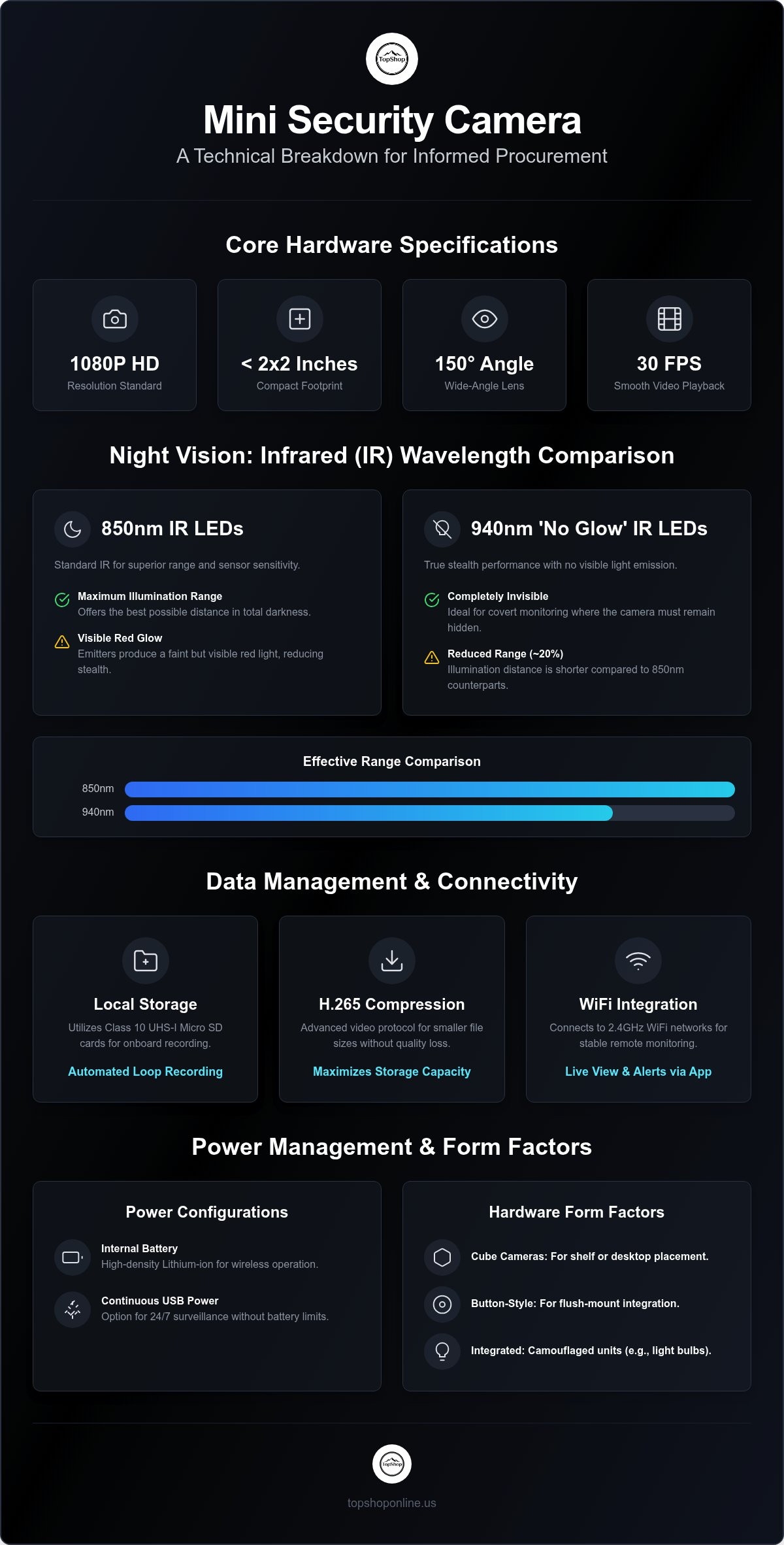
A mini security camera with night vision is technically defined as surveillance hardware with a physical footprint typically under 2x2 inches. These compact devices function as specialized endpoints within Closed-circuit television (CCTV) infrastructures. Classification by sensor type is a primary hardware differentiator. CMOS sensors dominate the miniature format because they consume less power and allow for faster data processing than CCD alternatives. This efficiency is critical for a mini security camera with night vision that operates on internal battery power. Hardware configurations prioritize high-density circuit integration to maintain 1080P HD resolution within constrained housing dimensions.
Form factor variations accommodate diverse installation requirements for residential and commercial monitoring:
- Cube Cameras: Self-standing units designed for shelf, desktop, or magnetic surface placement.
- Button-Style Lenses: Ultra-compact apertures for flush-mount integration into existing structures or objects.
- Integrated Housing: Camouflaged units, such as the 360° Panoramic Hidden Light Bulb Wifi Camera, which provide overhead deployment without visible wiring.
Primary use cases focus on localized asset monitoring, entryway surveillance, and internal security. These units provide a technical solution for environments where traditional, bulky camera housings are impractical or visually intrusive.
Lens and Sensor Specifications
Wide-angle coverage of 150 degrees is a standard hardware requirement for comprehensive room monitoring. Focal length typically stays within the 2.1mm to 2.8mm range to achieve this field-of-view. Aperture ratings, often f/2.0 or lower, dictate the volume of light reaching the CMOS sensor. High-performance units like the 1080P HD Wireless Mini Security WiFi Camera prioritize larger apertures to maximize light intake before the infrared LEDs activate. Physical dimensions remain compact, ensuring the mounting footprint doesn't exceed the device's base diameter, facilitating installation in tight corners or recessed areas.
Audio and Visual Integration
Integration of audio components includes built-in microphones with sensitivity ratings often calibrated for 35dB environments. This allows for legible voice recording within a 5-meter radius. Visual indicators consist of multi-color status LEDs for power, recording, and WiFi pairing. Operators can toggle these LEDs off through mobile applications for stealth configurations. Frame rate (FPS) standards for 1080P HD resolution are maintained at 30 FPS to provide smooth video playback. This frame rate is essential for identifying fast-moving objects during evidentiary review, ensuring no data loss occurs during high-speed motion segments.
Night Vision Technology and Optical Performance Standards
Infrared (IR) LED functionality enables illumination within the electromagnetic spectrum invisible to the human eye, typically between 700nm and 1mm. Wavelength selection is a critical hardware specification for a mini security camera with night vision. 850nm emitters produce a faint red glow visible to the eye but offer superior range and sensitivity for CMOS sensors. Conversely, 940nm LEDs provide true stealth performance with no visible emission. These 940nm units require higher sensor sensitivity and typically exhibit a 20 percent reduction in effective illumination distance compared to 850nm counterparts.
Effective range in zero-lux environments depends on the milliwatt output of the IR array. Automatic IR-cut filters manage the transition between daylight color and nighttime monochrome modes in a mini security camera with night vision. This mechanical filter blocks infrared light during daylight to prevent color distortion and retracts in low-light conditions to maximize sensor exposure. Reviewing technical reviews of the Best Home Security Cameras confirms that filter reliability is essential for 24/7 autonomous operation. Users can evaluate these specifications on the 1080P HD Wireless Mini Security WiFi Camera product page to ensure deployment suitability.
IR LED Array Configurations
Miniature housings often utilize a circular array of 6 to 12 IR emitters positioned around the lens perimeter. Power draw increases significantly when the IR array activates, often consuming 150mA to 300mA additional current. Extended IR operation generates localized thermal energy. Effective heat dissipation through ventilated or metal-alloy housings prevents sensor thermal noise and extends component lifespan. High-density arrays ensure even light distribution, preventing the "hot spot" effect where the center of the image is overexposed while the edges remain dark.
Resolution and Clarity in Low Light
1080P HD resolution provides the pixel density required for facial recognition at distances up to 5 meters in total darkness. Digital Noise Reduction (DNR) algorithms within the firmware mitigate the graininess common in high-gain low-light environments. Grayscale depth and contrast ratios determine the ability to distinguish foreground subjects from background surfaces. Hardware like the 1080P HD Wireless Mini Security WiFi Camera utilizes optimized firmware to maintain high-fidelity monochrome streams. This clarity doesn't degrade significantly during motion, ensuring consistent evidentiary quality throughout the recording cycle.
Data Management: Storage Capacity and WiFi Connectivity
Efficient data management in a mini security camera with night vision requires a balance between local storage hardware and network transmission protocols. Most compact units utilize Micro SD card slots compatible with Class 10 UHS-I standards. These cards ensure a minimum sustained write speed of 10MB/s, which is necessary for stable 1080P HD video recording without frame drops or file corruption. Loop recording protocols complement this hardware by automatically overwriting the oldest data segments when the card reaches capacity, ensuring continuous operation without manual intervention.
WiFi connectivity typically relies on the 802.11b/g/n 2.4GHz frequency. While 5GHz offers higher data transfer speeds, the 2.4GHz band provides superior wall penetration and signal range. This is essential for a mini security camera with night vision positioned behind structural obstacles or at a distance from the router. Data compression efficiency is dictated by the codec; H.264 is the legacy standard, while H.265 (High Efficiency Video Coding) reduces file sizes by approximately 50 percent without compromising visual fidelity. This reduction directly extends the lifespan of the storage medium and reduces bandwidth consumption during remote streaming.
Storage Duration Calculations
A 128GB storage module provides approximately 15-20 days of 1080P loop recording before the overwriting protocol activates. Bitrate settings significantly influence this duration; a higher bitrate increases visual fidelity but generates larger file sizes, potentially reducing the recording window. Local hardware storage offers high privacy and zero monthly costs, whereas cloud integration provides off-site redundancy at the expense of recurring subscription fees and increased bandwidth usage. Users must calibrate bitrate against storage capacity to meet specific evidentiary retention requirements.
Remote Monitoring and App Integration
Real-time streaming latency over standard 2.4GHz WiFi connections generally remains under two seconds, depending on network congestion and signal strength. Multi-user sharing protocols allow for simultaneous monitoring across multiple devices using unique authentication tokens. Instant alert triggers are managed through integrated motion detection sensors that send push notifications to connected smartphones. These specs ensure that a mini security camera with night vision functions as an active surveillance tool rather than a passive recording device, allowing for immediate response to detected incidents. Integration with mobile applications facilitates remote management of recording schedules and IR LED activation.
Deployment and Power Management Specifications
Deployment of a mini security camera with night vision involves selecting between transient battery operation and permanent hardwired power. Internal lithium-ion batteries typically offer capacities between 200mAh and 600mAh. Standby durations in low-power motion-detection modes reach approximately 12 to 24 hours depending on trigger frequency and IR LED activation cycles. Constant recording reduces this timeframe to 60-90 minutes due to high power draw from the CMOS sensor and WiFi transmitter. For overhead deployment without battery constraints, the 360° Panoramic Hidden Light Bulb Wifi Camera utilizes standard E27 light sockets for continuous AC power. Mounting hardware for other models includes several options for flexible placement:
- Magnetic Brackets: High-strength magnets for attachment to metallic surfaces and structural beams.
- Adhesive Pads: Double-sided industrial tape for non-porous walls and ceiling mounts.
- Rigid Swivel Stands: Mechanical mounts providing 360-degree rotation for precise field-of-view calibration.
Thermal operating ranges for these compact housings generally span from 14°F to 140°F (-10°C to 60°C). This range ensures functionality in indoor environments or protected outdoor locations like covered porches.
Continuous Power Integration
Permanent surveillance requires stable voltage inputs, typically DC 5V/1A via micro-USB or USB-C interfaces. Integration with a power strip with usb ports facilitates centralized power management for multi-camera arrays in modern workspaces. This configuration eliminates battery depletion risks and ensures it's powered continuously for uninterrupted IR LED performance during extended nighttime monitoring. Concealed installation requires thin-gauge cabling to maintain the device's low-profile footprint. Secure your perimeter with the 1080P HD Wireless Mini Security WiFi Camera for reliable 24/7 hardware performance.
Motion Detection Hardware
Motion detection is achieved through software-based pixel analysis or dedicated Passive Infrared (PIR) sensors. PIR hardware detects thermal signatures from human or animal movement, significantly reducing power consumption compared to continuous pixel processing. Software-based analysis offers higher sensitivity but increases the risk of false positives from light shifts, shadows, or insects. Firmware allows for sensitivity adjustment across low, medium, and high levels to filter environmental noise and prevent redundant notifications. Advanced models support detection zone configuration via mobile applications, allowing users to mask high-traffic areas and focus monitoring on specific entry points. This targeting optimizes storage usage and battery efficiency for a mini security camera with night vision by only capturing relevant data events.
Selecting 1080P HD Wireless Mini Security WiFi Camera Hardware
Selection of a mini security camera with night vision involves verifying resolution standards, network protocols, and physical dimensions. 1080P HD resolution functions as the baseline requirement for high-fidelity evidentiary video capture, providing 1920x1080 pixel density for clear identification of subjects. Wireless WiFi integration enables remote data access and real-time alerts via encrypted transmission protocols. Integrated IR LEDs ensure operational continuity in zero-light environments by providing active illumination within the stealth spectrum. The compact form factor facilitates discrete placement in residential or commercial settings without requiring structural modifications or professional installation services. These technical attributes define the transition from discovery to functional security implementation.
TopShop Hardware Specifications
Analyzing the technical specs of the 1080p Wireless Mini Security Camera with Night Vision reveals a high-density CMOS sensor paired with a wide-angle 150-degree lens. This model prioritizes a small footprint for versatile mounting on metallic surfaces, shelving units, or within recessed areas. In contrast, the 360° Panoramic Hidden Light Bulb Wifi Camera serves specific ceiling-mount needs, offering a fisheye perspective for total room coverage from a standard E27 light socket. Both units maintain compatibility with standard home WiFi routers operating on the 2.4GHz frequency band. Mobile OS support includes iOS and Android platforms, allowing for centralized management of multiple hardware endpoints through a single interface. This compatibility ensures that users can monitor real-time streams and adjust sensor sensitivity settings without specialized networking equipment.
Procurement and Support
Inventory management and distribution protocols prioritize speed and technical reliability for all surveillance hardware. Fast shipping standards ensure national US delivery within efficient timeframes for immediate security deployment. Technical support services assist with WiFi pairing, mobile app configuration, and firmware updates to maintain hardware stability. Bulk hardware options are available for multi-room security coverage, providing a scalable solution for larger commercial facilities or comprehensive residential monitoring. Each mini security camera with night vision undergoes quality control verification to ensure 1080P HD resolution performance and IR LED functionality meet stated hardware standards before distribution. This methodical approach ensures that the transition from procurement to transaction is grounded in verified data points and measurable product attributes. Organized cataloguing of these devices allows for quick comparison of battery capacities, storage limits, and lens apertures to meet specific site requirements.
Optimizing Surveillance Deployment with Verified Hardware Standards
Deploying a high-performance mini security camera with night vision requires precise alignment between CMOS sensor capabilities and infrared wavelength efficiency. This technical guide has detailed the requirements for 1080P HD resolution, H.265 data compression, and 2.4GHz WiFi stability. These specifications ensure high-fidelity evidence collection and reliable remote monitoring across residential and commercial environments. Proper hardware selection, including the choice between internal lithium-ion battery power and continuous USB integration, determines the long-term utility of the surveillance endpoint.
Technical reliability is achieved through measurable attributes like IR LED range, Class 10 Micro SD storage duration, and CMOS sensor sensitivity. These components work together to provide 24/7 autonomous monitoring without the need for professional installation services. You can now implement these standards for localized asset protection or entryway security using verified hardware configurations. Order the 1080P HD Wireless Mini Security WiFi Camera to access 1080P HD resolution and integrated night vision. Maintaining a secure environment is efficient when using hardware designed for transparency and technical precision.
Frequently Asked Questions
How long does a mini security camera battery typically last?
Internal lithium-ion batteries in these compact units typically provide 60 to 90 minutes of continuous recording. In low-power standby mode with motion detection active, battery life extends to approximately 12 to 24 hours. These durations depend on the mAh capacity of the specific hardware and the frequency of IR LED activation. Permanent power via USB is recommended for 24/7 surveillance requirements so battery depletion doesn't occur during critical monitoring windows.
Can I view the mini security camera feed on my phone while away from home?
Remote monitoring is possible through dedicated mobile applications connected via a 2.4GHz WiFi network. This allows for real-time video streaming and push notification alerts on iOS and Android devices from any location with internet access. A mini security camera with night vision maintains an encrypted link to the router, ensuring secure data transmission. Streaming latency typically remains under two seconds when network signal strength is optimal for high-bandwidth 1080P HD video.
What is the maximum SD card capacity supported by mini WiFi cameras?
Most modern hardware configurations support a maximum capacity of 128GB via Micro SD card slots. It's necessary to use Class 10 UHS-I cards to ensure the minimum 10MB/s write speed required for 1080P HD video. This capacity provides approximately 15 to 20 days of loop recording before the oldest data segments are overwritten. Using lower-class cards often results in file corruption or dropped frames during high-bitrate recording cycles.
Does the night vision on a mini camera emit a visible red glow?
Visibility depends on the infrared wavelength specification of the integrated IR LEDs. Emitters using the 850nm wavelength produce a faint red glow visible to the human eye in total darkness. Hardware utilizing 940nm LEDs provides true stealth performance with no visible emission, making it suitable for hidden applications. While 850nm LEDs offer longer range, 940nm LEDs are preferred for a mini security camera with night vision where complete concealment is the primary requirement.
Can mini security cameras record without a WiFi connection?
These devices can record locally to a Micro SD card without an active WiFi connection. The camera functions as a standalone digital video recorder, utilizing internal firmware to manage loop recording protocols on the hardware storage. While remote monitoring and instant alerts are disabled without WiFi, the CMOS sensor continues to capture 1080P HD evidence. It's possible to retrieve data by physically removing the SD card or connecting the camera to a computer via USB.
What is the difference between 720P and 1080P resolution in small lenses?
The primary difference is pixel density, with 1080P HD resolution providing 1920x1080 pixels compared to the 1280x720 pixels of 720P. Higher resolution is essential in miniature lenses to maintain clarity when identifying subjects or reading license plates. 1080P hardware captures more detail per square inch, reducing pixelation during digital zoom. This increased fidelity ensures that evidentiary footage remains actionable for security review, even when light levels are low and noise reduction algorithms are active.
Is a subscription required for cloud storage on these devices?
Cloud storage is an optional service that typically requires a recurring subscription fee for off-site data redundancy. However, local storage to a Micro SD card remains free and doesn't require any monthly payments. Most users prefer local hardware storage to maintain data privacy and eliminate ongoing operational costs. The 1080P HD Wireless Mini Security WiFi Camera supports both methods, allowing users to choose between high-privacy local recording and accessible cloud-based backups.
How far can the motion detection sensor trigger an alert?
Motion detection sensors typically trigger alerts within a range of 5 to 10 meters. PIR (Passive Infrared) hardware detects thermal signatures from human movement, while software-based analysis monitors pixel shifts in the field of view. Effectiveness depends on the sensitivity settings configured within the mobile application and the ambient temperature of the environment. Targeted detection zones can be set to focus monitoring on specific entry points, ensuring alerts are only generated for relevant movement events.