

Continuous video recording is an inefficient use of hardware resources that leads to rapid battery depletion and premature storage exhaustion. For professionals requiring high-density information security, a motion activated mini security camera serves as a data-efficiency tool rather than a simple recording device. You likely face the persistent frustration of false triggers from light shifts or pet movement. These errors fill SD cards with useless data and obscure critical evidence. This technical analysis addresses these hardware limitations by focusing on sensor calibration and deployment strategies. We'll examine how hardware configurations, such as the 1080P HD Wireless Mini Security WiFi Camera, utilize motion triggers to achieve long-term passive monitoring without constant manual intervention.
This guide provides a comprehensive overview of 2026 surveillance standards, hardware specifications, and implementation protocols. You'll learn how to manage storage via precise motion triggers and capture high-definition evidence effectively. We'll also detail the integration of 360° Panoramic Hidden Light Bulb Wifi Camera systems into existing security frameworks. The following sections break down PIR sensor mechanics, local storage limits, and legal standards for video and audio recording. This information ensures your deployment remains functional, legally compliant, and resource-efficient for high-volume data capture.
Key Takeaways
- Conserve critical battery and storage resources through hardware-triggered video capture protocols designed for long-term, high-density passive monitoring.
- Evaluate Passive Infrared (PIR) heat-signature sensors and software-based pixel-change analysis to ensure precise event triggering and data integrity.
- Verify essential 1080P HD resolution specifications and MicroSD card formatting requirements to maintain forensic-grade evidence capture capabilities.
- Optimize the deployment of a motion activated mini security camera by utilizing strategic mounting heights and angles that minimize false PIR triggers.
- Integrate the 360° Panoramic Hidden Light Bulb Wifi Camera for overhead monitoring to create technical synergy with localized surveillance hardware.
Technical Fundamentals of Motion Activated Mini Security Cameras
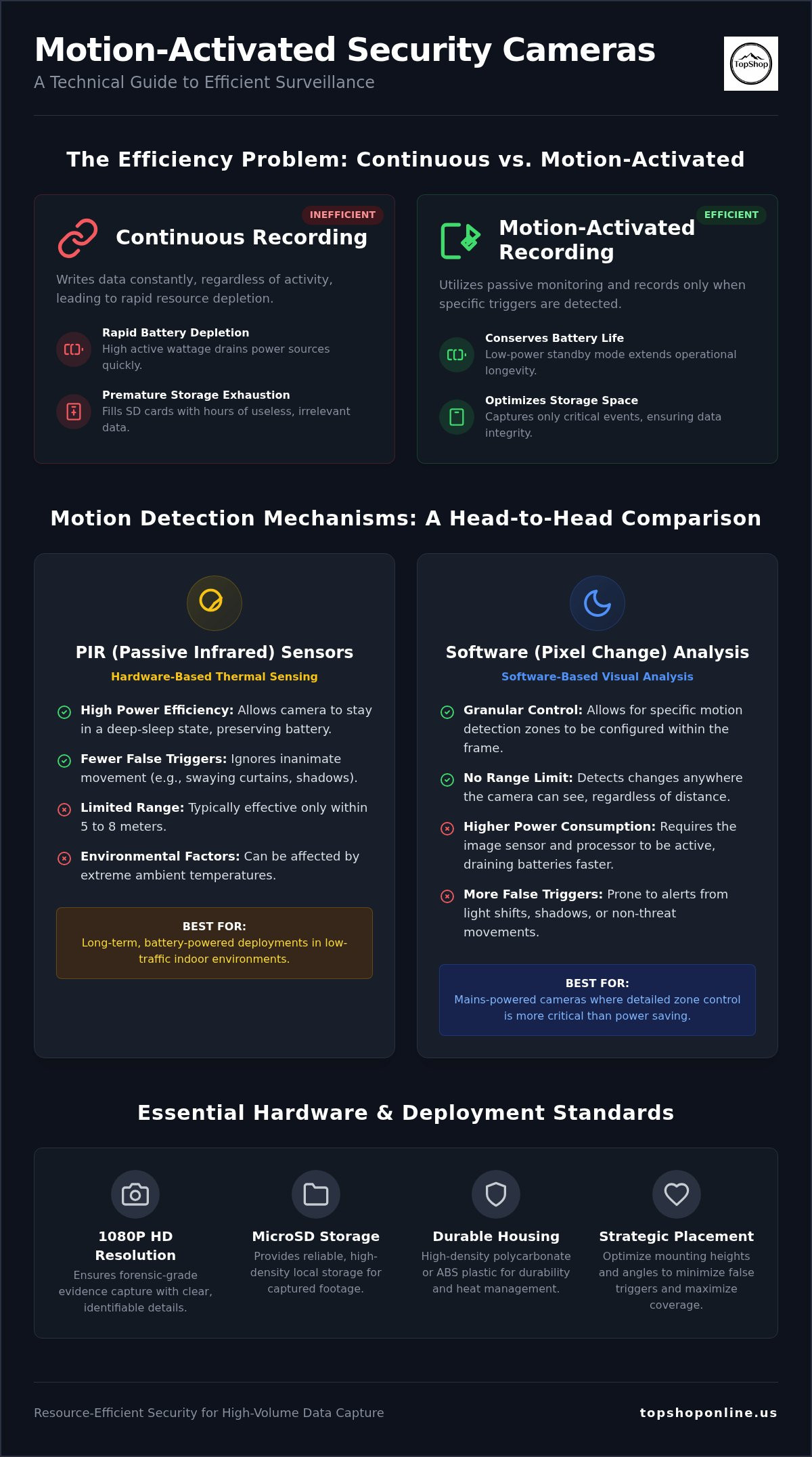
Motion-activated recording is defined as hardware-triggered video capture initiated by specific environmental changes, typically detected via infrared sensors or visual frame analysis. This operational logic differs fundamentally from continuous loop recording, which writes data to storage media regardless of activity. The primary function of a motion activated mini security camera is the conservation of storage space and battery power through a passive monitoring protocol. By remaining in a low-power state until triggered, these devices extend the operational window for high-density information security without requiring frequent manual data management or battery replacement.
In discreet residential and commercial applications, the mini form factor provides significant utility. These compact units allow for placement in locations where standard-sized surveillance hardware would be visually intrusive or physically impossible to mount. The hardware architecture prioritizes a small footprint while maintaining the internal components necessary for high-definition capture. Professional security deployments often depend on these technical efficiencies to ensure long-term reliability in unmonitored environments.
Passive Monitoring vs. Active Surveillance
Active surveillance involves constant sensor engagement and data writing, which results in high active recording wattage and rapid thermal accumulation. Passive monitoring utilizes a standby mode where only the motion sensor remains energized. This state significantly reduces standby power consumption compared to the wattage required for 1080P video processing. For devices powered by internal lithium-ion batteries, motion triggers are the primary factor in determining operational longevity. In low-traffic areas, such as storage rooms or secondary entrances, a motion activated mini security camera can remain functional for extended periods on a single charge by avoiding the energy drain of redundant recording.
Form Factors and Discreet Housing Materials
Compact surveillance hardware typically utilizes high-density polycarbonate or heat-resistant ABS plastic housings. These materials provide the necessary durability for long-term deployment while maintaining a lightweight profile. Thermal management is a critical design constraint in mini cameras because the small internal volume limits natural air circulation. Integrated heat sinks or specific ventilated housing patterns are often employed to manage thermal dissipation during extended recording sessions. Lens dimensions also play a vital role in device performance. Smaller lenses often trade light sensitivity for a wider field of view (FOV), which is essential for capturing comprehensive visual data in confined indoor environments. The synergy between material composition and sensor placement ensures hardware reliability under various environmental conditions.
Motion Detection Mechanisms: PIR vs. Software Sensors
The effectiveness of a motion activated mini security camera depends on its underlying detection logic, which generally falls into two categories: hardware-based thermal sensing or software-based visual analysis. These mechanisms determine the device's accuracy, battery life, and response time. Selecting the correct sensor type requires an understanding of how environmental variables like ambient temperature and light intensity interact with the camera's internal components. While hardware sensors offer superior power efficiency, software analysis provides granular control over detection zones within the visual frame.
Passive Infrared (PIR) Sensor Specifications
PIR sensors utilize dual-element infrared detection to identify human movement by measuring changes in thermal energy. These sensors consist of two compensated sensing areas that compare the infrared radiation levels in the environment. When a heat-emitting body moves from one sensing zone to the next, the resulting voltage differential triggers the recording sequence. In small-scale security hardware, the effective range of PIR sensors is typically limited to 5 to 8 meters. PIR is a heat-based trigger mechanism that ignores inanimate movement like swaying curtains. This hardware-level detection allows the camera to remain in a deep-sleep state, preserving internal battery resources until a verified thermal event occurs.
Pixel-Based Software Motion Analysis
Software-based detection relies on the Image Signal Processor (ISP) to perform frame-to-frame comparisons of the digital video feed. The ISP identifies motion by calculating the percentage of pixel variance between consecutive images. This method is highly sensitive but prone to limitations in low-light or high-noise environments where digital artifacts can be misinterpreted as movement. Unlike PIR, software analysis requires the image sensor and processor to remain active, leading to higher power consumption and faster battery depletion. This continuous analysis is most effective in wired configurations where power constraints are secondary to precise visual monitoring.
Successful implementation requires precise calibration of sensitivity settings to account for specific lighting conditions. High-sensitivity thresholds are useful for detecting distant movement but may increase false alarm rates from light shifts or pet activity. Low-sensitivity settings are preferable for high-traffic corridors to ensure only significant movement initiates a recording event. For professional-grade hardware that balances these detection technologies, explore the available models at TopShop to find a solution tailored to your environment. Understanding these technical distinctions ensures that your surveillance strategy minimizes data waste while maximizing the capture of relevant forensic evidence.
Hardware Specifications: Resolution, Storage, and Power
1080P HD resolution provides the necessary pixel density for forensic evidence capture, supporting facial recognition at distances up to 5 meters depending on lens aperture and ambient light. A motion activated mini security camera utilizing this resolution produces high-bitrate video that requires efficient data management. H.264 and H.265 (High Efficiency Video Coding) compression standards are utilized to maximize storage efficiency. H.265 specifically reduces file sizes by approximately 50% compared to H.264, allowing more event-based clips to be stored on the physical media. Storage architecture typically relies on MicroSD cards with specific formatting requirements. Cards up to 32GB utilize the FAT32 file system, while higher capacity cards often require exFAT formatting to handle larger file sizes and faster data transfer rates.
Power management for these devices involves a choice between internal lithium-ion batteries and continuous USB power supplies. Internal batteries are rated in milliampere-hours (mAh), where a higher rating supports a greater number of motion-triggered recording cycles. For permanent installations, a 5V USB connection ensures continuous uptime and eliminates the risk of power depletion during critical monitoring windows. The synergy between power source and sensor efficiency determines the overall reliability of the surveillance system.
1080P HD Optics and Night Vision Hardware
High-performance optics in mini cameras integrate Infrared (IR) LEDs to enable recording in 0.0 lux environments. These LEDs emit light at the 850nm or 940nm wavelength, which is invisible to the human eye but detectable by the camera's image sensor. The effective night vision range for compact hardware generally spans 5 to 10 meters in indoor settings, providing clear grayscale imagery in total darkness. For more detailed insights into specialized hardware, review this guide on the wireless mini security camera with night vision.
Storage Management and Loop Recording Logic
Storage capacity is managed through loop recording logic, which ensures continuous operation by automatically overwriting the oldest video files once the MicroSD card reaches its limit. The number of recordable hours depends on the resolution, frame rate, and frequency of motion triggers. WiFi integration allows for real-time remote access and optional cloud-based storage, providing a secondary backup layer if the local hardware is compromised. This dual-storage approach combines the reliability of local MicroSD recording with the accessibility of wireless data transmission. Users can calculate storage requirements by multiplying the average file size of a 30-second motion clip by the expected daily trigger frequency.
Strategic Placement and National Legal Standards
Placement of a motion activated mini security camera requires precision to ensure the sensor's trigger zone aligns with expected entry points. Optimal mounting height is typically between 2 and 2.5 meters. This elevation provides a sufficient downward angle to capture facial details while maximizing the sensor's reach. Avoid placing hardware directly facing windows or heat sources like radiators. Thermal fluctuations from sunlight or HVAC systems cause false PIR triggers, leading to storage waste. For PIR sensors, lateral movement across the field of view is detected more reliably than movement directly toward the lens.
Maximizing Field of View (FOV) and Trigger Zones
Corner mounting provides a broader 90-degree to 120-degree coverage area compared to flat shelf placement. You'll need to test trigger latency to ensure the recording starts before a subject exits the frame. High-performance models, such as the Arlo Pro 6, offer a 160-degree field of view to minimize blind spots. For overhead monitoring, technical synergy is achieved by using specialized hardware. Review the 360 panoramic wifi camera indoor coverage analysis to understand how panoramic lenses eliminate traditional coverage gaps and improve trigger reliability in open spaces.
Surveillance Compliance and Ethical Implementation
National US legal standards as of February 2026 permit video recording on private property in areas where there's no reasonable expectation of privacy. Prohibited areas include bathrooms and bedrooms. Audio recording is more strictly regulated by the Electronic Communications Privacy Act (ECPA). While federal law requires one-party consent, several states require all-party consent for recording conversations. These states include California, Delaware, Florida, Illinois, and Maryland. It's essential to verify local statutes before enabling audio features on any motion activated mini security camera.
Workplace environments require specific disclosure protocols. Employers must typically notify staff of surveillance measures to avoid legal liability. Differentiating between legitimate security monitoring and illegal stalking is a matter of intent and location. Ethical implementation prioritizes the protection of assets without infringing on individual privacy rights. To secure your premises with compliant hardware, browse the inventory at TopShop for professional-grade mini cameras and panoramic solutions.
Implementation: TopShop Motion Activated Hardware Solutions
TopShop functions as a reliable, high-volume distributor of utilitarian surveillance inventory tailored for national US deployment. The implementation of a motion activated mini security camera requires specific hardware synchronization to ensure data integrity and real-time monitoring. By focusing on technical synergy between localized units and overhead panoramic sensors, users can establish a high-density security environment. These solutions prioritize functional efficiency over aesthetic decoration, providing transparent data points for informed security management. The inventory is designed for high-speed browsing and quick decision-making, allowing professionals to select hardware based on measurable attributes like resolution and connectivity.
1080P Wireless Mini Security WiFi Camera Specifications
The 1080P HD Wireless Mini Security WiFi Camera features compact dimensions and a high-density polycarbonate housing for discreet indoor placement. It utilizes an integrated motion-triggered alert system that transmits push notifications to mobile devices via 2.4GHz WiFi frequencies. This specific frequency band is selected for its superior wall-penetration capabilities compared to 5GHz alternatives. Users don't need complex wiring for these units, as they are designed for rapid placement in high-traffic zones.
Initialization follows a methodical protocol: power the unit, synchronize with the compatible smartphone application, and calibrate the motion sensitivity thresholds to match environmental traffic levels. The 1080P model supports remote live-viewing via smartphone applications. This allows for immediate visual verification of motion events from any location with internet connectivity, ensuring no lag between trigger events and user awareness. It's essential to perform a signal strength test at the installation site to maintain a stable data uplink for high-definition streaming.
Panoramic Monitoring with Light Bulb WiFi Cameras
The 360° Panoramic Hidden Light Bulb Wifi Camera provides a technical advantage by utilizing standard E27 bulb sockets for continuous AC power. This eliminates the battery limitations discussed in previous sections and ensures 24/7 operational uptime without manual recharging cycles. The 360-degree fisheye lens optics capture a complete hemispherical view, removing the blind spots common in fixed-lens hardware. The hardware is built from heat-resistant materials to ensure longevity when installed in standard lighting fixtures.
Combining the 1080P HD Wireless Mini Security WiFi Camera with panoramic units creates a multi-layered security grid that covers both specific entry points and broad floor areas. Users can utilize the motion-activated alarm feature to trigger audible sirens or light sequences, providing a real-time deterrence mechanism against unauthorized access. This hardware integration facilitates efficient data management and comprehensive evidence capture through a unified mobile interface, maximizing the utility of the surveillance deployment. All units are shipped as standalone hardware solutions, as TopShop does not offer professional installation services.
Optimizing Surveillance Infrastructure for 2026
Effective implementation of a motion activated mini security camera depends on the integration of high-resolution optics and precise sensor calibration. By utilizing Passive Infrared (PIR) technology and 1080P HD resolution, users can maintain forensic-grade evidence capture while maximizing storage efficiency. Legal compliance across the United States requires strict adherence to privacy expectations and state-specific audio consent laws. Strategic placement remains the final variable in ensuring trigger reliability and minimizing false positives from environmental heat sources. TopShop serves as a high-volume distributor of these technical solutions, offering hardware designed for immediate deployment and remote monitoring. Access reliable surveillance inventory with 1080P HD resolution, WiFi remote access support, and fast national shipping. Browse TopShop Mini Security Camera Hardware to finalize your high-density monitoring grid. You'll achieve professional-grade security through methodical hardware selection and informed placement strategies.
Frequently Asked Questions
How long does the battery last on a motion-activated mini camera?
Battery longevity depends on trigger frequency and the specific mAh rating of the internal lithium-ion cell. In passive standby mode, a motion activated mini security camera can remain operational for several weeks. Continuous recording typically depletes power within 1 to 5 hours. Utilizing PIR sensors ensures the hardware only draws significant wattage during verified events, which preserves energy for long-term monitoring in low-traffic environments.
Can a mini security camera record without WiFi connectivity?
Yes, these units record directly to local MicroSD cards without an active wireless connection. While WiFi is required for remote live-viewing and real-time mobile alerts, the internal recording mechanism remains functional offline. Video data is processed by the Image Signal Processor and stored on the physical media in H.264 or H.265 formats. Users must manually retrieve the MicroSD card to review footage if network access is unavailable.
What is the maximum MicroSD card size supported by mini cameras?
Most compact surveillance units support MicroSD card capacities up to 128GB or 256GB. The 1080P HD Wireless Mini Security WiFi Camera typically requires FAT32 formatting for cards up to 32GB. Higher capacity cards utilize the exFAT file system to manage larger data volumes and faster bitrates. Exceeding the manufacturer's stated capacity limit can result in file system errors, data corruption, or the failure of the loop recording function.
Is it legal to use a hidden motion camera in my apartment?
It's generally legal to install a motion activated mini security camera within your private residence for asset protection. You must exclude areas where individuals have a reasonable expectation of privacy, such as bathrooms or dedicated guest bedrooms. Audio recording is subject to the Electronic Communications Privacy Act. Five US states, including California and Maryland, require all-party consent for audio capture. Always verify specific state statutes before enabling microphones.
Does motion activation work through glass or windows?
Standard Passive Infrared (PIR) sensors don't function through glass because they cannot detect thermal energy shifts through solid transparent barriers. Software-based motion detection can identify movement through windows by analyzing pixel changes in the visual frame. However, this method is prone to false triggers from glass reflections or light shifts. For reliable outdoor monitoring, hardware should be mounted externally or positioned to avoid physical obstructions between the sensor and the target zone.
How do I receive alerts when the camera detects motion?
Alerts are delivered via push notifications through a synchronized smartphone application. When the hardware identifies a trigger event, it utilizes the 2.4GHz WiFi uplink to transmit a signal to the cloud server. The server then pushes a notification to the user's mobile device. Users can calibrate motion sensitivity levels within the app settings to filter out minor environmental movements and ensure notifications are only sent for significant security events.
What is the difference between 720P and 1080P for mini cameras?
1080P HD resolution provides 1920x1080 pixels, which is approximately 2.25 times the pixel density of 720P hardware. This increased resolution is critical for forensic tasks like facial recognition and identifying small objects at a distance. While 1080P video requires more storage capacity, modern H.265 compression standards allow for efficient data management. High-definition optics ensure that captured evidence remains clear when digitally zoomed during a post-event security analysis.
Can multiple users access the camera feed simultaneously?
Most WiFi-enabled mini cameras support multi-user access through secure account sharing features in the mobile application. The primary administrator grants permissions to secondary users, allowing them to view live streams or recorded clips on their own devices. Simultaneous access is limited by the upload bandwidth of the local network. Each user must have the specific app installed and use authorized credentials to maintain the integrity of the surveillance network.