

A "1080p supported" label on a projector does not guarantee high-definition output. For actual 1920x1080 resolution, the hardware must possess a native 1080p chipset to avoid downscaling and image degradation. Selecting an outdoor portable projector 1080p unit involves analyzing native chipset resolution, light source durability, and standardized ANSI lumen density. Many consumers mistakenly purchase units based on "marketing lumens" rather than standardized ANSI measurements, which results in washed-out images in outdoor environments with ambient light.
You likely recognize that achieving a clear image in a backyard or campsite is difficult without the correct hardware specifications. This guide provides a technical breakdown of native 1080p hardware requirements, ANSI lumen calculation for varied lighting conditions, and power management strategies for 2026. We analyze specific connectivity standards, including HDMI 2.1 and USB-C Power Delivery; we also compare internal battery capacities against external power strip requirements for extended playback. You will gain the data necessary to identify a high-performance unit like the Smart Projector Wifi Portable 1080P that meets specific outdoor environmental demands.
Key Takeaways
- Identify the hardware distinction between native 1920x1080 resolution chipsets and 1080p supported inputs to prevent image degradation and downscaling.
- Prioritize ANSI lumen specifications over marketing Lux ratings to ensure sufficient brightness for outdoor environments after sunset.
- Select an outdoor portable projector 1080p featuring dual-band WiFi and integrated OS for stable, standalone streaming without external hardware.
- Evaluate digital keystone correction and auto-focus hardware capabilities to facilitate rapid image alignment on temporary or uneven outdoor surfaces.
- Analyze the trade-off between internal battery runtime and maximum lumen output to determine if external power sources are necessary for optimal performance.
Defining Native 1080p Resolution in Portable Outdoor Hardware
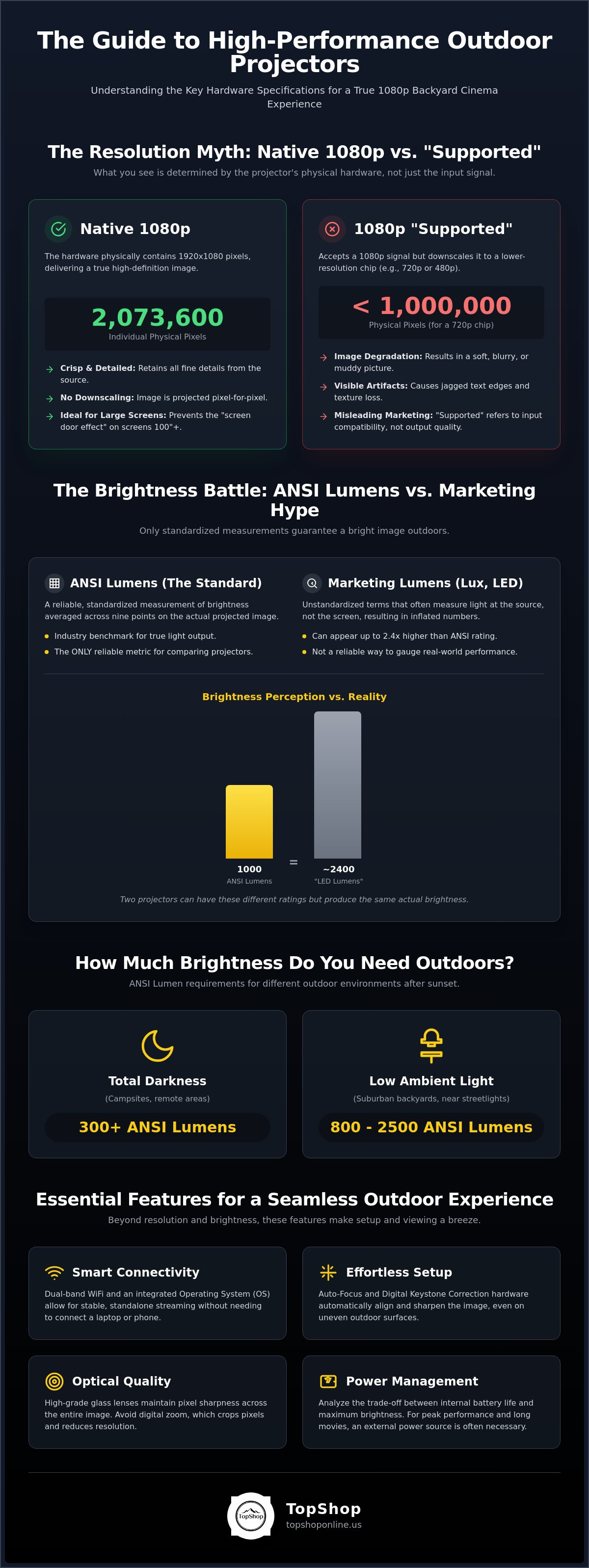
Native 1080p resolution refers to a fixed physical display grid containing 1920 horizontal pixels and 1080 vertical pixels. This 16:9 aspect ratio configuration produces exactly 2,073,600 individual pixels on the projection surface. For an outdoor portable projector 1080p, this hardware specification serves as the primary metric for image sharpness and detail retention. High pixel density is necessary to prevent the screen door effect, a visual phenomenon where the gaps between pixels become visible. This is especially vital for large-scale outdoor screen projection where throw distances frequently range from 100 to 300 inches. Without a native 1080p resolution, images projected at these significant sizes lose fine detail, resulting in a soft or muddy visual output that fails to meet modern high-definition standards.
Native vs. Supported Resolution Hardware Analysis
Portable projection hardware typically utilizes Digital Light Processing (DLP) technology. This system relies on a physical micro-mirror array located on a Digital Micromirror Device (DMD) chip. Each individual mirror corresponds to one pixel. A native 1080p chip, such as the 0.47-inch DMD, contains over two million physical mirrors. Many entry-level portable units marketed as 1080p "supported" actually utilize lower-resolution 720p or 480p chips. These devices use software-based signal downscaling to accept high-definition inputs, but the physical output remains limited by the low mirror count. This hardware-level bottleneck introduces visible artifacts like aliasing, jagged text edges, and significant texture loss in complex scenes. True 1080p performance requires the physical hardware pixel count to match the source signal resolution perfectly.
Optical Performance and Image Clarity
The relationship between resolution and clarity depends heavily on the optical lens assembly quality. High-grade glass lens elements are required to maintain 1080p pixel integrity across the entire projection area. Low-quality plastic lenses often suffer from chromatic aberration and edge softening, which effectively nullifies the benefits of a high-resolution chip. Digital zoom features also impact performance. When you use digital zoom to reduce image size, the projector crops the available pixels, reducing the effective resolution below the 1080p threshold. Physical projector placement is always superior to digital adjustments for maintaining pixel density. Furthermore, the selection of outdoor screen materials influences perceived clarity. High-gain screens improve brightness but can highlight pixel gaps if the hardware lacks sufficient native density. Regular optical path maintenance is required to prevent environmental dust from obstructing the lens and degrading the 1080p output during outdoor use.
Lumen Requirements and Brightness Standards for Outdoor Use
Projector brightness for outdoor environments is measured using the American National Standards Institute (ANSI) protocol. This standard averages light output across nine points on the screen, providing a reliable metric for hardware comparison. Marketing terms like "Lux" or "Light Source Lumens" lack standardized testing and often represent brightness at the lens rather than the actual projected image. For an outdoor portable projector 1080p, a minimum threshold of 300 ANSI lumens is required for viewing in total darkness. Environments with minor ambient light pollution require 800 to 2,500 ANSI lumens to maintain image integrity. High contrast ratios are equally critical; they ensure that the 1920x1080 pixel detail isn't lost when black levels are elevated by external light sources.
ANSI Lumens vs. LED Lumens
The ANSI measurement protocol is the industry benchmark for actual light throughput. In contrast, LED lumen ratings often utilize the Helmholtz-Kohlrausch (HK) effect, which measures perceived brightness based on color saturation rather than physical light energy. This results in LED lumen figures appearing up to 2.4x higher than their ANSI counterparts without delivering more actual illumination. Brightness also follows the inverse-square law; doubling the throw distance reduces the light intensity on the screen to one-fourth of its original value. When calculating requirements for a 100-inch screen, users must ensure the hardware's ANSI rating can overcome this natural light dissipation. For reliable hardware performance, the Smart Projector Wifi Portable 1080P provides standardized specifications suitable for varied outdoor distances.
Managing Ambient Light in Outdoor Settings
Optimal outdoor projection begins during astronomical twilight, which occurs when the sun is 12 to 18 degrees below the horizon. At this stage, ambient solar interference is minimal, allowing the projector's lamp or LED source to dominate the screen surface. Light pollution from residential streetlights or full moon cycles significantly degrades color accuracy by washing out dark scenes. Users can mitigate this by utilizing high-gain screens with ratings between 1.1 and 1.5, which reflect more light toward the audience. This technical approach is a staple of any comprehensive Outdoor Performance Guide. Maintaining 1080p clarity in open air requires balancing these environmental variables with the projector's native light output and the screen's reflective properties.
Hardware synchronization is necessary for a complete theater experience. High-brightness projectors generate more heat, requiring robust internal cooling systems to prevent thermal throttling of the LED source. Selecting a unit with efficient heat dissipation ensures consistent lumen output throughout a two-hour film. Proper maintenance of the optical path, including lens cleaning and air filter checks, prevents dust accumulation from reducing the effective ANSI lumen delivery over time.
Smart Connectivity: WiFi, Bluetooth, and Integrated OS
Connectivity specifications determine the operational efficiency of an outdoor portable projector 1080p. Integrated Android OS provides a standalone ecosystem for streaming applications, which removes the requirement for external media players. This hardware consolidation minimizes setup time and physical cable clutter. Dual-band WiFi (2.4GHz and 5GHz) is essential for maintaining the 15-25 Mbps bitrates required for stable high-definition playback. While the 5GHz band offers superior data throughput, the 2.4GHz band provides the extended range necessary for large backyard environments. Bluetooth 5.0 integration facilitates synchronized audio output to external speakers, solving the common issue of low-volume internal hardware in open-air settings.
Physical I/O ports serve as critical secondary interfaces. Standard hardware configurations for 2026 include:
- HDMI 2.0: Supports 18Gbps bandwidth for 1080p/60fps video and high-fidelity audio.
- USB 2.0/3.0: Enables local media playback from flash drives and provides 5V power for peripherals.
- 3.5mm Audio Out: Offers a zero-latency wired connection for analog sound systems.
Wireless Streaming and Casting Protocols
Wireless transmission protocols like AirPlay and Miracast allow for direct peer-to-peer screen mirroring. This functionality is vital for remote outdoor locations where a central router is unavailable. Reliable 1080p casting requires low-latency hardware to prevent audio-visual desynchronization. Users should verify that their hardware supports the latest encryption standards to ensure compatibility with modern mobile devices. For a detailed breakdown of these wireless standards, see our Smart WiFi Projector 1080P Portable Guide for comprehensive connectivity specs.
Integrated Smart Platforms vs. External Sticks
Utilizing a built-in OS offers significant power management advantages over external streaming sticks. Integrated software is optimized for the projector's specific CPU and GPU architecture, typically resulting in lower total system wattage. External devices often require an additional 5W to 10W of power via USB, which can prematurely drain internal batteries. System longevity in 2026 depends on the hardware's ability to receive Over-The-Air (OTA) updates. Projectors with at least 2GB of RAM and 16GB of internal storage are better equipped to handle the increasing resource demands of updated streaming applications. This integrated approach simplifies the user interface and reduces the number of potential hardware failure points in outdoor environments.
Portability Factors: Power Sources and Alignment Hardware
Hardware portability for an outdoor portable projector 1080p is determined by the intersection of power consumption, thermal management, and physical dimensions. A standard portable chassis typically weighs between 2 and 5 pounds, allowing for easy transport in a backpack or carrying case. However, internal hardware density impacts performance; high-performance 1080p chipsets generate significant heat, requiring robust heat sinks and active cooling fans. Compact units must balance fan RPM to prevent excessive noise from drowning out audio during quiet film sequences. Thermal throttling is a risk in smaller enclosures, where the system may automatically reduce brightness to protect internal components from heat damage.
Power Source Utility and Runtime
Battery-powered operation introduces a direct trade-off with light output. For example, the XGIMI Halo+ delivers 700 ANSI lumens on battery power but increases to 900 ANSI lumens when connected to a dedicated power source. Internal lithium-ion batteries, such as the 60Wh unit found in the Dangbei Freedo, provide approximately 2.5 hours of video playback. High-end models like the Nebula Mars 3 can extend this to 5 hours, but at the cost of increased weight and chassis size. For extended viewing sessions or to maintain maximum brightness levels, users should utilize a power strip with USB ports to facilitate continuous AC power integration. Portable power banks with USB-C Power Delivery (PD) of 65W or higher serve as effective secondary power solutions for field use.
Alignment and Image Correction Technology
Outdoor environments rarely provide perfectly level surfaces, making image alignment hardware essential for rapid setup. Modern units utilize Time-of-Flight (ToF) sensors and CMOS cameras to enable automatic focus and 4-point keystone correction. These systems digitally adjust the image to compensate for off-angle placement up to 40 degrees both vertically and horizontally. While digital correction is convenient, it can slightly reduce the effective resolution of an outdoor portable projector 1080p by cropping the pixel grid. Mechanical solutions, specifically 1/4-inch tripod mounts, offer a hardware-level advantage by allowing for precise physical leveling on uneven terrain. You can view the full specifications for hardware designed for rapid outdoor deployment at TopShop e-commerce catalog.
Electronic focus systems have largely replaced manual focus rings in the 2026 hardware landscape. These systems use internal motors to adjust the lens based on distance measurements, ensuring the 1920x1080 pixel grid remains sharp across the entire screen. Users should prioritize hardware that includes "Intelligent Screen Obstacle Avoidance," which automatically shrinks the image to fit within a screen's borders or moves it away from objects like light switches or wall decor. This level of automation reduces technical friction, allowing the hardware to function effectively in varied environmental configurations.
Optimizing the 1080p Outdoor Viewing Experience
Synchronizing hardware components creates a functional outdoor theater environment. While the outdoor portable projector 1080p provides the visual foundation, secondary hardware determines the overall performance stability. High-output audio is necessary for open-air environments where sound dissipates quickly. Users should utilize Bluetooth 5.0 for low-latency wireless speaker connection or a 3.5mm analog cable for zero-latency wired output. Integrated 5W or 10W internal speakers typically lack the decibel range required to overcome ambient environmental noise like wind or distant traffic.
External Hardware Integration
Power management for multiple peripherals requires structured distribution. To maintain the projector, external soundbars, and mobile charging devices, pair your setup with a power strip 6 outlet 6 usb for all peripherals. This configuration ensures consistent voltage delivery to the projector's LED light source, preventing brightness fluctuations during high-draw scenes. Projection surface selection also impacts 1080p clarity. Professional portable screens with a 1.1 gain factor provide superior color neutrality compared to DIY surfaces like bedsheets. Sheets suffer from light passthrough and visible fabric texture, which degrades the perceived pixel density of a 1920x1080 output.
- High-Gain Screens: Reflective coatings increase perceived brightness by 10-30%.
- Wired Audio: Eliminates signal interference common in high-density residential areas.
- Stable Mounting: Heavy-duty tripods prevent image jitter caused by wind.
Hardware Protection and Longevity
Environmental maintenance is critical for hardware longevity. Outdoor use exposes sensitive optical paths to dust, humidity, and varying temperatures. Projectors shouldn't be operated in environments exceeding 90% relative humidity to prevent internal lens fogging and circuit corrosion. After use, allow the internal cooling fan to complete its cycle before disconnecting power. This protects the LED driver from heat soak. Storage in a padded, moisture-resistant, dust-proof case is mandatory for preventing fungal growth on optical coatings and ensuring the outdoor portable projector 1080p maintains its lumen rating over multiple seasons.
Selecting the Smart Projector Wifi Portable 1080P ensures hardware compatibility with 2026 streaming standards. Future-proofing involves choosing units with sufficient RAM for OS updates and hardware-level HDR10 decoding. Regular firmware updates through the integrated WiFi interface maintain application security and playback stability. View technical specs for the Smart Projector Wifi Portable 1080P at TopShop to evaluate specific hardware dimensions, lumen output, and connectivity ports for your outdoor configuration.
Deploying High-Performance 1080p Projection Hardware in 2026
Successful field deployment requires native 1920x1080 resolution chipsets, high-density ANSI lumen output, and dual-band 2.4G/5G WiFi connectivity hardware. These specifications ensure image sharpness, ambient light mitigation, and stable standalone streaming performance. Efficient thermal management, active cooling fans, and integrated smart OS platforms facilitate rapid outdoor setup without external hardware requirements or excessive cable clutter. Maintaining optical path cleanliness and utilizing high-gain reflective screens further optimizes the high-definition visual output.
Acquiring a reliable outdoor portable projector 1080p with verified technical attributes is critical for modern performance standards. TopShop maintains an inventory of native resolution hardware with integrated WiFi and smart features for national US distribution. You'll receive fast national shipping on all high-performance optical equipment and peripheral accessories. Shop the Smart Projector Wifi Portable 1080P at TopShop for immediate technical hardware acquisition. It's time to finalize your outdoor configuration with professional-grade specifications.
Frequently Asked Questions
Can an outdoor portable projector be used during the day?
Daytime usage is not technically feasible for standard outdoor portable projector 1080p hardware. Direct solar illumination provides approximately 10,000 lumens per square foot, which completely overwhelms the 300 to 2,500 ANSI lumen output of most portable units. High-gain screens can improve reflectivity, but they cannot compensate for the lack of contrast caused by peak daylight. Successful projection requires waiting for astronomical twilight or using a fully shaded, light-controlled enclosure.
What is the difference between 1080p supported and native 1080p?
Native 1080p refers to a physical hardware grid consisting of exactly 1920 horizontal and 1080 vertical pixels on the display chip. In contrast, 1080p supported hardware only possesses the electronic firmware to accept a high-definition signal. The actual physical display occurs on a lower-resolution 720p or 480p chip through downscaling. This results in a significant loss of image sharpness and visible pixelation when the image is projected onto large outdoor screens.
How many ANSI lumens are needed for a clear outdoor movie?
Optimal outdoor viewing requires a minimum threshold of 300 ANSI lumens in environments with zero ambient light. If the projection area is subject to streetlights or moonlight, hardware with 800 to 2,500 ANSI lumens is required to maintain acceptable contrast ratios. Higher lumen density is also necessary as the screen size increases, because the light energy must be distributed over a larger surface area according to the inverse-square law of light dissipation.
Do portable projectors need external speakers for outdoor use?
Portable projectors generally require external audio hardware for effective outdoor performance. Integrated 5W or 10W speakers lack the acoustic pressure necessary to overcome wind, traffic, or environmental noise in open-air settings. Utilizing Bluetooth 5.0 for wireless speaker synchronization or a 3.5mm auxiliary cable for wired soundbars ensures the audio experience matches the 1080p visual quality. This setup prevents audio clipping and distortion at high volume levels during outdoor playback.
Can I power an outdoor projector with a portable power station?
Portable power stations are compatible with most projectors via AC outlets or USB-C Power Delivery ports. Users must verify that the power station's continuous wattage output meets the projector's peak hardware draw, which typically ranges between 60W and 150W. Calculating total runtime involves dividing the station's Watt-hour (Wh) capacity by the projector's hourly consumption. This setup allows for high-brightness projection in remote locations without access to traditional residential grid power.
Is WiFi necessary for an outdoor portable projector to function?
WiFi connectivity is not mandatory for core hardware functionality. Users can display media through physical HDMI 2.0 connections, USB flash drives, or microSD cards without an active network. However, WiFi is essential for accessing integrated Android or Google TV streaming platforms and receiving OTA firmware updates. Without WiFi, the outdoor portable projector 1080p functions as a standard display device rather than a standalone smart media hub for modern streaming content.
How do I calculate the throw distance for a 100-inch outdoor screen?
Throw distance is calculated by multiplying the physical width of the projection screen by the projector's specific throw ratio. For a standard 100-inch diagonal screen with a width of approximately 87 inches and a 1.2:1 throw ratio, the projector requires 8.7 feet of clearance from the screen. Users should verify the hardware's throw ratio in the technical specifications before setting up tripod mounts or permanent outdoor fixtures to ensure proper image alignment and focus.
What are the maintenance requirements for a portable LED projector?
Maintenance for LED projectors focuses on thermal management and optical clarity. Users should clean the lens using non-abrasive microfiber cloths and inspect air intakes for dust accumulation that could cause thermal throttling. Always allow the internal cooling fans to complete their shutdown cycle before disconnecting power to protect the LED source from heat soak. Storing the unit in a moisture-resistant case prevents fungal growth on internal glass elements during humid environmental conditions.