

As of January 1, 2026, the manufacture and sale of mercury-based projector lamps are prohibited in the UK and European Union, signaling a permanent market shift toward LED and laser light sources. You probably find that bulky televisions and tangled power cables are incompatible with a streamlined home gym where floor space is limited. This portable smart projector buying guide focuses on high-density technical specifications and hardware utility for modern fitness environments.
This evaluation provides a data-driven look at native 1080P resolution, standardized ANSI lumen ratings, and low-latency wireless mirroring protocols necessary for instructional clarity. You'll gain a clear understanding of how to implement compact, high-performance projection hardware that replaces permanent displays without sacrificing visual fidelity. We detail the essential connectivity standards, solid-state light source lifespans of up to 30,000 hours, and Android-based fitness app integrations required for a professional workout setup in 2026.
Key Takeaways
- Assess spatial efficiency by comparing the minimal hardware footprint of portable units against 75-inch fixed television panels for multi-functional workout areas.
- Identify critical connectivity standards including WiFi 6 and Bluetooth 5.2 to ensure low-latency streaming of high-definition instructional content.
- Use this portable smart projector buying guide to evaluate native 1080P resolution and integrated Android OS for direct fitness app execution without external hardware.
- Implement large-format, floor-level projection to facilitate life-size instructional visuals for precise form correction during yoga, Pilates, and strength training.
- Determine mobility requirements by assessing the utility of internal battery-powered units versus high-output plug-in hardware for varied training environments.
Evaluating Portable Smart Projector Hardware for Multi-Functional Spaces
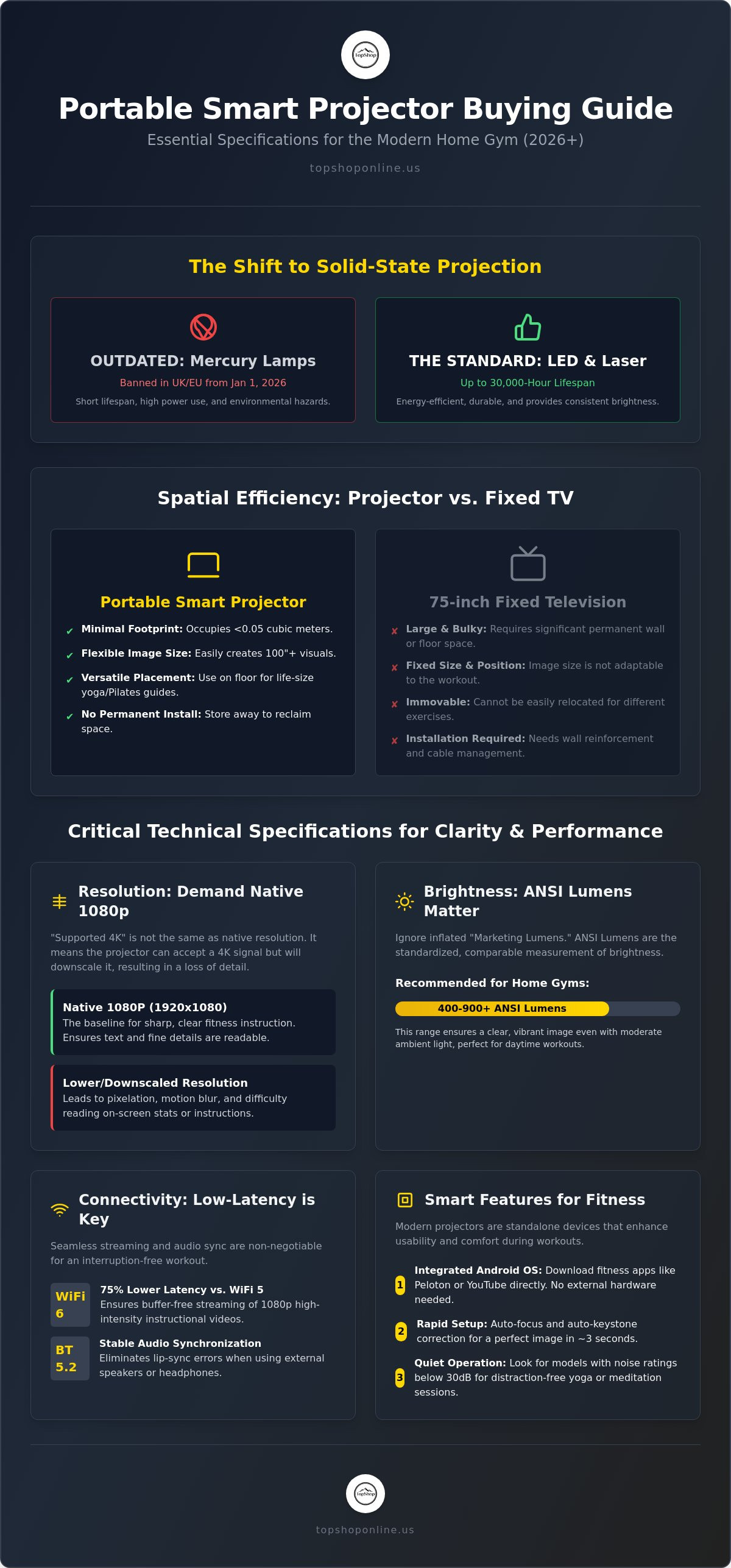
The 2026 portable smart projector is defined by its integration of solid-state LED light sources, onboard Android operating systems, and high-speed wireless connectivity. This hardware configuration eliminates the need for external media players or permanent mounting fixtures. This portable smart projector buying guide emphasizes the spatial advantages of projection technology in multi-functional rooms. A projector capable of producing a 100-inch image typically occupies less than 0.05 cubic meters of physical space. In contrast, a 75-inch fixed LED panel requires significant wall reinforcement and permanent floor clearance. Modern units feature impact-resistant polymer housings and recessed lens assemblies to withstand vibrations in high-activity fitness areas. Video projector technology has evolved to prioritize these compact, ruggedized form factors for versatile home use.
Brightness evaluation requires standardized ANSI lumen measurements rather than generic marketing lumens. High-performance portable hardware for non-darkened environments utilizes high-intensity LED arrays to achieve 800 to 1,200 ANSI lumens. This output level ensures visibility against moderate ambient light during daylight training sessions. Lower-rated units often fail to maintain contrast ratios without total blackout curtains, making them impractical for morning workout routines.
Native 1080P vs. Supported Resolution
Native resolution refers to the fixed physical pixel count on the internal imaging chip. Many budget units claim 4K support, which only indicates the ability to decode high-resolution files before downscaling them to a lower output. Native 1080P is the baseline requirement for instructional fitness clarity. It ensures that text-heavy smart interfaces and fine muscular details in form-correction videos remain sharp. High-definition output prevents the pixelation and motion blur common in 720P or software-upscaled hardware. This portable smart projector buying guide identifies native pixel density as the primary factor in visual instructional quality.
LED Lamp Life and Thermal Management
Solid-state LED light sources in current models provide operational lifespans between 20,000 and 30,000 hours. This longevity matches or exceeds the lifespan of traditional LED televisions while consuming significantly less power. Effective thermal management is achieved through active copper heat pipes and low-decibel cooling fans. For quiet activities like yoga or meditation, hardware with noise ratings below 30dB is essential. Active cooling prevents internal hardware degradation and ensures consistent brightness over long-duration training sessions. These energy-efficient cooling systems allow for compact chassis designs without the risk of thermal throttling during intensive use.
Core Technical Specifications: Resolution, Brightness, and Connectivity
Standardized brightness measurement is the critical metric for hardware selection. Marketing lumens often inflate values by up to 10x compared to ANSI lumens, which are measured using rigorous industry protocols. A reliable portable projector buying guide emphasizes that for fitness environments with moderate ambient light, a minimum of 400 to 900 ANSI lumens is required. High-performance 2026 units achieve these levels using advanced solid-state LED arrays. Auto-keystone correction and autofocus sensors provide rapid image calibration, allowing for 3-second setup times in multi-functional rooms. These automated systems utilize Time-of-Flight (ToF) sensors to adjust for tilt and distance instantly without manual intervention.
WiFi 6 (802.11ax) integration reduces latency by approximately 75% compared to WiFi 5, ensuring buffer-free streaming of 1080P instructional content. Bluetooth 5.2 provides stable synchronization with external audio hardware, eliminating lip-sync errors during high-intensity training. Native Android OS integration allows users to download Peloton, Fitbit, or YouTube directly onto the hardware. This direct app execution removes the need for HDMI dongles or laptops, minimizing signal degradation and simplifying the user interface. This portable smart projector buying guide prioritizes hardware that supports these integrated software ecosystems for maximum utility.
Wireless Mirroring and Mobile Integration
Wireless protocols including AirPlay, Miracast, and DLNA enable seamless screen mirroring from iOS and Android devices. For high-bandwidth tasks, mirroring fitness apps to a smart wifi projector 1080p portable requires a stable 5GHz network frequency. This hardware configuration supports life-size instructional video playback without the visual stuttering associated with older 2.4GHz bands. Managing network bandwidth is essential for maintaining 60fps video, which is the standard for high-motion athletic demonstrations.
Physical Port Configurations
Physical port configurations remain essential for zero-latency performance in professional setups. HDMI 2.1 ports support high-frame-rate video, while USB-C ports with Power Delivery (PD) allow the unit to run off high-capacity power banks. Audio output is managed through 3.5mm auxiliary jacks for wired headphones or Bluetooth for wireless speaker arrays. Power input requirements typically range from 65W to 100W, making them compatible with modern specialized fitness equipment setups that prioritize mobility. These physical connections ensure the projector functions as a reliable standalone hub even when wireless networks are congested or unavailable.
Hardware Comparison: Portable Smart Projectors vs. Fixed Television Displays
Fixed television displays require permanent architectural commitments and specific structural reinforcements. A standard 75-inch LED panel weighs approximately 30kg and requires VESA-compliant mounting hardware. This portable smart projector buying guide emphasizes the utility of variable throw distances as an alternative to fixed glass. Most 2026 portable units achieve a 100-inch diagonal image from a distance of 2.6 meters. Users can scale the display from 40 to 120 inches based on available wall surface area. According to PCMag's 2026 portable projector tests, optical zoom and digital scaling allow these units to function in rooms as small as 9 square meters. Simple desktop placement replaces the complexity of wall drilling and cable concealment behind drywall.
Optical health is a measurable factor when comparing these display types. Emissive displays like LED TVs project light directly into the retina, which often increases ocular fatigue. Projectors utilize reflective light technology where the image bounces off a surface before reaching the eye. This reduces direct blue light exposure during long-duration instructional fitness sessions. Asset mobility further distinguishes these categories. A portable projector transitions between a bedroom, living room, and dedicated gym space in seconds. This flexibility is impossible with fixed panels that are tethered to specific power and data outlets.
Cable Management and Power Solutions
Organizing hardware hubs in multi-functional spaces requires high-density power solutions. Integrating a power strip 6 outlet 6 usb ensures that the projector, external audio arrays, and mobile devices remain powered from a single source. Utilizing a power strip with usb ports facilitates the simultaneous charging of smartphones used for wireless mirroring protocols. Retractable cable solutions and central power hubs reduce floor-level clutter, which is essential for safety in high-activity workout environments.
Ambient Environment Control
Ambient light management determines the effective contrast ratio of the projected image. Deploying smart led fairy lights for indoor use provides low-intensity bias lighting that improves perceived black levels without washing out the display. While treated white walls provide a functional surface, dedicated Ambient Light Rejecting (ALR) screens improve gain and color accuracy in non-darkened rooms. Acoustic considerations are also vital; portable hardware often benefits from external Bluetooth speaker synchronization to overcome the ambient noise of gym equipment or cooling fans.
Optimizing Home Fitness Environments with Large-Format Smart Projection
Large-format projection technology transforms standard vertical surfaces into immersive, interactive fitness hubs. Life-size instructional video allows for 1:1 scale visual matching, which is essential for correct form and precise biomechanical alignment. This portable smart projector buying guide identifies the removal of fragile glass screens as a primary safety benefit in high-movement zones. Unlike fixed televisions, projectors eliminate the risk of screen impact during dynamic exercises involving kettlebells or medicine balls. This hardware configuration enables a dedicated workout hub using the Fitness & Workout collection. High-definition 1080P resolution is essential here to resolve fine details of instructor form, such as foot placement and spinal alignment, which are often lost on smaller or lower-resolution portable screens.
The flexibility of portable hardware allows for projection on unconventional surfaces, including ceilings for supine exercises or low-level floor areas for mat work. This adaptability ensures that the instructional visual remains within the user's natural line of sight, reducing neck strain and improving concentration. Integrated smart features allow for the direct streaming of workout apps, creating a streamlined training environment without the clutter of external laptops or cables.
Strength and Resistance Training Integration
High-intensity resistance training requires constant visual feedback to maintain joint integrity. Using Resistance Bands in conjunction with life-size projection ensures that every movement pattern matches the instructor's demonstration. For progressive overload, users can monitor their intensity while wearing a Weighted Vest during plyometric or bodyweight routines. Tracking secondary metrics such as grip improvements with the Adjustable Hand Strength Exerciser provides a comprehensive view of athletic progression. The large-scale display remains visible even during rapid directional changes or high-speed intervals.
Yoga, Pilates, and Recovery Visualization
Floor-level projection is uniquely suited for yoga and Pilates routines where the user's eye line is frequently parallel to the floor. Projecting calming environments or instructional guides during Yoga Ball core work maintains focus without straining the neck toward a wall-mounted TV. The ability to tilt the projector lens for low-level display ensures that instructional content is exactly where the user needs it during prone positions. Precision-based Pilates movements on the Foldable Pilates Reformer Machine benefit from life-size visual cues that emphasize subtle postural adjustments and spring resistance settings. Post-workout recovery sessions utilize video guidance on a Foam Massage Roller to target specific muscle groups effectively. These visual aids improve the efficacy of myofascial release by demonstrating correct pressure application and rolling speed. This portable smart projector buying guide highlights the utility of mobile hardware in these specialized recovery zones.
Enhance your home gym setup today by exploring the full Fitness & Workout collection.
Final Selection Criteria and Essential Fitness Equipment Integration
Final procurement decisions depend on the specific environmental constraints of the home gym. This portable smart projector buying guide recommends prioritizing hardware with a minimum 30,000-hour LED lifespan to ensure long-term operational ROI. Users must choose between internal battery-powered units for total wireless mobility and plug-in units that typically deliver higher ANSI lumen output for consistent daytime visibility. Budget allocation should account for the primary display unit alongside essential recovery and resistance hardware to create a functional, high-density training hub. Technical durability is a critical metric; selection should favor units with high-impact polymer chassis and integrated lens protection to ensure performance stability in multi-functional rooms where hardware is frequently repositioned.
The integration of high-speed WiFi 6 and Bluetooth 5.2 hardware remains the 2026 standard for reducing signal latency during interactive training sessions. These connectivity protocols ensure that life-size instructional video remains synchronized with external audio arrays. When assessing mobility requirements, consider the power-to-weight ratio and the availability of USB-C Power Delivery (PD) inputs. These features allow the projector to function with high-capacity external power banks, extending training sessions in areas without direct AC outlet access. This hardware flexibility distinguishes portable units from fixed television panels that remain tethered to specific architectural locations.
Featured Fitness Essentials for Your Setup
- Recovery Hardware: The Hollow Yoga Column Foam Roller ($8.35-9.01) facilitates myofascial release and muscle relaxation following high-intensity projection-guided sessions. Its grid-pattern surface targets deep tissue to improve muscle recovery times.
- Endurance Training: The 10 Lb. Adjustable Fitness Vest ($74.52) provides progressive resistance for advanced aerobic and strength routines. The adjustable strap system ensures a secure fit during dynamic movements in front of the large-format display.
- Full-Body Strength: Complete Resistance Band Sets ($44.83) offer versatile tension options for strength training within the projected instructional area. These bands include handles and ankle straps for comprehensive muscle engagement.
Conclusion: The Future of Flexible Home Gyms
The Smart Projector Wifi Portable 1080P provides native high-definition resolution and integrated Android connectivity, effectively eliminating the need for bulky, fragile fixed panels. Combining this hardware with a unified Fitness & Workout environment creates a professional-grade training space without permanent structural modifications. A final procurement checklist should include the primary projector unit, a high-density power hub, and specialized resistance tools to ensure a complete, high-performance fitness ecosystem. This integrated approach prioritizes spatial efficiency, visual clarity, and long-term athletic utility for the 2026 home gym standard. It's a practical strategy for users who demand professional-grade instructional visuals without sacrificing floor space.
Implementing High-Performance Projection for 2026 Home Gyms
Selection of hardware based on this portable smart projector buying guide ensures a transition from static viewing to interactive, large-format training hubs. Native 1080P resolution and high-output LED light sources deliver the visual fidelity required for precise form correction during complex athletic movements. These solid-state units provide the spatial efficiency and reflective-light optical safety necessary for high-intensity, multi-functional spaces. The integration of high-speed connectivity standards and Android OS allows for a streamlined user experience without the clutter of external media players or permanent wall mounts.
Integrating native 1080P portable projection technology with professional-grade Pilates reformers and strength hardware creates a comprehensive, data-driven athletic hub. TopShop offers fast shipping on all fitness essentials to facilitate rapid environment deployment. You can now browse the complete Fitness & Workout collection to procure professional-grade strength, yoga, and rehabilitation equipment. This hardware synergy allows for life-size instructional clarity and optimized training outcomes in any compact environment. It's a professional-grade solution for modern training requirements. Achieve your technical fitness goals with a setup built for precision and mobility.
Frequently Asked Questions
Is a portable smart projector bright enough for a daytime home gym?
High-output LED projectors achieving 800 to 1,200 ANSI lumens provide sufficient visibility in moderate ambient light. Standard daytime home gyms require hardware with these specific brightness ratings to maintain instructional clarity. Lower-output units under 400 ANSI lumens require controlled lighting or blackout curtains for effective image contrast. Hardware selection should prioritize ANSI lumen ratings over generic marketing lumens for accurate performance assessment.
Can I use a smart projector with fitness apps like Peloton or YouTube?
Smart projectors with integrated Android OS allow for the direct installation of Peloton, YouTube, and Fitbit apps from the Google Play Store. This eliminates the need for external media players or secondary hardware connections. Users can access life-size instructional content directly through the projector's native interface. High-speed WiFi 6 integration ensures stable, buffer-free streaming of high-definition workout videos during intensive training sessions.
What is the minimum throw distance for a 100-inch projected image?
A 100-inch diagonal image typically requires a throw distance of 2.6 to 3.0 meters depending on the specific optical lens assembly. Variable throw distances in modern portable units allow for flexible placement in rooms as small as 9 square meters. Digital zoom features provide additional image size adjustment without physical hardware relocation. This flexibility is essential for maintaining large-format visuals in multi-functional spaces or small home gyms.
Do I need a special screen for a 1080P portable projector?
A dedicated Ambient Light Rejecting (ALR) screen is recommended for maximum contrast but is not strictly necessary for a 1080P portable projector. A smooth, matte-white wall surface provides a functional alternative for instructional fitness visuals. This portable smart projector buying guide emphasizes that screen selection should match the ambient light levels of the training environment. High-gain screens improve perceived brightness and color accuracy in non-darkened rooms.
How do I connect Bluetooth speakers to a smart projector for workout audio?
Bluetooth speakers connect through the projector's system settings menu under the wireless connectivity or peripheral devices section. Pairing external audio arrays or wireless headphones provides high-fidelity sound for workout instructions while eliminating floor-level cable clutter. Bluetooth 5.2 ensures stable synchronization between the visual content and the audio output. This wireless configuration is ideal for maintaining a safe, obstacle-free exercise zone during dynamic movements.
Is the Smart Projector Wifi Portable 1080P compatible with iOS and Android?
The Smart Projector Wifi Portable 1080P supports universal wireless mirroring through AirPlay, Miracast, and DLNA protocols. This cross-platform compatibility ensures seamless screen sharing from iOS and Android smartphones or tablets. Users can mirror fitness app interfaces directly to the large-format display for real-time form tracking. The hardware maintains a stable connection over 5GHz network frequencies to prevent visual stuttering during high-motion athletic demonstrations.
How often do I need to replace the bulb in a portable LED projector?
LED light sources in solid-state portable projectors do not require frequent replacement like traditional mercury lamps. These light sources are rated for 20,000 to 30,000 operational hours, which exceeds the typical lifespan of the internal electronics. This portable smart projector buying guide identifies long-term durability as a key advantage of LED hardware over lamp-based units. This rating translates to over 10 years of use at 5 hours per day.
What are the power requirements for a portable projector in a remote setup?
Portable projectors typically require 65W to 100W of power delivered via a standard DC adapter or a USB-C Power Delivery (PD) port. Remote setups can utilize high-capacity external power banks or portable power stations with compatible wattage ratings. This power configuration supports mobility in areas without direct access to AC wall outlets. Users should verify that their power source meets the specific voltage and amperage requirements listed in the hardware technical specifications.