

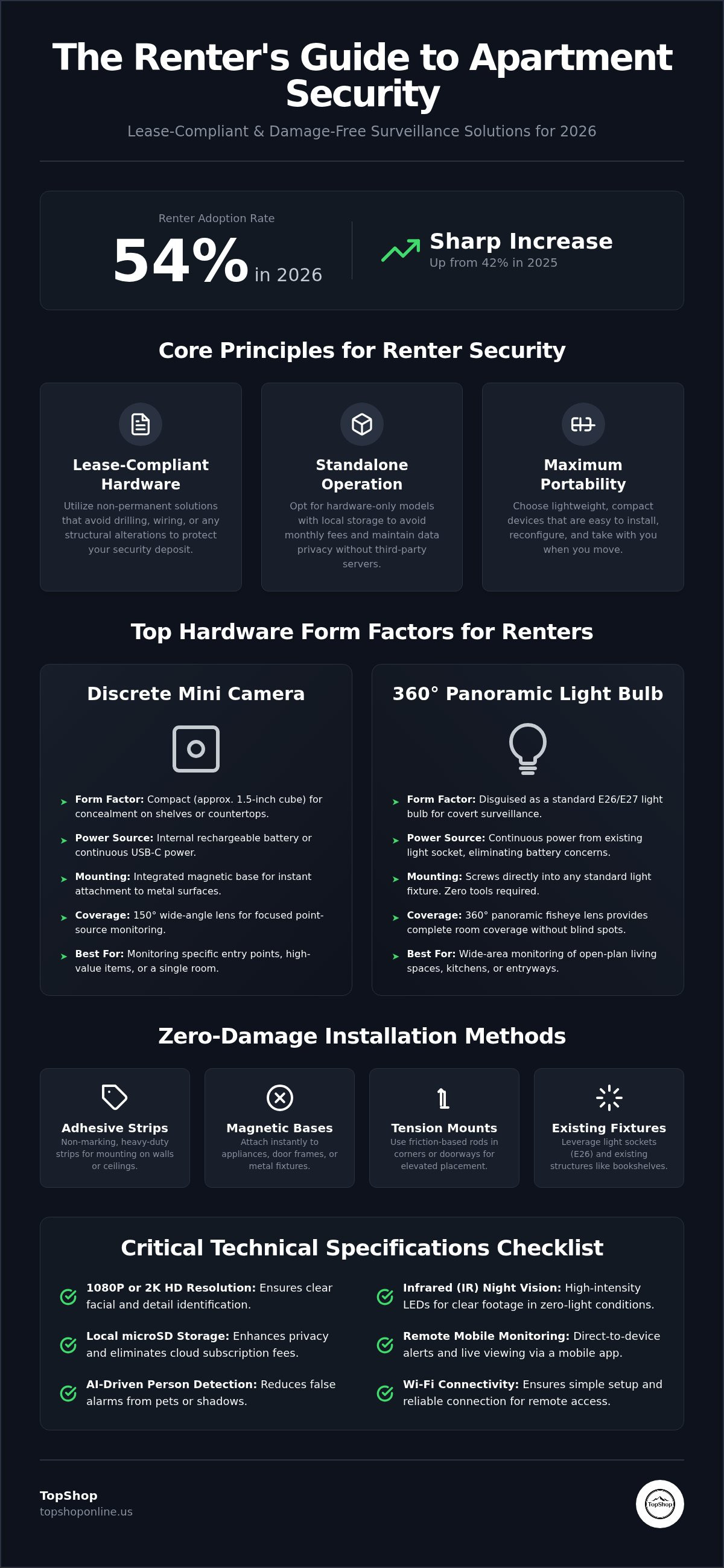
Adoption rates for security cameras among renters reached 54% in 2026, a sharp increase from 42% in 2025. Selecting a security camera for apartment renters requires balancing high-resolution monitoring with lease-compliant, non-permanent installation. You need reliable property surveillance without the risk of security deposit loss or structural damage. Traditional wired systems are often incompatible with rental agreements due to invasive drilling and permanent wiring requirements.
This technical roundup analyzes non-permanent hardware specifications and zero-damage deployment strategies for modern apartment environments. It evaluates 1080P wireless mini cameras, 360-degree panoramic light bulb units, and adhesive-based mounting hardware. We examine 2026 industry standards including AI-driven person-detection analytics, 2K HDR video sensors, and remote mobile monitoring integration. This data focuses on hardware-only solutions requiring zero drilling and no professional installation services. You'll find specific details on 1080P HD wireless mini cameras for discrete indoor placement and 360-degree light bulb form factors using standard E26 sockets. The analysis prioritizes affordable, standalone hardware with remote monitoring capabilities and zero-damage footprints.
Key Takeaways
- Identify lease-compliant hardware configurations that utilize existing fixtures and non-permanent adhesives to prevent structural damage and security deposit deductions.
- Compare the functional advantages of discrete mini cameras versus 360-degree panoramic light bulb units for varying apartment layouts and coverage requirements.
- Evaluate essential technical specifications for a security camera for apartment renters, focusing on 1080P resolution and infrared night vision for precise facial identification.
- Implement zero-damage deployment strategies using tension-based mounting hardware and heavy-duty adhesive strips for tool-free installation.
- Analyze specific hardware features of the 1080P HD Wireless Mini Security WiFi Camera and the 360° Panoramic Hidden Light Bulb Wifi Camera.
Essential Requirements for Apartment Renter Security Cameras
Renter-specific security hardware is defined by its non-permanent, modular, and non-invasive design characteristics. These devices function as standalone units that bypass the need for centralized control panels or professional wiring. A security camera for apartment renters must facilitate zero-damage deployment to protect the tenant’s security deposit and maintain lease compliance. The technical architecture typically involves Wi-Fi 6 connectivity, high-capacity internal lithium-ion batteries, and integrated microSD storage slots. This hardware-centric approach allows for immediate plug-and-play operation and effortless removal during relocation. Using a Wireless security camera provides the necessary flexibility for changing environments while maintaining high-resolution surveillance capabilities.
Legal and Lease Considerations for Renters
Standardized 2026 residential lease clauses categorize wall penetrations exceeding 0.5 inches as structural damage. Renters must prioritize hardware that utilizes non-marking adhesive backings, magnetic plates, or friction-based mounts. Legally, internal unit monitoring is permitted across all 50 states, though audio recording regulations vary by jurisdiction. In all-party consent states like California, Florida, or Illinois, tenants must ensure recording doesn't infringe on the privacy rights of guests or co-tenants. Utilizing zero-damage hardware mitigates the risk of landlord-tenant disputes regarding property condition reports and ensures the full return of security deposits upon move-out.
Standalone vs. Subscription-Based Models
Standalone security models offer a high-density information environment without the recurring overhead of professional monitoring fees. Technical advantages include local encrypted storage on Class 10 microSD cards, which prevents data leakage to cloud servers and enhances personal privacy. These units provide direct-to-device alerts via low-latency mobile applications, ensuring real-time awareness without third-party intervention. This system architecture eliminates the complexity of traditional wired configurations while providing 1080P or 2K video resolution. The hardware-only model is a one-time investment that remains functional across different living environments. It's a more efficient choice for individuals who prioritize data ownership and cost transparency.
Portability is a critical performance metric for renter-focused systems. Hardware must be lightweight, compact, and easily detachable from its mounting points. This allows for rapid reconfiguration if the tenant moves or decides to change the surveillance focus within the unit. Standalone devices don't require the transfer of service contracts, making them the most practical solution for mobile populations in 2026.
Non-Permanent Hardware Form Factors: Mini vs. Panoramic Bulb
Renter-specific surveillance hardware in 2026 utilizes two primary form factors to address spatial constraints and lease restrictions. Selecting a security camera for apartment renters involves evaluating the trade-offs between discrete point-source monitoring and wide-area panoramic coverage. Mini wireless units prioritize concealment and versatile placement, while light bulb-integrated cameras leverage existing electrical infrastructure for continuous power. Both configurations avoid structural modifications, ensuring full compliance with standard rental agreements and security deposit protection protocols.
Discrete Mini Camera Specifications
A small wireless security camera indoor unit typically features a compact, 1.5-inch cubic footprint designed for shelf, countertop, or bookshelf deployment. These devices utilize high-capacity internal lithium-polymer batteries for 24-hour operation or continuous USB-C power for long-term monitoring. Integrated magnetic bases allow for instantaneous attachment to metal appliances, door frames, or utility pipes without drilling. Technical specifications include 1080P HD CMOS sensors, 150-degree wide-angle lenses, and high-intensity infrared LEDs for zero-light performance. This form factor is optimal for monitoring specific entry points or high-value assets within a multi-room apartment layout.
Panoramic Hidden Light Bulb Camera Utility
The 360 panoramic wifi camera indoor form factor utilizes a standard E26/E27 screw-in light socket for both mounting and power delivery. This architecture eliminates the need for battery management or external wiring, providing an uninterrupted 24/7 surveillance stream. The hardware features a fisheye lens capable of capturing a complete 360-degree field of view, making it the most efficient solution for central living areas or open-concept studio apartments. Stealth capabilities are enhanced by the dual-function design, as the unit operates as a functional LED light source while housing a concealed 1080P sensor and two-way audio hardware. For those seeking comprehensive coverage, you can view standalone security hardware options that fit existing apartment fixtures.
Coverage requirements vary significantly based on apartment square footage. Studio apartments benefit from a single, centrally located panoramic bulb camera that eliminates blind spots in a single-room environment. Multi-room layouts require a distributed network of mini cameras to monitor disparate zones such as hallways, bedrooms, and kitchen entryways. In 2026, 54% of renters utilize a combination of these form factors to achieve full-unit visibility without violating lease terms regarding permanent hardware installation.
Critical Technical Specifications: Resolution, Night Vision, and Connectivity
Hardware performance in a security camera for apartment renters depends on three technical pillars: image clarity, sensor sensitivity, and network stability. 1080P resolution (1920 x 1080 pixels) is the 2026 industry baseline for actionable surveillance. To achieve reliable facial identification at a 5 to 10 meter distance, a sensor must maintain a high bitrate and utilize H.265 compression protocols. Lower resolution sensors often fail to provide the necessary pixel density for forensic review of recorded footage. High-density apartment buildings generate significant signal interference, making WiFi band compatibility a critical deployment factor. Hardware supporting 2.4GHz frequencies provides superior wall penetration, while 5GHz bands offer higher data throughput for 2K video streams. Internal storage architectures utilize Class 10 UHS-I microSD cards for high-speed write cycles. Automatic loop recording ensures continuous uptime by replacing expired video files with current data streams once storage capacity limits are reached.
Infrared and Low-Light Performance
Effective night vision requires a high-intensity infrared LED array capable of illuminating a 10 to 15 meter radius. A wireless mini security camera with night vision typically utilizes a 0.01 LUX rating to capture clear imagery in near-total darkness. Technical monitoring modes include motion-activated recording to preserve storage space and continuous 24/7 recording for high-traffic zones. High-contrast ratios in low-light environments prevent "white-out" effects when subjects move close to the infrared sensors. This ensures that facial features remain distinguishable even without external ambient lighting.
Remote Access and App Integration
Modern surveillance systems prioritize low-latency remote access via dedicated mobile applications. Understanding how to set up wifi security camera systems involves configuring P2P (Peer-to-Peer) protocols for secure, direct-to-device streaming. Real-time alert latency over standard 5G or LTE mobile data networks should remain sub-500ms for effective incident response. Multi-user access protocols allow roommates or family members to view live streams simultaneously without degrading the primary video feed. These apps also provide granular control over motion sensitivity zones, reducing false alerts from pets or hallway movement. Secure encryption standards protect the data stream from unauthorized external access while maintaining ease of use for the primary account holder.
Hardware durability and heat dissipation are also vital for continuous operation. Compact mini cameras and light bulb units must manage thermal output during high-bitrate recording. Efficient heat sink designs prevent sensor degradation and ensure long-term hardware reliability in varying indoor climates. This technical focus ensures that the surveillance system remains operational without requiring frequent maintenance or professional intervention.
Zero-Damage Deployment and Mounting Strategies for Renters
Deployment of a security camera for apartment renters relies on non-invasive hardware interfaces that eliminate the need for mechanical fasteners or structural drilling. Heavy-duty synthetic rubber adhesives and high-bond acrylic tapes provide the necessary shear strength for wall-mounted mini cameras without compromising paint integrity or wallboard stability. Tension-based mounting systems utilize adjustable, spring-loaded telescopic rods to secure devices within window frames or between vertical cabinetry surfaces. Repurposing existing apartment infrastructure, such as high-clearance bookshelves, refrigerator tops, or curtain rods, provides elevated vantage points for maximum room coverage and unobstructed fields of view. Socket-integrated hardware, specifically the 360-degree light bulb form factor, represents the most efficient zero-tool installation method by utilizing existing E26 electrical fixtures for both structural support and continuous power delivery.
Adhesive Mounting Technical Limits
Long-term camera stability depends on precise weight-to-surface area ratios and material compatibility. Standard wireless mini cameras typically weigh between 100 and 200 grams, requiring at least 5 square inches of adhesive contact for secure vertical placement on non-porous surfaces. Surface preparation is mandatory; users don't need professional tools, but they must clean the target area with 70% isopropyl alcohol to remove surface contaminants and ensure optimal polymer bonding. Heat dissipation remains a critical factor for hardware longevity and mounting reliability. Placing adhesive pads directly over heat-generating internal components can cause thermal throttling or adhesive failure as the bond weakens under high temperatures. Utilizing offset mounting brackets allows for a 5mm air gap to maintain airflow between the camera chassis and the wall surface.
Cable Management for Wired Units
Wired surveillance hardware requires organized cable routing to satisfy lease requirements and maintain a discrete, professional profile. Transparent polycarbonate cord clips facilitate secure USB power cable management along baseboards, window casings, or door frames, preventing loose wires from becoming trip hazards. Routing cables behind high-profile furniture or within decorative cord channels prevents accidental disconnection and visual clutter. For multi-camera configurations in home offices or living areas, utilize a high-capacity power strip with integrated USB ports to centralize power delivery and minimize wall outlet usage. This systematic approach ensures that the entire surveillance network remains portable and easily removable during relocation without leaving residue or damage.
To secure your living space without permanent modifications, browse non-permanent security camera hardware designed for immediate deployment.
Technical Overview of Renter-Friendly Security Hardware at TopShop
Standalone surveillance hardware for 2026 focuses on high-density data capture and non-permanent integration within existing residential structures. TopShop provides specialized security camera for apartment renters that bypasses the need for professional installation services or long-term monitoring contracts. The hardware inventory includes compact 1080P mini units and panoramic light bulb configurations designed for immediate deployment. These devices utilize standard WiFi protocols and local storage architectures to maintain data privacy and operational efficiency. Technical specifications prioritize sensor clarity, low-latency mobile connectivity, and zero-tool structural compatibility.
TopShop Mini Security Camera Specifications
The 1080P HD Wireless Mini Security WiFi Camera features a 1920x1080 high-definition CMOS sensor coupled with a 150-degree wide-angle optical lens. Dimensions are optimized for discrete placement, utilizing a compact cubic housing that fits on bookshelves, window sills, or within standard cabinetry. Connectivity is maintained via a 2.4GHz WiFi module, providing a stable signal range of up to 20 meters in typical apartment environments. Internal power is supplied by a high-capacity lithium-polymer battery for short-term wireless operation, or it can be connected to a continuous USB power source for 24/7 monitoring. The hardware includes integrated infrared LEDs for zero-light visibility and a microSD slot supporting high-speed loop recording on media up to 128GB.
TopShop Panoramic Light Bulb Camera Analysis
The 360° Panoramic Hidden Light Bulb Wifi Camera utilizes an E27 screw-in interface for simultaneous structural mounting and continuous power delivery. The optical array consists of a high-resolution fisheye lens providing a complete 360-degree field of view, effectively eliminating blind spots in open-concept studio apartments or central living areas. Installation requires zero tools; the user screws the unit into a standard light socket and completes the network handshake via a mobile application. Integrated two-way audio hardware includes a high-sensitivity microphone and a compact internal speaker for real-time remote communication. This dual-function device operates as a functional LED light source while maintaining a concealed surveillance profile for enhanced property security.
Mobile monitoring for both units is facilitated through low-latency applications compatible with iOS and Android platforms. These apps provide real-time motion-activated alerts, remote live-stream viewing, and playback control of locally stored video files. The encrypted P2P data stream ensures that footage remains private and accessible only to authorized users. TopShop maintains fast shipping across the United States, ensuring that hardware arrives within 3 to 5 business days for rapid security deployment. This hardware-centric approach provides a reliable, cost-effective security camera for apartment renters that adapts to changing living situations without the risk of property damage or lost deposits.
Implement Lease-Compliant Surveillance Solutions Today
Selecting a security camera for apartment renters in 2026 involves prioritizing standalone hardware that eliminates the need for structural modifications. The transition to non-permanent form factors ensures that security deposits remain intact while providing high-resolution monitoring. Key takeaways include the efficiency of 1080P sensors for facial identification and the utility of 360-degree panoramic light bulb cameras for tool-free installation. Utilizing adhesive-based mounting strategies and existing electrical sockets allows for rapid deployment and easy removal during relocation. These technical solutions provide reliable property surveillance through low-latency mobile applications without the complexity of professional monitoring contracts.
TopShop maintains an inventory of high-performance security hardware including the 1080P HD Wireless Mini Security WiFi Camera and the 360° Panoramic Hidden Light Bulb Wifi Camera. These units offer infrared night vision, motion-activated recording, and two-way audio for comprehensive indoor coverage. It's simple to deploy these systems using existing fixtures. We provide fast nationwide shipping across the United States to facilitate immediate property protection. Browse Renter-Friendly Security Cameras at TopShop to find high-density hardware solutions for your modern apartment living environment. Secure your space with confidence and technical precision.
Frequently Asked Questions
Do I need my landlord’s permission to install a security camera?
Internal installation of a security camera for apartment renters typically does not require formal landlord permission provided the deployment is non-permanent and causes zero structural damage. Tenants must ensure the device does not penetrate walls or modify electrical wiring. However, installing cameras in common areas or building exteriors almost always requires written authorization from the property owner to comply with building management policies and privacy regulations.
How do I mount a security camera in an apartment without drilling?
Non-invasive mounting is achieved through heavy-duty synthetic rubber adhesives, high-bond acrylic tapes, or tension-based telescopic rods. Magnetic bases allow for immediate attachment to metal appliances or door frames. These methods provide the necessary shear strength to support compact hardware while ensuring a clean removal process. This protects the tenant's security deposit from structural damage claims while maintaining a stable surveillance vantage point.
What is the best security camera for a small studio apartment?
The 360° Panoramic Hidden Light Bulb Wifi Camera is the most efficient hardware for studio apartments due to its fisheye lens and central placement. A single E27 socket installation provides complete room coverage without blind spots. This configuration eliminates the need for multiple devices and complex wiring in a single-room living environment. It maintains a discrete profile while delivering high-resolution monitoring of the entire square footage.
Can I use a WiFi security camera without a monthly subscription?
Standalone WiFi cameras function without monthly subscriptions by utilizing local encrypted storage on microSD cards. Users access live streams and playback through free mobile applications without recurring cloud storage fees. This hardware-centric approach ensures data privacy and eliminates long-term service contracts. It maintains real-time remote monitoring capabilities over standard network protocols while keeping the total cost of ownership restricted to the initial hardware purchase.
Will a light bulb camera work in any standard lamp socket?
Light bulb cameras are compatible with any standard E26 or E27 screw-in socket found in ceiling fixtures and floor lamps. The hardware draws continuous power directly from the lamp's electrical circuit, which eliminates the need for battery management. Users must keep the lamp's physical power switch in the "on" position to maintain the camera's network connectivity. The device functions as a standard LED light while housing the internal surveillance components.
What happens to my security camera data if the WiFi goes out?
If the WiFi connection fails, the security camera for apartment renters continues to record video data to the internal microSD card. While remote live-viewing and real-time mobile alerts are disabled during a network outage, the hardware preserves the incident footage locally. Once network connectivity is restored, the data becomes accessible for remote playback through the integrated application. This ensures that surveillance remains active even during temporary internet disruptions.
How long does the battery last on a wireless mini security camera?
Internal lithium-polymer batteries in wireless mini cameras typically provide 24 hours of continuous operation on a single charge. Battery life extends significantly when using motion-activated recording modes rather than constant streaming. For long-term surveillance, these units are often connected to a continuous USB-C power source or a high-capacity power bank. This setup ensures uninterrupted monitoring without the need for frequent manual recharging of the internal cell.
Are indoor security cameras legal in a shared apartment?
Indoor security cameras are legal in shared apartments when placed in common areas such as living rooms or kitchens, provided all roommates are notified. It's illegal to install surveillance hardware in areas with a reasonable expectation of privacy, including bathrooms or the private bedrooms of co-tenants. Compliance with state-specific audio recording consent laws is also mandatory. Tenants should review their co-habitation agreements to ensure all parties consent to shared area monitoring.