

The physical footprint of a small wireless security camera indoor is no longer the primary constraint on image quality; instead, thermal management and power consumption dictate the ceiling of surveillance performance. You likely encounter ambiguity regarding the trade-off between high-resolution 4K sensors and the limited battery life inherent in compact, heat-sensitive housings. It's common to experience signal instability when 5GHz connectivity fails to penetrate standard drywall barriers or structural obstructions within residential layouts.
This technical overview provides a functional analysis of hardware specifications and connectivity protocols required for stable 1080P and 2K monitoring in 2026. We examine sensor resolution benchmarks, power supply requirements for continuous recording, and mounting specifications to maximize field of view in confined spaces. This guide details Wi-Fi 7 adoption, local microSD storage capacities up to 512GB, and specific mounting locations to ensure comprehensive coverage without blind spots. You'll understand the hardware architecture needed to balance high-density data transmission with discreet, small-form-factor placement.
Key Takeaways
- Define the specific physical parameters and hardware architecture that differentiate mini form factor devices from standard indoor surveillance units.
- Select between 2.4GHz and 5GHz Wi-Fi bands to maximize signal penetration and minimize latency for a small wireless security camera indoor setup.
- Assess CMOS sensor specifications and f-stop aperture ratings to optimize 1080P video clarity and optical performance in variable indoor lighting conditions.
- Apply geometric calculations for horizontal and vertical field of view (FOV) to ensure total room coverage and minimize wide-angle lens distortion.
- Implement secure data storage by matching microSD write speeds (U1/U3) with local and cloud-based privacy protocols.
Defining the Small Form Factor Indoor Security Camera
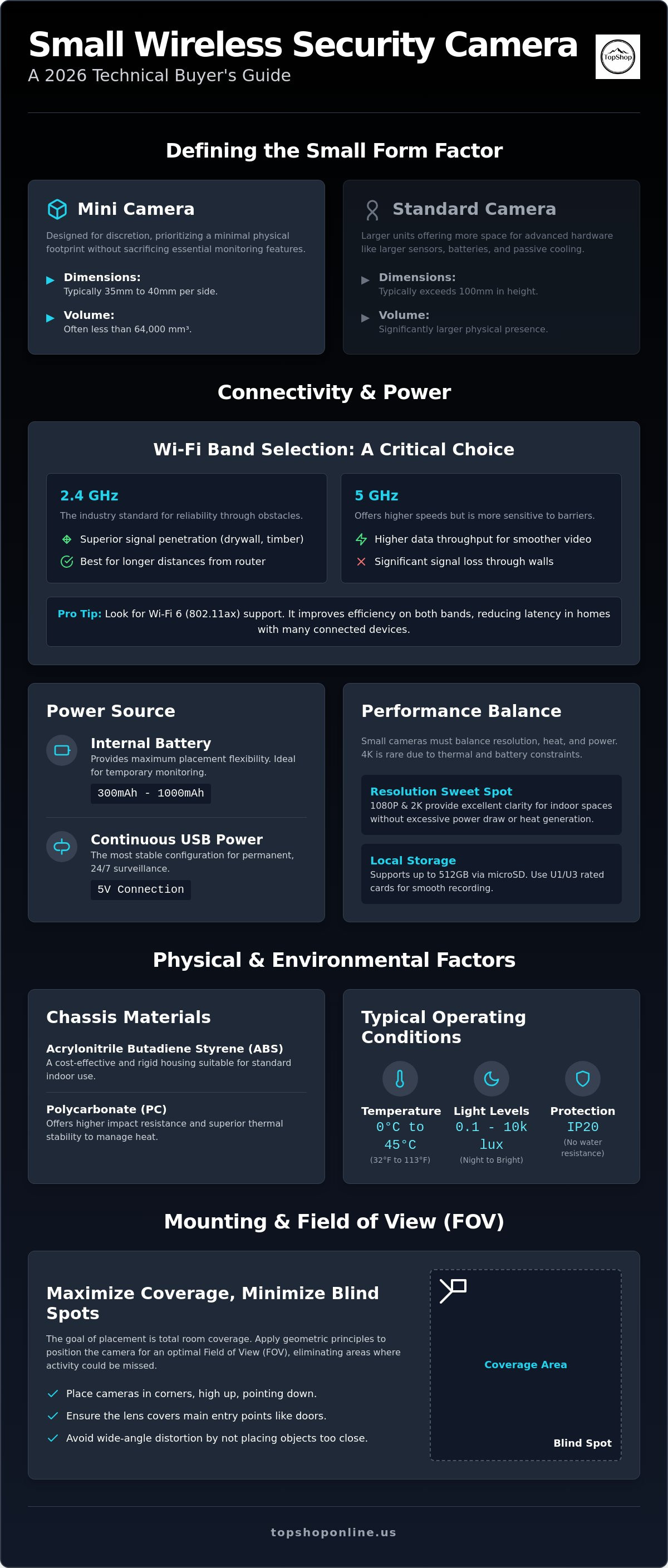
Technical classification of a small form factor indoor security camera relies on specific volumetric constraints and hardware integration density. Unlike standard indoor units that typically exceed 100mm in height, mini cameras occupy a cubic volume often less than 64,000 cubic millimeters, with average dimensions measuring 35mm to 40mm per side. This reduced footprint necessitates the use of high-density circuit boards and compact CMOS sensors. Modern wireless security camera technology allows these miniature devices to maintain 1080P resolution standards while fitting into spaces where traditional hardware is too conspicuous. The primary design objective for a small wireless security camera indoor is visual discretion without sacrificing the optical clarity required for identification.
Functional applications focus on short-range monitoring where high-resolution detail is prioritized over long-distance focal depth. Common use cases include:
- Nanny Monitoring: Discrete observation of childcare providers in residential living areas.
- Pet Surveillance: Real-time tracking of domestic animal activity in confined rooms.
- Point-of-Entry Security: Monitoring specific access points like interior hallway doors or sensitive cabinet storage.
Chassis size directly impacts internal power storage. A 1080P HD Wireless Mini Security WiFi Camera often utilizes lithium-polymer batteries ranging from 300mAh to 1000mAh. This creates a hardware trade-off where smaller chassis dimensions result in shorter standalone operational windows. Continuous monitoring usually requires a constant USB power connection to bypass these battery capacity limitations.
Miniature Chassis Materials and Durability
Manufacturers primarily utilize Acrylonitrile Butadiene Styrene (ABS) or Polycarbonate (PC) for camera enclosures. ABS provides a cost-effective, rigid housing suitable for standard use. Polycarbonate offers higher impact resistance and better thermal stability, which is essential for managing heat dissipation in compact designs. Because small form factors lack the surface area for large passive heat sinks, internal component layouts must prioritize airflow or use thermally conductive plastics to prevent sensor degradation during high-bitrate recording.
Indoor Application Environment Requirements
Indoor sensors are calibrated for ambient light levels ranging from 0.1 lux for night vision to 10,000 lux for bright interiors. Operating temperature tolerances for a small wireless security camera indoor typically span 0°C to 45°C (32°F to 113°F). Most units carry an IP20 ingress protection rating, indicating they are protected against solid objects larger than 12.5mm but lack resistance to water. High humidity environments require specific placement away from kitchen or bathroom moisture sources to prevent internal lens fogging or circuit corrosion.
Wireless Connectivity Standards and Power Supply Requirements
Wireless performance for a small wireless security camera indoor depends on the selected frequency band and the structural environment. The 2.4GHz spectrum remains the industry standard for indoor surveillance due to its superior wave propagation and ability to penetrate drywall, timber, and masonry. While 5GHz bands offer higher data throughput, they experience significant signal attenuation when passing through interior walls. Choosing a device with Wi-Fi 6 (802.11ax) capabilities improves network efficiency by utilizing Orthogonal Frequency Division Multiple Access (OFDMA). This reduces latency and prevents network congestion in environments with multiple connected IoT devices. Optimizing signal strength is as critical as camera placement and field of view when establishing a reliable monitoring network.
Power delivery methods determine the operational uptime and maintenance requirements of the hardware. Internal lithium-ion batteries provide maximum placement flexibility but require periodic recharging cycles. For permanent installations, continuous power via a 5V USB connection is the most stable configuration. Integrating a power strip with usb ports allows for centralized cable management and ensures consistent voltage delivery to the camera's internal processor. Reviewing the technical specifications of a 1080P HD Wireless Mini Security WiFi Camera ensures the hardware matches your existing network infrastructure and power availability.
Bandwidth and Data Transmission Protocols
Streaming 1080p video at 15 to 30 frames per second requires a consistent upload bitrate between 1.5 Mbps and 4 Mbps. Modern hardware utilizes H.265 (High Efficiency Video Coding) to reduce bandwidth consumption by approximately 50% compared to the older H.264 standard. This compression efficiency allows for smoother remote access via mobile applications without taxing the local network. Secure transmission is maintained through WPA2 or WPA3 encryption protocols, protecting the data stream from external interception during transit to cloud or mobile endpoints.
Battery Management and Standby Modes
Battery-operated units rely on Passive Infrared (PIR) sensors to conserve energy by remaining in a low-power sleep state until motion is detected. Wake-up latency, the duration from initial motion detection to the start of recording, is a critical performance metric; high-quality units achieve this in under 2 seconds. The internal rechargeable cells typically support 300 to 500 discharge cycles before capacity degradation occurs. Users should monitor battery health through the device interface to ensure the PIR trigger threshold doesn't cause excessive wake events that drain the cell prematurely.
Sensor Resolution and Night Vision Optical Performance
Optical clarity in a small wireless security camera indoor is fundamentally limited by the physical dimensions of the CMOS sensor and the lens aperture. Compact housings typically accommodate 1/2.7-inch or 1/3-inch CMOS sensors, which must balance pixel count with individual pixel size to maintain low-light sensitivity. A 1080p wireless mini security camera utilizes approximately 2.07 million pixels. Because the lens diameter is constrained by the miniature chassis, the aperture size (f-stop) becomes the primary factor for light intake. An f/2.0 aperture is standard; however, hardware featuring f/1.8 or lower provides significantly better performance in dim indoor environments by allowing more photons to reach the sensor surface.
Small lenses lack the internal space for moving elements required for optical zoom. Consequently, these devices rely on digital zoom, which crops the existing sensor data and reduces effective resolution. You should prioritize native optical resolution over software-based magnification to ensure identifiable facial features at distances exceeding three meters. Night vision capabilities involve the integration of Infrared (IR) LEDs. 850nm wavelength LEDs are common and produce a faint red glow, while 940nm LEDs are completely invisible to the human eye. This makes 940nm LEDs ideal for covert applications despite a slight reduction in effective illumination distance compared to the 850nm standard.
Night Vision Range and Interior Depth
Standard residential mini cameras provide an effective IR illumination range of 5 to 8 meters. Integrated IR-cut filters automatically toggle based on ambient lux levels, switching the sensor to monochrome mode to capture infrared light during night operations. Placement is critical to avoid IR bounce-back. This occurs when infrared light reflects off white walls or glass surfaces, causing overexposure and rendering the central image data unusable. Position the lens away from immediate foreground obstructions to maintain depth of field.
Frame Rate and Motion Clarity
Hardware processors in small-format units often toggle between 15 fps and 30 fps. While 30 fps produces fluid motion, it increases storage consumption and thermal output. For indoor security, 15 fps is frequently sufficient to capture identifiable movement while reducing the risk of processor-induced frame drops. Shutter speeds must remain high enough to prevent motion blur, particularly when monitoring fast-moving subjects in low-light conditions where the sensor naturally attempts to increase exposure time to compensate for lack of light.
Indoor Mounting Physics and Field of View Optimization
Mounting a small wireless security camera indoor requires precise geometric alignment to maximize sensor coverage. Horizontal Field of View (HFOV) and Vertical Field of View (VFOV) are determined by the focal length of the lens relative to the sensor size. A 2.8mm focal length typically provides a 110-degree HFOV. Placing this hardware in a room corner allows the lens to monitor two perpendicular walls simultaneously, minimizing unobserved space. High-angle mounting between 2.1 and 2.4 meters provides the optimal balance between room depth and facial recognition clarity. Angles exceeding 30 degrees from the horizontal plane often obscure facial features under the brow line.
Wide-angle lenses in mini cameras frequently exhibit barrel distortion, where straight lines appear curved toward the edges of the frame. This fisheye effect is a byproduct of fitting a wide FOV into a small lens assembly. For total room coverage without multiple units, consider a 360 panoramic wifi camera indoor configuration, which utilizes a hemispherical lens to capture an entire interior space from a central ceiling point. Select a 1080P HD Wireless Mini Security WiFi Camera for high-altitude central mounting that eliminates traditional corner blind spots.
Adhesive vs. Magnetic Mounting Systems
Surface compatibility dictates the stability of adhesive mounts. 3M VHB tapes perform optimally on non-porous surfaces like glass, finished metal, or smooth plastics. Textured drywall reduces the contact surface area, increasing the risk of bond failure over time. Magnetic mounting systems utilize N52-grade neodymium magnets to provide high pull-force in a compact footprint. These systems allow for rapid angle adjustment without tool intervention. Ensure the mounting bracket supports at least three times the camera's weight to account for vibration and cable tension.
Blind Spot Identification and Mitigation
Every fixed-lens camera possesses a "Dead Zone" directly beneath its chassis where the FOV doesn't reach the floor. You can calculate this distance by multiplying the mounting height by the tangent of the angle outside the lens's vertical reach. Large interior spaces require an overlapping FOV strategy to mitigate these gaps. Position secondary units to cover the entry points of primary camera blind spots. Architectural features like support pillars, pendant lights, and high-backed furniture create permanent occlusions that must be factored into the initial installation plan. A small wireless security camera indoor must be positioned specifically to avoid these structural shadows.
Data Storage Architectures and Privacy Protocols
Storage architecture for a small wireless security camera indoor dictates both operational cost and data accessibility. Local storage utilizing microSD cards eliminates recurring subscription fees and maintains data within the physical premises. However, local storage remains vulnerable to hardware theft. Cloud-based architectures mitigate this risk through off-site redundancy but typically require monthly service fees. For reliable 1080p recording, the hardware must support high-endurance microSD cards. Card specifications should meet Class 10, U1, or U3 standards to ensure consistent write speeds. U3 cards are prioritized for high-bitrate video to prevent frame dropping or file corruption during simultaneous read/write operations. High-endurance cards are specifically engineered for the constant write-erase cycles of security surveillance, offering higher Terabytes Written (TBW) ratings than standard consumer cards.
Secure data transmission relies on End-to-End Encryption (E2EE), often utilizing AES-256 bit standards, to protect the video stream from the camera sensor to the mobile application. This protocol ensures that intermediate servers or unauthorized network actors can't view the raw footage. It's a critical layer for maintaining residential privacy. For comprehensive protection, users should follow established protocols on how to set up wifi security camera systems to verify firewall settings and port configurations. Proper network integration prevents common vulnerabilities like default password exploits or unencrypted telnet ports.
Loop Recording and File Management
Loop recording protocols manage storage capacity by automatically overwriting the oldest saved files once the microSD card reaches its limit. Continuous recording at 1080p resolution consumes approximately 24GB of storage per day of footage. Motion-triggered settings reduce this volume significantly by only capturing relevant events, which extends the functional life of the flash memory. Users should configure motion-triggered clip durations between 15 and 60 seconds to balance detail capture with storage efficiency. It's recommended to format cards monthly to minimize file fragmentation and verify the health of the storage medium.
Network Security and Privacy Features
Network-level privacy requires the implementation of WPA3 encryption for camera-to-router links, offering stronger protection against brute-force attacks than the older WPA2 standard. Access to mobile monitoring applications must be secured via Two-Factor Authentication (2FA) to prevent unauthorized remote viewing if account credentials are compromised. Software-based privacy zones allow users to black out specific areas within the camera's FOV, such as computer monitors or interior doorways, ensuring surveillance remains targeted. Physical privacy shutters provide a hardware-level guarantee that the sensor is inactive when the system is disarmed, preventing accidental or unauthorized recording. This combination of physical and digital safeguards is standard for any modern small wireless security camera indoor deployment.
Optimizing Indoor Surveillance Infrastructure
Selecting a small wireless security camera indoor requires aligning hardware specifications with specific room geometry and data security requirements. Effective surveillance depends on high-density CMOS sensors providing 1080P HD video resolution and efficient H.265 compression protocols. You've seen how mounting height and corner placement eliminate blind spots while WPA3 encryption secures the wireless WiFi connectivity. These technical parameters ensure that a compact discreet design doesn't compromise optical clarity or network stability. Prioritizing high-endurance microSD storage and stable power delivery further enhances the reliability of the monitoring system.
Implementing these hardware standards provides a robust monitoring framework for residential and professional interiors. You can now determine the optimal balance between battery longevity and sensor performance for your specific environment. This technical alignment ensures long-term operational uptime and data integrity across all monitoring zones. Shop 1080P Wireless Mini Security Cameras at TopShop to deploy these advanced surveillance features in your space today. Establishing a secure and efficient indoor monitoring system is straightforward when you prioritize measurable hardware attributes and verified connectivity protocols.
Frequently Asked Questions
How long does the battery last on a small wireless indoor camera?
Battery life typically ranges from 1 to 4 hours of continuous recording or up to 30 days in PIR standby mode. Standard internal lithium-polymer cells feature capacities between 300mAh and 1000mAh. Actual duration depends on Wi-Fi signal strength; motion trigger frequency; and IR LED activation during night vision operations. Low-power standby modes significantly extend operational windows between recharge cycles in low-traffic areas.
Can a mini security camera record without Wi-Fi?
Yes; most units record directly to a local microSD card without an active internet connection. While remote mobile viewing and cloud uploads require Wi-Fi; the internal processor handles video encoding and local storage independently. Data is retrieved by physically removing the memory card and accessing the files via a computer. This ensures continuous recording during network outages or in locations without internet access.
What is the maximum MicroSD card capacity for indoor mini cameras?
Many modern small wireless security camera indoor models support microSD capacities up to 512GB. Standard hardware compatibility often starts at 32GB for FAT32 file systems; while larger cards require exFAT formatting. You should use high-endurance Class 10 U3 cards to ensure sufficient write speeds for 1080p video streams. High-capacity cards allow for several days of continuous 1080p footage before loop recording overwrites old files.
How do I hide a small wireless security camera in plain sight?
Effective concealment involves placing the camera within high-density environments like bookshelves; potted plants; or electronic stacks. The miniature chassis allows for integration into common household objects without specialized tools. Avoid placing the lens behind glass or translucent plastics; as this causes IR reflection and significantly degrades optical clarity during night vision mode. Strategic placement near power sources facilitates continuous USB power for long-term monitoring.
Do small indoor cameras have two-way audio functionality?
Yes; many units integrate miniature omnidirectional microphones and compact speakers for two-way communication. This hardware allows for real-time audio monitoring and verbal interaction via a connected mobile application. Note that audio recording laws vary by state; often requiring all-party consent in private settings like bedrooms. Check local regulations before activating audio recording features to ensure compliance with privacy statutes and surveillance laws.
What is the difference between 1080p and 4K in mini camera sensors?
1080p sensors capture 2.07 million pixels; while 4K sensors provide 8.29 million pixels. In a small wireless security camera indoor; 4K resolution offers superior digital zoom clarity but generates significantly more heat and consumes higher bandwidth. 1080p remains the industry standard for balancing thermal management with identifiable image detail in compact housings. Higher resolutions also require more storage space and faster microSD write speeds.
Is there a monthly fee for using a wireless mini security camera?
Monthly fees are not required for cameras utilizing local microSD storage architectures. Subscription costs only apply if you opt for cloud-based storage services for off-site video redundancy. Most hardware allows for full functional use; including motion alerts and remote viewing; through free manufacturer-provided mobile applications. This makes local storage a cost-effective alternative for users who don't require external data backups or professional monitoring services.
Can I view the camera feed on my phone while away from home?
Remote viewing is accessible via dedicated mobile applications when the camera is connected to a local Wi-Fi network. The system uses secure P2P (Peer-to-Peer) protocols or cloud relay servers to transmit the encrypted video stream to your mobile device. This allows for real-time monitoring and alert management from any location with cellular data access. Ensure your router's firewall settings allow for secure outgoing camera traffic to maintain remote connectivity.