

As of July 1, 2026, EU Regulation 2026/1289 mandates that all LED lighting products display a specific photobiological safety class between RG0 and RG3 on the product nameplate. This regulatory shift highlights the necessity for precise technical data when selecting a 10m led fairy lights indoor string for residential or commercial use. You understand that vague marketing descriptions often obscure critical information regarding power draw, heat dissipation, and material composition. Selecting the incorrect specification results in inefficient power usage or non-compliance with updated indoor safety standards.
This technical guide provides an exhaustive breakdown of 10m LED fairy light specifications, power requirements, and physical dimensions. It details the exact voltage and current needs for 5V USB configurations while comparing the electrical properties of copper and silver wire materials. You will identify the necessary safety certifications, including the latest Ecodesign for Sustainable Products Regulation requirements for repairable, non-destructive disassembly. This analysis ensures your lighting choices meet 2026 efficiency and safety benchmarks.
Key Takeaways
- Identify standard physical dimensions and LED density benchmarks for 10m strings to ensure adequate light distribution in indoor residential settings.
- Compare USB 5V power delivery against 31V mains adapters to optimize energy efficiency for 10m led fairy lights indoor.
- Analyze the material properties of copper and silver wire, including tensile strength and conductivity, for high-durability indoor installations.
- Implement 2026 fire safety standards by monitoring surface temperature benchmarks and heat dissipation protocols when mounting LEDs on fabrics.
- Streamline procurement by matching string lengths to hardware availability, focusing on USB port integration for modern desk and office environments.
Technical Specifications of 10m LED Fairy Lights Indoor
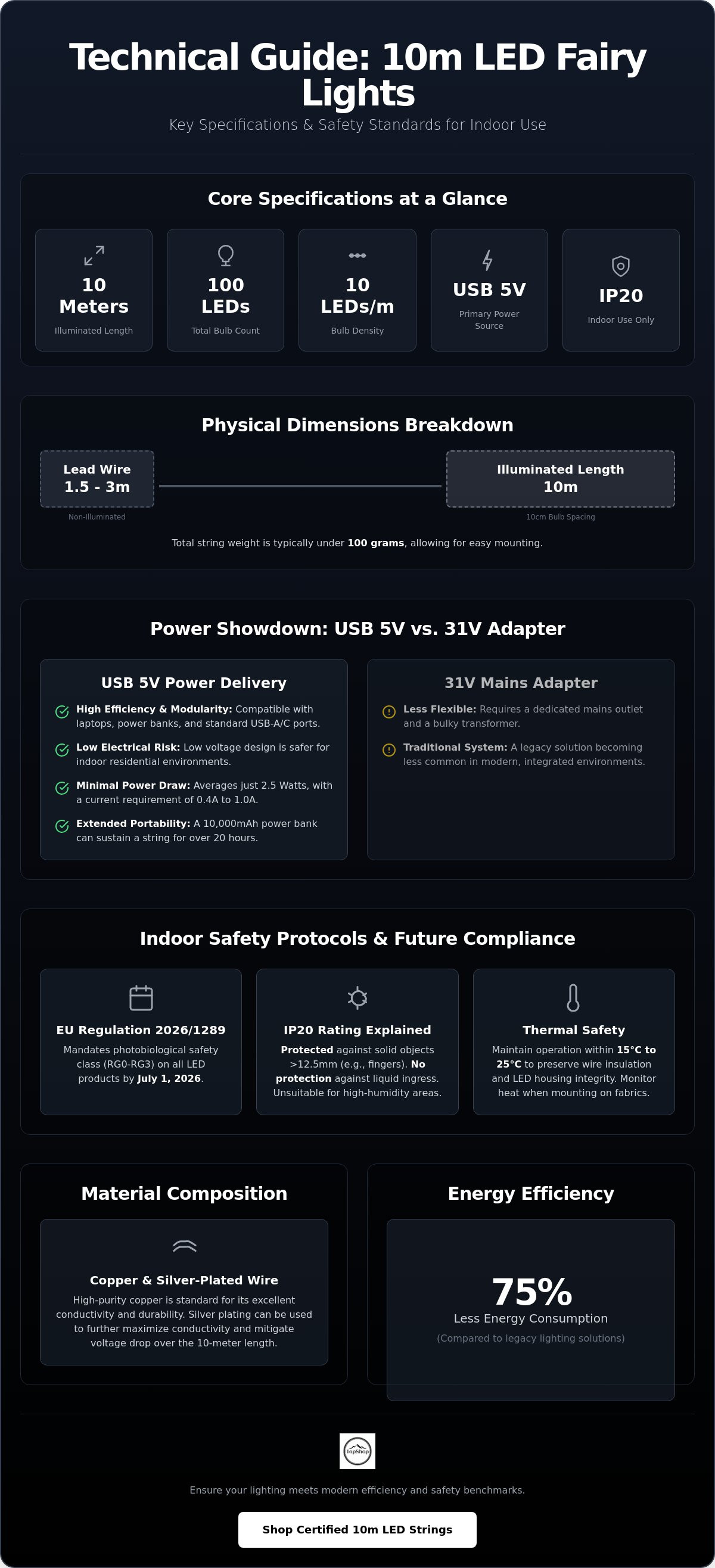
Standard 10m led fairy lights indoor configurations utilize a 10-meter (approximately 32.8 feet) illuminated length as the primary residential benchmark. This length provides optimal coverage for standard interior features such as door frames, shelving units, or small holiday trees. The architecture of these strings typically features a total count of 100 LEDs, resulting in a consistent bulb density of 10 bulbs per linear meter. This specific Holiday lighting technology relies on parallel or series-parallel wiring circuits to maintain illumination across the entire 10-meter span. Technical performance depends on the stability of these internal connections and the gauge of the conductive wire used.
- Standard Length: 10 meters (32.8 feet)
- Total Bulb Count: 100 LEDs
- Bulb Density: 10 to 12 LEDs per meter
- Power Interface: USB 5V or 31V DC Adapter
- Ingress Protection: IP20 (Indoor use only)
Dimensions and Bulb Spacing Metrics
Calculating the total footprint of a 10m led fairy lights indoor string requires distinguishing between the lead wire length and the illuminated length. The lead wire, extending from the USB or mains interface to the first LED, typically measures between 1.5 and 3 meters. This non-illuminated segment allows for flexible routing to power outlets without wasting light output behind furniture. Standard bulb spacing is fixed at 10cm (approximately 4 inches). This 10cm interval ensures uniform light distribution without the visual gaps found in lower-density strings. Lightweight copper wire construction keeps the total weight of a 10m string under 100 grams, facilitating mounting with minimal adhesive or tension requirements.
Indoor IP Ratings and Environmental Limitations
The IP20 rating is the mandatory electrical standard for components intended strictly for indoor residential environments. The first digit, 2, indicates protection against solid objects larger than 12.5mm, such as fingers or large tools. The second digit, 0, signifies a total lack of protection against liquid ingress. Consequently, these strings are unsuitable for bathrooms, kitchens, or high-humidity zones where condensation might occur. Material degradation in climate-controlled spaces is minimal, though prolonged exposure to UV light or extreme temperature fluctuations can eventually embrittle the wire insulation. Maintaining operation within a standard 15°C to 25°C temperature range preserves the integrity of the conductive core and the LED epoxy housing.
While these IP20-rated LEDs are ideal for standard decor, those requiring specialized lighting and environmental management for indoor cultivation should check out Discount Hydro for professional-grade hydroponic resources.
Power Input and Energy Efficiency Ratings
The power architecture for a 10m led fairy lights indoor configuration primarily utilizes a 5V DC USB interface or a 31V DC mains adapter. High-efficiency 5V USB systems offer superior modularity compared to traditional 31V transformers. These low-voltage systems reduce electrical risk and allow for integration with a wider range of power sources. A standard 100-LED 10m string typically requires between 0.4A and 1.0A of current. This amperage range ensures consistent brightness across the entire length. Resistance within the thin-gauge conductive wire leads to voltage drop over the 10-meter span. This physical property results in a marginal decrease in luminous intensity at the distal end of the string. Engineers mitigate this by using high-purity copper or silver-plated wire to maximize conductivity. Selecting a high-quality 10M/20M USB Christmas Tree LED String Light ensures the power controller handles these current fluctuations without overheating.
USB 5V Power Delivery Efficiency
USB-powered strings are compatible with standard USB-A and USB-C power bricks found in modern residential environments. These units draw minimal current from hardware sources like laptops, desktop computers, and portable power banks. A 10,000mAh power bank can typically sustain a 10m string for over 20 hours of continuous use. This makes them ideal for temporary indoor installations where mains access is limited. The average power consumption of a 10m USB LED string remains constant at approximately 2.5 Watts during standard operation. Most modern USB ports provide at least 0.5A, which is sufficient for 100-LED strings, though 1.0A or 2.1A ports offer improved thermal headroom for the power controller.
Calculating Long-Term Energy Costs
Operational costs for LED technology are significantly lower than legacy lighting solutions. According to the Department of Energy LED guide, LEDs use at least 75% less energy and last up to 25 times longer than incandescent bulbs. When calculating energy costs for a 10m led fairy lights indoor setup, users must account for the total runtime and the specific mode selected. A 2.5W string running for 24 hours consumes approximately 0.06 kilowatt-hours (kWh). In a 30-day billing cycle, this results in a total consumption of 1.8 kWh. This represents a negligible impact on residential utility expenses. Integration of 8-mode controllers further optimizes energy usage. These controllers utilize pulse-width modulation (PWM) to create flashing, fading, and strobing effects. Because the LEDs aren't energized 100% of the time in these modes, the average power draw decreases compared to the "steady on" setting.
Material Composition and Durability Factors
The material composition of 10m led fairy lights indoor strings determines physical durability and electrical performance. Manufacturers primarily utilize high-purity, triple-strand, flexible copper wire or silver-plated copper wire with a protective PVC coating. Bare copper wire offers superior flexibility, allowing the string to retain complex shapes during installation. Silver-plated variants provide higher surface conductivity and improved resistance to oxidation. These micro-LED strings possess a specific tensile strength calibrated for indoor mounting; however, excessive tension doesn't just stretch the wire, it fractures the thin conductive filaments. LED encapsulation typically involves high-grade, hermetic, clear epoxy resin. This material provides a seal against internal oxidation, unlike lower-quality molded plastic housings. Adhering to Indoor electrical safety tips ensures that these materials remain within safe operational limits, preventing insulation degradation over time.
Copper Wire Conductive Properties
Copper wire used in 10m strings usually adheres to 24-28 AWG (American Wire Gauge) standards. This gauge provides the necessary balance between electrical capacity and physical malleability. Exposed copper filaments facilitate rapid heat dissipation, preventing localized thermal buildup at the LED junction points. The "shape-holding" capability is a unique mechanical property of triple-strand copper wire configurations. This allows the 10m led fairy lights indoor string to wrap around fixtures without requiring additional fasteners. Corrosion resistance in indoor settings is generally high, though unplated copper may develop a patina over several years in non-climate-controlled environments.
LED Lifespan and Luminous Degradation
The operational lifespan of integrated LEDs ranges from 20,000 to 50,000 hours, depending on thermal management and drive current. Luminous degradation occurs as the phosphor coating within the LED diode ages. This leads to a gradual shift in color temperature, often manifesting as a "cooling" or blue-shift in warm white variants. Lumen maintenance is the metric used to track this decline; high-quality 10m strings maintain 70% of original brightness (L70) at the 30,000-hour mark. Factors such as consistent 5V power delivery and stable ambient temperatures prevent accelerated degradation. Plastic encapsulation is prone to yellowing under UV exposure, while epoxy resin maintains clarity, ensuring stable light output throughout the product's life cycle.
Indoor Safety Protocols and Heat Dissipation
Safety protocols for 10m led fairy lights indoor installations center on thermal management and electrical certification. Low-voltage 5V systems operate at significantly lower temperatures than legacy high-voltage alternatives. Surface temperature benchmarks for these LEDs typically remain between 30°C and 45°C (86°F to 113°F). This thermal profile sits well below the ignition point of common household fabrics like polyester or cotton. Compliance with UL (Underwriters Laboratories) or CE (Conformité Européenne) standards is mandatory for indoor electronics. These certifications verify that the product has undergone rigorous testing for fire hazards and electrical failure. Modern USB controllers integrate short-circuit protection (SCP) to immediately terminate power delivery if a wire fracture or liquid ingress occurs.
EU Regulation 2026/1289, effective as of July 1, 2026, requires all LED products to display a photobiological safety class on the nameplate. Most 10m indoor strings fall into the RG0 (Exempt) or RG1 (Low Risk) categories. This ensures the light output doesn't pose a risk of retinal damage or skin irritation during prolonged exposure. Fire safety standards for mounting on curtains or tapestries require that the light source doesn't exceed 90°C under fault conditions. The low wattage of 10m strings, typically 2W to 5W, makes reaching these dangerous thresholds physically impossible under normal operating parameters.
Thermal Management in Enclosed Spaces
Micro-LED designs utilize passive cooling through exposed wire filaments and epoxy resin encapsulation. This architecture prevents heat accumulation in stagnant air environments. Safe operating temperature ranges for these strings span from -10°C to 50°C. Low-voltage 10m LEDs generate negligible heat, ensuring they remain cool to the touch even after extended operational cycles. Because these lights lack a heavy glass bulb, they possess a low thermal mass. This means they cool down almost instantly once powered off. Effective heat dissipation is further aided by the triple-strand copper wire, which acts as a heat sink for the individual LED diodes.
Circuit Overload and Load Management
Load management is critical when deploying multiple strings in a single room. Daisy-chaining non-connectable 10m strings creates high resistance and potential controller failure. High-quality USB plugs incorporate internal fuse mechanisms or over-current protection chips to prevent short circuits. For multi-string setups, users should utilize dedicated power distribution hardware rather than cascading adapters. A Power Strip with 6 AC Outlets & 6 USB Ports provides stable, regulated current to several 10m led fairy lights indoor units simultaneously. This prevents port overload on computers or standard wall adapters. This configuration ensures that each string receives the required 0.5A to 1.0A current without triggering safety shutdowns or causing voltage sag in the circuit.
Procurement and Implementation of 10m LED Strings
Selecting the correct length depends on the total linear distance of the target surface. A 10m led fairy lights indoor string covers approximately 32.8 feet, which is sufficient for 2-meter wide shelving units, standard window frames, or headboards. Larger architectural features or full-room perimeters typically require 20m variants to avoid visible gaps. USB integration allows these lights to draw power directly from monitors, docking stations, or desktop towers. This eliminates the need for bulky AC adapters in cluttered workspace environments. For users seeking advanced automation or app-based control, reviewing a smart led fairy lights for indoor guide provides data on scheduling and feature sets.
TopShop 10m USB LED String Specifications
The 10M/20M USB Christmas Tree LED String Lights feature 100 high-intensity micro-LEDs spaced at 10cm intervals. The integrated USB controller includes eight distinct lighting modes, such as steady-on, slow fade, and sequential flash. A built-in memory chip retains the last selected mode after power-off cycles. Cable options include clear PVC for neutral blending or bare copper for a technical, industrial aesthetic. These strings operate at 5V DC and draw approximately 0.5A to 1.0A depending on the active mode. Lightweight construction facilitates mounting on delicate surfaces like monitors or office partitions without causing structural strain.
Integration with USB Hubs and Power Strips
Managing multiple strings requires a stable power distribution network. Using a power strip with 6 AC outlets & 6 USB ports ensures that each 10m led fairy lights indoor unit receives a consistent 5V supply. High-quality power strips prevent voltage sag when all ports are occupied. This is critical for maintaining uniform brightness across multiple 10m segments. Standard USB 2.0 ports on older hardware may only provide 0.5A, which might cause dimming or flickering during high-intensity modes. Dedicated charging ports on modern power strips typically offer 2.1A or 2.4A, providing significant thermal headroom for the controller.
Before final deployment, verify the following technical checklist:
- Total current draw vs. available port amperage.
- Lead wire length relative to the nearest USB port.
- Surface temperature of the USB controller during the first hour of operation.
- Integrity of the copper filaments at high-stress bend points.
Proper implementation ensures long-term reliability and compliance with 2026 indoor safety standards. Adhering to these specifications prevents electrical overhead and maximizes the operational life of the LED diodes.
Optimizing Indoor LED Infrastructure for 2026 Standards
Technical integration of 10m led fairy lights indoor systems requires strict adherence to 5V power delivery and IP20 safety ratings. You've identified that high-purity copper wiring and epoxy resin encapsulation are critical for maintaining luminous flux and structural integrity. Standardizing on 100-LED strings ensures predictable current draw and thermal stability in residential environments. These specifications align with the latest EU photobiological safety mandates and 2026 energy efficiency benchmarks. Effective implementation relies on matching string length to hardware capacity and power distribution limits.
Utilizing regulated USB hubs or dedicated power strips prevents voltage sag and ensures consistent brightness across all illuminated segments. High-efficiency diodes and low-voltage USB interfaces provide a safe, scalable solution for modern interior design. You're prepared to execute data-driven procurement for your specific coverage requirements. View Technical Specs for 10M USB LED String Lights featuring 100 high-efficiency LED bulbs and USB 5V low-voltage safety. These units are available in 10M and 20M technical lengths for precise deployment. Your indoor lighting setup is now technically optimized for safety and performance.
Frequently Asked Questions
How many LEDs are typically found on a 10m indoor string?
A standard 10m indoor string typically contains 100 LED bulbs. This configuration maintains a 10cm bulb spacing interval across the entire illuminated length. This specific density provides uniform light distribution for residential decor applications without overloading the thin-gauge copper wiring used in the circuit. Higher density strings may exist, but 10 bulbs per meter is the industry benchmark for 5V USB power constraints.
Can 10m LED fairy lights be cut to a shorter length?
You cannot cut standard 10m LED fairy lights to a shorter length without disabling the circuit. These strings use a series-parallel wiring architecture where the electrical path depends on the integrity of the entire conductive strand. Severing the wire terminates the current flow and prevents the remaining LEDs from functioning. For shorter requirements, you should purchase a dedicated 5m string or coil the excess length of the 10m unit.
What is the average power consumption of a 10m USB LED string?
The average power consumption for a 10m led fairy lights indoor string is approximately 2.5 Watts. This translates to a current draw of 0.5 Amps at a 5V DC input. Total wattage fluctuates between 2W and 5W depending on the specific lighting mode and brightness level selected via the USB controller. This low power draw makes the hardware compatible with standard laptop ports and portable power banks.
Are 10m LED fairy lights safe to leave on overnight?
Low-voltage 10m LED strings are safe for overnight operation because they generate minimal heat during continuous use. The surface temperature of the micro-LEDs remains well below the ignition point of common household fabrics like cotton or polyester. Modern USB controllers also include internal circuit protection to mitigate risks from electrical faults. It's still recommended to use a high-quality power adapter with over-current protection for unattended operation.
What is the difference between warm white and cool white color temperatures?
Warm white LEDs typically operate at a color temperature of 2700K to 3000K, while cool white LEDs range from 5000K to 6500K. Warm white emits a yellow-spectrum light suitable for creating a relaxed atmosphere in residential living areas. Cool white provides a blue-spectrum output with higher perceived brightness. This makes cool white more effective for modern office environments or task-oriented lighting where visibility is the primary requirement.
Can I connect two 10m LED strings together?
Connecting two 10m strings together is only possible if the units feature integrated end-to-end connectors. Most USB-powered 10m led fairy lights indoor models are standalone units and don't support daisy-chaining. Attempting to manually splice strings increases electrical resistance and often leads to controller failure or significant voltage drop. For 20-meter coverage, it's more efficient to use a single 20m string or a multi-port USB hub.
What does the IP20 rating mean for indoor fairy lights?
An IP20 rating indicates that the hardware is protected against solid objects larger than 12.5mm but has zero resistance to water. This is the standard ingress protection level for indoor electrical components. It prevents fingers or large tools from contacting live parts while signaling that the device is not waterproof. These lights must remain in dry, climate-controlled environments to prevent internal corrosion and electrical short circuits.
Do 10m LED lights require a specific power adapter?
These lights require a 5V DC power source, such as a standard USB-A power adapter, power bank, or computer port. The adapter must provide a minimum of 0.5A of current, though 1.0A or 2.1A adapters offer improved thermal efficiency for the controller. Using a higher voltage adapter, such as a 9V or 12V unit, will permanently damage the LED diodes. Always verify the output voltage of your power brick before connection.