

More string lights don’t automatically make a room look better; deliberate placement does. If you’re unsure how to use usb powered led string lights for room decor without making a space feel cluttered, start with the room’s layout, not the lights. Shelves, furniture, and a headboard can guide a clean route, while the location of a USB power source determines where that route can begin and end.
It’s easy to focus on the effect and overlook practical details: whether the light line will look balanced, whether the cable can reach a suitable power source, and whether the chosen length suits the route. This guide offers a room-by-room placement plan, tips for coordinating lights with existing decor, and a setup checklist to help you avoid visual clutter. It also explains what to consider before choosing between the 10M and 20M options of TopShop’s USB Christmas Tree LED String Lights. Measure the path and plan the power connection before hanging the lights.
Key Takeaways
- Use string lights as accent lighting, not as a replacement for the room’s general illumination.
- Sketch a route along furniture or room features, keeping the lights clear of busy surfaces and focal points.
- Compare USB, battery, and plug-in setups by power access, cable routing, and how easily the lights can be repositioned.
- Plan usb powered led string lights for room decor around both the measured route and the USB power source.
- Use the checklist to assess your decor goal, route length, power access, product instructions, and final placement. TopShop’s 10M/20M USB Christmas Tree LED String Lights are one option to consider.
USB-Powered LED String Lights for Room Decor: Start with the Look You Want
USB-powered LED string lights receive power through a USB connection. That affects where you can place them: the lights need a route from the chosen area to a compatible power source. Consider both before settling on a layout. For an overview of the connection standard and its applications, see Universal Serial Bus (USB) technology.
Start by defining the intended effect. Accent lighting adds a localized highlight, such as a line along a shelf or a glow near a headboard. General room illumination serves broader visibility across the space. Decorative strings can add a visual layer, but they shouldn’t replace the room’s main lighting.
A lighting plan starts with the room’s focal point, not the product listing. Before choosing a length or hanging method, decide what the lights should draw attention to and where they can run without interrupting the room’s existing arrangement.
- Intended effect: Choose subtle accent lighting or a more visible decorative feature.
- Focal area: Select one primary target, such as a shelf, headboard, or wall edge.
- Available route: Trace the path the lights would follow around or beside room features.
- Power-source location: Identify where the USB connection can reach without leaving an awkward cable route.
Choose a decor goal before choosing a layout
For a subtle accent, keep the lights to one defined edge or a compact area. For a stronger decorative feature, use a deliberate arrangement rather than extending the lights across every available surface. A shelf, headboard, or wall edge can provide a clear boundary. Choose one primary area first; several competing routes can make the overall effect feel busy.
Existing colors and furnishings also shape the result. A line beside a dark bookcase may stand out differently from one against a pale wall, while patterned bedding or crowded shelves already add visual detail. Consider what the lights will sit beside, not just where they can physically fit. The aim is to complement the room’s materials and colors, not create a feature that competes with them.
Map the room’s focal point and visual balance
Identify the first area you want the eye to notice when entering or looking across the room. Place the lights to support that focal point, then check how their path relates to nearby artwork, windows, and furniture. Leave breathing room around those features so the illuminated line doesn’t cut across a frame, crowd a window edge, or make a furniture outline harder to read.
Repeated lines or grouped placement can look more intentional than scattered runs. For example, a consistent route along a shelf’s edge creates a clear visual boundary, while a compact grouping can emphasize one display area. Step back and assess the whole arrangement, including the USB cable path. For usb powered led string lights for room decor, a balanced route should suit both the focal area and the practical position of the power source.
Plan LED String Light Placement Around Furniture and Room Features
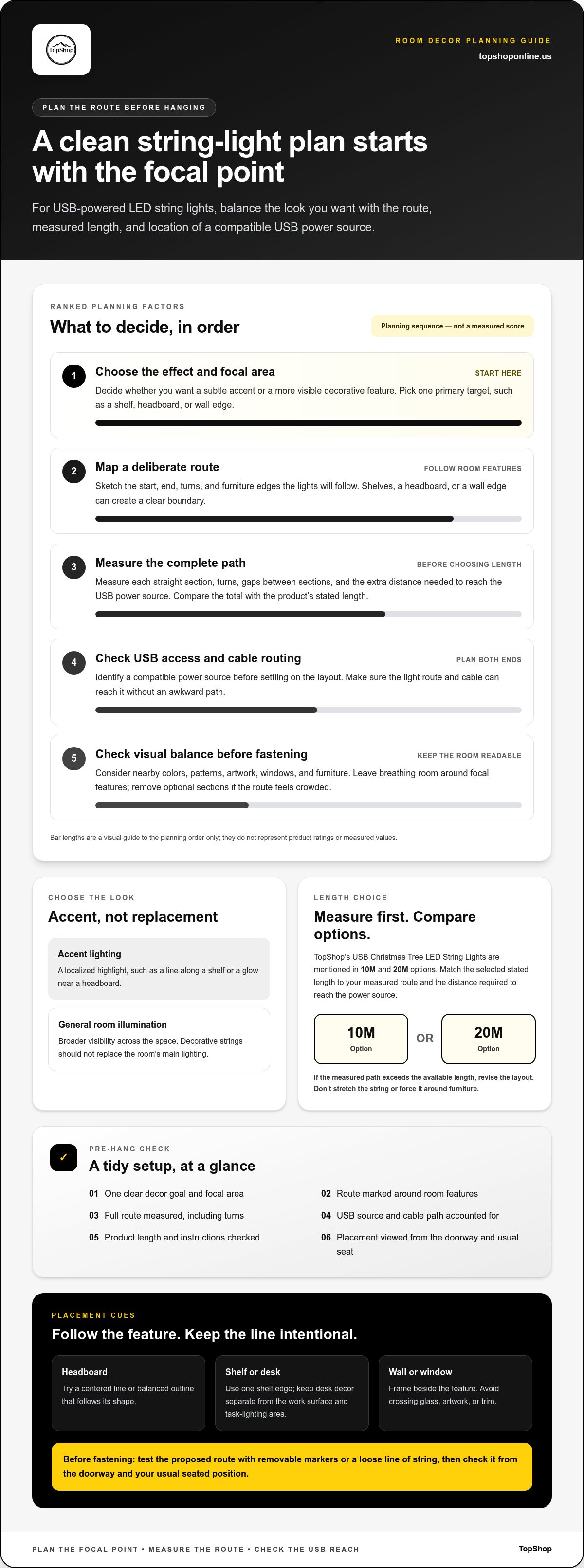
Plan the route before hanging the lights. Use a quick room sketch to mark the furniture edges or architectural lines the string will follow, then note where it needs to turn and where the USB power source is located. This makes it easier to spot cable crossings, awkward gaps, and routes that compete with the room’s main decorative feature.
Measure the complete planned route before selecting a string-light length. Measure each straight section and include the distance around corners or between separate sections. Compare the total with the product’s stated length, and account for any additional distance needed to reach the power source. Revise the layout if the measured path exceeds the available length; don’t rely on stretching the string or forcing it around furniture.
- Mark the start point, end point, turns, and nearby power-source location.
- Follow furniture edges as guides rather than drawing a route across open surfaces.
- Remove optional sections if the path feels crowded or clashes with the room’s focal feature.
- Compare the measured route with the product’s stated length before fastening anything.
Bedroom, desk, and shelf placement ideas
For a headboard, sketch a centered line or a balanced outline that follows its shape. Avoid adding extra loops on one side unless the asymmetry is deliberate. On a shelf, a single run along the front or underside can define the edge without crossing the displayed objects. Around a desk, keep decorative lights separate from the work surface and task-lighting area.
Before fastening the lights, temporarily trace the proposed route with removable markers or a loose line of string. View it from the doorway and the usual seated position. This quick visual test can reveal uneven spacing, an off-center headboard layout, or a route that feels too close to a monitor or artwork.
Wall and window layouts without visual clutter
A single outline can frame a wall feature or window without covering its details. Keep the line beside the feature rather than across the glass, artwork, or trim. At each corner, plan a clear turn and maintain a consistent direction. Avoid tangled overlaps and repeated crossings, which can make the arrangement look accidental and obscure the shape you intended to highlight.
Check the full route against nearby curtains, shelves, and furniture. A tidy line should remain visually distinct from those elements and avoid crossing busy surfaces. For related details on light types and features, see this indoor smart LED fairy lights guide. Once the route and length are clear, browse TopShop’s USB string-light options.
Compare USB String Lights with Other Decorative Lighting Setups
The power source affects where decorative lights can go and how the cable or battery unit fits into the room. USB-powered strings need a compatible USB power source within reach of the light’s connector. Battery-powered options don’t need a nearby USB port, but their battery compartment and replacement or recharging requirements become part of the layout. Plug-in decorative lights need access to a suitable outlet, with the cord route planned around furniture and movement paths.
No format is the best fit for every room. Compare the power access and route each option requires before deciding where the lights should sit.
| Setup | Power access | Cable route | Repositioning considerations | Room-planning fit |
|---|---|---|---|---|
| USB-powered string lights | A compatible USB power source must be reachable. | Plan from the lights to the USB connection. | Moving the lights may also require a new route to power. | Useful when the intended placement and USB access align. |
| Battery-powered decor lights | Consider the battery compartment and its access. | No power cable route to a USB source, though the product may have other components. | Check the product’s battery requirements before moving or remounting. | Can suit a layout where a nearby USB source is difficult to reach. |
| Plug-in decorative lights | A suitable outlet must be accessible. | Account for the product cord between the lights and outlet. | Moving the setup may change its outlet and cord path. | Can fit a room where the planned route works with outlet placement. |
USB power source and cable-route considerations
Check that the light’s USB connector matches the selected power source. Don’t assume every USB-powered light uses the same connector or has identical power requirements; follow the product instructions and specifications. Before mounting, map the route from the light connection to the power source, including turns and the cable’s path around furniture. TopShop also lists a Power Strip with 6 AC Outlets & 6 USB Ports. Compare its product details with the lights’ instructions before using it as a power source.
With usb powered led string lights for room decor, the power-source position can narrow the practical placement options. A shelf may be a good visual location but a poor fit if reaching the USB source leaves a cable across a walkway or work surface. Adjust the route or choose a different power location before securing the lights.
When another decorative-light format may fit better
A battery-powered format may suit a feature with no nearby USB source, while a plug-in format may work when an outlet aligns with the planned route. Flexibility depends on the individual product, including its connector, cable, power requirements, and instructions. Compare those specifications with the room’s layout. If USB access is convenient and the connector matches, a USB setup can be a practical choice; if not, another format may better suit the placement.
Set Up USB-Powered LED String Lights Neatly and Safely
A tidy setup starts before the lights are secured. Follow the product’s instructions for power, testing, placement, and care. Set up decorative lighting according to its product instructions. Don’t use a damaged cable or an unsuitable power source, and don’t assume connector types or power requirements are interchangeable between products.
Test the layout before securing the lights
Lay out the full proposed route first, including the section that leads to the USB power source. Check that the lights reach the intended focal area without crossing a door, walkway, or frequently used surface. Testing the arrangement before fastening it lets you adjust direction or spacing while the route is still easy to change.
- Plan the route. Mark the starting point, turns, endpoint, and cable path to the power source. Check that the route fits the room and the product’s stated length.
- Check the product instructions. Review the specified connector, power requirements, and any directions for placement or use. Use a power source suitable for that product.
- Test the lights. Connect and test them as directed before completing the arrangement. If they don’t operate as expected, disconnect them and refer to the product instructions rather than continuing with installation.
- Position the lights. Follow the planned line, keeping spacing consistent where practical. Avoid pulling the cable tight or bending it sharply around furniture edges.
- Review the result. View the setup from the main parts of the room. Adjust it if the line crowds artwork, competes with nearby features, or creates a distracting overlap.
Keep cables organized and the arrangement maintainable
Route the cable along unobtrusive edges where it won’t block a doorway, cross a walking path, or interfere with normal furniture use. Keep it away from places where it could be pulled, pinched, or caught during everyday movement. Follow the product’s instructions for securing or positioning the lights; don’t assume a particular clip, adhesive, or mounting method is suitable.
Leave the cable with a natural path to the power source rather than stretching it to hide excess length. A neat route should also remain accessible for inspection and adjustment. Avoid tightly winding or trapping cable sections unless the product instructions specifically allow it.
Before finishing, check for loose sections, visible tangles, sharp bends, and strain near the connector. Recheck the setup after adjusting nearby furniture or decor, since movement can shift the route. For usb powered led string lights for room decor, neatness depends on both the light placement and the cable path.
- Confirm the connection is secure without forcing the connector.
- Check that the cable isn’t under tension or in a movement path.
- Make sure the finished layout remains clear of nearby decor and furniture use.
Once your route and power access are planned, compare them with TopShop’s 10M/20M USB Christmas Tree LED String Lights.
Choose a Room-Decor Setup Using TopShop’s USB String Lights
Make the product decision after checking your decor goal, measured route, USB power access, and product instructions. TopShop’s 10M/20M USB Christmas Tree LED String Lights are listed in two length options. Use the route you measured to compare those options with your plan. Neither length should be assumed to fit without measuring.
Match the planned route to the listed light length
Measure the complete path you intend to decorate, including the sections around furniture edges and any turns. Compare that total with the listed 10M and 20M options, then account for the route from the lights to the USB power source where relevant. A bedroom, shelf, or wall doesn’t determine the required length on its own; the actual path does.
Before setup, review the product specifications and instructions, including the connector and power requirements. Don’t infer additional features from the product name or length. Use the listed details to check that the product suits the route and power access you planned.
Use a final decision checklist
Work through each item before positioning or securing the lights. If one part of the plan doesn’t fit, adjust the route or reconsider the setup before proceeding.
- Decor goal: Identify the feature the lights should support and keep the layout consistent with the room.
- Measured route: Record the full planned path and compare it with the 10M or 20M listed length. Don’t select an option based on room size alone.
- Power access: Confirm the USB connector matches the intended source and that the cable can follow a practical route.
- Product instructions: Review the stated specifications and setup directions before testing or mounting.
- Final placement: Check spacing, balance, cable position, and nearby furniture or decor before completing the arrangement.
Finish with a room-by-room review
View the proposed setup from the room entrance and from the main seating or sleeping area. Check that the light path draws attention to the intended feature without making the rest of the room feel crowded. Confirm the cable doesn’t cross a doorway or interfere with furniture use, and that the USB source remains accessible. Follow the product instructions through testing and placement.
For usb powered led string lights for room decor, a considered route and suitable power access matter as much as the listed length. Make any needed layout changes before setup. Once your measurements and specifications align, browse TopShop’s USB string lights and compare the listed options with your plan.
Turn Your Room Plan Into a First Placement
Use your layout as a starting point, not a permanent commitment. Choose one area, test how the planned line looks in the room, and make small adjustments before settling on the final arrangement. This keeps the decision manageable and lets you assess the visual effect in context instead of trying to decorate every surface at once.
For usb powered led string lights for room decor, let the finished plan guide your product choice. TopShop lists 10M/20M USB Christmas Tree LED String Lights, giving you two length options to compare with your measured route and intended placement.
Review the product details alongside your room plan, then select the option that aligns with the route and power access you’ve prepared. A deliberate first placement can help you judge whether the room needs any further changes before adding more decorative lighting.
Browse TopShop’s USB string lights and compare the listed lengths with your plan. Start with one focal area, make the placement your own, and build from there.
Frequently Asked Questions
Can USB-powered LED string lights decorate a bedroom?
Yes, they can add a decorative accent to a bedroom when the placement and power connection suit the space. For example, a short section could highlight a display area or provide a visual detail beside a dressing table. Keep the arrangement clear of items that need frequent access, such as drawers or bedside storage. Check product instructions for placement guidance, and use the room’s regular lighting for activities that need broader illumination.
How do I choose the right string-light length for a room?
Measure the exact route you plan to decorate, rather than estimating from the room’s overall dimensions. Include turns and any distance needed to reach the USB power source, then compare the measurement with the product’s stated length. For example, a path around one furniture feature may need a different length from a route spanning several areas. Don’t assume the lights can be extended or connected together unless the product specifications say so.
Can I power USB string lights from a power strip?
Yes, if the power strip’s USB port and output meet the light’s stated requirements. Check the light’s instructions and the power strip specifications before connecting them. A power strip with USB ports may be useful when its position keeps the connection accessible and the cable route orderly. Don’t rely on the USB connector’s shape alone to establish compatibility, and avoid adding adapters unless the product instructions support their use.
Are USB-powered LED string lights suitable as a room’s main light?
Generally, decorative string lights should be treated as accent lighting, not as the room’s main light. Don’t assume a decorative string can provide the broad illumination needed for reading, cleaning, or other tasks. Keep an appropriate main light source for visibility, and use the string lights as an additional decorative element in the room.
How can I hang string lights without making a room look cluttered?
Limit the arrangement to one clearly defined area, then assess it from the room’s usual viewpoints. For example, a single line near a display can be easier to read visually than several runs around unrelated objects. Keep the lights from obscuring labels, artwork details, or items you use regularly. If the string becomes the first thing you notice instead of the feature it was meant to frame, simplify the layout.
Can I leave USB string lights on overnight?
Only do so if the product instructions explicitly permit overnight or extended operation. If they don’t, switch the lights off before sleeping. Before use, inspect the cable and connection, and don’t operate lights with visible damage, unusual heat, or an unstable connection. Keep the arrangement clear of bedding and other materials, and follow any product-specific warnings. Don’t assume USB power alone makes unattended use suitable.
What should I check before connecting USB-powered string lights?
Check the product instructions for connector compatibility, power-source requirements, and any limits on placement or operation. Inspect the cable and connector for damage, and make sure the power source matches the stated specifications. Confirm that the intended location is suitable for the product, since a decorative appearance doesn’t establish where it can be used. For usb powered led string lights for room decor, verify these details before routing or securing the lights.