

Cordless operation convenience often conceals significant technical LED output decline as voltage levels drop. Standard alkaline power sources don't maintain peak voltage, leading to measurable dimming within hours of activation, a critical factor when analyzing usb vs battery powered string lights. High-drain hardware configurations frequently encounter maintenance-intensive cycles characterized by repetitive battery replacements and diminishing diode performance. These scenarios necessitate a transition toward stable 5V power delivery systems that ensure consistent luminosity across extended, high-density deployment periods without the voltage sag common in disposable cells.
This comprehensive technical analysis evaluates power source efficiency, voltage stability, and lifecycle operational costs for LED decorative lighting hardware. It's a data-driven overview of the electrical performance of 10M and 20M string variants and the utility of multi-port USB power strips for centralized power management. Readers will gain the technical specifications required to select the most cost-effective hardware for specific indoor and outdoor installation environments. This guide identifies the hardware configurations necessary to maintain peak brightness standards while minimizing long-term energy expenditure and material waste.
Key Takeaways
- Analyze the technical correlation between constant 5V USB output and stable luminous flux maintenance compared to battery-driven voltage decay.
- Evaluate the cumulative operational expenditure of alkaline batteries versus grid electricity for high-drain 10M and 20M LED configurations.
- Identify optimal deployment environments for usb vs battery powered string lights based on portability metrics and proximity to power management hardware.
- Integrate multi-port USB power strips to facilitate centralized control and consistent power delivery for high-density decorative lighting systems.
Understanding Power Source Mechanics for LED String Lights
LED string lighting systems utilize distinct electrical architectures based on their primary energy source. USB-powered units rely on external regulated power supplies to deliver consistent voltage. Battery-operated systems utilize internal chemical cells that discharge over time. The primary technical differentiator in the usb vs battery powered string lights debate involves voltage regulation and current consistency. Most decorative LED hardware requires a stable 5V DC input to maintain driver efficiency and prevent thermal runaway within the diode housing. High-density 10M/20M LED strings demand precise current management to ensure longevity and uniform light distribution across the entire length of the copper wire substrate.
USB Powered Hardware Specifications
USB-powered systems operate via a direct current (DC) supply through standard Type-A or Type-C interfaces. These systems adhere to established USB power standards, typically delivering a nominal 5V output. For high-density 10M and 20M USB Christmas Tree LED String Lights, current draw typically ranges from 500mA to 2A depending on diode density and length. These units are fully compatible with standard 5V/1A and high-output 5V/2.4A power adapters. Utilizing a Power Strip with 6 AC Outlets & 6 USB Ports allows for centralized management of multiple strings without the voltage fluctuations common in multi-device setups. Constant voltage delivery ensures that the LED driver maintains a steady current, which is essential for consistent heat dissipation and diode protection.
Battery Operated Circuitry and Power Draw
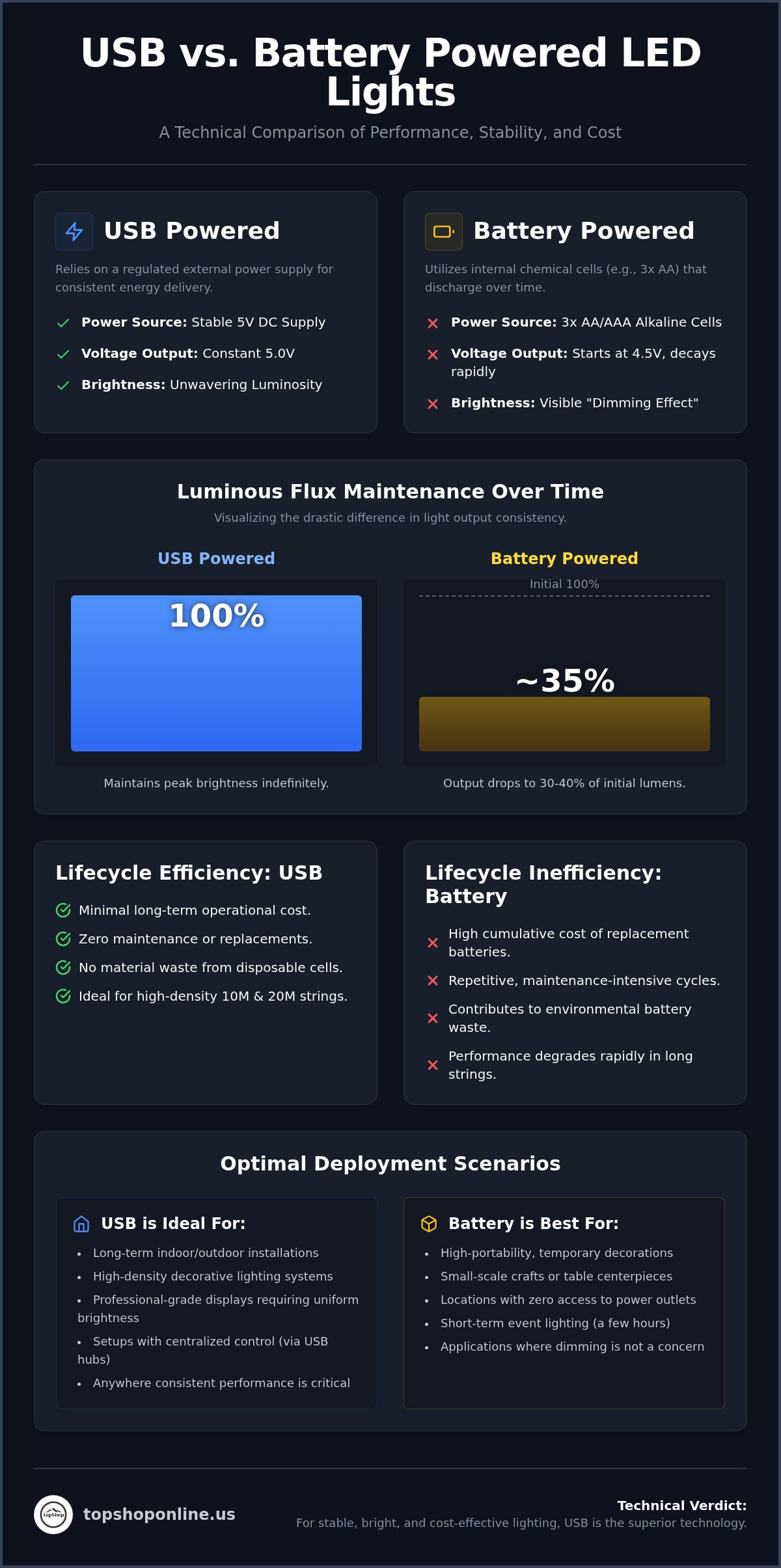
Battery-operated units generally utilize three AA or AAA alkaline cells wired in series. This configuration provides a nominal starting voltage of 4.5V. Unlike regulated USB sources, battery voltage drops immediately upon load application. Alkaline cells exhibit a steep discharge curve; voltage often falls below 1.2V per cell long before capacity is fully depleted. Lithium batteries provide a flatter discharge profile but remain limited by total milliamp-hour (mAh) capacity. Higher current draw in 20M strings leads to rapid internal resistance increases within the batteries. This generates excess heat and reduces total runtime compared to shorter 10M variants. Self-discharge rates also mean stored battery units lose potential energy even when inactive, leading to unreliable performance in long-term installations. LED drivers in these units often lack sophisticated regulation, resulting in visible dimming as the chemical energy source weakens.
Technical Performance: Voltage Stability and Lumens Maintenance
Luminous flux maintenance depends entirely on the electrical stability of the input current. In the technical evaluation of usb vs battery powered string lights, USB interfaces provide a constant 5V DC supply regulated by external switch-mode power supplies. This stability ensures that the LED diodes receive a uniform current, maintaining peak brightness levels throughout the entire operational cycle. Conversely, battery cells experience a non-linear chemical discharge profile. As cell potential drops from a nominal 1.5V to 1.1V or lower, the forward voltage required by the LED is no longer met. This results in a rapid reduction in light intensity and visible dimming. Research into advances in power electronics highlights how modern converters manage these energy flows to prevent diode flickering and ensure hardware durability.
Light Output Consistency Over Time
USB-powered hardware maintains a static luminous flux indefinitely. A 20M high-density string remains at 100% intensity as long as the source provides current. Battery-powered units exhibit significant decay. At 20% power capacity, typical alkaline-driven strings produce approximately 30-40% of their initial light output. This creates visual inconsistencies in large-scale 20M installations where uniform brightness is a primary requirement. Technical specifications for high-performance setups prioritize USB connectivity to avoid the "dimming effect" common in portable units. Utilizing 10M or 20M USB Christmas Tree LED String Lights ensures that decorative displays maintain a professional-grade appearance without the need for frequent hardware adjustments or battery monitoring.
- USB Output: Constant 5.0V / 100% Lumen Maintenance.
- Alkaline Output: 4.5V (Start) to 3.0V (Terminal) / <40% Lumen Maintenance at discharge.
- Lithium Output: 4.5V (Start) to 3.6V (Terminal) / ~70% Lumen Maintenance.
Impact of Voltage Fluctuations on LED Lifespan
Thermal management is optimized under stable power conditions. USB power delivery limits the mechanical stress on integrated circuit (IC) controllers and copper-wire LED diode clusters. Low-voltage battery operation forces these controllers into unstable states, increasing internal resistance and localized heat. This thermal stress accelerates the degradation of the phosphor coating on the LED, leading to permanent color temperature shifts. Stable 5V USB power prevents the diode over-current or under-voltage cycles that shorten component lifespan. High-density 10M strings benefit from this stability, as it preserves the integrity of the thin-gauge wiring and prevents premature diode failure. Regulated DC power supply architecture is the standard for long-term decorative installations where hardware longevity is a measurable priority.
Operational Efficiency and Lifecycle Cost Analysis
Comparing the raw energy metrics of usb vs battery powered string lights reveals significant disparities in long-term financial expenditure. A standard 10M LED string powered via USB typically consumes between 2.5W and 5W. At the average U.S. residential electricity rate of 18.44¢/kWh as of August 2026, operating a 5W string for 6 hours daily costs approximately $0.0055 per day. This equates to an annual electricity cost of roughly $2.01. The efficiency of modern USB power adapters ensures that energy loss during AC-to-DC conversion remains minimal, maximizing the utility of grid-supplied power for high-density decorative hardware.
Battery Replacement Cycles vs. Direct Power Draw
Battery-operated units incur substantially higher recurring costs and material waste. A typical 10M LED string requires three AA batteries for operation. With an 8-pack of alkaline AA batteries currently retailing between $8 and $22, the cost per cell is significant. High-drain decorative LEDs often exhaust a set of batteries within 48 to 72 hours of continuous use at peak brightness. For a standard daily 6-hour cycle, users must replace batteries every 8 to 12 days. This frequency results in the consumption of approximately 90 to 135 batteries annually for a single string. The cumulative cost of these replacements exceeds the electricity cost of a USB-powered unit by several orders of magnitude within the first year of operation.
Maintenance Requirements and Downtime
Labor efficiency represents another technical consideration for large-scale or permanent deployments. Battery-powered systems require frequent manual intervention for cell replacement. This increases operational downtime and maintenance overhead, particularly in hard-to-reach installations such as high ceilings or architectural eaves. USB-powered configurations support set-and-forget scheduling. Integrating these units with smart led fairy lights for indoor enables automated control through software timers or hardware controllers. Reliability remains high when these systems are paired with a Power Strip with 6 AC Outlets & 6 USB Ports. This centralized power hub eliminates the logistical burden of monitoring individual battery levels across multiple 20M installations.
Environmental impact and e-waste regulations also influence the selection process for high-volume decor. The Resource Conservation and Recovery Act (RCRA) and state-specific mandates like California’s SB 1215 increase the complexity of disposing of battery-embedded products. High-volume use of disposable alkaline cells contributes to localized e-waste and chemical runoff risks. Transitioning to USB-powered hardware reduces the material footprint of lighting projects. Modern USB hubs feature high efficiency ratings, converting AC grid power to stable 5V DC with superior performance compared to the chemical energy conversion inefficiencies of disposable alkaline cells.
Application Scenarios: Deployment Environments and Portability
Site-specific infrastructure determines the optimal selection between usb vs battery powered string lights. Indoor environments with established electrical grids favor USB-driven hardware due to the availability of regulated 5V DC ports. These ports are commonly integrated into consumer electronics such as televisions, desktop computers, and gaming consoles. Outdoor or remote deployments without grid access necessitate battery-operated solutions. However, technical constraints regarding battery enclosure durability and chemical cell performance in varying ambient temperatures must be considered. High-density 20M strings require higher current levels that quickly deplete portable power reserves. This makes them better suited for fixed installations where constant current is accessible and maintenance requirements are minimal.
Indoor Fixed Installations and USB Integration
Permanent decorative setups benefit from the stability of direct power sources. Utilizing existing hardware interfaces like smart TVs or laptops provides a convenient power delivery method for 10M LED strings. For complex projects involving multiple high-density strands, centralizing power management is essential. A power strip with usb ports allows for the simultaneous operation of up to six strings from a single AC outlet. This configuration simplifies cable management and eliminates the need for multiple individual wall adapters. When deploying 20M USB Christmas Tree LED String Lights, cable routing should prioritize concealment along architectural lines. Adhesive clips and wire channels prevent cable strain and maintain a clean aesthetic in professional or residential workspaces.
Remote and Grid-Independent Lighting Solutions
Battery-powered hardware provides tactical advantages for mobile applications and temporary event decor. Compact battery packs facilitate the integration of LED strings into wearable costumes or table centerpieces where trailing cables present safety hazards or aesthetic interference. These systems are effective for emergency lighting or short-duration off-grid use. Technical limitations arise in extreme cold weather environments. Standard alkaline batteries experience a significant drop in nominal capacity when temperatures fall below 0°C (32°F). This leads to immediate voltage sag and reduced LED brightness. While battery enclosures provide basic physical protection, they lack thermal insulation. For long-duration outdoor projects in low temperatures, USB-powered lights connected to high-capacity, thermally protected power banks provide superior reliability and consistent luminous flux.
Select the appropriate hardware for your specific lighting project today. Explore high-density 10M and 20M USB LED string lights for professional-grade performance and consistent brightness.
Selecting Optimal Lighting Hardware for 2026 Applications
Hardware selection for 2026 requires a focus on electrical interoperability and power source stability. In the technical comparison of usb vs battery powered string lights, the industry-wide transition toward universal USB-C and Power Delivery (PD) standards directly influences component durability and luminous flux maintenance. High-density LED installations demand hardware capable of maintaining color accuracy across 10M and 20M lengths without the significant voltage drop observed in chemical battery cells. Selecting units with high-quality phosphor-coated diodes and sophisticated integrated circuit controllers ensures uniform spectral output and prevents the premature color shifting common in low-voltage portable units.
USB Christmas Tree LED String Lights Features
TopShop 10M and 20M USB Christmas Tree LED String Lights utilize high-efficiency SMD diodes mounted on flexible, high-conductivity copper substrates. These variants provide standardized 5V DC connectivity, ensuring seamless integration with existing power infrastructure. Hardware durability is enhanced through weather-resistant insulation, making these units suitable for repeated seasonal deployment cycles. Compatibility with 5V/1A and 5V/2.4A interfaces allows for versatile operation via wall adapters, high-capacity power banks, or integrated hardware ports on consumer electronics. These technical specifications ensure the hardware remains functional as global charging mandates accelerate the adoption of universal USB power delivery standards.
Centralized Power Management with USB Hubs
Complex decorative projects involving high-density arrays require robust power distribution hardware to maintain electrical safety. Consolidating multiple 20M strings into a single power strip 6 outlet 6 usb minimizes localized fire hazards through integrated surge protection and intelligent over-current safeguards. This centralized management approach reduces the logistical burden of managing multiple individual wall adapters and significantly streamlines cable organization in home office or architectural setups. Surge-protected USB power delivery provides a highly stable electrical environment, protecting sensitive integrated circuit controllers from the voltage spikes common in residential power grids. This configuration supports continuous operation without the thermal risks associated with under-regulated battery power.
- Input Voltage: Regulated 5V DC.
- Interface: USB Type-A or Type-C.
- Safety Features: Surge protection and thermal cut-off.
- Cable Substrate: Reinforced multi-strand copper wire.
- Controller Type: Integrated IC for pulse-width modulation (PWM) stability.
Standardizing on USB-powered hardware represents the most reliable technical path for decorative lighting. While battery-operated units offer niche portability, the performance metrics of usb vs battery powered string lights clearly favor direct power for permanent and high-density 2026 applications. Utilizing centralized power hubs ensures consistent brightness and hardware longevity across all installation scenarios.
Optimizing High-Density LED Infrastructure for 2026
Selecting the appropriate electrical architecture for decorative lighting involves evaluating long-term voltage stability and total lifecycle expenditure. The technical comparison of usb vs battery powered string lights confirms that regulated 5V DC interfaces provide superior luminous flux maintenance and reduced maintenance downtime. Standardizing on USB-powered systems eliminates the voltage sag and frequent replacement cycles inherent in alkaline-driven hardware, especially in high-density 10M or 20M configurations. Centralized power management via multi-port hardware ensures consistent 100% lumen output and simplified cable routing for professional installations. It's the most efficient method for maintaining peak brightness without the thermal stress of under-regulated battery cells.
Transitioning to direct-power LED systems reduces material waste and streamlines operational control for complex residential or commercial projects. High-conductivity copper substrates and reinforced insulation ensure these units meet the durability requirements for repeated seasonal deployment. View USB Christmas Tree LED String Lights Specifications for 10M and 20M variants compatible with high-density 6-port USB power strips. Upgrading to stable power infrastructure ensures your lighting displays remain bright and efficient throughout their operational lifespan.
Frequently Asked Questions
How long do battery-powered string lights typically last?
Battery-powered LED strings utilizing three AA alkaline cells typically provide 48 to 72 hours of peak luminous output. While the LEDs may remain illuminated for up to 100 hours, the visual utility decreases as voltage levels fall below the required forward threshold. High-density 20M strings exhaust portable power reserves faster than 10M variants. Users should anticipate frequent maintenance cycles if using disposable cells for daily decorative lighting applications.
Can I plug USB string lights into a standard phone charger?
Standard 5V phone chargers are fully compatible with these lighting systems. Most decorative LED hardware operates within the 500mA to 2.1A range, which matches the output of common Type-A and Type-C adapters. This regulated power delivery is a primary advantage in the usb vs battery powered string lights comparison, as it prevents the diode flickering associated with unstable current. Always verify the amperage rating of the adapter against the string length requirements.
Do USB string lights use a lot of electricity compared to batteries?
USB-powered LED strings consume minimal electricity, typically ranging from 2.5W to 5W per unit. Operating a 10M string for six hours daily results in an annual expenditure of approximately two dollars based on average residential utility rates. This cost is statistically insignificant compared to the cumulative price of alkaline batteries. The electrical efficiency of AC-to-DC conversion in modern USB hubs ensures that energy waste remains extremely low during operation.
Why are my battery-operated lights getting dimmer after a few hours?
Dimming occurs because alkaline batteries exhibit a steep discharge curve that reduces output voltage as chemical energy depletes. LED diodes require a constant forward voltage to maintain specific brightness levels. When the battery voltage drops below 3.6V for a three-cell series, the current flow to the diodes decreases. This results in a visible loss of intensity and a shift in color temperature, which is avoided with constant USB power sources.
Are USB-powered string lights safer than battery-operated ones?
USB-powered strings offer enhanced safety features when connected to certified power management hardware. High-quality power strips include integrated surge protection, thermal cut-offs, and over-current safeguards that battery packs lack. Disposable cells present additional risks, including chemical leakage and localized overheating during high-drain scenarios. Centralized USB power delivery through a surge-protected hub provides a stable and secure electrical environment for long-term indoor or architectural lighting projects.
Can I use a power bank to run USB string lights for portability?
Portable power banks are an effective power source for USB LED strings in off-grid environments. A 10,000mAh unit typically provides 10 to 15 hours of continuous operation for a 10M high-density string. This configuration offers the mobility of traditional battery packs while maintaining the 5V voltage stability required for consistent brightness. It is an ideal solution for temporary event decor, costumes, or mobile displays where grid access is unavailable.
What is the maximum length for USB-powered string lights without voltage drop?
The 20M length specification represents the functional limit for most high-conductivity copper wire LED strings. Beyond this distance, internal resistance within the thin-gauge wiring causes a measurable voltage drop, resulting in dimmer LEDs at the end of the run. In the usb vs battery powered string lights evaluation, USB-powered 20M units maintain better uniformity than battery versions because they start with a higher, regulated 5V base voltage to overcome resistance.
Do USB string lights work with smart plugs and timers?
USB-powered hardware integrates seamlessly with smart plugs, hardware timers, and automated home systems. By connecting the USB adapter to a smart AC outlet, users can establish precise operational schedules through software applications. Battery-operated units generally lack this functionality, requiring manual activation via a physical switch on the battery enclosure. This compatibility makes USB-powered strings the preferred choice for permanent installations requiring automated control and centralized power management.