

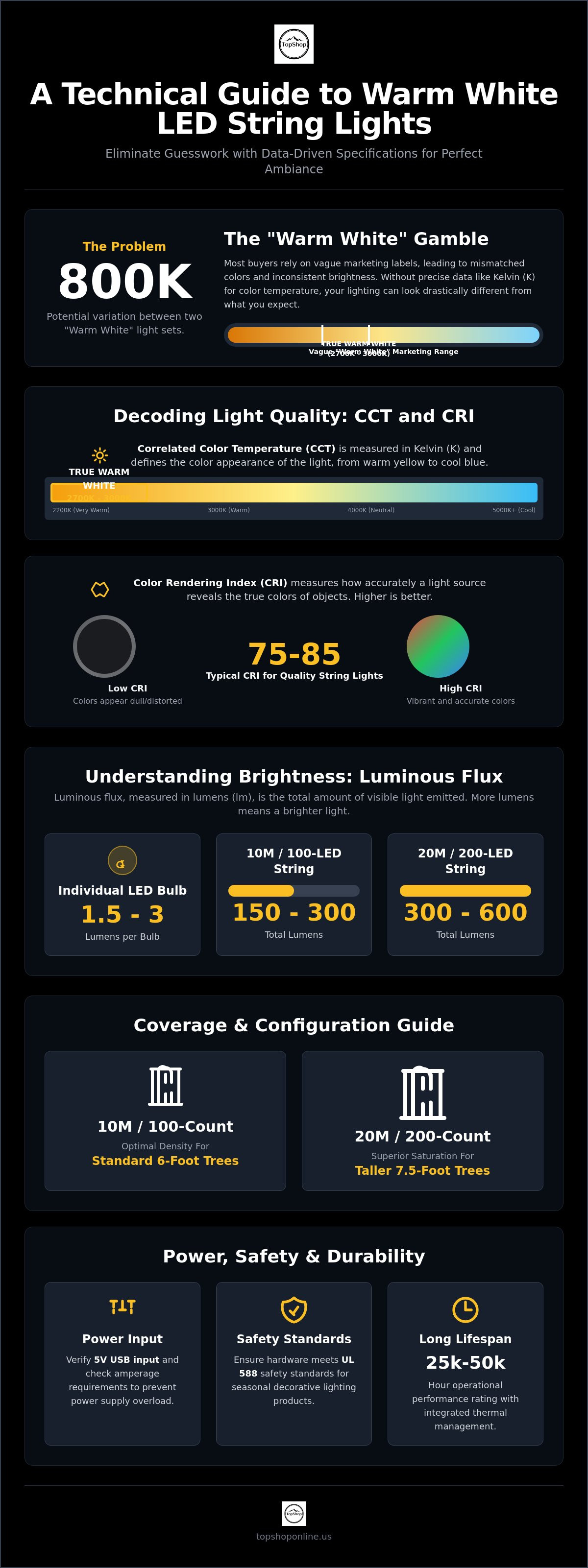
Did you know that two different sets of warm white led string lights can vary by as much as 800 Kelvins, fundamentally altering the visual output of your installation? Most buyers find that "warm white" is often treated as a vague marketing label rather than a precise technical specification. This inconsistency leads to mismatched color temperatures and insufficient brightness for specific decorative tasks. Relying on subjective descriptions instead of measurable data points like correlated color temperature (CCT) and luminous flux results in poor lighting integration.
This article serves as a comprehensive technical reference to eliminate these variables. You'll learn the exact Kelvin ranges that define true warm white, standard lumen ratings per meter, and critical USB power compatibility requirements. We'll examine the 2200K to 3000K spectrum, analyze luminous flux benchmarks for 10M and 20M configurations, and explain how USB PD 3.1 standards impact power delivery. This guide provides the data necessary to ensure your hardware meets UL 588 safety standards for seasonal decorative products and aligns with current US performance benchmarks for low-voltage lighting systems.
Key Takeaways
- Identify the specific correlated color temperature (CCT) range of 2700K to 3000K to ensure visual consistency across different semiconductor lighting hardware.
- Calculate total luminous flux requirements by analyzing average lumen output per individual LED bulb for standardized decorative brightness levels.
- Verify 5V USB input compatibility and specific amperage draw for 10M and 20M warm white led string lights to prevent power supply overload.
- Compare 100-count and 200-count configurations to determine optimal coverage density for standard 6-foot and 7.5-foot tree dimensions.
- Evaluate long-term operational performance through 25,000 to 50,000-hour lifespan ratings and integrated thermal management specifications.
Defining Warm White LED Color Temperature and Kelvin Scales
The Kelvin (K) scale provides the fundamental quantitative measurement for the spectral distribution of light emitted by semiconductor diodes. Unlike traditional heat-based incandescent filaments, LED color output is an engineered product of specific chemical compositions. Defining Warm White LED Color Temperature requires an understanding of the Correlated Color Temperature (CCT) metric. Most high-quality warm white led string lights operate strictly within the 2700K to 3000K range. This specific interval replicates the amber-heavy spectrum of legacy tungsten lighting, providing a visual profile that's distinct from higher Kelvin alternatives.
Technical differentiation between white light categories is essential for maintaining interior design consistency. Warm white (2700K-3000K) features high red and yellow spectral peaks. Neutral white (4000K) offers a balanced spectral power distribution often utilized in commercial task environments. Cool white (5000K+) contains high blue light content to mimic midday daylight conditions. These distinctions directly impact interior material appearance. Warm white light enhances natural wood grains, earthy textiles, and gold-toned hardware. Higher Kelvin ratings often cause these same materials to appear desaturated, flat, or artificially grey.
The Science of 2700K-3000K Warmth
Phosphor conversion is the primary method for generating warm tones in LED hardware. Manufacturers apply specific phosphor coatings to blue LED chips to shift the wavelength toward the lower end of the Kelvin scale. Thicker phosphor layers result in more pronounced yellow and orange tones. The 3000K rating serves as the current industry standard for residential decorative lighting. It offers a functional balance between visual clarity and a non-clinical atmosphere. This makes it the preferred specification for products like 10M/20M USB Christmas Tree LED String Lights where visual comfort is a primary requirement.
Color Rendering Index (CRI) in String Lights
The Color Rendering Index (CRI) quantifies how accurately a light source reveals the true colors of objects relative to a natural reference. This metric is separate from color temperature. A light source can be "warm" but have a low CRI, causing colors to look muddy or distorted. Standard warm white led string lights typically feature CRI values between 75 and 85. Higher CRI ratings ensure that deep reds, vibrant greens, and metallic finishes in holiday decor remain visually accurate. This technical attribute prevents the visual flattening of complex textures in indoor environments, ensuring that ornamental details remain sharp and identifiable.
Luminous Flux and Brightness Standards for LED Strings
Luminous flux, measured in lumens (lm), quantifies the total visible light output from a source. For warm white led string lights, this metric determines the environmental impact and effective reach of the installation. Individual LED diodes in consumer-grade strings typically generate 1.5 to 3 lumens per bulb. This low intensity classifies these products as decorative accent lighting rather than high-output task lighting. Total string brightness depends on bulb density, diode efficacy, and driver efficiency. High-quality strings ensure that light output remains stable throughout the operational lifespan of the product.
Lumen density represents a critical metric often omitted in basic retail descriptions. A standard 10M string with 100 LEDs provides approximately 150 to 300 total lumens. A 20M string with 200 LEDs doubles this output to 300-600 lumens. These values ensure adequate visibility for ornamental displays without causing optical fatigue or excessive light pollution. For high-density applications, the 20M configuration offers superior light saturation per square meter. Consistent lumen output across the entire length indicates a well-engineered circuit design with minimal resistance.
Voltage drop across extended lengths can lead to diminished luminous flux at the end of a 20M string. High-quality warm white led string lights utilize thicker gauge copper wiring to maintain constant current flow. This ensures that the first bulb and the 200th bulb exhibit identical brightness levels. Inconsistent flux often indicates substandard conductor materials or inadequate power supply amperage. Regular testing of the luminous flux per meter helps identify potential failures in the internal wiring or the USB controller unit.
Calculating Total Lumen Output
Total string brightness calculation utilizes the formula: (Bulb Count) x (Average Lumen per Bulb) = Total Luminous Flux. LED efficiency is significantly higher than legacy incandescent mini-lights. Modern LEDs achieve 80-100 lumens per watt. Incandescent bulbs operate at roughly 10-15 lumens per watt. This efficiency gap allows for longer strings with lower power requirements. When configuring power sources, consult USB Power Specifications to ensure the amperage matches the total diode load. For technical-grade hardware, consider the 10M/20M USB Christmas Tree LED String Lights for consistent luminous flux across the entire wire length.
Light Distribution and Beam Angles
Lens design dictates light spread and perceived intensity. 5mm wide-angle conical lenses provide a 120-degree to 160-degree beam angle. This creates a uniform glow suitable for tree wrapping and architectural outlining. Concave lenses focus light forward in a narrower 60-degree cone. This increases perceived intensity but creates "hot spots" in dense foliage. Modern string lights use refractive plastic housings to diffuse light and reduce glare. Proper bulb orientation minimizes direct line-of-sight exposure to the diode, maintaining a soft ambient effect.
USB Power Specifications and Electrical Requirements
Standardized 5V DC input serves as the operational baseline for modern warm white led string lights, providing a stable low-voltage power environment. Amperage requirements are directly proportional to the total diode count and the specific resistance of the conductor wire. A 10M configuration with 100 LEDs typically draws approximately 1.0A of current at peak brightness levels. The 20M variant, which utilizes 200 LEDs, requires a 2.0A power supply to maintain consistent luminous flux across the extended circuit. Utilizing a power source with insufficient amperage results in flickering, dimming, or premature controller failure.
Universal USB-A connectivity facilitates seamless integration with various hardware interfaces, including portable lithium-ion power banks, 5V/2A wall adapters, and desktop PC ports. This versatility eliminates the need for bulky AC transformers and specialized seasonal outlets. 5V low-voltage systems are inherently more energy-efficient than traditional 120V AC lighting, as they minimize conversion losses and reduce thermal output. The lower heat signature of these systems is a critical factor in their safe application on flammable materials like synthetic Christmas tree needles or interior textiles.
Voltage Drop and String Length
Electrical resistance within copper conductors causes a measurable decrease in potential, known as voltage drop, as current travels further from the power source. Longer 20M strings are particularly susceptible to this phenomenon; without proper circuit design, the LEDs furthest from the USB plug would exhibit lower brightness. High-quality warm white led string lights utilize parallel wiring architectures and optimized wire gauges to mitigate this resistance. This engineering ensures that the voltage remains within the operational window for every diode on the string. From a safety perspective, 5V DC power is significantly safer than 120V AC, as it's below the threshold for electrical shock and minimizes the risk of fire-starting arcs in the event of wire insulation damage.
USB Interface and Controller Functions
The standard USB-A interface provides a robust mechanical connection and universal port access across modern electronic ecosystems. Integrated controller hardware, often embedded within the USB connector housing, manages the electrical pulses required for various operational modes like steady-on, flashing, or gradual fading. These controllers often include memory functions to retain the last selected mode after a power cycle. A standard USB 2.0 port is technically rated to deliver a maximum safe current of 500mA. For 20M strings, users should prioritize USB 3.0 ports or dedicated 5V/2A wall chargers to meet the higher amperage demands of the 200-LED load.
Comparing 10M and 20M String Light Configurations
Selection between 10M and 20M configurations depends on total surface area, installation height, and target light density. 10M strings feature 100 LEDs with standardized 10cm bulb spacing, while 20M strings provide 200 LEDs. Total luminous flux doubles in the 200-LED model, providing higher visual impact for large-scale residential and commercial displays. For a standard 6-foot Christmas tree, a 10M string provides adequate baseline accent coverage. A 7.5-foot tree typically requires a minimum of 20M of warm white led string lights to achieve professional-grade saturation and 360-degree visibility. Coverage calculations suggest approximately 100 LEDs per foot of tree height for high-density results.
Physical wire weight, conductor gauge, and durability are critical factors for long-term installation stability. 10M strings are lightweight and flexible, minimizing mechanical stress on fragile branches, interior wreaths, or delicate garment-based displays. 20M strings double the copper conductor and PVC insulation mass, requiring reinforced mounting points to prevent cable sag and connector fatigue. High-tensile copper wiring, typically utilizing 22AWG or 24AWG conductors, ensures electrical continuity across the entire 200-LED parallel circuit. Standard 10cm spacing maintains uniform light distribution, preventing visual gaps and ensuring a cohesive visual field across large architectural features like staircases or ceiling perimeters.
10M String Specifications
10M strings are optimized for localized accent lighting tasks and small-scale decorative projects. Typical use cases include tabletop displays, 3-foot miniature trees, architectural wreaths, and glass cloche arrangements. These short-run setups draw approximately 1.0A of current, making them highly compatible with low-capacity 5V portable battery packs and standard USB 2.0 laptop ports. Portability is a primary advantage, allowing for flexible placement in areas without direct access to fixed AC wall outlets. The reduced length facilitates rapid deployment and simplified cable management, making it the preferred choice for temporary event staging.
20M String Specifications
20M strings offer high-density coverage for full-sized 7.5-foot holiday trees and expansive interior perimeters. Managing cable tension is vital for 20M runs to protect the integrated USB controller and solder points from physical strain. These high-capacity strings are often integrated with Smart LED Fairy Lights for Indoor systems for complex multi-zone control and synchronized effects. To ensure consistent technical performance across large installations, select the 10M/20M USB Christmas Tree LED String Lights for your high-volume decorative requirements.
Operational Standards and Long-Term Performance
LED lifespan for high-quality warm white led string lights typically ranges from 25,000 to 50,000 operational hours. This duration is significantly longer than the 1,000-hour average for incandescent mini-bulbs. Long-term performance is measured by the L70 rating, which identifies the point when light output depreciates to 70% of its initial value. Proper thermal management is the primary driver of this longevity. LEDs convert approximately 80% of energy into light, leaving only 20% as heat. This efficiency ensures the bulbs remain cool to the touch, reducing the risk of thermal degradation in the surrounding wire insulation. It's a critical safety feature when lights are in direct contact with synthetic Christmas tree needles or flammable textiles.
Environmental protection is defined by Ingress Protection (IP) ratings. IP20-rated strings are designed for dry indoor environments. IP44 or IP65 ratings are required for outdoor applications to resist moisture and particulate ingress. Material composition also dictates durability. High-conductivity copper wire provides the necessary flexibility for repeated installation and removal. Silver-coated copper variants offer enhanced corrosion resistance and a neutral aesthetic that blends with modern decor. These materials ensure the electrical path remains stable even after multiple seasons of use.
Durability and Material Construction
Wire gauge directly influences the physical tensile strength of the string. 22AWG to 24AWG copper conductors provide a balance between electrical efficiency and mechanical durability. Silver-coated wiring resists oxidation in humid indoor environments, preventing the "greening" effect seen in low-quality copper strings. Non-removable LED bulbs create a maintenance-free system. These sealed units prevent moisture from entering the bulb socket, eliminating the primary cause of circuit failure in traditional string sets. They're built to withstand the mechanical stress of being wrapped and unwrapped annually.
TopShop 10M/20M USB LED String Lights
The TopShop 10M/20M USB Christmas Tree LED String Lights provide a standardized solution for residential decorative needs. These units utilize a 5V DC input, ensuring compatibility with universal USB power sources like power banks or wall adapters. The 10M model features 100 LEDs, while the 20M model scales to 200 LEDs for high-density coverage. Technical specifications include integrated controllers for mode selection and high-efficiency warm white led string lights designed for long-term lifespans. These strings prioritize safety through low-voltage operation and minimal thermal output, making them a reliable choice for indoor holiday displays.
Optimizing Technical Parameters for Decorative Lighting
Selecting high-performance hardware requires strict adherence to technical specifications like Kelvin ratings and luminous flux density. True warm white output is defined by the 2700K to 3000K range; this ensures visual consistency across all interior installations. Proper electrical integration involves matching the 5V DC power source to the specific amperage draw of your chosen string length to prevent voltage drop and maintain constant brightness. Whether scaling for 10M accent displays or 20M full-density tree coverage, verifying these data points ensures professional-grade results and long-term diode reliability.
The integration of warm white led string lights into modern smart ecosystems depends on standardized USB connectivity and robust thermal management. These low-voltage systems provide a safe, energy-efficient alternative to legacy AC lighting while maintaining a functional lifespan of up to 50,000 hours. Utilizing verified hardware with copper-core conductors ensures mechanical durability throughout repeated seasonal cycles. Implementing these technical standards allows for precise control over your environmental lighting output and environmental footprint.
Browse 10M/20M USB Christmas Tree LED String Lights to secure high-density lighting solutions featuring universal USB compatibility and a low-voltage 5V safety design. Start building your technically optimized lighting setup today.
Frequently Asked Questions
What is the difference between warm white and cool white LED lights?
The primary difference lies in the spectral power distribution and correlated color temperature (CCT). Warm white led string lights operate in the 2700K to 3000K range, emitting long-wavelength light that emphasizes red and yellow tones. Cool white LEDs exceed 5000K, producing short-wavelength blue light. This technical distinction affects visual contrast and interior color rendering, with warm tones providing a softer ambient effect compared to the high-intensity clinical output of cool white diodes.
How many lumens are in a 10M warm white LED string?
A standard 10M string featuring 100 diodes generates approximately 150 to 300 total lumens of luminous flux. This calculation assumes an average output of 1.5 to 3 lumens per individual LED bulb. Total brightness depends on the specific efficiency of the semiconductor materials and the voltage stability of the 5V USB driver. These values ensure adequate light saturation for decorative accent tasks without exceeding the power limitations of standard USB 2.0 interfaces.
Can I plug USB string lights into a standard phone charger?
You can utilize a standard 5V USB phone charger to power these light strings. Most modern adapters provide 1.0A to 2.4A of current, which exceeds the 1.0A requirement for 10M strings and meets the 2.0A requirement for 20M configurations. Verify the output specifications printed on the charger housing to ensure it matches the 5V DC input requirement. Using an underpowered 500mA port may result in intermittent flickering or reduced luminous flux.
What is the Kelvin rating for warm white LED string lights?
The standard Kelvin rating for high-quality warm white led string lights is 2700K to 3000K. This specific interval on the Kelvin scale replicates the warm, amber-heavy spectrum of traditional incandescent lighting. Ratings below 2700K are classified as extra warm or candlelight, while ratings approaching 3500K transition into the neutral white category. Precise CCT control ensures that multiple strings maintain visual consistency across a single installation area.
Are USB-powered LED lights bright enough for a Christmas tree?
USB-powered LED strings provide sufficient brightness for full-sized holiday trees when used in high-density configurations. A 20M string with 200 LEDs offers approximately 300 to 600 total lumens, which is optimal for a 6-foot to 7.5-foot tree. The low-voltage 5V system delivers consistent accent lighting that mimics the intensity of legacy 120V mini-lights while significantly reducing energy consumption and heat generation. For larger trees, multiple independent strings may be required to achieve complete coverage.
How long do warm white LED string lights last?
These lighting systems feature an expected operational lifespan of 25,000 to 50,000 hours. This longevity is achieved through solid-state construction and efficient thermal management that prevents filament burnout common in traditional bulbs. Actual durability depends on factors such as the quality of the integrated circuit controller and the gauge of the copper conductor wire. Continuous operation at stable 5V current maximizes the service life of the individual semiconductor diodes.
Can I connect multiple USB string lights together?
Standard USB string lights are designed for independent operation and cannot be connected end-to-end like traditional AC strings. Each 10M or 20M unit requires its own dedicated USB-A power input to maintain 5V circuit integrity and prevent excessive voltage drop. To power multiple strings simultaneously, utilize a high-capacity power source such as a Power Strip with 6 AC Outlets & 6 USB Ports. This parallel power configuration ensures each string receives the necessary amperage for maximum brightness.
Do warm white LEDs get hot after several hours of use?
LEDs remain cool to the touch even after extended operational periods because they convert the vast majority of energy into light rather than heat. The low-voltage 5V DC system generates minimal thermal output compared to high-wattage incandescent alternatives. This technical attribute makes them safe for direct contact with heat-sensitive materials like synthetic foliage, paper ornaments, and textiles. Integrated heat-sinking properties within the diode housing further dissipate any residual thermal energy to ensure safe long-term use.