

The most expensive item in your wardrobe is the one you replace three times. Poor stitching, fabric that pills after five washes, sizing that shifts between brands with no logical explanation: these are the real costs buried inside a "budget-friendly" purchase. Women's clothing is a category where the gap between what looks good on a product page and what holds up in daily use can be significant, and most buying guides don't give you the technical vocabulary to close that gap.
You already know the frustration. A blouse fits perfectly in one brand's size 8, then runs two sizes small in another. A pair of jeans survives one season before the dye fades and the seams loosen. These aren't random outcomes; they're the predictable result of buying without a clear set of material and construction benchmarks to reference.
This guide cuts through that uncertainty. It covers the specific fabric compositions, weave structures, and construction standards that separate durable, high-utility garments from disposable ones, so you can build a cohesive 2026 wardrobe based on measurable criteria rather than marketing language. From fabric weight tolerances to seam reinforcement types, every section is designed to make your next purchase decision faster and more accurate.
Key Takeaways
- Fabric composition ratios — specifically the balance of natural fibers to synthetic elastomers — directly determine fit retention and garment lifespan across repeated wash cycles.
- Selecting women's clothing based on measurable construction standards, including seam reinforcement type, weave density, and fabric weight, reduces long-term replacement costs significantly.
- Outerwear and denim performance can be evaluated against specific technical benchmarks: insulation temperature ratings for coats and thread count per square inch for abrasion-resistant bottoms.
- A high-utility capsule wardrobe built on neutral color palettes and multi-functional silhouettes maximizes coordination across professional and casual contexts with fewer total pieces.
- Sole construction materials and upper breathability ratings are quantifiable criteria that determine everyday footwear durability — factors most product listings omit but this guide covers in full.
Evaluating Material Composition and Durability in Women's Apparel
Fabric composition isn't a minor detail buried in a product tab. It's the primary variable that determines whether a garment retains its shape after 50 wash cycles or loses structural integrity after 10. For women's clothing, the difference between a garment that lasts two years and one that lasts two seasons almost always traces back to specific, measurable material and construction specifications that most product listings skip entirely.
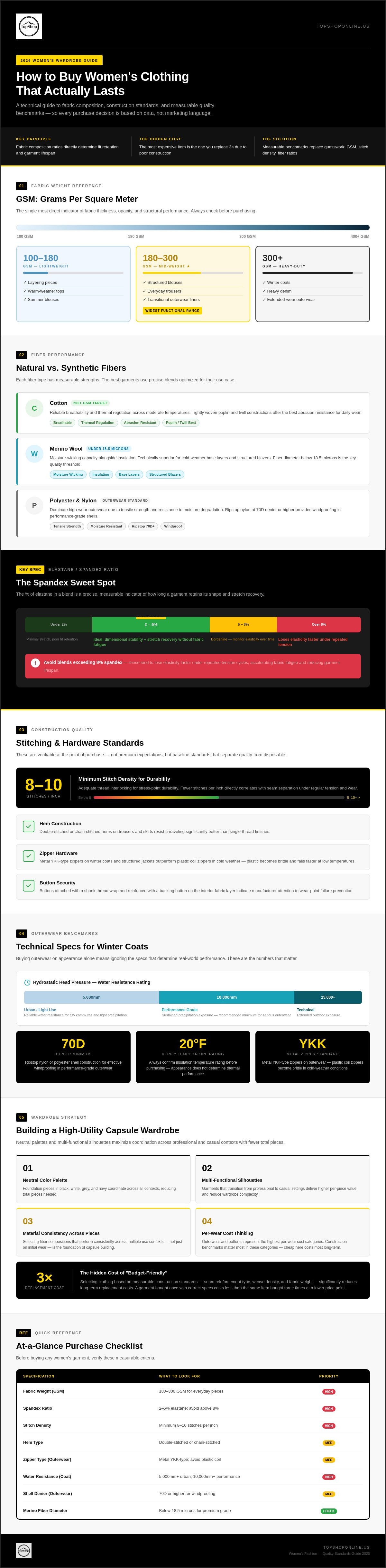
Grams per square meter (GSM) is the most direct indicator of fabric thickness and opacity. Lightweight fabrics typically fall in the 100-180 GSM range, suitable for layering pieces and warm-weather tops. Mid-weight fabrics, 180-300 GSM, cover the widest functional range: structured blouses, everyday trousers, and transitional outerwear liners. Fabrics above 300 GSM indicate heavy-duty construction appropriate for winter coats and denim designed for extended wear. Checking GSM before purchasing eliminates guesswork about whether a fabric will drape, hold its form, or show through under light.
Natural vs. Synthetic Fiber Performance
Cotton woven at 200 GSM or higher delivers reliable breathability and thermal regulation across moderate temperature ranges, with tightly woven poplin and twill constructions offering the best abrasion resistance for daily-wear items. Wool, particularly merino grades with fiber diameters below 18.5 microns, provides moisture-wicking capacity alongside insulation, making it a technically superior choice for cold-weather base layers and structured blazers. Polyester and nylon dominate high-wear outerwear applications because of their tensile strength and resistance to moisture degradation. The critical specification to look for in blended women's clothing is the spandex ratio: 2-5% elastane content is sufficient for dimensional stability and stretch recovery in fitted silhouettes without accelerating fabric fatigue. Blends exceeding 8% spandex tend to lose elasticity faster under repeated tension. Building a functional capsule wardrobe depends on selecting fiber compositions that perform consistently across multiple use contexts, not just on initial wear.
Stitching and Hardware Standards
Construction quality is verifiable at the point of purchase. Specific benchmarks to check:
- Stitch density: A minimum of 8-10 stitches per inch on seams indicates adequate thread interlocking for stress-point durability; fewer stitches per inch correlates with seam separation under regular tension.
- Hem construction: Double-stitched or chain-stitched hems on trousers and skirts resist unraveling significantly better than single-thread finishes.
- Zipper hardware: Metal YKK-type zippers on winter coats and structured jackets outperform plastic coil zippers in cold-weather conditions where plastic components become brittle.
- Button security: Buttons attached with a shank thread wrap and reinforced with a backing button on the interior fabric layer indicate manufacturer attention to wear-point failure.
These aren't premium-tier expectations. They're baseline construction standards that separate garments engineered for repeated use from those built to a single-season price point.
Key Selection Criteria for Outerwear and Bottoms
Outerwear and bottoms represent the highest per-wear cost categories in most women's wardrobes, which makes construction benchmarks here more consequential than anywhere else. A winter coat purchased without verifying insulation ratings or shell water-resistance is a purchase made on appearance alone, and appearance doesn't determine whether a garment functions at 20°F or survives a season of commuter use.
Technical Specifications for Winter Outerwear
Shell material is the first specification to verify. Outer fabrics rated at 5,000mm hydrostatic head pressure or higher provide reliable water resistance for urban and light outdoor use; ratings above 10,000mm indicate performance-grade waterproofing appropriate for sustained precipitation exposure. Windproofing is a separate property: look for tightly woven ripstop nylon or polyester shell constructions with a denier count of 70D or higher for wind-blocking capacity without excessive weight.
Insulation type and fill power determine thermal performance across temperature ranges:
- Down fill (600-800 fill power): Rated for sustained cold below 20°F; compressible and lightweight but loses insulation capacity when wet without a treated shell.
- Synthetic insulation (PrimaLoft-type constructions): Retains approximately 60-70% of thermal efficiency when wet; suitable for high-moisture environments and transitional-season outerwear.
- Fleece-lined shells: Effective in the 30-45°F range; not rated for sustained sub-freezing conditions without a secondary insulation layer.
Lining composition matters for internal moisture management. Polyester taffeta linings with a brushed interior reduce static and wick perspiration away from base layers during active wear. Unlined or thin acetate linings offer minimal moisture management and tend to deteriorate faster at friction points like underarms and cuffs. Hood adjustment mechanisms should include a drawcord closure with a locking toggle rather than elastic-only construction, which loses retention after repeated compression. Cuff adjustment via hook-and-loop or snap closure provides a tighter thermal seal than fixed-width cuffs.
Dimensional Accuracy in Denim and Skirts
Denim durability traces directly to fabric weight and weave density. Standard-weight denim falls between 10-12 oz per square yard; anything below 9 oz tends to thin at stress points within two seasons of regular wear. Stretch denim should carry a clearly stated recovery specification: fabrics with 2-4% elastane and a stated recovery rate of 90% or higher maintain their original silhouette after repeated wear and washing cycles. Blends exceeding 5% elastane in denim frequently show bagging at the knees and seat within months.
Inseam and rise measurements are non-negotiable reference points for consistent fit across women's clothing categories. A mid-rise specification should place the waistband 8-9 inches above the crotch seam; any listing that omits rise measurement provides insufficient sizing data for an accurate purchase decision.
For skirts, fabric weight determines both drape quality and seasonal utility. Woven polyester or viscose blends in the 120-180 GSM range produce the fluid drape required for professional silhouettes without the opacity issues of lighter fabrics. Lined skirts with a separate lining layer cut on the bias reduce static cling and extend the garment's usable temperature range. Unlined skirts below 150 GSM are primarily warm-weather pieces; using them year-round without a slip liner produces visible transparency under office lighting.
Hardware on bottoms deserves the same scrutiny applied to outerwear. Adjustable waistbands with internal elastic channels and button-tab closures accommodate a wider fit range than fixed-waist constructions, reducing the likelihood of size mismatch. Functional pocket construction, specifically pockets with a minimum 5-inch depth and bar-tacked stress points at the mouth, indicates a garment built for actual use rather than decorative detail. Browse TopShop's curated selection of bottoms and outerwear to cross-reference these specifications against available inventory before purchasing.
Functional Footwear: Sneakers and Everyday Shoes Performance Analysis
Footwear decisions in women's clothing are routinely made on silhouette and colorway alone. That's a specification gap with real consequences: sole delamination after four months, upper materials that trap moisture through an eight-hour shift, and closure systems that lose tension within weeks of regular use. Evaluating shoes against measurable construction benchmarks before purchasing eliminates the most common failure points.
Sole Construction and Ergonomic Support
Outsole material determines both impact absorption and surface durability. Rubber outsoles, particularly carbon-rubber compounds, outperform EVA (ethylene-vinyl acetate) in abrasion resistance on urban surfaces like concrete and asphalt. EVA outsoles are lighter and provide superior cushioning for low-impact daily wear, but compress and lose rebound capacity faster under sustained load. The practical benchmark: EVA-only outsoles are appropriate for casual, low-mileage use; rubber or rubber-EVA combination outsoles are the correct specification for commuter and all-day wear scenarios.
Insole construction directly affects arch support and fatigue accumulation over extended wear periods. Contoured insoles with a clearly defined arch ridge and heel cup provide measurably better plantar support than flat foam inserts. Look for insoles with a density rating appropriate for the intended use: softer foams (low durometer ratings) absorb impact but compress faster; denser foams maintain support geometry longer under repeated compression. Removable insoles allow aftermarket orthotic replacement, which extends the functional lifespan of the shoe beyond the original insole's compression threshold.
Tread pattern and slip-resistance ratings are quantifiable and frequently omitted from standard product listings. Outsoles with multi-directional lug patterns and a Shore A hardness rating below 60 provide adequate wet-surface grip for urban environments. Flat or minimally patterned outsoles lack the surface channeling required to displace water at the contact point, increasing slip risk on wet tile and pavement.
Material Maintenance and Longevity
Upper material determines both breathability and maintenance requirements across the shoe's service life. Textile mesh uppers, particularly engineered knit constructions, provide the highest air permeability for prolonged daily use but require more frequent cleaning and are less resistant to lateral abrasion. Synthetic leather uppers offer easier surface cleaning with a damp cloth and resist scuffing at high-contact zones, but reduce breathability in warm conditions. The correct choice depends on use environment: mesh for temperature-regulated indoor settings; synthetic leather for mixed indoor-outdoor commuter use.
Specific construction details that indicate longevity:
- Reinforced toe cap: A thermoplastic or rubber toe bumper rated to withstand repeated impact contact extends the upper's service life at the highest-wear point; absent on most fashion-oriented sneakers but standard on performance-grade constructions.
- Eyelet reinforcement: Metal grommets or stitched eyelet reinforcement prevents lace-hole tearing under repeated tension; plastic-stamped eyelets on lightweight uppers are a common early failure point.
- Lace material: Flat woven laces with a polyester core retain tension and resist fraying longer than round cotton laces; the lace-tip aglet should be heat-fused rather than crimped to prevent unraveling.
- Closure system security: Lace-up closures provide adjustable tension distribution across the instep and are more secure under dynamic movement than slip-on elastic constructions; slip-on designs are appropriate for low-exertion use where fit precision is secondary to convenience.
Weight specification is a direct indicator of construction category. Everyday casual sneakers typically fall in the 200-300 gram per shoe range; anything above 400 grams per shoe indicates heavy-duty construction with additional reinforcement layers appropriate for high-impact or extended outdoor use. Lighter isn't universally better: sub-200 gram constructions frequently sacrifice outsole thickness and upper reinforcement to hit a weight target, reducing durability at high-wear contact zones.
Building a High-Utility Capsule Wardrobe with Essential Pieces
A capsule wardrobe fails when it's built around aesthetics alone. The functional definition is more precise: a finite set of garments where every item coordinates with at least three others, transitions across at least two use contexts, and meets the construction standards covered in previous sections. That last condition matters. A neutral-palette blazer in a degraded fabric composition doesn't extend wardrobe utility; it just adds another replacement cycle.
Neutral color anchors, specifically off-white, slate grey, navy, camel, and black, provide the highest coordination coefficient across garment categories. These tones work across denim washes from light indigo to dark rinse, integrate with both warm and cool knitwear undertones, and don't create visual conflicts when layered. Selecting core pieces exclusively within this palette before introducing accent colors reduces the number of garments required to achieve full outfit coverage.
Item Interoperability and Coordination
Denim wash selection directly affects coordination range. Mid-wash indigo denim pairs with the widest range of knitwear weights and shirt fabrics without requiring color correction in the outfit. Dark rinse denim functions as a professional-context substitute for tailored trousers when paired with a structured blouse at 200 GSM or above. Light-wash denim narrows coordination options and reads as casual-only in most professional environments.
Skirts integrate into year-round wardrobes when paired with technical hosiery rated for the relevant temperature range: 40-70 denier opaque tights for temperatures below 50°F, 15-20 denier sheers for transitional and warm contexts. This pairing extends a single mid-weight woven skirt across three seasons without additional purchases. Sneakers with a clean, low-profile silhouette and a neutral colorway balance structured outerwear effectively, producing a utilitarian aesthetic that reads as intentional rather than mismatched in both commuter and professional-casual settings.
Closet organization directly affects how consistently these coordination systems get used. Smart LED fairy lights for indoor closet installation improve inventory visibility across low-light conditions, making color and fabric differentiation accurate without pulling items into a separate light source. Consistent visibility reduces the likelihood of overlooking key pieces during outfit assembly.
Seasonal Transition Strategies
Lightweight winter coats in the 300-400 GSM shell weight range function across spring and autumn temperature fluctuations without the bulk of full winter insulation. The layering system underneath carries the thermal load: a merino base layer, a mid-weight knit at 250-300 GSM, and the shell creates a modular stack that adjusts by removing one layer rather than switching between entirely different outerwear pieces.
Remote and hybrid work contexts introduce a separate comfort variable. The Deskpro XL Ergonomic Adjustable Laptop Bed Desk supports posture-neutral positioning during extended work sessions, which affects how women's clothing performs across a full day: garments that fit correctly in motion maintain their silhouette and comfort through static desk use without bunching at the waist or restricting shoulder movement.
Every piece added to a capsule wardrobe should pass a single interoperability test before purchase: does it coordinate with at least three existing items and function in at least two contexts? If not, it increases total garment count without increasing outfit range. Browse TopShop's curated women's clothing selection to identify core pieces that meet both the construction benchmarks and coordination criteria outlined across this guide.
Sourcing Premium Women's Fashion Essentials at TopShop
Applying the construction benchmarks covered throughout this guide requires access to inventory that actually meets them. TopShop's curated selection of women's clothing is organized by category and updated to reflect current material and silhouette standards, which reduces the time between specification research and purchase execution.
Inventory Overview and Category Access
The catalog covers the four highest-priority wardrobe categories identified in this guide: winter coats, sneakers, jeans, and skirts. Each category is stocked with functional design as the primary selection criterion, not trend-cycle turnover. Inventory reflects 2026 fashion standards across silhouette, fabric composition, and construction detail. Access the full Women's Clothing collection to cross-reference available pieces against the GSM, seam construction, and fiber composition specifications outlined in earlier sections.
Competitive pricing across premium material compositions is a consistent feature of the catalog. Garments built to mid-weight and heavy-weight fabric specifications, the 180-300 GSM range for structured everyday pieces and above 300 GSM for outerwear, are available without the markup typically attached to technical construction details at other retailers. That pricing structure makes it practical to prioritize quality benchmarks without adjusting the total wardrobe budget upward.
Shipping and Fulfillment Efficiency
Fast national shipping covers all US locations, providing reliable delivery timelines regardless of region. That's a direct operational advantage for time-sensitive wardrobe decisions, particularly seasonal transitions where outerwear and layering pieces need to arrive within a narrow weather window.
Packaging standards are designed to protect garment integrity during transit. Structured pieces, specifically coats and denim, require dimensional stability during shipping; compression or improper folding at stress points can affect seam alignment before a garment is worn once. Fulfillment packaging accounts for this.
Order tracking is delivered via email notification, covering dispatch confirmation and delivery status updates. The same notification channel provides access to exclusive inventory deals, which is a practical mechanism for monitoring restocks on high-demand category items without manual site checks.
Checkout is streamlined for high-speed procurement. No loyalty point accumulation systems or reward-tier friction; the transaction path moves directly from product selection to order confirmation. For buyers who've completed the specification research this guide provides, that efficiency matters. The decision framework is already built; the purchase process shouldn't add steps to it.
Every category in the TopShop catalog maps to at least one section of this guide's technical criteria. Use those benchmarks as your filter, then use the collection to execute.
Apply These Benchmarks to Your Next Women's Clothing Purchase
Every specification covered in this guide points toward the same outcome: women's clothing decisions made on measurable criteria rather than product page aesthetics. GSM ranges, seam construction standards, insulation fill ratings, and sole compound types are all verifiable before purchase. Using them consistently reduces replacement cycles and lowers long-term wardrobe cost.
Three benchmarks worth keeping front of mind: fiber composition ratios determine fit retention across wash cycles, construction details like stitch density and zipper hardware separate durable pieces from single-season builds, and capsule coordination depends on interoperability, not volume.
TopShop's curated selection covers the core categories this guide addresses, with competitive pricing on premium material compositions, a functional selection filtered for utility rather than trend turnover, and fast national shipping across the US for time-sensitive seasonal purchases.
The specification framework is built. The next step is straightforward. Shop the Women's Clothing Collection for High-Utility Essentials and match available inventory directly against the construction benchmarks you now have the vocabulary to evaluate.
Frequently Asked Questions About Women's Clothing
What is the most durable fabric for everyday women's clothing?
Tightly woven cotton at 200 GSM or higher delivers reliable durability for daily-wear items, particularly in poplin and twill constructions. For blended fabrics, polyester-cotton combinations with 2-5% elastane content balance abrasion resistance with dimensional stability. The key variable isn't fiber type alone; it's weave density combined with appropriate GSM for the intended use category.
Merino wool with fiber diameters below 18.5 microns performs exceptionally well in structured pieces like blazers, combining durability with moisture management. For high-friction zones such as pockets and cuffs, reinforced weave constructions outperform single-layer lightweight fabrics regardless of fiber content.
How do I determine the correct size when buying jeans online?
Don't rely on labeled size alone. Cross-reference three measurements against the product's stated specifications: waist circumference, inseam length, and rise measurement. A mid-rise jean should place the waistband 8-9 inches above the crotch seam; any listing that omits rise data provides insufficient sizing information for an accurate online purchase.
Also check the elastane percentage in the denim composition. Stretch denim with 2-4% elastane and a stated recovery rate of 90% or higher will maintain its fit across repeated wear cycles. Blends exceeding 5% elastane tend to bag at stress points like the knees and seat within months, which makes the initial size fit unreliable over time.
What features define a high-quality winter coat?
Shell water-resistance rating, insulation type, and lining composition are the three non-negotiable specifications. Look for a hydrostatic head pressure rating of 5,000mm or higher for reliable urban water resistance, and a shell denier count of 70D or above for wind-blocking capacity. Insulation fill power between 600-800 indicates down rated for sustained cold below 20°F; synthetic PrimaLoft-type insulation retains 60-70% thermal efficiency when wet.
Construction details confirm build quality: drawcord hood closures with locking toggles outperform elastic-only designs, metal YKK-type zippers handle cold-weather conditions better than plastic coil alternatives, and brushed polyester taffeta linings manage internal moisture more effectively than thin acetate finishes.
Are the sneakers at TopShop suitable for all-day wear?
TopShop's sneaker selection is curated for functional daily use. For all-day wear suitability, the relevant specifications to check per pair are outsole compound and insole construction. Rubber or rubber-EVA combination outsoles handle commuter surfaces like concrete and asphalt with better abrasion resistance than EVA-only builds, which compress faster under sustained load.
Contoured insoles with a defined arch ridge and heel cup provide measurably better plantar support than flat foam inserts across extended wear periods. Where insoles are removable, aftermarket orthotic replacement is possible, which extends the shoe's functional lifespan beyond the original insole's compression threshold.
How often is the women's clothing collection updated?
TopShop's women's clothing inventory is updated to reflect current material and silhouette standards rather than trend-cycle turnover. The selection prioritizes functional design as the primary criterion, so additions to the catalog reflect construction and utility benchmarks rather than seasonal fashion rotations. Signing up for email order notifications is the most reliable way to monitor restocks on high-demand category items without manual site checks.
What is the typical shipping time for national US orders?
TopShop provides fast national shipping across all US locations. Specific delivery timelines can vary by region and carrier conditions; verify current estimates at checkout before completing your order, as transit windows may shift with seasonal demand. Order tracking is delivered via email notification, covering both dispatch confirmation and delivery status updates, so you have visibility across the full fulfillment cycle.
How can I build a capsule wardrobe on a budget?
Prioritize interoperability over volume. Every piece purchased should coordinate with at least three existing items and function across at least two use contexts. Start with neutral color anchors, specifically off-white, slate grey, navy, camel, and black, before introducing any accent tones. This palette produces the highest coordination coefficient across categories without requiring additional pieces to resolve color conflicts.
Concentrate the budget on high-wear categories first: outerwear and bottoms carry the highest per-wear cost and the greatest durability variance. A single mid-weight woven skirt paired with technical hosiery rated for the relevant temperature range extends across three seasons without additional purchases, which is a better budget allocation than buying multiple single-season pieces at lower individual price points.
What are the benefits of synthetic vs. natural fiber blends in women's clothing?
Natural fibers like cotton and merino wool provide breathability, thermal regulation, and comfort against skin, but they're more vulnerable to moisture degradation and shape loss under repeated tension without reinforcement. Synthetic fibers like polyester and nylon add tensile strength, moisture resistance, and dimensional stability, making them the correct specification for outerwear shells and high-friction garment zones.
Blended compositions capture both properties when the ratios are correct. For fitted women's clothing, 2-5% elastane content delivers stretch recovery without accelerating fabric fatigue. Polyester-cotton blends in mid-weight constructions combine the breathability of natural fiber with the durability of synthetic weave, producing garments that perform consistently across multiple wash cycles rather than degrading after the first season.