

High-resolution 4K video recording often fails during low-light operation if the hardware lacks sufficient sensor dimensions and wide aperture ratings. While many users prioritize raw pixel count, a high-performance 4k dash cam with night vision requires specific technical components like the Sony STARVIS 2 image sensor to capture legible license plate data amidst heavy headlight glare. Standard 4K resolution alone doesn't guarantee usable evidence quality when ambient lux levels drop below functional thresholds. High-density technical specifications including f/1.8 aperture lenses and High Dynamic Range (HDR) processing are essential for maintaining visual clarity.
You likely recognize that grainy, pixelated nighttime footage or blurred plates caused by light flare render a dash cam ineffective for insurance liability and legal documentation. This guide analyzes technical hardware requirements and sensor capabilities for 4K dash cams to ensure optimal low-light evidence capture. We provide a comprehensive comparison of 3-channel coverage configurations, Wide Dynamic Range (WDR) processing, and supercapacitor thermal durability for reliable 24/7 monitoring. The analysis evaluates systems like the Guardian 3-Channel 4K Dash Cam and similar high-specification units featuring 5.8GHz Wi-Fi connectivity and integrated interior cabin monitoring for full vehicle oversight.
Key Takeaways
- Understand why 3840 x 2160 pixel resolution provides the necessary fourfold detail increase over 1080p for reliable license plate identification.
- Identify critical hardware specifications, including f/1.8 aperture ratings and Sony STARVIS 2 sensors, required for a functional 4k dash cam with night vision.
- Compare the utility of Infrared LEDs for interior cabin surveillance against WDR and HDR software for exterior light balance.
- Verify storage compatibility by selecting U3 or V30 rated microSD cards capable of sustaining high-bitrate 4K video recording.
- Analyze 3-channel configurations like the Guardian 4K system to achieve comprehensive 360-degree vehicle monitoring and liability protection.
4K Dash Cam Night Vision: Technical Overview and Core Architecture
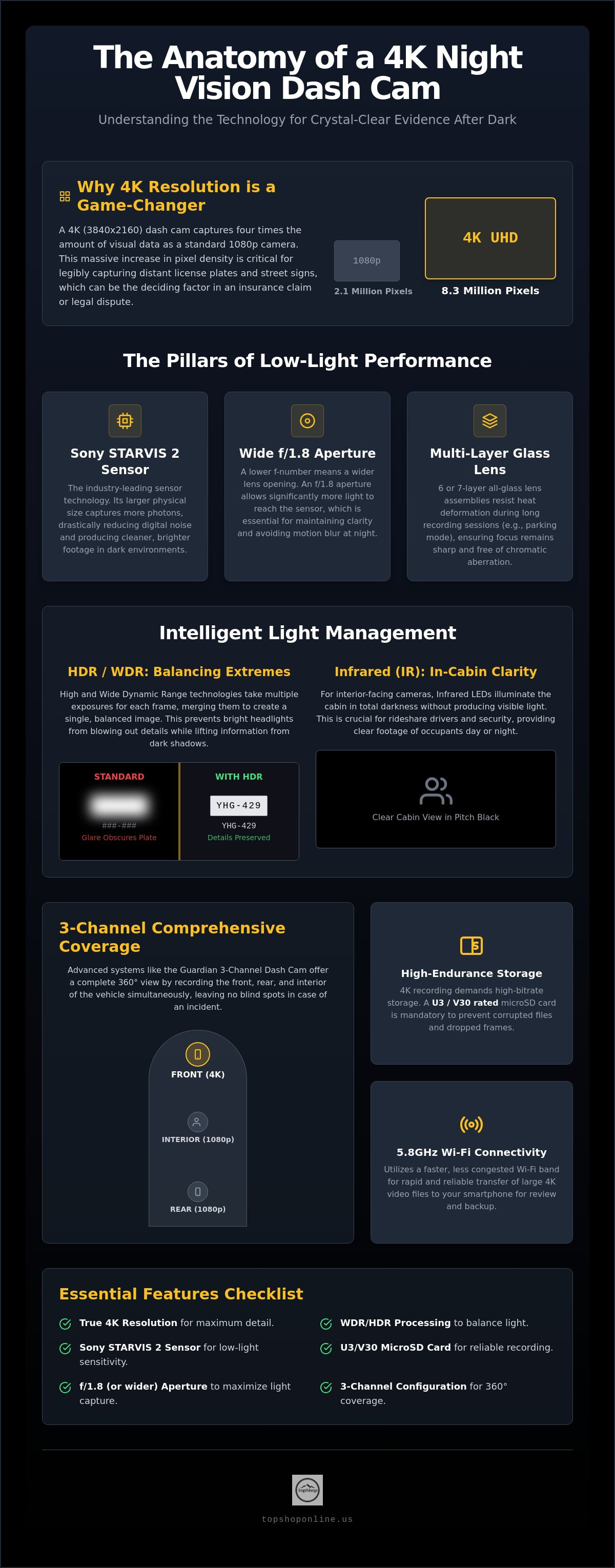
Modern 4K resolution standards utilize a pixel grid of 3840 x 2160, delivering precisely 8,294,400 pixels per frame. This configuration provides four times the raw visual data compared to standard 1080p systems. For a 4k dash cam with night vision, this density is critical for resolving fine details like license plate characters and street signage at distances exceeding 20 feet. Effective dash cam technology relies on a specialized technical architecture. This includes high-performance Image Signal Processors (ISP) capable of managing high-bitrate data streams without frame drops. These processors must execute real-time noise reduction and exposure balancing to handle high-contrast light sources, such as oncoming LED headlights against pitch-black backgrounds.
Integration of multi-channel recording adds complexity to the internal hardware architecture. A 3-channel system, such as the Guardian 3-Channel 4K Dash Cam, manages simultaneous data feeds from front, rear, and interior lenses. This setup creates a comprehensive environmental data log for liability protection. Each channel requires dedicated processing bandwidth to maintain resolution integrity. The front-facing lens typically prioritizes 4K resolution, while interior and rear cameras often utilize 1080p to balance total system heat generation and power consumption levels.
Resolution vs. Pixel Density in Low Light
Higher pixel counts on a standard-sized image sensor result in smaller individual pixels. Small pixels capture less light, which often leads to significant digital noise and graininess in dark conditions. To maintain low-light sensitivity at 3840 x 2160 resolution, hardware manufacturers must utilize larger physical sensors to increase the surface area available for photon collection. The physical dimensions of the image sensor directly determine the maximum volume of light intake possible for achieving 4K clarity in sub-optimal lighting environments. Without a sufficiently large sensor, 4K footage in the dark may appear less clear than lower-resolution 2K footage captured on a superior sensor.
Frame Rates and Motion Blur at Night
Frame rate selection between 30fps and 60fps impacts the legibility of moving objects. While 60fps provides smoother video, it requires shorter exposure times for each frame, which can reduce total light intake in dark settings. 30fps allows for longer shutter speeds, improving brightness but increasing the risk of motion blur during high-speed travel. A 4k dash cam with night vision must utilize high bitrates, often exceeding 30Mbps, to preserve detail during complex night-time scenes. Technical adjustments to shutter speed are necessary to mitigate light blooming from streetlights and high-intensity discharge lamps, ensuring that light flares don't obscure critical evidence.
Sensor Hardware and Aperture: The Drivers of Night-Time Clarity
The optical performance of a 4k dash cam with night vision is fundamentally limited by its lens aperture and sensor architecture. Aperture size, denoted by the f-number, dictates the physical volume of light permitted to strike the image sensor. A lower f-number indicates a wider opening. High-specification hardware utilizes f/1.6 or f/1.8 lenses to maximize photon collection in low-lux environments. These glass components must maintain structural integrity under high thermal loads. 6-layer or 7-layer all-glass lens assemblies are standard for reducing thermal deformation and chromatic aberration. Unlike plastic lenses, glass doesn't warp in high-temperature environments, ensuring consistent focus during extended parking mode monitoring sessions.
Multi-exposure hardware integrates with the lens stack to balance light levels across the frame. This configuration prevents the "white-out" effect caused by reflective license plates and high-intensity headlights. By utilizing multiple shutter speeds for a single frame, the system preserves detail in both deep shadows and bright highlights simultaneously. This technical requirement is essential for capturing legible evidence when driving through areas with inconsistent municipal lighting.
Aperture Specifications and Light Sensitivity
Transitioning from an f/1.8 aperture to an f/1.6 aperture provides an approximate 30% increase in light gathering area. This hardware-level improvement allows the camera to maintain shorter shutter speeds, which reduces the motion blur commonly seen in nighttime footage. Fixed-focus hardware is preferred in dash cam applications to eliminate the "hunting" effect that occurs when autofocus systems struggle in dark conditions. In rural driving environments with zero street lighting, large-aperture lenses prevent total frame blackout by maximizing the utility of the vehicle's own headlight illumination.
CMOS Sensor Technology for 4K Capture
The image sensor serves as the primary data collection point for high-resolution video. Sony STARVIS and STARVIS 2 sensors represent the current industry standard for back-illuminated (BSI) pixel technology. BSI architecture relocates the sensor's wiring behind the light-sensitive photodiodes, increasing the effective area for photon absorption. This design is crucial for a 4k dash cam with night vision because it improves the signal-to-noise ratio in high-contrast scenes. Dynamic range expansion at the hardware level counters headlight glare by preventing sensor saturation. For users requiring comprehensive interior coverage, the dash cam with inside cabin view configuration often places specialized IR-sensitive sensors on the interior lens to monitor passengers in total darkness.
Reliable hardware prevents the "light blooming" effect that obscures license plates. High-density glass lens stacks work in tandem with STARVIS 2 hardware to resolve high-frequency details. For drivers seeking a professional-grade 3-channel solution, the Guardian 4K Dash Cam integrates these high-aperture optics with advanced BSI sensor technology for consistent liability protection across all light levels.
Comparing Night Vision Technologies: Infrared vs. WDR/HDR
Night vision capabilities in automotive recording systems bifurcate into active illumination and passive dynamic range processing. For a 4k dash cam with night vision, identifying the specific implementation of these technologies is critical for data integrity. Interior monitoring relies on active Infrared (IR) light sources to illuminate the cabin without distracting the driver. Exterior road monitoring utilizes Wide Dynamic Range (WDR) or High Dynamic Range (HDR) to manage high-contrast light sources like streetlights and high-beam headlights. These systems must operate simultaneously in a 3-channel configuration to ensure complete liability coverage across all vehicle zones.
The distinction between IR and dynamic range software is fundamental to hardware selection. IR tech isn't designed for road use because the wavelengths reflect off glass surfaces, causing significant glare. Instead, it serves the specific purpose of cabin visibility. For the road, processors must balance light levels digitally or through multi-exposure hardware to prevent the "white-out" effect seen on reflective license plates. High-bitrate 4K systems require robust processing power to execute these balancing algorithms at 30 or 60 frames per second without inducing lag or pixelation.
Infrared (IR) for Interior Cabin Monitoring
Infrared hardware is a mandatory requirement for rideshare professionals operating on Uber or Lyft platforms. These systems utilize dedicated IR LEDs that provide illumination in 0-lux conditions, allowing the interior lens to capture passenger activity in total darkness. Most systems use 850nm wavelength LEDs which emit a faint red glow but offer greater illumination distance. Conversely, 940nm LEDs are completely invisible to the human eye but provide shorter effective ranges. Hardware logic includes an automatic IR cut filter that switches from full-color day mode to grayscale night mode based on ambient lux levels. Strategic placement of these LEDs on the camera chassis is essential to avoid reflection on the front windshield, which can obscure the 4K road view.
WDR and HDR for Exterior Evidence
Exterior evidence capture depends on the sensor's ability to resolve details in shadows and bright spots. Software-based WDR balances the lighting across the frame by adjusting the gain and brightness levels digitally. This is often insufficient for 4K bitrates where detail loss occurs in high-contrast scenes. Hardware-based HDR is superior, as it captures dual exposures for every frame to eliminate license plate washout from following vehicles' headlights. Hardware-based HDR provides superior pixel-level exposure control compared to software-based WDR in high-resolution 4K systems. This technical advantage ensures that alphanumeric characters on plates remain legible even when hit directly by high-intensity discharge (HID) lamps. The Guardian 3-Channel 4K Dash Cam utilizes this hardware-level HDR on its front-facing sensor to maintain evidence standards in unlit rural environments.
Operational Requirements for 4K Dash Cam Hardware
High-bitrate video encoding for a 4k dash cam with night vision places extreme stress on internal hardware components. Processing 8.3 million pixels per frame while simultaneously managing interior and rear feeds generates significant thermal energy. Sustained 4K operation in high-temperature summer conditions requires advanced heat dissipation hardware, such as internal aluminum heat sinks or ventilated chassis designs. Failure to manage this thermal load results in processor throttling, which causes frame drops or system reboots during critical recording periods. Most professional-grade units utilize high-performance chipsets specifically designed to handle the 30-40 Mbps bitrates required for clear 4K evidence capture without overheating.
Installation requirements for these systems extend beyond a simple cigarette lighter adapter. A dedicated hardwiring kit is necessary for 24/7 parking mode monitoring to provide a constant power source from the vehicle's fuse box. These kits facilitate the transition between ignition-based recording and motion-activated surveillance. Without this hardware, the device can't monitor the vehicle's environment once the engine is deactivated. The integration of high-speed wireless modules is also standard, allowing users to manage large video files via smartphone applications without physical card removal.
Storage Capacity and Write Speeds
Writing high-bitrate 4K video files requires specialized storage media with consistent write speeds. Standard Class 10 cards are insufficient for these data loads. Users must utilize U3 (Ultra High Speed Class 3) or V30 (Video Speed Class 30) rated microSD cards to ensure a minimum sustained write speed of 30MB/s. A triple-channel system recording at 4K front resolution consumes approximately 30GB of storage per hour of footage. High-endurance cards are necessary to withstand the continuous loop recording cycles that wear down NAND flash memory cells over time. Efficient 3-channel 4k dash cam parking mode management requires high-capacity cards, often supporting up to 512GB or 1TB, to prevent vital evidence from being overwritten during extended parking sessions.
Power Management and Installation
Reliable 24/7 monitoring depends on the power delivery architecture and the energy storage medium. Supercapacitors are preferred over lithium-ion batteries for automotive applications due to their superior thermal stability and longevity. They don't pose the swelling or fire risks associated with chemical batteries in hot vehicle interiors during summer months. For continuous surveillance, the hardwiring kit includes adjustable voltage cutoff settings to preserve the vehicle's starter battery, typically disconnecting at 11.8V or 12.0V to prevent a flat battery. Data transfer of large 4K files, which often exceed 500MB per three-minute clip, is optimized through 5.8GHz WiFi. This frequency provides significantly faster download speeds and reduced interference compared to standard 2.4GHz bands.
Ensure your vehicle is equipped with high-performance hardware for consistent liability protection. You can buy the Guardian 3-Channel 4K Dash Cam to access professional-grade recording, superior thermal reliability, and integrated voltage protection.
Guardian 3-Channel 4K Dash Cam: Technical Solution Analysis
The Guardian 3-Channel system functions as a high-density 4k dash cam with night vision, offering simultaneous front, rear, and interior recording. Its primary architecture utilizes a 4K front-facing lens (3840 x 2160 pixels) paired with 1080p resolution interior and rear-facing channels. This multi-channel configuration provides a centralized data log for full vehicle monitoring. Integrated night vision sensors are calibrated for all-weather, all-light condition monitoring, ensuring that evidence quality remains consistent during heavy rain or unlit nighttime driving. The hardware supports high-bitrate data streams, preserving the pixel integrity required for identifying license plates and passenger details in complex, high-contrast environments.
Incident management is handled through integrated tri-axial G-sensor hardware. When the sensor detects sudden gravitational shifts, such as collisions or emergency braking, the system initiates an automatic incident lock. This prevents the current video segment from being overwritten during the standard loop recording cycle. High-capacity storage support ensures that extended road trips are documented without frequent card maintenance. The system utilizes efficient H.265 video compression to maximize storage utility while maintaining the high-frequency detail required for liability protection and legal documentation.
Full Vehicle Monitoring Specifications
Optical coverage is achieved through a 170-degree front field of view, which captures maximum environmental data across multiple traffic lanes. This wide-angle hardware reduces peripheral blind spots common in narrow-lens systems. The interior lens is specifically designed for driver and passenger safety, utilizing high-sensitivity sensors to monitor cabin activity in low-lux conditions. Rear-view integration provides critical documentation for rear-end collision analysis. Together, these three optical channels create a 360-degree surveillance loop, providing 4k dash cam with night vision capabilities for the road while maintaining clear 1080p visibility for the vehicle interior and rear perimeter.
Functional Reliability and Build Quality
The Guardian system features a utilitarian chassis design optimized for heat dissipation and discreet mounting. Ventilated housing allows the high-speed processor to maintain 4K recording bitrates without thermal throttling during sustained operation. Mounting hardware is designed for stability, reducing vibration-induced motion blur. Data access is streamlined through high-speed 5.8GHz WiFi for smartphone synchronization or direct microSD card extraction for desktop analysis. This focus on hardware utility ensures that the system remains operational under US national driving conditions, including extreme temperature fluctuations and high-vibration environments.
Utilitarian hardware and high-resolution sensors provide the necessary data for liability protection. View technical specs for the Guardian 3-Channel 4K Dash Cam to analyze the complete performance data and mounting configurations.
Optimizing Vehicle Liability Protection with 4K Hardware
Effective nighttime evidence capture requires a precise configuration of f/1.6 aperture lenses, back-illuminated BSI sensors, and high-bitrate processing. A high-specification 4k dash cam with night vision ensures that high-contrast light sources don't obscure license plate data or critical environmental details. Reliable operation depends on the integration of supercapacitor power delivery and V30-rated storage to handle the 30-40 Mbps data streams generated by triple-channel systems. These technical standards provide the necessary documentation for legal and insurance liability verification across all driving conditions.
The Guardian system establishes a technical baseline for professional-grade monitoring through simultaneous 3-channel 4K monitoring and integrated G-sensor incident locking. High-speed 5.8GHz WiFi provides instant footage access for immediate liability protection. This hardware is designed for professional and consumer liability protection in diverse US national driving environments. Shop the Guardian 3-Channel 4K Dash Cam for Full Vehicle Protection to secure your high-resolution documentation solution today. Maintain a stable and verified record of every road event with advanced optical hardware.
Frequently Asked Questions
Does 4K resolution automatically mean better night vision?
No, resolution alone doesn't guarantee superior low-light performance. Pixel density on small sensors often increases digital noise in dark conditions. A high-performance 4k dash cam with night vision requires a large physical sensor and a wide f/1.8 or f/1.6 aperture to maximize light intake. Hardware like the Sony STARVIS 2 sensor is specifically designed to improve signal-to-noise ratios in dark environments, which is more critical for clarity than raw pixel count.
What SD card is required for a 4K 3-channel dash cam?
You must use U3 or V30 rated microSD cards for 4K recording. These cards maintain a minimum sustained write speed of 30MB/s, which is necessary for handling the high-bitrate data streams of a 3-channel system. High-endurance cards are recommended to withstand the constant thermal stress and frequent write cycles of continuous loop recording. Standard Class 10 cards often fail or cause frame drops when writing 4K video files.
How does infrared night vision work in a dash cam?
Infrared (IR) night vision uses active LED illumination to light up the vehicle interior in zero-lux conditions. It operates on 850nm or 940nm wavelengths that are invisible to the human eye but visible to the camera's CMOS sensor. This technology is restricted to cabin monitoring because IR light reflects off windshield glass, causing significant glare that obscures exterior road footage. Most systems switch to grayscale mode automatically when IR is active.
Can a 4K dash cam capture license plates at night?
License plate capture at night depends on hardware-level HDR and sensor sensitivity. A 4k dash cam with night vision can resolve alphanumeric characters if it successfully manages headlight glare and light blooming. Without HDR, reflective plates often appear as solid white blocks due to overexposure from following vehicles. The combination of 3840 x 2160 resolution and multi-exposure hardware is essential for capturing legible plate data at distance.
Is hardwiring necessary for 4K dash cam night vision?
Hardwiring is mandatory for 24/7 parking surveillance and reliable nighttime monitoring. High-resolution 4K processing and WiFi modules consume significant power that standard internal batteries or supercapacitors can't sustain for long periods. Hardwiring kits connect directly to the vehicle fuse box, providing a constant power source. These kits include voltage cutoff protection to ensure the camera shuts down before the vehicle's starter battery is depleted.
What is the difference between WDR and HDR in dash cams?
WDR is a software-based algorithm that adjusts brightness and contrast levels digitally across the frame. HDR is a hardware-based process that captures multiple exposures for every single frame and combines them to preserve detail in both deep shadows and bright highlights. HDR is the superior technical solution for preventing license plate washout and managing high-contrast nighttime scenes. It's the industry standard for high-end 4K recording systems.
How much storage does 4K dash cam footage use?
Storage consumption is approximately 30GB per hour for a 3-channel system recording at 4K front resolution. This high data rate is a result of the 3840 x 2160 resolution and the 30-40 Mbps bitrates required for detail preservation. Using high-capacity cards, such as 256GB or 512GB, is standard for long-distance driving. Efficient H.265 compression hardware is necessary to manage these large file sizes while maintaining evidence-grade visual quality.