

What if your vehicle security system fails at the precise moment of a high-speed collision due to thermal throttling or a low-bitrate bottleneck? Many drivers install recording hardware only to discover blurry night footage or corrupted files when they need evidence for an insurance claim or legal dispute. This technical guide provides a comprehensive analysis of triple-lens systems designed for total vehicle surveillance and liability protection. We identify the hardware configurations that define the best 3 channel 4k dash cam for 2026, focusing on native resolution and high-speed data throughput.
You will learn the critical differences between upscaled and native 4K output, the necessity of specific sensor technology for low-light cabin monitoring, and the power requirements for 24/7 parking protection. This article examines the Guardian 3-Channel 4K Dash Cam architecture and outlines the thermal management strategies required to prevent hardware failure during long-duration drives. By analyzing processing capabilities and storage endurance, we provide a technical framework for selecting a reliable monitoring solution that ensures crystal-clear license plate capture and consistent data integrity across all recording channels.
Key Takeaways
- Analyze triple-stream video architecture and central processing unit requirements for simultaneous front, interior, and rear-cabin surveillance coverage.
- Distinguish true 4K (3840x2160) resolution from upscaled alternatives using Sony STARVIS 2 sensor benchmarks for high dynamic range performance.
- Identify critical hardware components for high-bitrate data management, specifically Class 10, U3, and V30 high-endurance MicroSD card specifications.
- Evaluate the best 3 channel 4k dash cam configurations based on integrated thermal management, GPS location logging, and legal audio recording compliance.
- Review technical performance metrics of the Guardian 3-Channel 4K Dash Cam focusing on 4K Ultra HD lens output and G-sensor loop recording stability.
Understanding 3-Channel 4K Dash Cam Architecture and Coverage
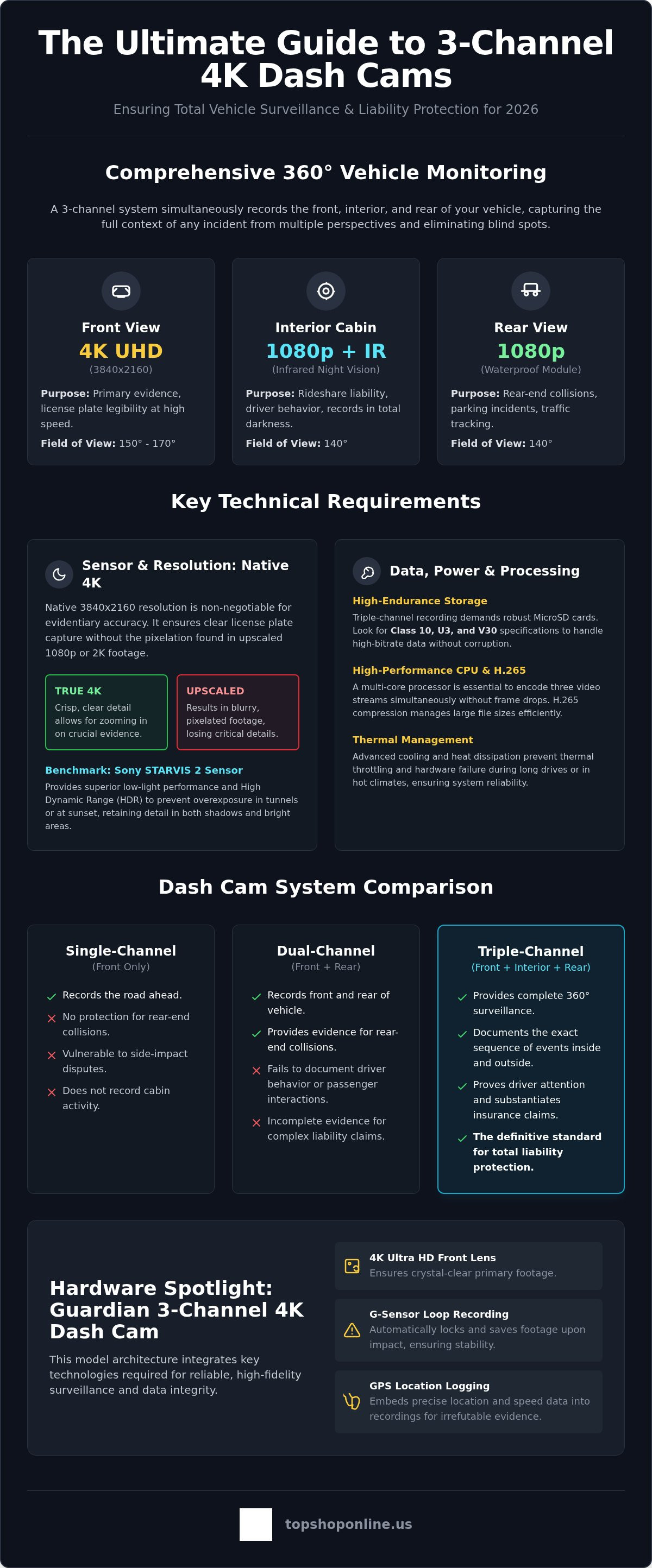
A 3-channel system provides comprehensive 360-degree environmental monitoring by recording the front, interior, and rear of a vehicle simultaneously. The hardware architecture relies on a high-performance central processing unit designed to manage triple-stream video data without frame drops. For a device to qualify as the best 3 channel 4k dash cam, it must maintain a 4K Ultra HD resolution on the front channel while concurrently encoding two additional high-definition streams. A comprehensive Dashcam technology overview indicates that multi-channel systems are vital for evidentiary support in accident reconstruction, as they capture the full context of an incident from multiple perspectives.
Field of View (FOV) requirements are critical for eliminating blind spots. Most professional-grade systems utilize a 150-degree to 170-degree front lens, a 140-degree interior lens, and a 140-degree rear lens. This configuration ensures that side-swipe incidents and adjacent lane activity are recorded. High-speed processors, such as those found in the Guardian 3-Channel 4K Dash Cam, utilize H.265 compression to manage the significant data throughput required for three active video feeds while maintaining thermal stability during extended operation.
Front, Interior, and Rear Lens Specifications
The front-facing lens serves as the primary evidentiary tool, requiring 3840x2160p resolution to ensure license plate legibility at high speeds. The interior lens focuses on cabin activity and must include Infrared (IR) LED sensors. These sensors allow for clear recording in total darkness, which is a specific requirement for rideshare liability protection. The rear lens is typically a separate, waterproof module mounted on the exterior or the rear windshield. It requires high-speed connectivity to the main unit to prevent latency in the triple-stream recording process.
Comparison with Single and Dual-Channel Systems
Single-channel systems only record the road ahead, leaving the vehicle vulnerable to rear-end collisions and side-impact disputes. Dual-channel systems add rear coverage but fail to document driver behavior or passenger interactions. The technical complexity of adding a third interior channel involves significant power management and heat dissipation challenges. Triple-lens systems provide the necessary data for insurance claim substantiation by proving the driver’s attention and documenting the exact sequence of events inside and outside the vehicle. This level of hardware redundancy is the primary differentiator for the best 3 channel 4k dash cam models available in 2026.
- Front: 4K Ultra HD (3840x2160) for detail capture.
- Interior: 1080p with IR for low-light cabin monitoring.
- Rear: 1080p waterproof module for exterior traffic tracking.
- Processor: Multi-core CPU for simultaneous triple-stream encoding.
Technical Specifications: 4K Resolution and Sensor Performance
True 4K resolution involves a native pixel count of 3840x2160. Many budget models use interpolation to upscale 1080p or 2K footage, which results in pixelation and lost detail when zooming in on license plates. Native resolution is non-negotiable for evidentiary accuracy. The best 3 channel 4k dash cam systems utilize high-bandwidth image sensors to maintain this native resolution across the primary front channel. Frame rates typically stay at 30FPS in triple-channel mode to balance thermal loads and processing demands, ensuring consistent recording without system crashes.
Sony STARVIS 2 technology represents the current industry benchmark for dynamic range and low-light performance. This back-illuminated pixel technology increases sensitivity to visible and near-infrared light. In high-contrast environments, such as driving toward a sunset or through a tunnel, High Dynamic Range (HDR) processing prevents overexposure. This ensures that both dark shadows and bright highlights retain detail. If you require hardware that meets these professional benchmarks, consider the Guardian 3-Channel 4K Dash Cam for your vehicle security setup.
Night Vision and Infrared Capabilities
Total darkness cabin recording requires dedicated 940nm infrared LEDs. Unlike exterior sensors that rely on ambient light, these interior lenses activate IR emitters to illuminate passengers without distracting the driver. Exterior sensors for the best 3 channel 4k dash cam configurations target low-light sensitivity metrics below 0.01 Lux. Software-level noise reduction algorithms further clean up 4K video processing by removing grain from high-ISO footage, which is critical for identifying faces in low-light parking scenarios.
Bitrate and Compression Standards
High-resolution recording generates massive data volumes that can overwhelm standard processors. H.265 (HEVC) compression offers up to 50% better efficiency than the older H.264 standard, allowing for smaller file sizes without sacrificing clarity. High bitrates, often exceeding 30Mbps for the front channel, are necessary for license plate legibility at highway speeds. Variable bitrate (VBR) recording modes adjust data allocation based on scene complexity, saving storage during static parking monitoring while maximizing detail during high-speed motion.
- Native Resolution: 3840x2160 pixels for front-facing lenses.
- Sensor Hardware: Sony STARVIS 2 back-illuminated technology.
- Compression: H.265 (HEVC) for optimized storage management.
- Infrared: 940nm wavelength LEDs for cabin monitoring.
- Sensitivity: Low-light performance rated below 0.01 Lux.
Data Management and Power Requirements for Triple-Channel Recording
High-resolution triple-channel recording generates a sustained data stream that exceeds the capabilities of standard consumer electronics. To function as the best 3 channel 4k dash cam, a device must handle simultaneous write operations from 4K, 1080p, and 1080p sources. This creates a high-bitrate environment where data bottlenecks lead to frame loss or file corruption. Managing these streams requires specific hardware standards for both storage media and internal processing units.
MicroSD card selection is a critical failure point in multi-channel systems. Users must utilize cards with Class 10, U3, and V30 ratings to ensure the minimum 30MB/s sustained write speed required for 4K video. High-endurance cards are mandatory because triple-channel systems overwrite data frequently, leading to rapid flash memory wear. A 256GB card serves as the recommended minimum for a system like the Guardian 3-Channel 4K Dash Cam. This capacity provides approximately 6 to 8 hours of footage before loop recording begins overwriting the oldest files. Loop recording ensures continuous operation, while integrated G-sensors provide automatic file locking to protect footage during impact events.
Triple-stream encoding generates significant internal heat within the primary housing unit. Hardware units require optimized PCB layouts and heat sinks to dissipate thermal energy effectively. Failure to manage this thermal load results in processor throttling, which reduces video quality or causes total system resets. Selection should prioritize units with dedicated ventilation design to maintain hardware longevity during long-duration drives.
Hardwire Kits and Parking Mode Functionality
Achieving 24/7 surveillance requires a dedicated hardwire kit. These kits connect directly to the vehicle fuse box, bypassing the cigarette lighter socket to provide constant power. Integrated voltage monitoring is a required safety feature. It detects when the vehicle battery drops below a specific threshold, typically 11.8V or 12V, and terminates power to prevent a dead battery. Parking mode functionality utilizes G-sensor triggers for impact detection or time-lapse recording to minimize storage consumption during stationary periods.
Thermal Protection and Operating Temperature Ranges
High-performance dash cams utilize supercapacitors instead of lithium-ion batteries. Supercapacitors offer superior thermal stability and longevity in extreme temperatures. They operate reliably from -20°C to 70°C and do not pose the swelling or fire risks associated with traditional batteries in high-heat environments. Automatic thermal shutdown thresholds protect internal circuitry by powering down the unit if internal temperatures exceed safe operating limits. This hardware-level protection is essential for maintaining the best 3 channel 4k dash cam performance in climates with high solar radiation.
- Storage: V30 High-Endurance MicroSD (256GB Minimum).
- Power: Hardwire kit with 11.8V/12V low-voltage cutoff.
- Battery Type: Supercapacitor for heat resistance.
- Protection: G-sensor triggered file locking and thermal shutdown.
Selection Criteria for Professional and Rideshare Use
Professional and rideshare applications demand specific hardware durability and legal compliance features. The best 3 channel 4k dash cam for these users must include integrated GPS logging to verify speed, heading, and precise location data during legal disputes or insurance investigations. Audio recording capabilities are equally vital for documenting passenger interactions, though they require adherence to regional privacy laws. In the United States, numerous jurisdictions require all-party consent for audio recording. Hardware with physical mute toggles or clear LED status indicators ensures compliance while maintaining continuous cabin surveillance.
Physical security features protect the integrity of the recorded data from external interference. Professional-grade units often feature tamper-resistant SD card slots with screw-down covers and locking mounts to prevent unauthorized access or removal of the storage media by passengers. User interface (UI) design focuses on functional efficiency, allowing drivers to access instant playback via high-speed Wi-Fi 6 connectivity. This enables immediate evidence review on a mobile device without the need to remove the high-endurance memory card from the vehicle.
Mounting and Cable Management Systems
Adhesive mounts provide superior vibration reduction compared to suction cup alternatives, which is critical for maintaining 4K image stability on uneven road surfaces. Hidden cabling techniques involve routing power and signal wires through vehicle headliners, weather stripping, and A-pillars. Applying cable management for home office principles to vehicle interiors ensures that the complex wiring for a three-channel system does not interfere with airbag deployment or driver visibility. Secure cable routing prevents physical wear on the connectors and maintains a professional cabin appearance.
Liability Protection and Evidence Export
One-touch emergency file locking allows drivers to protect current footage segments instantly during road rage incidents or near-misses. High-speed 5GHz Wi-Fi modules enable the rapid export of large 4K files to mobile devices for immediate insurance submission. Regular formatting of the high-endurance SD cards, as discussed in the data management section, remains a core requirement for preventing file system errors and maintaining write speeds. For drivers seeking a hardware solution that integrates these professional-grade features, the Guardian 3-Channel 4K Dash Cam provides the necessary technical architecture for 2026 vehicle security standards.
- GPS Logging: Verification of speed and location coordinates.
- Security: Tamper-resistant SD slots and adhesive mounts.
- Connectivity: Wi-Fi 6 for rapid 4K file transfers.
- Compliance: Physical audio mute controls for legal adherence.
Hardware Overview: Guardian 3-Channel 4K Dash Cam
The Guardian 3-Channel 4K Dash Cam serves as a high-specification hardware solution for comprehensive vehicle monitoring. It utilizes a primary 4K Ultra HD lens assembly with a native 3840x2160 resolution, providing the pixel density required for license plate identification at variable distances. The system integrates three independent recording channels, ensuring the best 3 channel 4k dash cam performance through synchronized timestamping and G-sensor event triggers. Interior and rear-facing modules utilize 1080p resolution sensors; the interior unit features 940nm infrared LEDs for low-light cabin surveillance. All three streams are processed by a multi-core CPU designed to maintain 30FPS stability without thermal throttling.
Guardian Series Build Quality and Durability
Hardware durability is centered on a high-density polycarbonate casing with integrated thermal dissipation vents. These vents facilitate passive airflow across the internal PCB, protecting the processor during high-bitrate recording cycles. The unit supports high-endurance storage media up to 256GB, utilizing V30 speed class requirements to prevent write errors. Installation in standard passenger vehicles is simplified through a modular cable system that uses a single power source for all three cameras. Adhesive mounting brackets reduce high-frequency vibrations, ensuring stable 4K footage on diverse road surfaces.
Integrating Vehicle Security with Home Monitoring
A unified security strategy extends beyond the vehicle to include personal property monitoring. While the Guardian system handles mobile surveillance, a 1080p wireless mini security camera provides stationary coverage for home or office environments. Both systems utilize similar CMOS sensor technology and infrared capabilities to ensure 24/7 visibility. Integrating these hardware solutions creates a redundant security perimeter for personal assets. To acquire the best 3 channel 4k dash cam for your 2026 security requirements, verify your vehicle's power specifications and select a high-endurance MicroSD card to finalize the installation.
- Front Resolution: 4K Ultra HD (3840x2160) for detail capture.
- Night Vision: 940nm IR LEDs for interior monitoring.
- Thermal Management: Polycarbonate housing with passive cooling vents.
- Storage: Supports up to 256GB V30 high-endurance MicroSD media.
- Sensors: Integrated G-sensor for automated collision file locking.
Implement Advanced Vehicle Surveillance Standards
Selecting the best 3 channel 4k dash cam requires verifying native resolution, sensor thermal limits, and high-bitrate storage compatibility. Effective liability protection depends on simultaneous front, interior, and rear recording streams that capture comprehensive environmental data. Native 4K Ultra HD front resolution ensures license plate legibility at highway speeds. Integrated G-sensors provide automated incident locking to protect critical footage from loop recording overwrites. Professional configurations must prioritize supercapacitor power systems and high-endurance memory cards to withstand 2026 operational demands.
Data integrity remains the primary metric for system performance. High-performance hardware manages triple-stream encoding while maintaining thermal stability in high-heat environments. Drivers who implement these technical standards reduce liability risks and ensure verifiable evidence for insurance claims. Shop the Guardian 3-Channel 4K Dash Cam for Complete Vehicle Protection to access professional-grade specifications and total vehicle coverage. Reliable hardware provides the necessary documentation for every drive.
Frequently Asked Questions
Does a 3-channel dash cam record all three views simultaneously?
Yes. All three channels record concurrently to a single MicroSD card. The central processing unit manages triple-stream video data from the front, interior, and rear lenses. This simultaneous operation ensures synchronized timestamps across all feeds, providing a comprehensive 360-degree record of the vehicle environment during a single event. It maintains data integrity by encoding each stream into separate files for easier retrieval.
What is the minimum SD card requirement for 4K 3-channel recording?
A high-endurance MicroSD card with a minimum 256GB capacity and V30 speed rating is required. The best 3 channel 4k dash cam systems generate high-bitrate data that necessitates Class 10 and U3 write speeds. 256GB provides approximately 6 to 8 hours of triple-stream footage before loop recording overwrites the oldest files. Using lower-rated cards often leads to write errors and file corruption.
Will a 3-channel dash cam drain my car battery in parking mode?
No, provided a hardwire kit with integrated low-voltage protection is used. These kits monitor vehicle battery levels and terminate power if the voltage drops below a preset threshold, typically 11.8V or 12V. This hardware-level safety prevents battery depletion while allowing for G-sensor triggered or time-lapse parking surveillance. It's a standard requirement for 24/7 vehicle monitoring without manual battery maintenance.
Is the interior camera effective in total darkness?
Yes, interior cameras equipped with 940nm infrared LEDs provide clear monochrome footage in total darkness. These IR sensors illuminate the cabin without emitting visible light that could distract the driver. This hardware configuration is essential for rideshare liability protection during nighttime operation. It ensures passenger behavior and cabin incidents remain visible regardless of external lighting conditions or window tint levels.
How does 4K resolution compare to 1080p for license plate capture?
4K resolution (3840x2160) provides four times the pixel density of 1080p (1920x1080). This increased resolution allows for digital zooming on distant license plates without significant pixelation. Native 4K sensors capture finer details, such as registration stickers and small text, which are often illegible on lower-resolution hardware. This extra clarity is critical when identifying vehicles involved in high-speed hit-and-run incidents.
Can I install a 3-channel dash cam myself or do I need a professional?
DIY installation is possible for users comfortable with vehicle trim removal and fuse box access. Standard installations involve routing cables through headliners and weather stripping. However, professional installation is recommended for complex hardwire kit integration to ensure clean cable management and proper low-voltage cutoff calibration. Correct mounting is essential to prevent vibration and ensure the G-sensor functions accurately during impact events.
What happens when the SD card is full?
The system utilizes loop recording to overwrite the oldest unprotected files automatically. This ensures continuous operation without manual intervention. Integrated G-sensors detect impacts and lock the corresponding video segments into a protected folder, preventing them from being overwritten during the loop cycle. Users don't need to format the card daily, though monthly formatting is recommended to maintain optimal file system health.
Are 3-channel dash cams legal for Uber and Lyft drivers?
Yes, they're legal in all 50 U.S. states for visual recording. However, audio recording laws vary by jurisdiction. Twelve states, including California and Florida, require all-party consent for audio capture. Drivers should check local regulations and consider using hardware with physical mute buttons to maintain legal compliance. Displaying a recording notice decal inside the vehicle is a standard practice for rideshare professionals.