

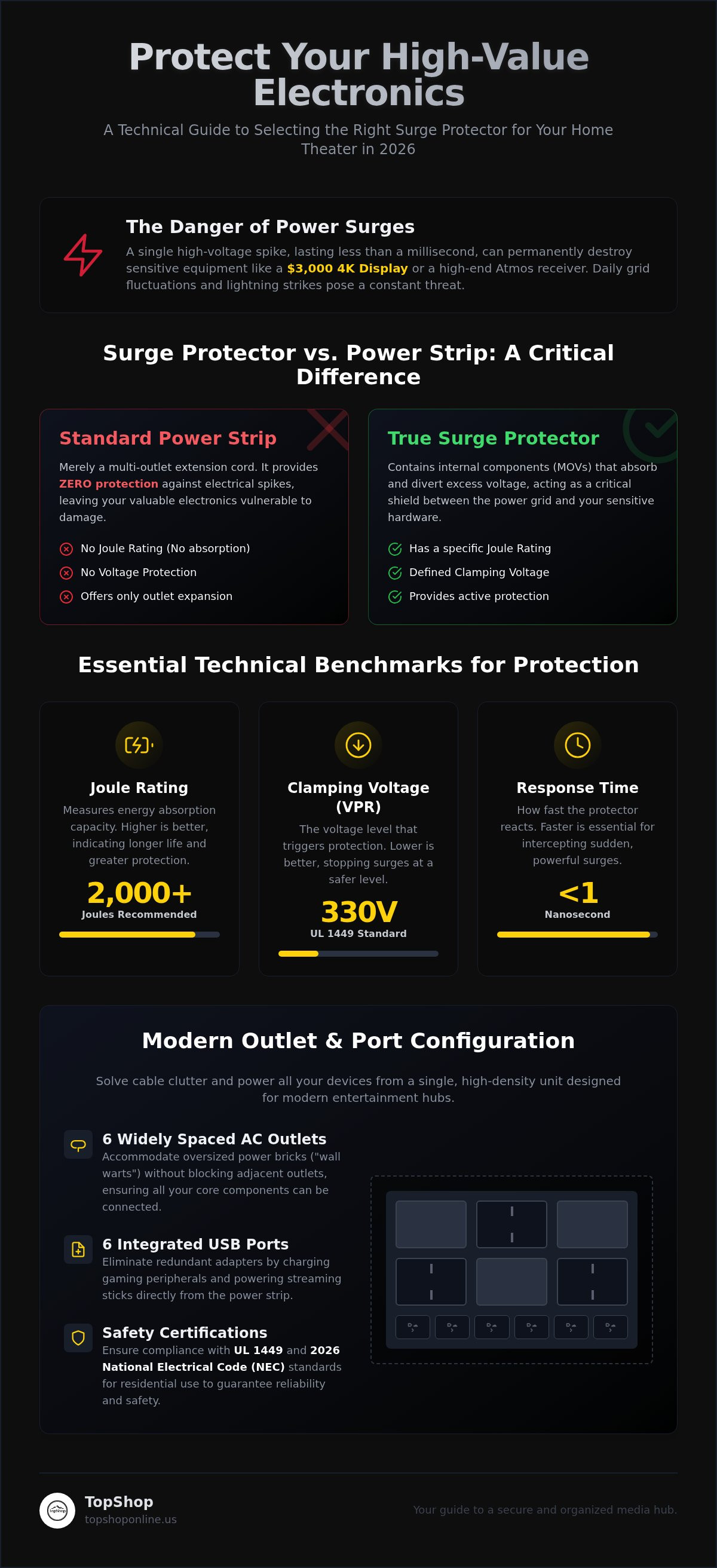
A single high-voltage spike lasting less than a millisecond can permanently degrade the sensitive internal circuitry of a $3,000 4K display or a high-end Atmos receiver. Most home theater owners manage a chaotic landscape of tangled HDMI cables and oversized power bricks that render adjacent outlets useless. The persistent anxiety of sudden lightning strikes or grid instability causing total hardware failure is a logical response to the increasing complexity of modern electronics. This 2026 selection guide identifies the technical benchmarks required for a surge protector for entertainment center applications, focusing on UL 1449 safety standards and specific Voltage Protection Ratings.
You'll learn how to evaluate 2,000+ joule absorption capacities, 330V clamping voltage thresholds, and 2026 National Electrical Code (NEC) compliance for residential service upgrades. We analyze high-density 6 AC outlet and 6 USB port power strip configurations featuring integrated fast-charging capabilities and widely spaced transformer outlets. This overview covers the essential hardware specifications, physical port layouts, and safety certifications necessary to maintain a zero-failure environment for high-value home theater peripherals.
Key Takeaways
- Identify the critical 2,000+ joule rating and 330V clamping voltage thresholds required to safeguard high-value home theater hardware from permanent electrical damage.
- Ensure compliance with 2026 National Electrical Code (NEC) standards when selecting a surge protector for entertainment center setups to prevent equipment failure during grid instability.
- Solve cable clutter and "wall wart" obstruction by utilizing high-density power strips featuring widely spaced transformer outlets and integrated USB ports.
- Power streaming sticks and charge gaming peripherals directly via dedicated USB ports to eliminate redundant wall adapters and streamline your media hub aesthetics.
- Consolidate multiple high-draw devices into a single unit using specialized 6 AC outlet and 6 USB port configurations designed for modern multi-device connectivity.
Why Entertainment Centers Require Dedicated Surge Protection
Standard power distribution units often lack defensive components. A dedicated surge protector for entertainment center use functions as a critical buffer between the municipal grid and sensitive home theater hardware. Unlike basic extension blocks, these units incorporate internal circuitry designed to intercept and redirect transient electrical energy. A surge is a transient voltage increase exceeding 120V. Residential grids in 2026 face frequent fluctuations due to high-demand appliance cycling, utility switching, and atmospheric discharge events. The 2026 National Electrical Code (NEC) emphasizes the deployment of point-of-use suppression to mitigate these risks effectively.
Modern 4K OLED displays and gaming consoles rely on high-density Printed Circuit Boards (PCBs) with microscopic traces. These components possess extremely low thermal tolerance. Excessive voltage causes immediate dielectric breakdown within semiconductor layers, leading to permanent hardware failure. Integrated Metal Oxide Varistors (MOVs) act as voltage-sensitive resistors. When potential exceeds safe thresholds, MOV resistance drops instantaneously to divert the excess current to the system ground. This process prevents the energy from reaching the delicate logic gates of your high-value media equipment.
Surge Protector vs. Power Strip: The Critical Difference
Physical aesthetics often mask functional disparities. A standard power strip provides additional outlets without active filtration or suppression. You can identify a legitimate surge protector for entertainment center applications by checking the technical specifications for a Joule rating on the packaging or device chassis. Units lacking this metric offer zero protection against overvoltage. Using non-protected strips for high-value media hubs leaves hardware vulnerable to both catastrophic lightning strikes and daily grid noise. True surge suppressors are defined by their ability to absorb energy, measured in Joules, whereas power strips are merely multi-outlet extensions.
The Economic Impact of Electrical Spikes on Home Media
Financial losses from power events extend beyond immediate device failure. Component degradation occurs through cumulative micro-surges. These small, frequent spikes don't trigger breakers but slowly erode the integrity of power supply capacitors and logic boards. Repairing 4K displays or next-gen gaming hardware typically requires expensive board-level replacements or total unit disposal. Implementing a high-density solution, such as a 6 AC Outlet and 6 USB Port power strip, provides a cost-effective preventative measure. These units consolidate power for multiple peripherals while maintaining the necessary safety buffers to prevent expensive hardware replacement cycles.
Technical Specifications: Joules, Clamping Voltage, and Response Time
Technical performance for a surge protector for entertainment center setups is determined by energy absorption, activation thresholds, and suppression speed. Understanding How Surge Protectors Work requires a precise analysis of the Joule rating. This metric quantifies the total energy a device can dissipate before internal Metal Oxide Varistor (MOV) components fail. High Joule ratings correlate directly with extended product durability. Clamping voltage, or Voltage Protection Rating (VPR), identifies the specific voltage level where the unit initiates energy diversion to the ground. Response time, measured in nanoseconds, is critical for intercepting fast-moving transients during atmospheric discharge events. Quality units also feature EMI/RFI noise filtering. This filtration process utilizes internal capacitors and inductors to clean the power signal, ensuring that high-fidelity audio equipment operates without background hum or video artifacts.
Calculating the Required Joule Rating for Your Setup
Joule requirements scale with the cumulative replacement cost and sensitivity of the connected hardware. Tier 1 configurations, typically 1000 to 2000 Joules, support basic setups consisting of a single 4K display, soundbar, and streaming device. Tier 2 configurations require 2000+ Joules to protect high-density hubs containing AV receivers, powered subwoofers, and gaming consoles. Advanced setups often include high-current devices like Class A/B amplifiers which necessitate robust suppression to prevent back-EMF damage. High-capacity absorption allows the unit to survive multiple minor electrical events without compromising the connected hardware. Users managing complex media centers should consider high-performance power strip options that combine high Joule ratings with multiple outlet configurations to ensure long-term hardware stability.
Understanding Clamping Voltage and UL 1449 Standards
The UL 1449 standard provides the definitive safety and performance certification for residential surge protective devices. Underwriters Laboratories (UL) evaluates units based on their ability to withstand repeated overvoltage events and their specific clamping voltage levels. Standard VPR ratings include 330V, 400V, and 500V. A 330V rating represents the superior threshold for sensitive electronics, providing the lowest pass-through voltage during a spike. The 2026 National Electrical Code (NEC) regulations require Type 1 or Type 2 surge protection for residential service upgrades, emphasizing the need for verified clamping performance. UL 1449 certification ensures that technical specifications regarding energy absorption and response time meet rigorous independent testing protocols. It's essential to verify this certification on the product chassis to confirm that the suppression circuitry meets current safety requirements.
Outlet Configuration and Transformer Spacing Requirements
Physical layout efficiency determines the practical utility of a surge protector for entertainment center setups. High-density media hubs utilize various external power supplies, commonly known as "wall warts," which feature oversized housings that often obstruct adjacent AC ports. Selecting a unit with transformer-spaced outlets ensures that bulky adapters for gaming consoles or network switches don't render half the available ports unusable. A 1.5-inch to 2-inch center-to-center spacing between outlets provides sufficient clearance for standard Class 2 power transformers. This spacing allows for the simultaneous connection of multiple large power bricks without the need for additional extension adapters.
Form factor enhancements like right-angle flat plugs allow for flush-mounting behind TV stands and media cabinets. This low-profile design prevents cable strain and permits furniture to sit within 0.5 inches of the wall surface. Integrated mounting holes on the chassis underside facilitate secure attachment to the back of entertainment consoles, preventing the unit from hanging by its power cord. This mechanical stability reduces the risk of accidental disconnection and cable fatigue over time. Securely mounted units also simplify the process of plugging and unplugging peripherals during hardware upgrades.
Optimizing Port Density for Multi-Device Hubs
A 6 AC outlet configuration serves as the baseline for standard home theater environments. This layout accommodates a primary 4K display, an AV receiver, a subwoofer, two gaming consoles, and a streaming peripheral. Maximizing usable ports requires a strategic arrangement where the largest adapters occupy the end-of-row wide-spaced outlets. For users transitioning between professional and leisure spaces, implementing a Cable Management for Home Office strategy helps organize the high-density wiring typical of modern entertainment centers. Effective cable routing prevents thermal buildup and ensures that each device remains accessible for maintenance. High-density strips consolidate power delivery into a single, manageable footprint.
Physical Durability and Housing Materials
Housing materials impact long-term safety and fire resistance. Fire-retardant, high-impact, non-conductive ABS plastic provides a lightweight exterior suitable for residential use, while heavy-duty metal housings offer superior impact resistance for floor-level installations. Cord length is a critical logistical factor; a 6ft heavy-duty 14AWG power cord is standard, but 10ft options provide the necessary reach for centralized power distribution in larger rooms. Functional LED indicators for "Protected" and "Grounded" status provide immediate visual verification of the suppression circuitry and house wiring integrity. If the "Grounded" light is inactive, it indicates a lack of a proper path for surge diversion, necessitating an electrical inspection. These visual cues are essential for maintaining a safe and functional 2026 home theater environment.
Integrating USB Charging for Home Theater Accessories
Modern entertainment hubs require diverse power delivery methods beyond standard AC rectification. Utilizing a surge protector for entertainment center applications with integrated USB ports eliminates the need for bulky external USB wall adapters, creating a streamlined aesthetic behind media consoles. High-density units featuring a 6 AC outlet and 6 USB port configuration provide dedicated power for low-voltage peripherals such as streaming sticks (Roku, Amazon Fire Stick), gaming controllers, and wireless headsets. Direct USB power delivery reduces the footprint of the power hub and frees up AC outlets for high-draw components like AV receivers and active subwoofers. Modern 2026 standards require these ports to provide stable amperage to prevent device resets during high-bitrate streaming or intensive controller vibration feedback cycles.
Amperage requirements for 2026 mobile devices and peripherals necessitate high-output specifications. Standard USB-A ports typically provide 2.4A for efficient charging of legacy hardware, while integrated USB-C ports support higher wattage profiles for fast-charging modern smartphones and tablets. Consolidating these connections into a single high-density strip reduces cable clutter and simplifies the power management of an entire media ecosystem. To optimize your hardware layout, consider the TopShop 6 AC and 6 USB power strip to manage all high-draw and low-voltage devices from a single protected source.
USB-A vs. USB-C in 2026 Power Strips
Hardware connectivity in 2026 utilizes a hybrid of legacy USB-A and modern USB-C interfaces. Power strips featuring 6 USB ports offer a significant logistical advantage for families managing multiple wireless controllers and mobile devices simultaneously. USB-C ports are increasingly prioritized for high-speed power delivery, providing up to 20W for compatible hardware, while USB-A ports maintain compatibility with standard peripherals. For a detailed analysis of port types and power delivery standards, refer to our Power Strip with USB Ports: 2026 Buying Guide. This technical overview clarifies how to match port specifications with device requirements to ensure optimal charging speeds without overheating internal components.
Smart Charging Circuits and Device Protection
Integrated intelligent ICs (Integrated Circuits) are essential for managing power distribution across high-density USB arrays. These smart charging circuits detect the specific power requirements of connected lithium-ion batteries to prevent overcharging and thermal runaway. Power is often distributed through shared amperage across multiple ports, meaning the total output is divided based on active connections. High-quality surge protectors utilize advanced PCB layouts to reduce heat generation during high-load scenarios. This thermal management ensures that the suppression circuitry remains within safe operating temperatures while providing consistent current to streaming sticks and gaming accessories. Maintaining low operating temperatures is critical for the longevity of both the surge protector for entertainment center use and the connected sensitive electronics.
High-Density Power Strips for Multi-Device Entertainment Hubs
Consolidating diverse hardware categories into a single terminal requires a high-density power management solution. A surge protector for entertainment center applications must support concurrent electrical draws from 4K televisions, multi-channel AV receivers, and high-performance gaming consoles. The 6 AC Outlet and 6 USB Port configuration represents a specialized hardware solution that centralizes power distribution for up to 12 devices. Technical specifications for these units typically feature a 15A/125V/1875W total capacity. This overhead ensures electrical stability for high-wattage home theater hardware. Transitioning from a disorganized cable landscape to a structured hub is achieved by utilizing a unit that accommodates standard NEMA 5-15P plugs alongside low-voltage USB accessories.
Functional Advantages of the 6+6 Configuration
The 6+6 configuration balances high-voltage AC requirements with low-voltage DC charging needs. This layout permits the simultaneous connection of primary media components and secondary peripherals like a wireless keyboard for PS5 controller or 1080P HD wireless mini security WiFi camera. Space-saving dimensions allow the unit to sit securely on standard 18-inch entertainment center shelving or mount directly to the console chassis. For a comprehensive overview of hardware compatibility and load limits, consult the Power Strip 6 Outlet 6 USB: Technical Specifications. This technical reference identifies the specific material composition and internal wiring gauges necessary to maintain stability under peak load conditions.
Implementation and Safety Best Practices
Safe implementation of high-density strips requires adherence to specific electrical protocols. Never engage in "daisy-chaining" by connecting multiple power strips in a series; this practice creates excessive resistance and fire hazards. Conduct regular inspections of the integrated LED status lights to verify active suppression and grounding. If the "Protected" indicator doesn't illuminate, the internal MOVs have reached their absorption limit. Position the strip in a well-ventilated area behind the media console to allow for passive cooling of the internal circuitry. To upgrade your media hub with a verified high-density solution, view technical specs for the 6 AC / 6 USB Power Strip at TopShop. This unit provides the necessary port density to organize complex entertainment environments while maintaining 2026 safety standards.
Implementing High-Density Power Management for 2026 Media Hubs
Securing a high-value home theater requires precise hardware selection based on measurable suppression metrics. 2,000+ Joule absorption ratings and 330V clamping voltage thresholds prevent catastrophic PCB failure during atmospheric discharge events. Modern media hubs benefit from physical layout optimization. Transformer-spaced outlets ensure bulky console adapters don't obstruct adjacent ports. Integrating 6 AC outlets and 6 USB ports into a single terminal provides necessary density for televisions, receivers, and low-voltage accessories.
Selecting a technical-grade surge protector for entertainment center setups ensures long-term hardware reliability and NEC compliance. These high-density units feature a neutral utilitarian design suitable for visible living room integration while maintaining industrial-grade electrical safety. Dedicated USB ports eliminate redundant wall adapters for streaming sticks and gaming peripherals. Efficient power management protects your investment and streamlines complex cable environments.
Browse Professional Surge Protectors and Power Strips at TopShop to access 6 AC and 6 USB configurations designed for 2026 electrical standards. Maintaining a protected and organized media environment ensures optimal device performance and safety.
Frequently Asked Questions
How many joules should a surge protector have for a 4K TV?
A 4K TV requires a minimum absorption capacity of 1,000 to 2,000 joules to ensure adequate protection against standard electrical transients. High-performance OLED displays and home theater hubs should ideally utilize units with 2,000+ joules. This capacity allows the internal components to dissipate multiple minor surges over several years. Higher ratings correlate with a longer operational lifespan for the suppression circuitry, providing a more robust buffer for sensitive display panels and internal logic boards.
Is it safe to plug a gaming console into a surge protector with USB ports?
Plugging a gaming console into a surge protector for entertainment center use is safe, provided the total AC wattage doesn't exceed the unit's 1875W capacity. Integrated USB ports operate on a separate DC circuit managed by intelligent ICs. These circuits provide stable current to peripherals like wireless controllers or headsets without interfering with the high-voltage AC delivery required by the console's internal power supply. This configuration allows for streamlined power management of all media hardware.
What happens when a surge protector "expires" or the light goes out?
When the "Protected" LED indicator turns off, the internal Metal Oxide Varistors (MOVs) have reached their energy absorption limit. The device no longer provides surge suppression but may continue to deliver standard AC power. This state leaves connected hardware vulnerable to subsequent electrical spikes. You must replace the unit immediately to restore protection. Most 2026 models feature fail-safe mechanisms that indicate when the sacrificial components are depleted through these visual status signals.
Can a surge protector improve my TV picture or audio quality?
High-quality surge protectors can improve audio and video clarity through integrated EMI/RFI noise filtering. This technical feature utilizes internal capacitors and inductors to remove electromagnetic and radio frequency interference from the power line. Eliminating these artifacts reduces background hum in speakers and minimizes visual "snow" or flickering on displays. While it doesn't upgrade the native resolution of your hardware, it ensures the components receive clean power for optimal signal reproduction.
Do I need a surge protector if I have a whole-house surge suppressor?
Point-of-use surge protection remains necessary even with a whole-house suppressor installed at the service entrance. Whole-house units manage large external surges from the grid but don't address micro-surges generated internally by appliances cycling on the same circuit. A secondary surge protector for entertainment center applications provides a final layer of defense against these localized transients. This tiered approach is the standard recommendation in the 2026 National Electrical Code for protecting high-value residential electronics.
What is the difference between a surge protector and a UPS for a home theater?
A surge protector redirects excess voltage to the ground to prevent hardware damage, whereas an Uninterruptible Power Supply (UPS) provides battery backup during outages. UPS units include surge suppression but prioritize maintaining power for a safe shutdown of devices like projectors or gaming consoles. For most home theater setups, a high-density surge strip provides sufficient protection. A UPS is only necessary if your region experiences frequent blackouts or if you use hardware requiring specific cooling shutdown cycles.
How often should I replace the surge protector in my entertainment center?
Industry standards recommend replacing a surge protector for entertainment center use every three to five years. This timeframe accounts for the gradual degradation of internal MOVs caused by cumulative micro-surges. You should also replace the unit immediately following a significant electrical event, such as a direct lightning strike or a transformer failure, even if the indicator light remains active. Frequent inspections of the chassis for heat discoloration or physical wear are essential for maintaining safety.
Are USB ports on power strips safe for expensive smartphones?
Integrated USB ports on modern power strips are safe for expensive smartphones because they utilize intelligent charging ICs. These chips communicate with the connected device to deliver the specific amperage required, preventing overcharging and excessive heat generation. High-density strips often provide 2.4A per port or higher for fast-charging compatibility. Using these ports eliminates the need for third-party wall adapters, reducing clutter while providing a stable, regulated DC power source for mobile hardware.