

A blurred license plate or pixelated night-time frame results in a liability deadlock during insurance disputes despite the presence of a recording. Standard 1080p video capture often fails to provide the granular detail required by adjusters to determine fault in high-speed or low-light collisions. Utilizing a high resolution dash cam for insurance claims is a technical necessity for drivers seeking to eliminate ambiguity through verifiable digital evidence. Reliable identification of vehicle identifiers and traffic signal states depends on sensor quality, high bitrates, and optical clarity.
It's understood that evidentiary-grade footage requires a synergy of 4K resolution output and environmental adaptability. This analysis details the technical specifications, including resolution standards, High Dynamic Range (HDR) functionality, and multi-channel coverage, required for successful claim processing. We examine how the Guardian 3-Channel 4K Dash Cam meets these evidentiary standards by providing front, rear, and interior monitoring. This overview covers hardware requirements, frame rate importance, and the specific utility of 360-degree vehicle protection for comprehensive liability defense.
Key Takeaways
- Determine the technical specifications required for dash cam footage to meet the evidentiary standards of insurance adjusters.
- Evaluate the performance differences between 4K and 1080p sensors when utilizing a high resolution dash cam for insurance claims.
- Analyze the utility of 3-channel systems in providing 360-degree coverage to eliminate liability ambiguity in multi-vehicle accidents.
- Identify hardware requirements such as G-sensors and hardwire kits that ensure footage integrity during high-impact events.
- Review the functional capabilities of the Guardian 3-Channel 4K Dash Cam for comprehensive vehicle monitoring and claim protection.
The Role of High-Resolution Dash Cams in Insurance Claim Success
Evidentiary-grade footage in 2026 refers to video data containing sufficient resolution and metadata to withstand forensic scrutiny by insurance adjusters and legal professionals. A high resolution dash cam for insurance claims functions as an objective witness, replacing unreliable human testimony with empirical visual data. High-definition recording eliminates "he-said-she-said" disputes by documenting precise vehicle positioning, indicator usage, and traffic light states during an impact event. Clear technical evidence reduces the probability of contested claims. Insurance providers prioritize high-fidelity video because it minimizes investigation timelines and administrative costs associated with liability determination. Modern dashboard camera technology and configurations utilize advanced CMOS sensors and high-bitrate recording to ensure that recorded frames remain sharp under varying velocity and vibration conditions.
License Plate Recognition and Pixel Density
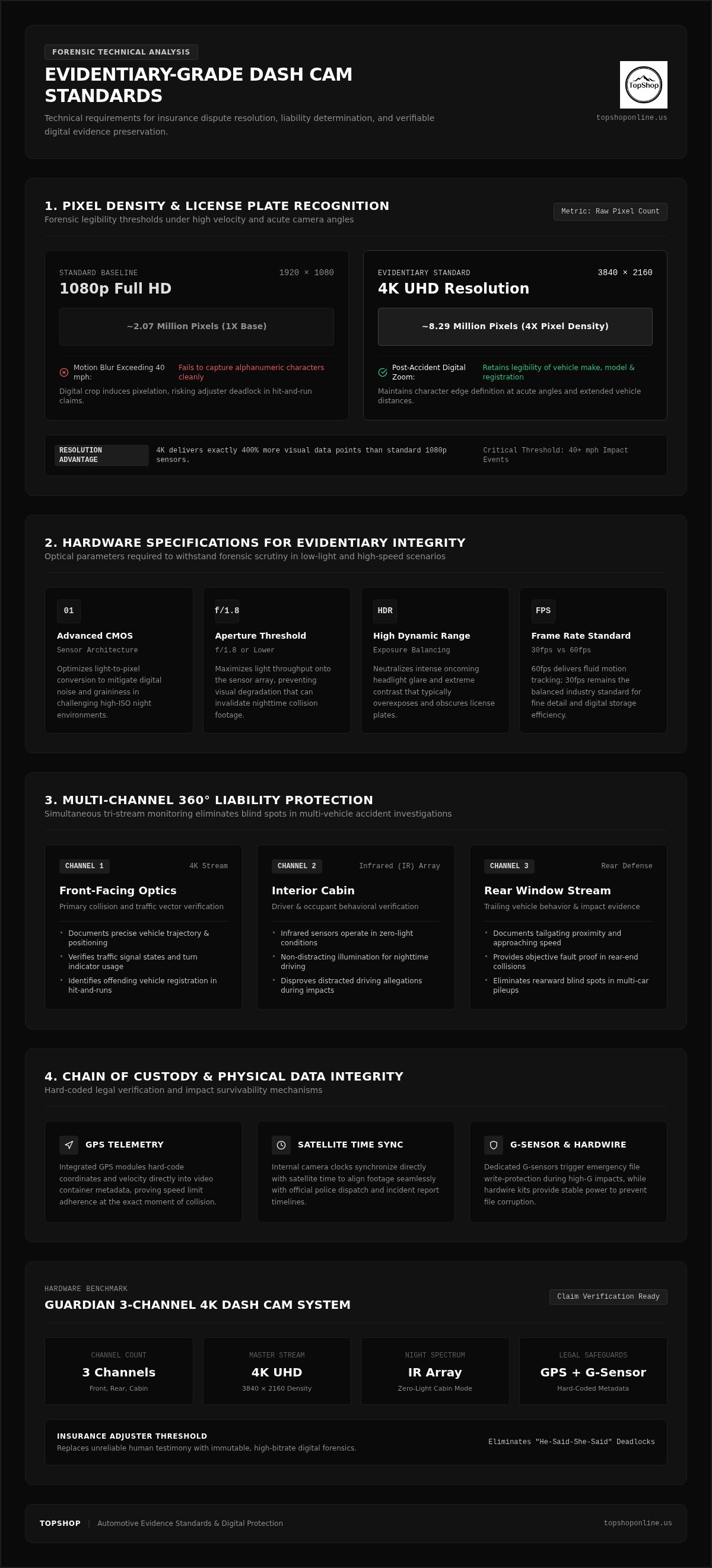
Standard 1080p resolution (1920 x 1080) often results in motion blur when capturing alphanumeric characters on license plates at speeds exceeding 40 mph. In contrast, 4K resolution (3840 x 2160) provides four times the pixel count of 1080p systems. This increased pixel density allows for significant digital zooming during post-accident analysis without losing legibility. Higher pixel density ensures that small details, such as vehicle make, model, and registration numbers, remain clear at greater distances. This technical advantage is critical for hit-and-run incidents where the offending vehicle's plate must be identified from a distance or at an acute angle. The Guardian 3-Channel 4K Dash Cam utilizes this high-density sensor array to maintain clarity across three simultaneous video streams, ensuring all critical identifiers are preserved for claim processing.
Time-Stamping and GPS Metadata
Reliable evidence requires more than just visual imagery; it necessitates contextual data. Integrated GPS modules log real-time coordinates and vehicle speed directly into the video file metadata. This hard-coded information verifies that the vehicle was at the reported location and identifies if the driver was adhering to speed limits at the moment of impact. Synchronizing internal camera clocks with satellite time ensures that footage aligns perfectly with official police report timelines. These immutable data points act as a deterrent against claims of footage tampering or digital manipulation. Accurate metadata provides a secure chain of custody for digital evidence, making it significantly more difficult for opposing parties to contest the validity of the recording during the claim process.
Critical Technical Specifications for Evidentiary Grade Video
Achieving the legal threshold for evidence requires hardware that maintains image integrity under extreme lighting and high velocity. Technical precision ensures that recordings meet the evidentiary standards for authenticating video recordings, specifically regarding the clarity of involved parties and environmental conditions. While 1080p sensors capture basic movement, they often fail in low-light environments due to insufficient data throughput. A high resolution dash cam for insurance claims utilizing 4K resolution provides the necessary data points to distinguish between similar vehicle models in dark conditions. High Dynamic Range (HDR) technology is essential for neutralizing headlight glare that typically obscures license plates. Lenses with an aperture of f/1.8 or lower maximize light intake, reducing the digital noise that can invalidate footage during nighttime claims. Frame rates also dictate clarity; 60fps offers smoother motion, though 30fps remains the industry standard for balancing detail with storage efficiency.
Image Sensors and Night Vision Capabilities
Industry-standard CMOS sensors determine the dynamic range and light sensitivity of the unit. High-ISO recording scenarios often introduce digital noise, which manifests as graininess that hides small details. Advanced sensors mitigate this by optimizing light-to-pixel conversion. For comprehensive protection, infrared (IR) sensors are required for interior cabin recording. They provide clear imagery in total darkness without distracting the driver. This ensures that driver behavior and passenger activity are documented regardless of external lighting. Reducing noise in these high-ISO scenarios is vital for maintaining the sharp edges required for forensic video analysis.
Bitrate and Video Compression Standards
Resolution alone doesn't guarantee legibility. The relationship between bitrate and license plate legibility is direct; a low bitrate causes blocky artifacting during high-speed motion, even on 4K sensors. Bitrate refers to the amount of data processed per second. If it's too low, the system compresses the image too aggressively, resulting in "macroblocking" where alphanumeric characters become indistinguishable. High bitrate recording preserves fine details in complex scenes by allocating more data to each frame. Modern systems use H.265 (HEVC) compression to maintain high-bitrate quality while managing the storage requirements of 4K streams. Selecting a device like the Guardian 3-Channel 4K Dash Cam ensures that the hardware can handle these high-density data streams without compromising the detail needed for legal verification. Preserving these details is vital for identifying hit-and-run suspects or verifying disputed traffic signal changes.
3-Channel Monitoring: Eliminating Blind Spots in Liability Disputes
Total vehicle coverage requires a multi-sensor array. A single front-facing lens leaves substantial portions of the vehicle perimeter unmonitored. Utilizing a high resolution dash cam for insurance claims with 3-channel recording provides a 360-degree safety net. This specific configuration captures the forward road, the rear approach, and the internal cabin space simultaneously. It's a technical defense against staged accidents, fraudulent liability claims, and complex multi-vehicle collisions. The Guardian 3-Channel 4K Dash Cam facilitates this comprehensive monitoring by managing three distinct data streams without frame rate degradation. This ensures that every angle is recorded with sufficient clarity for forensic review.
Interior Cameras and Driver Behavior Documentation
Interior cameras document driver behavior and cabin activity. This visual data proves driver attentiveness during the moment of impact, effectively countering false allegations of mobile device distraction or negligence. Wide-angle cabin lenses, typically featuring 140 to 170-degree fields of view, capture side-impact or T-bone details through the side windows. These angles are often missed by traditional front-only cameras. For rideshare drivers, this documentation is essential for verifying passenger conduct and defending against false liability claims. Recording internal audio provides a verifiable record of verbal interactions immediately following an accident. This helps verify witness statements and documents admissions of fault from third parties. Following best practices for preserving digital video evidence ensures these interior streams maintain their technical integrity for legal review.
Rear-View Protection and Tailgating Evidence
Rear-facing sensors identify aggressive driving patterns and tailgating behavior prior to a collision. This evidence is critical for defending against "swoop and squat" scams or rear-end impacts where the following driver is at fault. Technical requirements for rear hardware include IP67 weatherproofing for external mounting and high-shielded cabling to prevent electromagnetic interference. Cable lengths must be sufficient for varied vehicle architectures, including SUVs and commercial vans. The system integrates front, rear, and interior footage into a single synchronized file structure. This synchronization allows insurance adjusters to analyze the sequence of events across all three perspectives on a unified timeline. It eliminates the blind spots that often lead to "50/50" fault determinations in the absence of complete visual data. High-resolution rear sensors ensure that even distant license plates are legible during high-speed highway incidents.
Proper Installation and Footage Management for Legal Protection
Installation protocols determine the operational reliability of recording hardware during high-impact events. Hardwire installation kits utilize direct fuse box connections to ensure uninterrupted power delivery, bypassing the physical instability of cigarette lighter adapters. Maintaining a high resolution dash cam for insurance claims requires a constant power source to facilitate emergency file locking. The integrated G-sensor identifies sudden gravitational changes associated with collisions. Upon detection, the system automatically flags the current video segment as protected, preventing the loop recording function from overwriting critical evidence. Adjusting G-sensor sensitivity is necessary; settings that are too low may fail to trigger, while high sensitivity results in storage exhaustion from non-critical road vibrations.
Parking Mode and Motion Detection
Parking mode functionality extends monitoring to periods when the vehicle is unattended. This feature is essential for capturing hit-and-run incidents or vandalism in parking structures. Hardwire kits must include battery protection modules to monitor vehicle voltage levels. These modules automatically disconnect the dash cam if the car battery drops below a specific threshold, typically 11.8V or 12V, to prevent drainage. Buffered recording represents a critical technical advantage. It continuously stores a short temporary video loop, allowing the device to save the 15 seconds of footage preceding a motion or impact trigger. This provides adjusters with the full context of an incident rather than just the aftermath.
SD Card Maintenance and File Integrity
Constant 4K write cycles demand high-endurance MicroSD cards specifically rated for video surveillance. A high resolution dash cam for insurance claims is only as effective as its storage media. Standard SD cards utilize flash memory that degrades rapidly under the heat and repetitive writing of dash cam environments. High-endurance cards (UHS-I U3, V30 or higher) support the sustained bitrates required for 4K streams. Users should implement a formatting interval every 30 to 60 days to clear file system errors and prevent corruption. Local storage remains the most reliable method for immediate claim filing. While cloud backup offers remote access, the large file sizes of 4K video often exceed mobile data upload speeds at accident scenes.
Establishing a protocol for transferring footage is the final step in legal protection. Drivers should utilize high-speed card readers to move protected files to a secondary device immediately. Review the technical requirements for the Guardian 3-Channel 4K Dash Cam to ensure your storage and power configurations meet these evidentiary standards. Direct digital transfers preserve the original metadata and timestamps required for forensic authentication by insurance carriers.
The Guardian 3-Channel 4K Dash Cam: Technical Overview and Utility
The Guardian 3-Channel 4K Dash Cam operates as a centralized hub for vehicle telemetry and visual documentation. It utilizes a 4K UHD front sensor to capture road details, while synchronized 1080p rear and interior cameras eliminate the blind spots common in single-channel setups. This high resolution dash cam for insurance claims provides the technical density required for forensic analysis of multi-vehicle collisions. Its multi-stream processing ensures that high bitrates are maintained across all channels, preventing the frame drops that often occur in lower-tier systems. Operational reliability is supported by high-speed processing chipsets that manage simultaneous recording, G-sensor monitoring, and GPS logging without latency.
Hardware Durability and Material Composition
The chassis is constructed from high-thermal-resistance polymers to withstand internal temperatures reaching 158°F (70°C). This thermal management prevents sensor degradation and file corruption during long-duration operation in direct sunlight. The reinforced mounting hardware ensures vibration-free recording on uneven road surfaces, which is vital for maintaining the sharpness of license plate characters. While this device is optimized for automotive use, its technical reliability mirrors the high-performance components found in gaming setup essentials or professional mobile workstations. The use of supercapacitors instead of standard lithium batteries further enhances safety by reducing the risk of overheating in extreme climates.
User Interface and Footage Retrieval
Rapid submission to insurance portals is facilitated through direct file access and standard MP4 encoding. The user interface prioritizes logical navigation, allowing drivers to locate and lock specific incident timestamps within seconds. Installation follows a simplified workflow suitable for US vehicle architectures, utilizing modular cabling for the rear and cabin sensors. For those seeking comprehensive property monitoring, you can compare this with our wireless mini security camera with night vision for static residential security. The Guardian 3-Channel 4K Dash Cam remains the specialized tool for mobile environments where high-velocity data capture is mandatory. Selecting a high resolution dash cam for insurance claims like the Guardian system ensures that technical limitations don't compromise your financial protection during liability disputes.
Secure Evidentiary-Grade Documentation
Reliable liability protection requires technical hardware specifications matching modern insurance standards. A high resolution dash cam for insurance claims captures license plate characters, traffic signal states, and driver behavior with forensic clarity. 4K resolution eliminates pixelation during high-speed collisions. High-bitrate recording preserves image integrity across all files. These technical attributes ensure that footage remains admissible and verifiable during rigorous adjuster reviews.
Comprehensive 360-degree monitoring via front, rear, and interior sensors removes ambiguity regarding blind-spot impacts or cabin activity. The Guardian 3-Channel 4K Dash Cam delivers this multi-angle security with 4K resolution for maximum detail. National US shipping is available for rapid hardware deployment. Proper installation through hardwire kits and high-endurance storage cards guarantees that critical footage remains protected after significant impact events.
View the Guardian 3-Channel 4K Dash Cam Specifications to verify these technical parameters for your vehicle. Maintaining high-fidelity digital records is the most effective method for ensuring successful claim processing and protecting your driving record.
Frequently Asked Questions
Will insurance companies accept 4K dash cam footage as proof?
Yes, insurance adjusters accept high-resolution video as objective evidence to determine fault. 4K footage is preferred because it provides the granular detail needed to identify vehicle registration and environmental factors. Using a high resolution dash cam for insurance claims reduces the investigative timeline. It eliminates reliance on conflicting witness statements by providing a verifiable digital record of the incident that withstands forensic scrutiny.
Do I need a 3-channel dash cam for my insurance claim to be successful?
While not strictly required, a 3-channel system significantly increases the probability of a successful claim by eliminating blind spots. Devices like the Guardian 3-Channel 4K Dash Cam capture the front road, rear approach, and interior cabin simultaneously. This provides a 360-degree context that single-lens cameras miss. It protects against side-impact allegations, rear-end scams, and false claims of driver distraction or negligence during the event.
What is the best dash cam resolution for license plate recognition?
4K (3840 x 2160) resolution is the industry standard for reliable license plate recognition at high speeds. Lower resolutions like 1080p often produce motion blur that renders alphanumeric characters illegible. 4K sensors provide the necessary pixel density for digital zooming during post-accident forensic analysis. This ensures that identifiers remain sharp at greater distances or in low-light conditions where detail preservation is critical for hit-and-run identification.
Does a dash cam lower my insurance premiums in the United States?
Most US insurance carriers don't offer a direct premium discount for installing a dash cam. However, the device provides indirect financial protection by preventing fraudulent claims and 50/50 fault determinations. By proving you aren't at fault, you avoid deductible payments and future premium increases associated with accident history. Some commercial insurers may offer specific programs, but personal policyholders should verify current guidelines with their individual agent.
How long does a dash cam keep footage before overwriting it?
Retention time depends on the SD card capacity and the recording bitrate. A 128GB card recording 4K video typically stores between 4 and 6 hours of footage before loop recording begins overwriting the oldest files. Lowering the resolution or using H.265 compression can extend this duration. Users must ensure the G-sensor's active to lock incident files, preventing them from being recycled during the standard loop process.
Can dash cam footage be used against me in a claim?
Yes, dash cam footage is a neutral record and can be subpoenaed by opposing parties or law enforcement. If the video documents speeding, signal violations, or distracted driving, it can be used to establish partial or full liability. Drivers should maintain consistent road safety standards because the camera records all activity. The objective nature of a high resolution dash cam for insurance claims means it documents the facts regardless of which party's favored.
What SD card is required for 4K dash cam recording?
High-endurance MicroSD cards with a UHS-I U3 or V30 speed rating are mandatory for 4K data streams. Standard cards often fail under the sustained write cycles and thermal stress of a dash cam environment. These specialized cards handle the high bitrates required to prevent frame corruption. Using a card with at least 128GB capacity's recommended to provide sufficient storage for multi-channel systems like the Guardian 3-Channel 4K Dash Cam.
How does a G-sensor work during an accident?
A G-sensor, or accelerometer, measures sudden gravitational changes caused by hard braking, sharp turns, or physical impact. When a pre-set threshold's exceeded, the sensor triggers an emergency recording mode. The system automatically flags the current video file as protected or locked in the memory. This prevents the loop recording function from overwriting the accident data, ensuring the evidence's preserved for later retrieval and insurance submission.