

Effective holiday lighting is a function of linear measurement and power source compatibility rather than arbitrary bulb counts. You've likely experienced the frustration of a string that ends three feet short of the tree crown or the logistical burden of managing bulky excess cabling. Understanding how to choose christmas light length requires more than a visual estimate; it demands a systematic approach to dimensions and power requirements. This 2026 technical guide provides precise calculation frameworks to determine exact linear footage requirements for interior trees, exterior eaves, and architectural features.
Precise data is essential when transitioning from traditional incandescent sets to high-density 10M and 20M USB-powered LED strings. We will analyze string utility, explain the NEC 590.3(B) temporary lighting rules, and provide a standardized formula for vertical and horizontal coverage. This specification guide ensures compliance with the UL 588 standard for seasonal products while eliminating the confusion between meter and feet conversions for imported hardware. You'll gain a clear understanding of how to optimize string density, amperage requirements, and power distribution for a professional, efficient installation. This technical overview focuses on measurable attributes and functional descriptors to streamline your holiday lighting procurement process.
Key Takeaways
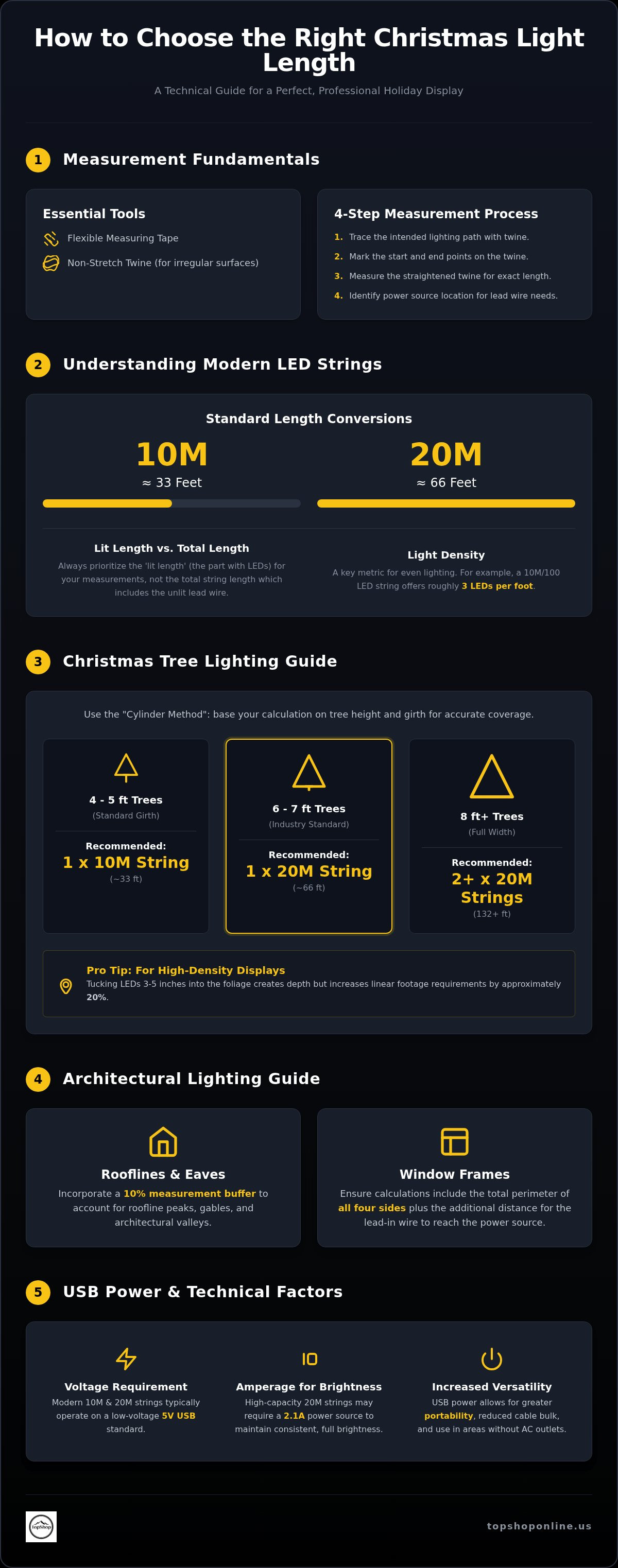
- Utilize flexible measuring tape and twine to establish precise linear footage for irregular surfaces. Identifying the primary measurement unit prevents procurement errors with imported LED sets.
- Apply the Cylinder Method to determine how to choose christmas light length based on tree height and girth. This framework adjusts requirements for slim pencil trees versus high-density full-width evergreens.
- Incorporate a 10% measurement buffer for roofline peaks and architectural valleys. Ensure window frame calculations include four-sided perimeter totals plus additional lead-in wire distance.
- Evaluate LED density and USB power specifications, specifically 5V requirements for 10M and 20M strings. High-capacity 20M strings may require 2.1A amperage to maintain consistent brightness levels.
- Transition to 10M and 20M USB-powered LED strings for increased portability and reduced cabling bulk. These low-voltage solutions facilitate lighting in areas without immediate AC outlet access.
Measuring Fundamentals for Holiday Lighting Projects
Accurate installation begins with defining the specific measurement units of the hardware. Most modern LED sets, including the 10M and 20M USB Christmas Tree LED String Lights, use metric specifications. Determining how to choose christmas light length requires converting these metric lengths into the imperial feet used for US architectural dimensions. Failure to account for the difference between lit length and total string length often results in insufficient coverage. Lit length refers specifically to the portion of the wire containing LEDs, while total length includes the unlit lead wire connecting to the power source.
Tools and Preparation for Accurate Scaling
Precise scaling requires a flexible measuring tape, a stable ladder, and non-stretch twine. Twine is a critical tool for tracing irregular paths, such as tree branches or complex roof gables, where a rigid tape measure fails to provide an accurate reading. Users should record vertical and horizontal dimensions as separate data points to simplify the string selection process. Follow these steps for architectural measurement:
- Trace the intended lighting path with twine, ensuring it sits flush against the surface.
- Mark the twine at the start and end points of the desired lit area.
- Measure the straightened twine against a tape measure to find the exact linear footage.
- Identify and mark the power source location to determine lead wire requirements.
Identifying the proximity of the power source is a primary step in the planning phase. If using a Power Strip with 6 AC Outlets & 6 USB Ports, the distance from the first LED to the USB port must be measured. This distance determines if the integrated lead wire is sufficient or if a USB extension is required. Understanding the history and technology of Christmas lights helps installers appreciate why modern low-voltage systems require these specific power considerations compared to older high-voltage incandescent sets.
Standard Unit Conversions for LED String Lights
Standardized conversions are necessary for accurate procurement. A 10M string equates to approximately 32.8 feet, while a 20M string provides 65.6 feet of coverage. Calculating bulb density per linear foot is a more reliable metric than total bulb count. To find this, divide the total number of LEDs by the lit length. For example, a 10M string with 100 LEDs provides 10 LEDs per meter, or roughly 3 LEDs per foot. This density data allows for consistent light distribution across different surfaces. When deciding how to choose christmas light length, always prioritize the linear footage of the lit section over the total package length to ensure the display reaches the intended boundaries without gaps.
Calculating String Length for Christmas Trees by Height and Girth
The "Cylinder Method" provides a technical framework for determining string requirements based on the tree's maximum circumference. Tree geometry dictates length. Instead of relying on height alone, calculate the average diameter at the base and midpoint. Multiply the average circumference by the number of intended horizontal rotations. For high-density displays, installers must account for "branch depth." Tucking LEDs three to five inches into the foliage creates internal dimension but increases linear footage requirements by approximately 20%. When determining how to choose christmas light length, specific tree geometry is the primary variable. Slim pencil trees require significantly less footage than full-width evergreens of the same height due to the reduced horizontal wrap distance.
Tree Height vs. Recommended Linear Footage
Standardized guidelines for 10M and 20M strings facilitate efficient planning. Measure the base diameter. For 4ft to 5ft trees, a single 10M (33ft) string provides adequate coverage density for a standard wrap. 6ft to 7ft trees represent the industry standard and require a minimum of one 20M (66ft) string for a full 360-degree wrap. For 8ft trees and larger, calculating the need for multiple 20M strings is necessary. These should be deployed in parallel to maintain consistent voltage and brightness. Industry benchmarks for calculating Christmas light length often suggest 100 lights per vertical foot, but linear footage is a more precise metric for modern high-density LED sets.
Wrap Density and Vertical vs. Horizontal Methods
The horizontal wrap method remains the standard for traditional aesthetics. It requires calculating the total length based on a 6-inch vertical spacing between loops. Tighten the spacing for density. The vertical "zig-zag" method involves measuring vertical runs from the base to the crown, plus the distance for top and bottom transitions. This method often requires 15% less material than a full 360-degree horizontal wrap. If the tree is positioned against a wall, "front-loading" the lights can reduce total length requirements by 40%. However, 360-degree visibility demands full circumference coverage. For versatile setups, utilizing 10M and 20M USB Christmas Tree LED String Lights allows for modular expansion based on these specific girth calculations. This approach ensures maximum luminosity without the logistical burden of excess cabling.
Linear Measurement for Eaves, Windows, and Architectural Features
Determining how to choose christmas light length for architectural features requires a precise inventory of linear dimensions and transition points. For exterior rooflines, the primary calculation involves measuring horizontal gutters and diagonal rakes separately. A technical "slack factor" of 10% must be added to the total measurement. This surplus accounts for the depth of peaks, valleys, and the physical space occupied by mounting clips. Without this buffer, the string may experience tension, leading to wire fatigue or connector failure.
Window framing requires a four-sided perimeter measurement. A standard 3ft by 5ft window has a 16ft perimeter; however, the calculation must also include the lead-in wire distance to the nearest power source. For railings and banisters, use a spiral wrap formula. Multiply the banister circumference by the desired number of revolutions per linear foot. If a banister is 10 feet long with a 6-inch circumference and you wrap every 4 inches, you need approximately 15 feet of lit length.
Managing surplus length in 20M segments is necessary when architectural runs don't match standard string outputs. Professional installers double-back excess wire along the underside of eaves or hide surplus segments behind downspouts. This maintains a continuous visual line without requiring wire cutting, which is prohibited on most integrated LED sets. These surplus segments can also be coiled and secured at the end of a run using weather-rated zip ties to prevent dangling wires.
Calculating Roofline and Eave Runs
Horizontal gutter runs and vertical drops are recorded as distinct data points. Use a non-stretch twine to trace the path of rakes and gables. This ensures the 10% slack factor is applied to a realistic path rather than a straight-line estimate. Effective cable management for home office environments offers transferable techniques for exterior wire routing, such as using weather-rated adhesive clips to secure transitions between eaves and power sources.
Interior Accent Lighting: Mantels and Doorways
Interior measurements differ from exterior runs due to the "swag" or "drape" multipliers required for mantels. A standard mantel measurement should be multiplied by 1.5 to account for decorative drooping. Doorway framing typically requires a minimum of 17 linear feet, consisting of two 7ft vertical runs and one 3ft horizontal top. Utilizing smart led fairy lights for indoor applications allows for precise interior accenting, as these low-profile wires are easily concealed within molding or decorative garlands. When you analyze how to choose christmas light length for these areas, always prioritize the distance to the USB power source to ensure the lead wire reaches the 5V port without tension.
Technical Factors: LED Density and Power Requirements
Technical specifications for USB-powered lighting systems dictate the maximum effective length of a single run. Determining how to choose christmas light length requires an analysis of voltage drop and current requirements. Voltage drop occurs when electrical resistance in longer copper wires reduces the available voltage at the end of the string, resulting in dimming. While a 10M string operates efficiently on standard 1.0A outputs, the 20M string requires a specific 2.1A amperage for full brightness. Exceeding the recommended length without increasing the power supply capacity leads to thermal stress on the integrated circuitry and inconsistent luminosity across the LED array.
USB Power Source Compatibility
Standard USB 2.0 ports on computers generally provide 500mA, which is insufficient for high-density 20M strings. Dedicated wall adapters or a Power Strip with 6 AC Outlets & 6 USB Ports ensure stable 5V delivery. For cordless "island" displays like table centerpieces, high-capacity power banks offer a portable 5V source. These setups must adhere to the UL 588 standard for seasonal decorative products, which requires rigorous testing for water immersion and UV exposure. Using certified power sources prevents overcurrent scenarios that could damage the LEDs. It's essential to match the total wattage of the string to the port's output rating. According to 2026 ENERGY STAR requirements, certified decorative light strings shouldn't exceed 0.2W per bulb to maintain efficiency.
LED Spacing and Visual Output
Bulb spacing directly influences the perceived density of the display. Most high-density sets utilize 10 LEDs per meter (approx. 3.3 LEDs per foot). This high-density cluster configuration provides a continuous light line compared to wide-spaced sets with 4 to 6 inches between bulbs. Wire color also impacts length perception; green wires blend into foliage, making the lit length appear shorter but more integrated. Clear or silver wires reflect light, potentially increasing the visual footprint of the string. Total lumens are calculated by multiplying the LED count by the average output per diode. For a 20M string with 200 LEDs, the total lumen output is significantly higher than a standard incandescent set while consuming 92% less energy. To ensure your display meets these technical specifications, procure 10M and 20M USB Christmas Tree LED String Lights that match your power source amperage.
USB-Powered Lighting Solutions for Versatile Holiday Displays
Modern holiday lighting in 2026 favors the 5V DC architecture found in USB-powered LED strings over traditional high-voltage AC sets. These 10M and 20M USB Christmas Tree LED String Lights feature an integrated LED design on ultra-thin, flexible wiring. This construction reduces the physical footprint of the display and simplifies post-season storage. Because these sets don't require direct AC wall outlet access, they offer superior portability. You can deploy them in remote zones using high-capacity power banks. To centralize a multi-string installation, installers should utilize a power strip 6 outlet 6 usb. This hardware hub provides six dedicated USB ports, allowing for the simultaneous operation of multiple 10M or 20M segments from a single power source.
Selecting Between 10M and 20M Configurations
Hardware selection is determined by the specific linear requirements of the target surface. A 10M configuration provides 32.8 feet of lit length, making it the technical choice for tabletop trees, window framing, and interior mantel accents. It eliminates the need to manage bulky excess cabling in small-scale applications. In contrast, the 20M configuration provides 65.6 feet of coverage, which is the minimum specification for standard 6ft to 7ft evergreens or large room perimeters. When evaluating how to choose christmas light length for complex, multi-zone environments, modular 10M segments are often more manageable than a single massive run. This modularity ensures that if one zone requires maintenance, the rest of the display remains operational.
Implementation and Final Setup
The final implementation phase requires a systematic verification of power source compatibility and physical reach. Before final attachment, connect the USB lights to the intended tech hub or power bank to confirm the 5V delivery is stable. This is especially critical for 20M strings that require higher amperage to maintain consistent brightness. For a professional finish, secure the thin wiring along architectural lines using non-conductive clips. This maintains the 10% slack factor required for roofline peaks and valleys. To procure high-density, low-voltage hardware for your project, Shop 10M and 20M USB Christmas Tree LED String Lights at TopShop. Following these technical steps for how to choose christmas light length ensures a high-luminosity display that is both energy-efficient and easy to install. Final testing should involve a full 30-minute burn-in period to verify thermal stability across all USB ports.
Optimizing Holiday Lighting Through Technical Specification
Executing a high-luminosity display requires strict adherence to linear measurements and power source compatibility. Applying the Cylinder Method and a 10% slack factor ensures consistent coverage across trees and architectural features without the logistical burden of excess cabling. You now have the technical framework for how to choose christmas light length based on specific dimensions and 5V USB power requirements. Prioritize high-density LED configurations to maintain professional luminosity levels while reducing energy consumption by approximately 92% compared to traditional incandescent sets.
Transitioning to low-voltage hardware eliminates the hazards associated with high-voltage AC strings. These integrated LED designs provide a stable, efficient solution for indoor and covered outdoor environments. To implement these measurement frameworks with high-performance hardware, Browse 10M and 20M USB Christmas Tree LED String Lights featuring 5V low-voltage safety and high-density diode spacing. Standardizing your setup with 10M and 20M configurations allows for modular expansion and centralized control through USB tech hubs. Your calculated approach to linear footage and amperage draw will result in a precise, durable installation that functions reliably throughout the season.
Frequently Asked Questions
How many feet of lights do I need for a 6-foot Christmas tree?
A standard 6-foot tree requires a minimum of 65.6 feet (20M) for a basic wrap. High-density coverage or deep branch tucking increases requirements to approximately 100 feet. Girth is a critical variable; a full-width evergreen requires more linear footage than a slim pencil tree of the same height. Use the Cylinder Method to establish precise requirements based on base circumference and intended rotation count to avoid shortages.
What is the difference between 10M and 20M LED string lights in feet?
A 10M string equates to approximately 32.8 feet, while a 20M string provides 65.6 feet of coverage. These metric specifications are standard for modern high-density LED sets. When determining how to choose christmas light length, verify if the measurement refers to the lit length or the total string length including the lead wire. Accurate conversion prevents procurement errors during architectural scaling and ensures compatibility with US standard dimensions.
Can I connect two USB Christmas light strings together?
Most USB-powered LED strings aren't designed for end-to-end daisy-chaining due to 5V DC limitations. Connecting strings in series often causes significant voltage drop and dimming in the second set. Instead, connect multiple strings in parallel using a multi-port USB hub or power strip. This configuration ensures each segment receives the required amperage for consistent luminosity across the entire display without stressing the integrated circuitry.
How do I measure my roofline for Christmas lights without a ladder?
Measure the ground-level perimeter of the house and add a 10% slack factor for peaks and transitions. For gables, measure the horizontal base of the triangle and use a pitch gauge to calculate the diagonal rake length. Alternatively, count the number of shingles along the eave if the shingle width is known. This provides a safe, ground-level estimation for linear footage while identifying necessary drop points.
What USB power adapter is needed for a 20M LED string?
A 20M LED string requires a dedicated USB wall adapter or power port capable of delivering at least 2.1A (2100mA) at 5V. Standard 0.5A or 1.0A ports found on older electronics are insufficient and will cause the LEDs to flicker or appear dim. Verify the amperage rating on your power adapter or multi-port hub to ensure it matches the high-density load requirements for full brightness.
How much extra length should I buy for peaks on my roof?
Add 10% to your total linear measurement to account for roofline peaks, valleys, and mounting hardware. This "slack factor" prevents wire tension and ensures the string can follow the architectural contour without gaps. When you analyze how to choose christmas light length for exterior eaves, including this buffer is essential for navigating corners and vertical drops to the power source without overextending the wire.
Are USB LED lights bright enough for a main Christmas tree?
High-density USB LED strings provide sufficient luminosity for main Christmas trees due to their integrated diode design. These sets typically feature 10 LEDs per meter, offering a continuous light line that rivals traditional incandescent sets. They consume 92% less energy and generate minimal heat, which increases safety. For a standard 7-foot tree, one 20M string or two 10M strings provide high-output coverage and consistent density.
How do I calculate bulb spacing for a specific string length?
Divide the total lit length of the string by the number of LED diodes to determine the average bulb spacing. For example, a 10M string with 100 LEDs has a spacing of 10 centimeters, or approximately 4 inches. High-density sets often feature tighter 5-centimeter spacing. Understanding this ratio is necessary for maintaining consistent wrap density on trees and calculating the visual impact of architectural outlines across different surfaces.