

A standard 5V USB port on a legacy laptop often fails to provide the 3A current necessary for high-density 20M LED strings; this mismatch leads to immediate flickering or hardware thermal shutdown. Understanding how to power usb christmas lights requires a precise look at amperage draw and voltage stability across different hardware interfaces. You likely want a vibrant display without the safety risks of overloaded circuits or the visual frustration of dim, underpowered bulbs.
This technical guide details the hardware requirements and power source options for efficient holiday lighting systems. You'll learn to calculate the specific electrical load for 10M versus 20M strings and identify stable power sources like dedicated 6-port USB power strips. We provide a clear breakdown of 5V output standards, amperage limits, and cable management strategies to ensure a clean, reliable setup for your 2026 holiday display.
Key Takeaways
- Identify the specific 5V DC voltage requirements and amperage limits to understand how to power usb christmas lights without causing hardware failure or light flickering.
- Distinguish between standard AC-to-USB wall adapters and dedicated multi-port USB power strips for high-density 10M and 20M LED string light configurations.
- Evaluate technical load differences between 10M and 20M LED strings to prevent overloading low-amperage ports on legacy devices or underpowered hubs.
- Implement centralized power management using integrated hardware like the Power Strip with 6 AC Outlets & 6 USB Ports for organized, multi-string holiday displays.
- Verify hardware compatibility by checking port types and adhering to indoor versus outdoor power source restrictions for low-voltage lighting systems.
Primary Power Sources for USB Christmas String Lights
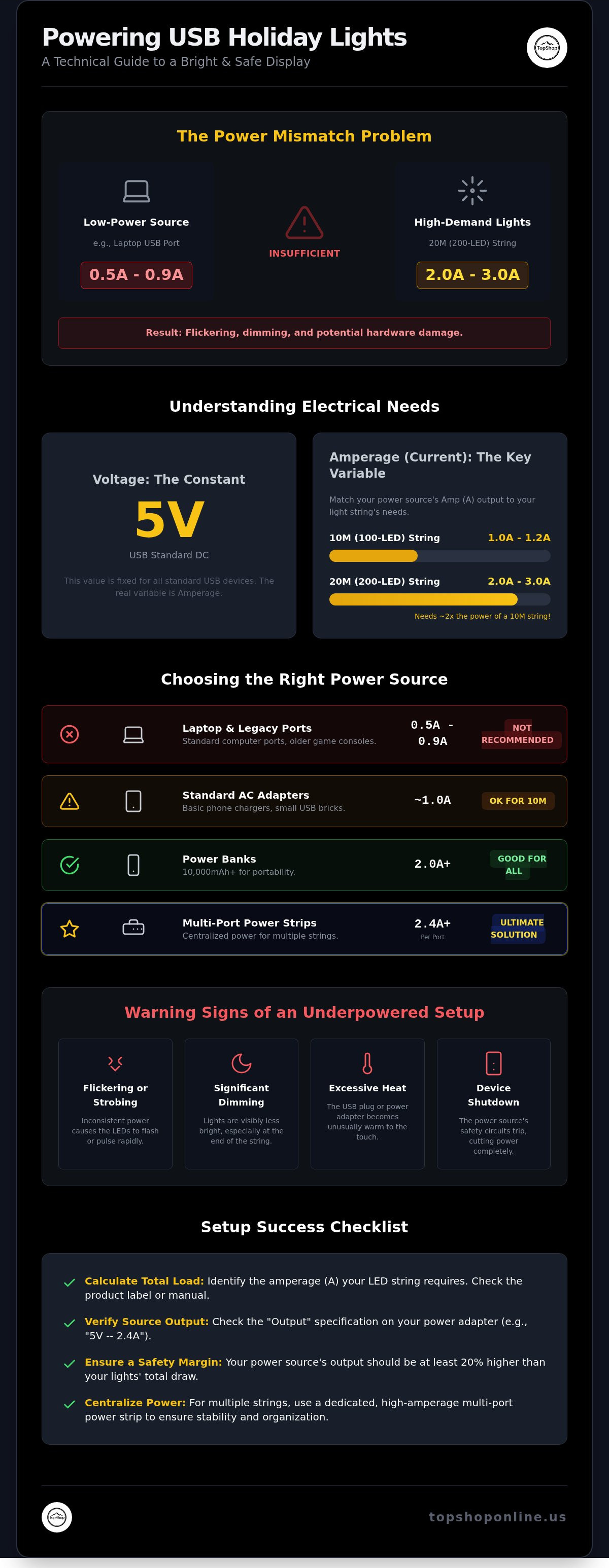
The Universal Serial Bus (USB) standard provides a consistent 5V DC power delivery interface for low-voltage LED hardware. Determining how to power usb christmas lights requires matching the total amperage draw of the string to the maximum output of the power source. Standard computer ports often provide only 500mA to 900mA; this is insufficient for longer strings. Dedicated power adapters and high-capacity hubs offer a more stable alternative for holiday lighting systems.
AC Wall Adapters and Charging Bricks
Standard AC-to-USB adapters, or charging bricks, function as the most common interface for indoor lighting. These components convert 120V AC household electricity into stabilized 5V DC output. Basic units provide 1A (5W) output, whereas high-capacity chargers deliver 2.4A (12W) or higher. Users must verify the UL-listed status of these adapters to ensure safety during continuous operation. Multi-port wall chargers share amperage across ports; checking the "Output" specification on the adapter housing is critical to confirm each port meets the 2A to 3A requirements of 20M LED configurations.
Portable Power Banks for Remote Displays
Portable power banks facilitate cordless lighting in center-room locations like dining tables or entryways. These lithium-ion sources eliminate trip hazards and cable clutter for wreaths and mantels. Runtime calculations involve dividing the bank capacity (mAh) by the LED string amperage draw. A 10,000mAh bank generally supports a 10M string for 10 to 12 hours. For 20M strings, a 20,000mAh minimum capacity is recommended to maintain brightness and reduce charging frequency. These units provide a mobile, flexible solution for isolated holiday decor.
High-Density Power Strips and Integrated Ports
Modern hardware like the Power Strip with 6 AC Outlets & 6 USB Ports serves as a centralized hub for high-density displays. This configuration manages up to six 10M or 20M USB Christmas Tree LED String Lights from a single wall outlet. Integrated USB ports on televisions and gaming consoles provide convenient power but often have restricted amperage that causes LED dimming. Using a dedicated power strip with high-amperage ports ensures consistent voltage and luminosity across all connected hardware. This approach simplifies cable management and reduces the footprint of the power infrastructure.
Technical Voltage and Amperage Requirements for LED Strips
USB string lights operate on a strictly regulated 5V DC power standard. This low-voltage requirement ensures safety in residential environments, significantly reducing the risk of electrical shock or fire compared to high-voltage AC alternatives. 5V DC is the universal standard for USB-powered consumer electronics.
Understanding the 5V DC Power Standard
Maintaining 5V DC across long distances is technically challenging due to resistance in the copper conductors. Standard USB cables experience voltage drop; this is a measurable reduction in voltage as electricity travels from the source to the LEDs. If the voltage drops below the 4.75V threshold, the lighting controller may malfunction or reset. The USB Power Delivery (PD) Specification provides a framework for advanced power negotiation, but basic holiday lights rely on fixed 5V profiles. Using high-gauge copper wiring in extension cables helps mitigate these losses.
Calculating Amperage Draw for 10M and 20M Strings
Effective setup depends on matching the current output of your source to the specific draw of the light string. A 10M (100-LED) string typically requires approximately 1.0A to 1.2A for full luminosity. A 20M (200-LED) string doubles this requirement, often pulling between 2.0A and 3.0A depending on the specific LED density. If you are researching how to power usb christmas lights, you must prioritize amperage over voltage. It's essential to check the output label on your power adapter. Most legacy computer ports only provide 0.5A, which won't sufficiently power a 20M string.
Connecting a 20M string to an underpowered port results in immediate performance degradation. Common symptoms include:
- Rapid LED flickering or strobing.
- Significant dimming toward the end of the string.
- Excessive heat buildup in the power adapter housing.
- Internal circuit failure or thermal shutdown.
Understanding how to power usb christmas lights also involves managing the cumulative heat generated by multiple adapters. For safe operation, your power source should provide a 20% safety margin above the total calculated draw. Total wattage is calculated by multiplying voltage (5V) by the amperage (A). A single 20M string drawing 2A consumes 10W. For high-density displays, the Power Strip with 6 AC Outlets & 6 USB Ports provides the necessary amperage overhead for several 10M/20M USB Christmas Tree LED String Lights simultaneously.
Comparing USB Power Hubs vs. Integrated Power Strips
Hardware selection determines the stability of the final installation. High-density environments require either dedicated DC hubs or hybrid AC-USB strips. Knowing how to power usb christmas lights effectively means choosing between these two form factors based on the total number of LED strings and the presence of other AC-powered ornaments. Both options provide centralized control but differ in their voltage distribution and physical footprint.
High-Density USB Charging Stations
Tabletop USB charging stations centralize power delivery for displays requiring five or more individual strings. These hubs connect to a single wall outlet but distribute power across multiple high-amperage ports. Internal circuitry uses smart-charging technology to monitor the specific draw of each 10M or 20M configuration. This active monitoring prevents overcurrent and short-circuit scenarios that occur when daisy-chaining underpowered cables. Desktop hubs don't experience the same thermal bottlenecks as small wall bricks because their larger housings allow for better airflow and heat dissipation. Port output stability is a primary benefit; these hubs maintain a constant 5V level even when all ports are under maximum load. This prevents the dimming observed when using passive, unpowered hubs that rely on a single upstream computer port for power.
Integrated Power Strips for Holiday Organization
Integrated power strips serve as a comprehensive hub for complex holiday setups involving both AC and DC hardware. A Power Strip with 6 AC Outlets & 6 USB Ports allows for the connection of 12 separate devices from one grounded wall source. This configuration supports high-wattage AC components like motorized tree stands and legacy lighting strings while simultaneously powering several LED string lights. Using these strips eliminates "wall wart" clutter, which is the accumulation of multiple bulky adapters that block access to adjacent outlets. The physical design often includes surge protection and fire-retardant ABS plastic construction for enhanced safety during continuous 24-hour operation. These units provide a robust solution for users who need to scale their displays with additional 10M or 20M USB Christmas Tree LED String Lights.
Consolidating power sources simplifies the implementation of cable management for home office standards in a residential holiday context. Proper organization involves grouping low-voltage USB cables separately from high-voltage AC cords to reduce electromagnetic interference and physical tangling. Knowing how to power usb christmas lights with this hardware enables a cleaner visual display by hiding the power infrastructure behind the tree or furniture. This methodical approach ensures that the total electrical load remains within the 15A or 20A limits of a standard household circuit. Integrated strips provide the most versatile platform for managing the high-density power requirements of modern LED lighting systems.
Installation and Hardware Compatibility Checklist
Successful deployment of holiday lighting depends on physical interface compatibility and environmental safety. Determining how to power usb christmas lights requires a thorough inspection of connector types and port output specifications before final placement. Mismatched hardware leads to mechanical strain on ports or intermittent power delivery. This checklist ensures all technical components meet the operational requirements of 10M and 20M LED strings.
Connector Types and Port Compatibility
Standard USB-A interfaces remain the primary connector for most holiday lighting hardware. These rectangular connectors are compatible with legacy wall bricks, power strips, and computer ports. Modern power hubs and high-end laptops increasingly utilize USB-C ports, which require a dedicated USB-C to USB-A adapter for light string connection. Users must ensure these adapters support power passthrough of at least 2.4A to prevent throttling. Secure physical connections are vital; a loose plug creates high resistance, leading to localized heat buildup and potential port damage. High-density setups benefit from using the Power Strip with 6 AC Outlets & 6 USB Ports to provide dedicated, high-amperage USB-A slots without the need for multiple third-party adapters.
Extension and Safety Guidelines
Voltage drop is a significant technical constraint when extending the reach of 5V lighting systems. Standard USB extension cables longer than 3 meters (approx. 10 feet) often result in a measurable decrease in luminosity. This occurs because the thin internal copper wiring increases electrical resistance over distance. For larger displays, it's more efficient to move the power source closer to the lights using an AC extension cord rather than using multiple USB extensions. Safety protocols require keeping all power connections dry and elevated from floor level to avoid moisture contact. Routine hardware checks should include:
- Inspecting cables for frayed insulation or exposed copper wiring.
- Monitoring adapter temperatures; units should be warm but never painful to touch.
- Verifying that port housings are free of dust and debris.
- Confirming that indoor-rated hardware is not used in high-humidity or outdoor environments.
Troubleshooting common failures often reveals simple power-related issues. If a 20M string fails to illuminate, the first step is testing the string on a known high-output 2.4A port. Flickering usually indicates an insufficient amperage supply or a failing extension cable. Most USB Christmas lights are rated for indoor use only. Deploying these units outdoors exposes the non-weatherproof USB plug and controller to oxidation and short-circuiting. Maintaining a strict indoor environment for your 10M and 20M USB Christmas Tree LED String Lights ensures a longer operational lifespan and consistent technical performance throughout the season.
Optimizing Holiday Setups with TopShop USB Lighting Hardware
Professional holiday displays require hardware that maintains technical stability under continuous 24-hour operation. Selecting high-density 10M/20M USB Christmas Tree LED String Lights provides a low-voltage alternative to traditional incandescent systems. These units utilize the 5V DC standard to minimize thermal output and electrical consumption. Identifying how to power usb christmas lights at scale involves integrating these strings with high-capacity distribution hardware to maintain consistent luminosity across large-scale indoor installations.
10M vs 20M USB LED String Specifications
The 10M configuration features 100 high-efficiency LEDs, making it suitable for 4-foot to 5-foot trees or localized mantel accents. The 20M variant doubles the density with 200 LEDs, providing comprehensive coverage for 6-foot to 7-foot trees. Both versions utilize a direct USB-A interface, ensuring universal compatibility with standard ports and adapters. These LEDs are engineered for low-heat operation; this prevents localized drying of natural tree needles and reduces fire risks in dense foliage. Precise current management within the integrated controller prevents the voltage drop issues common in unbranded alternatives. For advanced configurations, users can integrate smart LED fairy lights for indoor use alongside these standard strings to create layered lighting effects with varying control protocols.
The 6-USB Power Strip as a Centralized Hub
Scaling a multi-string display requires hardware capable of handling high-amperage cumulative loads. The Power Strip with 6 AC Outlets & 6 USB Ports functions as a technical nexus for complex holiday electronics. This hardware eliminates the need for 12 individual wall adapters by providing integrated 5V ports alongside standard AC sockets. It supports up to six 10M or 20M USB Christmas Tree LED String Lights simultaneously while leaving the AC outlets available for mechanical ornaments or secondary lighting controllers. The internal circuitry includes surge protection and overcurrent safeguards, protecting sensitive LED controllers from grid fluctuations. Utilizing this power strip 6 outlet 6 usb hardware streamlines the physical footprint of the display. It centralizes the power source, simplifies cable management, and ensures each USB port receives a stable current. This methodical approach to how to power usb christmas lights results in a professional, safety-compliant installation that remains efficient throughout the season.
Streamlining Your 2026 Holiday Power Infrastructure
Successful holiday lighting deployment requires precise hardware matching to ensure voltage stability and amperage sufficiency. Technical implementation involves reconciling 5V DC standards with the specific current draw of 10M and 20M LED configurations. Utilizing centralized distribution hardware like 6-port integrated power strips manages multiple low-voltage connections while providing surge protection for internal controllers. Understanding how to power usb christmas lights with stabilized 2.4A or 3A ports prevents the dimming and thermal shutdown associated with underpowered legacy interfaces.
Durable 10M and 20M LED string configurations provide the necessary hardware baseline for high-density holiday systems. Integrating these with high-capacity 6-USB power strips ensures centralized control and simplified cable management. All technical components are available with fast national shipping for US-based installations. Shop USB Christmas Tree LED String Lights and Power Hardware at TopShop to acquire reliable lighting and power distribution equipment. Implementing these technical standards guarantees a stable, high-performance display for the entire season.
Frequently Asked Questions
Can I plug USB Christmas lights into a standard phone charger?
Yes, provided the charger meets the 5V output standard. Most basic chargers offer 1A (5W), which supports a 10M string. However, 20M strings require 2A to 3A current. If you're determining how to power usb christmas lights, using a high-output charger (2.4A) is recommended to prevent the adapter from overheating during continuous operation. Check the fine print on the charger housing to verify current limits before connecting hardware.
How long will a 10,000mAh power bank run a 10M LED string?
A 10,000mAh power bank typically provides 10 to 12 hours of continuous operation for a 10M string. This calculation assumes a standard current draw of approximately 0.8A to 1A. Efficiency losses in the power bank's internal voltage conversion circuit may reduce actual runtime. For extended displays, using a 20,000mAh unit ensures the lights remain illuminated through a full evening without requiring a recharge.
Is it safe to power USB lights from a computer or laptop port?
It's technically safe but often inefficient for high-density lighting. Standard USB 2.0 ports are capped at 500mA, while USB 3.0 ports provide up to 900mA. Neither provides sufficient current for a 20M string. Attempting to draw excessive power through a motherboard can lead to port deactivation or hardware instability. Dedicated power sources are superior for long-term holiday installations.
Why are my USB Christmas lights flickering or dimming?
Flickering or dimming usually indicates an insufficient amperage supply from your power source. This occurs when the LED string attempts to draw more current than the port can provide. It's a common issue when researching how to power usb christmas lights using low-output wall bricks or unpowered hubs. Switching to a high-amperage 2.4A port or a dedicated multi-port power strip typically resolves these luminosity fluctuations immediately.
Can USB-powered lights be used outdoors if plugged into a power bank?
No, standard USB Christmas lights are rated for indoor use only. Even when using a portable power bank, the USB plug and the integrated controller housing lack the IP-rated waterproofing necessary for outdoor exposure. Moisture infiltration leads to rapid oxidation of the copper contacts or a complete short circuit. Keep all USB-enabled holiday hardware within temperature-controlled, dry indoor environments to ensure technical longevity.
Do I need a specific amperage to power a 20M USB light string?
Yes, a 20M string requires a power source capable of delivering at least 2A to 3A at 5V. Most standard 1A phone chargers will underpower these longer configurations, resulting in significant dimming toward the end of the wire. Verifying the "Output" label on your hardware is essential. High-density power strips with dedicated 2.4A ports are the most reliable option for maintaining full brightness across 200-LED strings.
Can I use a USB extension cable with my Christmas lights?
You can use extension cables, but you must account for voltage drop over distance. Passive cables longer than 3 meters (10 feet) often cause the voltage to dip below the 5V threshold. This results in reduced LED brightness or controller malfunction. If you need more reach, it's technically more efficient to move the AC power source closer to the tree using a standard grounded extension cord.
What is the difference between USB-A and USB-C Christmas lights?
The primary difference is the physical connector interface and the potential power delivery capacity. USB-A is the rectangular legacy standard found on most charging bricks and power strips. USB-C is the newer, reversible connector that supports higher current through the Power Delivery (PD) protocol. While most lights currently use USB-A, you can use a simple adapter to connect them to modern USB-C ports on laptops or high-end charging hubs.