

A standard USB 2.0 port provides only 2.5 watts of power, which is technically insufficient for the 4 to 10 watt requirement of high-density 10-meter LED arrays. You likely recognize that low-voltage lighting offers superior energy efficiency and safety, but technical hurdles like voltage drop and adapter incompatibility often lead to inconsistent brightness or hardware failure. Selecting the correct USB powered string lights for bedroom applications requires a precise understanding of amperage draw, wire insulation durability, and power source calibration. This guide analyzes the essential technical specifications needed to build a reliable lighting configuration that maintains performance across various string lengths and power delivery standards.
This article evaluates the electrical requirements for 10M and 20M LED strings, focusing on the 5V power interface and UL 588 safety certifications for indoor decorative equipment. We will identify compatible USB power sources, including high-output wall adapters and multi-port power strips, to prevent overheating and ensure uniform light distribution. You will also learn about material composition factors, such as IP-rated insulation and high-density diode spacing, that influence the longevity of bedroom lighting systems. This technical overview provides the data necessary to select and install hardware that meets 2026 industry standards for residential safety and electrical efficiency.
Key Takeaways
- Identify 5V DC voltage standards and 0.5A to 2A amperage requirements to ensure stable power delivery for high-efficiency LED diodes.
- Evaluate 10M and 20M coverage metrics to determine the optimal configuration of USB powered string lights for bedroom features like headboards and ceilings.
- Apply surface-specific installation protocols for drywall, wood, and metal while maintaining mechanical strain relief for USB connectors.
- Integrate multi-port power strips and high-output charging stations to consolidate power management for multiple high-density LED string arrays.
Technical Specifications of USB Powered String Lights
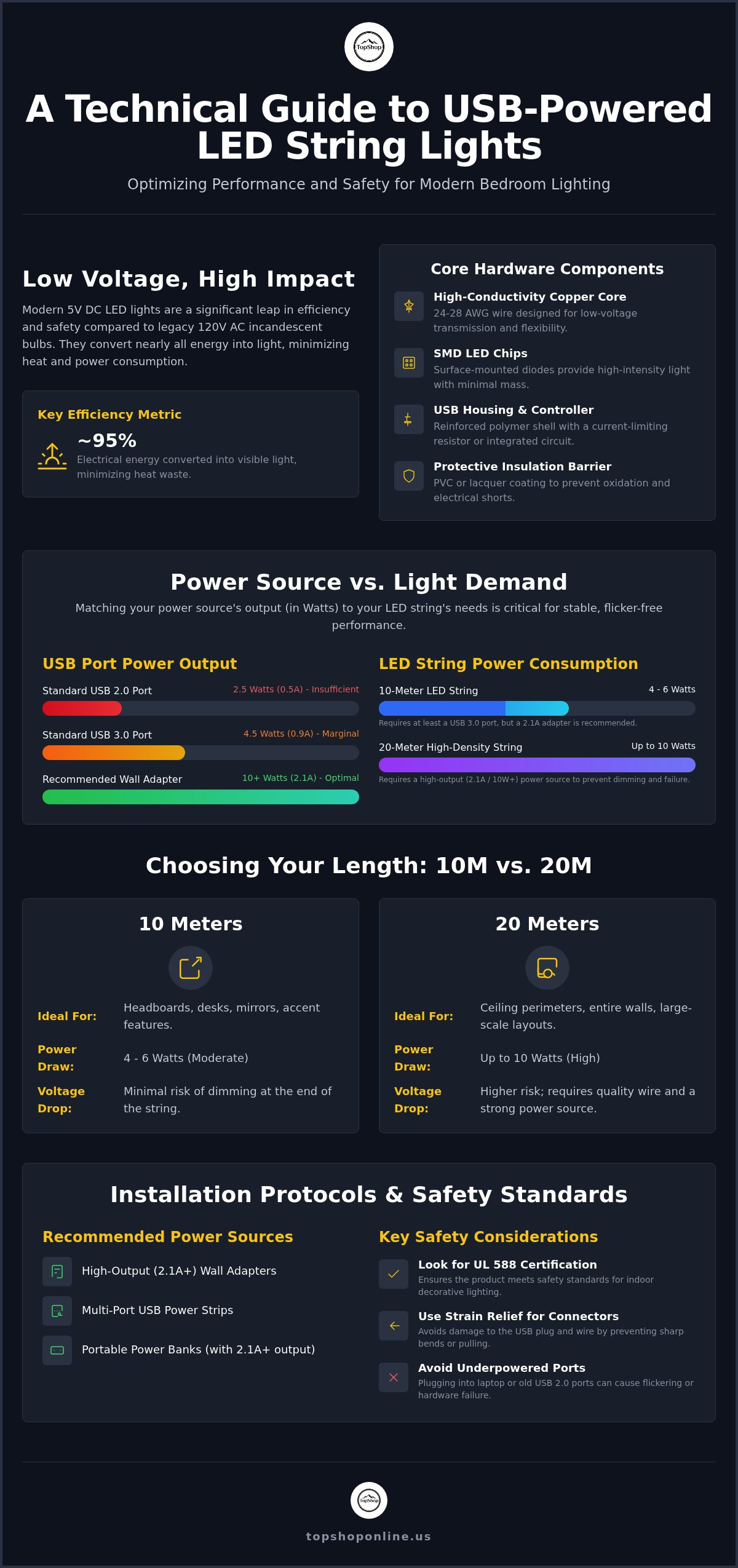
USB powered string lights for bedroom applications are categorized as low-voltage, 5V DC (Direct Current) illumination systems. These devices represent a technological shift from legacy 120V AC incandescent string lights, which rely on heated filaments and high power consumption. Modern LED hardware utilizes semi-conductor chips to convert approximately 95% of electrical energy into visible light, minimizing heat waste. The integration of the USB Type-A connector allows these systems to interface with standardized USB standards found in wall adapters, power banks, and multi-port charging hubs common in residential settings.
The core hardware architecture consists of four primary components:
- High-Conductivity Copper Core: Typically 24 to 28 AWG wire designed for low-voltage transmission.
- SMD LED Chips: Surface-mounted diodes that provide high-intensity light with minimal physical mass.
- USB Housing: A reinforced polymer shell containing the current-limiting resistor or integrated circuit controller.
- Insulation Barrier: Protective coating to prevent oxidation and electrical shorting.
LED Diode Density and Color Temperature
LED spacing directly dictates the visual uniformity and total lumen output of a string. High-density configurations, such as those found in 10M or 20M arrays, reduce dark spots between light points, creating a continuous glow rather than isolated dots. Color temperature is measured in Kelvin (K), a metric defining the spectral output of the LED. Warm white variants typically operate between 2700K and 3000K, producing a yellow-toned light. Cool white variants exceed 5000K. RGB (Red, Green, Blue) systems utilize multi-channel controllers to produce millions of color combinations through additive color mixing, allowing for dynamic bedroom lighting effects.
Material Composition and Insulation Standards
Insulation material is critical for electrical safety and physical durability in USB powered string lights for bedroom use. Manufacturers utilize clear PVC or thin lacquer coatings to protect the conductive core from environmental factors. While standard copper wire is the industry baseline, silver-coated copper wiring provides enhanced flexibility and superior aesthetic integration for exposed installations. These technical requirements align with the smart led fairy lights for indoor benchmarks, ensuring the hardware meets specific performance tolerances for long-term residential operation. Lacquer-coated "fairy" wires allow for more intricate shaping, whereas PVC-jacketed strings offer higher tensile strength for larger 20M installations.
Power Consumption and USB Port Compatibility Analysis
Standard USB powered string lights for bedroom configurations operate on a 5V DC platform with a current draw ranging from 0.8A to 2.0A depending on diode density and total length. A 10-meter array typically consumes between 4 and 6 watts of power, whereas a 20-meter high-density string can reach up to 10 watts. This electrical demand significantly exceeds the 2.5W output limit of legacy USB 2.0 ports. USB 3.0 ports offer 4.5W (0.9A), which may still be insufficient for 20M strings at maximum brightness settings.
For consistent performance, hardware should be paired with ports following the USB Power Delivery (PD) specification to ensure adequate wattage overhead. Voltage drop remains a critical technical challenge for 20M strings; internal resistance in the 28 AWG copper core leads to a gradual voltage decrease, causing the final LEDs in the sequence to appear dimmer than those nearest the USB housing. This phenomenon is most noticeable in strings using thin-gauge wire without reinforced conductive paths.
Compatible Power Sources for Bedroom Use
Effective bedroom installation requires a stable 5V power source capable of sustained output. Dedicated wall adapters and portable power banks with 2.1A outputs are recommended for all string lengths. Integrating a power strip with usb ports provides a centralized hub for managing multiple lighting arrays and other bedroom electronics simultaneously. Plugging high-density 20M strings into 0.5A laptop ports often results in visible flickering, reduced diode lifespan, or port shutdown due to overcurrent protection circuits. Utilizing high-capacity USB power distribution hardware ensures that each connected string receives the full amperage required for peak luminance and color accuracy.
Thermal Management and Energy Efficiency
LED technology offers superior thermal management for residential environments compared to traditional incandescent bulbs. These diodes convert 95% of energy into light, maintaining a low surface temperature that prevents heat-related damage to delicate bedroom fabrics, wallpaper, or wooden frames. Fire risk is virtually eliminated because these systems operate at temperatures barely above ambient levels. Energy efficiency is equally high; a 10W string running for 8 hours daily consumes only 0.08 kWh per day, or 2.4 kWh per month. This low consumption profile allows for long-term nightly use with minimal impact on electrical utility bills. The combination of low heat output, high electrical efficiency, and 5V safety makes these systems the most reliable choice for textile-heavy bedroom environments.
Comparing 10M vs. 20M Lengths for Bedroom Layouts
Selecting the appropriate length for USB powered string lights for bedroom installations depends on total linear footage, diode density, and mounting substrate compatibility. A 10M string provides approximately 33 feet of coverage, while a 20M variant doubles this to 66 feet. This increase in length directly affects the visual impact, as the 20M configuration typically houses 200 high-density LED diodes compared to the 100 diodes found on 10M models. Beyond light output, physical weight is a primary technical consideration. Longer strings exert higher tensile load on adhesive-backed mounting hardware, necessitating more frequent support points to prevent mechanical failure. Doubling the diode count enhances the overall spatial distribution of light, but it also compounds the electrical resistance across the copper core. This resistance makes the 20M string more sensitive to the quality of the USB power supply.
Adhering to electrical safety standards for decorative lights ensures that these longer runs don't create hazards when draped over furniture or textiles. While 10M strings are lightweight, 20M strings require strategic planning to avoid entanglement and ensure the 5V power source remains accessible within the bedroom layout. The 20M variant offers a more continuous luminous flux for large-scale architectural projects, whereas the 10M model serves as a precision tool for localized highlighting. Both lengths utilize the same 28 AWG wire gauge, meaning the shear force on mounting clips increases proportionally with length.
10M String Light Coverage Metrics
A 10M USB powered string light configuration is optimized for localized accent lighting. Common applications include wrapping standard queen-sized headboards or lining small window frames and floating shelves. With 100 LEDs spaced at 10cm intervals, this length provides sufficient diode density for intimate spaces without excessive cable overlap. Cable management is simplified due to the lower mass of the wire, allowing for discrete routing behind furniture and easier installation on fragile surfaces.
20M String Light Coverage Metrics
The 20M variant is engineered for large-scale architectural integration, such as perimeter ceiling runs or expansive wall displays. Covering 66 linear feet allows for a single continuous run around the upper boundary of a standard bedroom. Securing 20M strings requires high-bond adhesive clips every 50cm to counteract the cumulative weight. This prevents sagging, which places undue stress on the USB housing and connector pins during long-term operation.
Installation Protocols and Safety Standards
Installing USB powered string lights for bedroom setups requires substrate-specific hardware to maintain mechanical stability and electrical safety. For drywall surfaces, utilize high-bond adhesive-backed polymer clips. Wood surfaces permit the use of non-conductive insulated staples; however, installers must avoid compressing the PVC jacket. Metal bed frames or window casings are best served by nickel-plated magnetic mounting hooks. Before deployment, conduct a visual inspection of the 28 AWG wire core for insulation breaches, copper oxidation, or loose connections at the LED diode nodes. Hardware should comply with UL 588 standards for seasonal and decorative lighting to ensure fire safety in residential environments.
A comprehensive pre-installation checklist includes:
- Insulation Integrity: Verify the clear PVC or lacquer coating is free of cracks or abrasions.
- Housing Security: Ensure the USB Type-A connector shell is firmly attached to the wire lead.
- Diode Testing: Connect the string to a 5V source before mounting to identify flickering or dead diodes.
- Amperage Verification: Confirm the power adapter provides at least 2.0A for 20M high-density strings.
Mounting Hardware and Adhesive Options
Adhesive clips provide a non-destructive mounting solution but require surface degreasing with isopropyl alcohol for maximum adhesion. Staples offer high permanent retention on wooden substrates but present a significant risk of piercing the internal conductor. Magnetic mounts facilitate rapid reconfiguration on metallic surfaces without damaging finishes. For extensive 20M runs, implementing cable management for home office techniques prevents excess wire from creating trip hazards or accidental tension. Never use uninsulated metal fasteners that could bypass the lacquer coating and cause a short circuit within the 5V DC system.
Operational Safety and Port Stress
Mechanical stress on the USB Type-A interface is a primary cause of hardware failure in decorative lighting systems. The cumulative weight of a 20M string can exceed the structural tolerance of standard USB port pins, leading to intermittent connectivity or permanent port damage. Utilizing a male-to-female USB extension cable transfers the gravitational load from the power source to a secondary anchor point on the wall or furniture. Standard LED operation should maintain a surface temperature below 45°C (113°F) to remain compatible with bedroom textiles and pillows. You can source certified USB powered string lights for bedroom use that feature reinforced connector housings and high-gauge copper cores for maximum durability.
Integrating USB String Lights with Modern Hardware
Modern bedroom configurations require a unified power strategy to consolidate multiple low-voltage devices into a single, manageable interface. The 10M/20M USB Christmas Tree LED String Lights are engineered for this high-density environment, featuring high-conductivity copper cores and standardized USB Type-A connectors. These units integrate directly with smart home adapters, allowing for automated scheduling, dimming protocols, and remote operation via Wi-Fi-enabled controller hubs. By utilizing a dedicated USB power hub, you eliminate the need for multiple discrete wall adapters, reducing electrical clutter and improving thermal management. This hardware synergy ensures that high-density LED arrays maintain peak luminance without the voltage fluctuations common in daisy-chained AC systems.
Hardware Synergy: Power Strips and LED Strings
Centralizing electrical distribution is critical when deploying multiple lighting arrays across a single room. The power strip 6 outlet 6 usb provides the necessary hardware infrastructure to support complex configurations by providing six dedicated 5V ports. This hub manages the amperage distribution across its integrated circuits, ensuring that each connected string receives a stable current. For a standard dual-string setup-utilizing one 20M string for ceiling perimeters and one 10M string for headboard accents-the system must handle a combined draw of approximately 2.5A to 3.0A. High-capacity power strips prevent the overcurrent shutdowns and flickering associated with underpowered 0.5A or 1.0A charging blocks. Using a single hub also allows for easier cable routing and minimizes the mechanical stress on individual wall sockets.
Future-Proofing with USB-Powered Solutions
The transition toward universal power standards ensures the long-term viability of USB powered string lights for bedroom applications. 2026 hardware standards prioritize energy efficiency and material durability, with high-density LED diodes now rated for over 50,000 hours of continuous operation. Compared to legacy 120V AC string lights, these 5V DC systems offer superior safety profiles due to their low-voltage operation and negligible heat emission. The shift toward USB-C and Power Delivery (PD) protocols further enhances compatibility, as modern adapters can negotiate precise wattage requirements for different string lengths. This technical advantage makes USB powered string lights for bedroom use the primary choice for modern residential lighting, providing a scalable solution that remains compatible with evolving charging technologies and integrated smart home ecosystems. The combination of reinforced polymer housings and lacquer-coated copper wiring ensures these systems meet the rigorous durability requirements of 2026 residential electronics.
Optimizing Your 2026 Bedroom Lighting Configuration
Successful deployment of low-voltage lighting depends on precise electrical calibration and hardware synergy. You now understand the critical 5V DC power requirements and amperage draw metrics necessary to maintain consistent brightness across 10M and 20M lengths. By prioritizing high-density LED diode configurations and UL 588 safety standards, you ensure a durable, low-heat installation suitable for residential textiles and furniture. Integrating these systems with multi-port power strips centralizes control and prevents mechanical stress on individual USB interfaces.
Choosing the correct USB powered string lights for bedroom applications involves evaluating your specific linear footage needs against available amperage output to prevent voltage drop. This technical approach guarantees a reliable, energy-efficient lighting environment that meets modern residential performance benchmarks. You can now configure your space with confidence using standardized hardware that supports long-term operational stability.
View 10M/20M USB LED String Lights Technical Specifications at TopShop to identify the optimal 5V architecture for your layout. Achieving professional-grade illumination is straightforward when you prioritize technical compatibility and safety standards.
Frequently Asked Questions
Can I plug USB powered string lights into a standard phone charger?
Yes, standard phone chargers are compatible provided they deliver a 5V output. Most modern wall adapters supply between 1A and 2.1A of current. You should use a 2.1A adapter for high-density 20M strings to ensure stable power delivery and prevent diode flickering. Standard 1A chargers are sufficient for shorter 10M arrays with lower power requirements.
Are USB string lights safe to leave on throughout the night?
Yes, these systems are engineered for safe nightly operation due to their low-voltage 5V DC architecture. LED diodes convert 95% of energy into light, resulting in negligible heat emission compared to incandescent bulbs. This low thermal profile allows the lights to remain in contact with bedroom textiles and wooden furniture without presenting a fire hazard.
What is the maximum length available for USB powered string lights?
Standard technical configurations for these systems are 10M and 20M lengths. The 20M variant represents the upper limit for 5V systems because longer runs often suffer from significant voltage drop across the copper core. These lengths provide approximately 33 feet and 66 feet of coverage respectively, which is sufficient for most residential bedroom perimeters and headboards.
Do USB string lights require a specific amperage to reach full brightness?
Yes, achieving peak luminance requires an amperage output between 1.0A and 2.0A. While a 10M string functions on a 1.0A source, high-density 20M arrays often require a 2.0A or 2.1A dedicated port. Underpowered ports, such as legacy USB 2.0 laptop connections, only provide 0.5A and will cause the LEDs to appear dim or inconsistent.
Can these lights be used with a portable power bank for wire-free setups?
Yes, any portable power bank with a 5V/2.1A USB-A output can power these lights. A standard 10,000mAh power bank can typically drive a 10M string for 10 to 12 hours of continuous use. This configuration is ideal for temporary bedroom displays or areas where wall outlets are not accessible within the existing layout.
What is the difference in power draw between 10M and 20M strings?
A 10M string consumes between 4 and 6 watts, whereas a 20M string draws up to 10 watts. The 20M variant doubles the diode count and conductive path length, placing a higher load on the USB power source. You must ensure your power hub can handle this increased wattage to maintain uniform brightness across the entire 66-foot run.
Are USB powered string lights compatible with smart home USB plugs?
Yes, these lights interface seamlessly with Wi-Fi-enabled USB adapters and smart power hubs. This compatibility allows you to integrate USB powered string lights for bedroom use into automated schedules and voice-controlled ecosystems. Ensure the smart adapter's internal circuitry supports the specific amperage draw of your 10M or 20M LED configuration to avoid hardware resets.
What should I do if the wire insulation on my string lights is damaged?
Discontinue use of the hardware immediately to prevent electrical short circuits or oxidation of the copper core. Although 5V is a safe low-voltage standard, exposed wires can lead to intermittent connectivity or permanent damage to your USB power source. Repairing lacquer-coated or thin PVC insulation is not recommended for residential applications; the unit should be replaced to ensure safety.