

String lights are no longer temporary seasonal decorations; they are now essential hardware components for permanent architectural lighting. Implementing year-round indoor string light ideas requires a transition from casual hanging to precise technical installation. Many users face challenges with visible cabling, adhesive wall damage, and limited power outlet access. You likely prioritize a clean, integrated appearance that avoids high energy consumption and messy cord management.
It's common to encounter installation bottlenecks such as inadequate port availability or surface degradation from poor adhesives. This article delivers a technical framework for integrating low-voltage USB LED string lights using non-destructive mounting solutions and optimized power distribution. We will analyze hardware requirements for 10M and 20M length variants, multi-port USB power strip management, and compliance with 2026 lighting power density regulations. You'll gain the data necessary to execute a permanent, energy-efficient configuration that functions as a primary or accent lighting layer without compromising structural integrity or aesthetic consistency.
Key Takeaways
- Select appropriate 10M or 20M USB LED string lengths based on specific interior coverage requirements and semiconductor light source efficiency.
- Identify functional year-round indoor string light ideas by categorizing installations into task, accent, and ambient lighting zones for maximum utility.
- Master damage-free installation protocols using clear adhesive clips and surface preparation techniques to ensure long-term structural retention.
- Calculate power distribution needs and integrate high-capacity USB power strips to manage multi-string configurations safely without overloading circuits.
- Implement energy-efficient, low-voltage solutions that comply with current 2026 lighting power density standards for sustainable interior use.
Technical Specifications of USB LED Indoor String Lights
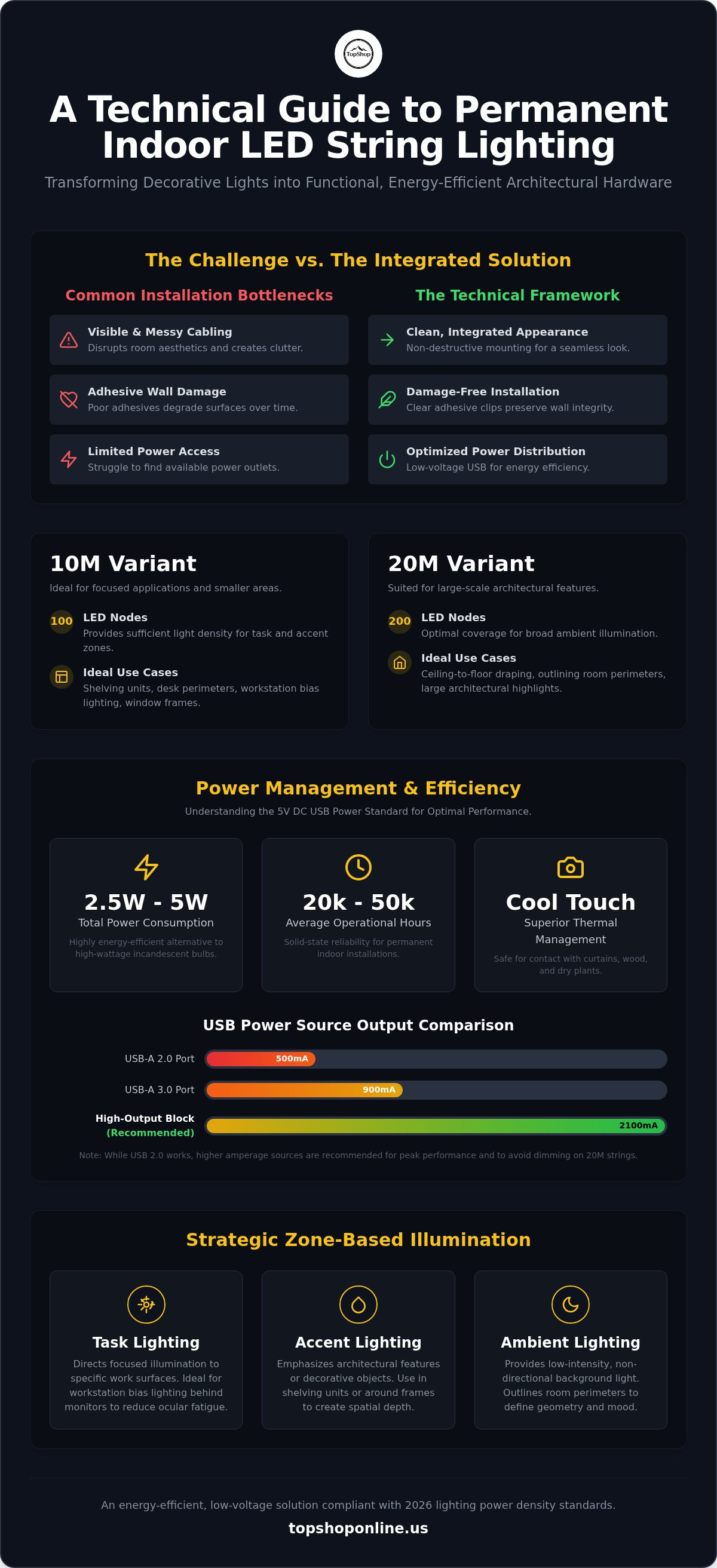
Modern LED string lights function as low-voltage semiconductor light sources, converting electrical energy directly into photon emission with high efficiency. Unlike traditional holiday lighting technology, these systems utilize light-emitting diodes (LEDs) soldered onto a flexible, multi-strand copper wire. For users executing year-round indoor string light ideas, the choice between 10M and 20M length specifications is fundamental. A 10M string typically hosts 100 individual LED nodes, providing sufficient coverage for shelving units or desk peripheries. The 20M variant, containing 200 nodes, is better suited for large-scale architectural features or ceiling-to-floor draping. The copper wire core allows for extreme flexibility, enabling the string to conform to sharp angles without fracturing the internal circuit. Each diode is encased in a polycarbonate housing, which provides high-impact resistance and protects the semiconductor from dust or moisture.
Voltage and Amperage Requirements for LED Strings
USB-powered lighting hardware operates on a 5V DC power standard, ensuring safety and compatibility with consumer electronics. A 100-LED configuration generally requires a power draw of approximately 500mA to 1A. While standard USB-A 2.0 ports provide up to 500mA, they may cause dimming or flickering on 20M strings that demand higher current. USB-A 3.0 ports, offering 900mA, or high-output charging blocks providing 2.1A, are recommended for peak performance. This low-voltage architecture results in a total power consumption of roughly 2.5W to 5W per string. It's an energy-efficient alternative to high-wattage incandescent bulbs that often require high-voltage AC connections.
Durability and Lifespan of Indoor LED Hardware
Solid-state LED diodes provide an average operational lifespan between 20,000 and 50,000 hours, depending on current stability and heat dissipation. This long-term reliability is necessary for permanent indoor installations. Thermal management is inherently superior in LEDs; the low-heat output ensures the hardware remains cool to the touch. This is vital when strings are in direct contact with curtains, wood, or dry plants. For detailed information on advanced controller features, see the guide on smart LED fairy lights for indoor. Consistent low-temperature operation prevents the degradation of the copper wire insulation over years of use, maintaining the integrity of the electrical circuit without the risk of thermal failure.
Strategic Zone-Based Illumination Configurations
Effective year-round indoor string light ideas utilize a layered lighting framework consisting of task, accent, and ambient zones. Task lighting directs focused illumination to specific work surfaces. Accent lighting emphasizes architectural features or decorative objects. Ambient lighting provides low-intensity, non-directional background light. Integrating low-voltage USB LED strings into these zones allows for precise control over interior light density without the high energy consumption of holiday lights based on older incandescent technology. This technical approach transforms decorative strings into functional hardware components that supplement or replace traditional 120V AC fixtures.
Workstation and Home Office Integration
Workstation optimization requires bias lighting to reduce ocular fatigue. Positioning 10M USB LED strings behind computer monitors creates a diffused 2700K to 3000K light buffer. This buffer decreases the high contrast between the luminous screen and the adjacent wall surface, effectively minimizing screen glare. For configurations involving a Deskpro XL Ergonomic Adjustable Laptop Bed Desk, cable management is critical. Routing the flexible copper wiring along the underside of the desk frame ensures a clean, integrated look. Utilizing a 5V DC power source directly from a laptop or monitor USB port eliminates the need for external power adapters, maintaining a streamlined hardware profile.
Living Zone and Bedroom Accent Lighting
Bedroom and living area configurations prioritize diffused light distribution and spatial depth. Installing 10M USB strings within shelving units provides localized accent lighting that highlights books or hardware while creating a sense of interior volume. Bedroom perimeters benefit from low-intensity night lighting achieved by outlining ceiling borders or window frames. This architectural highlighting defines the room's geometry without the harshness of overhead fixtures. Integrating LEDs with textiles, such as sheer curtains or bed canopies, further diffuses the light source for a non-intrusive ambient layer. For large-scale installations, USB-powered 20M LED strings offer the necessary length for continuous perimeter runs. These setups are most effective when managed via high-density power strips to ensure consistent current delivery across all zones.
Mounting Hardware and Structural Installation Techniques
Executing permanent year-round indoor string light ideas requires a transition from temporary hanging methods to disciplined structural installation. Unlike seasonal displays, year-round configurations must withstand environmental factors like humidity changes and vibration without sagging or adhesive failure. Selecting the correct hardware depends on the substrate material and the weight of the LED string. Copper-wire 10M and 20M strings are lightweight, yet they require consistent tensioning to maintain a flush, professional appearance. Proper tensioning involves securing the wire at 24-inch intervals to prevent mechanical stress on the soldered LED nodes. Following established holiday lighting safety tips remains relevant here; always inspect wires for insulation damage and avoid over-tensioning that could lead to circuit fractures.
Surface preparation is the most critical step for long-term adhesive retention. All mounting points should be cleaned with 70% isopropyl alcohol to remove dust, oils, and latex paint residues that inhibit chemical bonding. For rental properties, damage-free removal is a priority. Using a slow-release pull-tab technique for adhesive clips prevents drywall paper tearing. If installing on high-traffic areas or textured surfaces, mechanical fasteners provide superior durability compared to standard chemical adhesives.
Adhesive and Mechanical Fastener Options
Low-profile clear adhesive clips, such as 3M Command-style variants, are the standard for 10M copper-wire strings. These clips provide a transparent interface that does not obstruct the light path. For permanent installations on wooden baseboards or crown molding, insulated cable staples offer a secure, high-tension fit. Industrial furniture and metal shelving units are best served by neodymium magnetic hooks. These allow for rapid repositioning without leaving residue or requiring pilot holes. Each hardware choice must account for the 5V USB lead wire weight to ensure the connector remains seated in the power source.
Cable Management and Concealment
A professional installation hides all non-luminous components, including USB controllers and lead wires. Routing power cables along existing architectural lines like doorframes or corner molding minimizes visual clutter. Implementing advanced cable management for home office techniques is essential when integrating lights into workstations. Use J-channel raceways or split-sleeving to bundle USB leads with existing peripheral cables. Excess wire length should be coiled and secured with hook-and-loop fasteners before being concealed behind furniture or inside decorative cable management boxes. This ensures the focus remains on the light output rather than the electrical infrastructure.
Functional Applications for Multi-Season Interior Lighting
Transitioning from holiday-specific decor requires a shift in installation logic. Permanent architectural accents replace seasonal themes. These year-round indoor string light ideas emphasize functional utility over temporary aesthetics. For example, installing low-intensity LED strings along hallway baseboards or staircase risers creates a dedicated night-path. This configuration provides enough illumination for safe transit during low-lux conditions without the high glare of overhead 120V fixtures. The low-voltage nature of USB-powered LEDs allows for continuous operation with minimal thermal accumulation. This makes them suitable for placement in high-traffic zones where traditional lamps might be obstructive or inefficient.
Indoor Plant and Biophilic Integration
Wrapping internal vegetation like Ficus or Monstera plants utilizes the flexibility of 20M copper-wire strings. The high diode density of 200 LEDs per 2000cm length provides comprehensive coverage for large-scale biophilic features. Maintain a minimum distance of 0.5 inches between the LED diode and sensitive foliage to prevent localized moisture trapping. Even though LEDs remain cool to the touch, consistent air circulation is necessary for plant health. If plants require regular misting, ensure the USB connector and power source remain in a dry zone. The copper wire itself resists moisture, but the power interface is susceptible to oxidation if exposed to direct water contact.
Automated Scheduling and Smart Integration
Smart home integration optimizes energy efficiency and operational longevity. Connecting USB LED strings to smart plugs enables voice-controlled activation and automated dusk-to-dawn scheduling. Programmed off-intervals during daylight hours reduce total diode run-time, extending the hardware lifespan toward the upper 50,000-hour threshold. For complex setups involving multiple zones, a power strip with 6 AC outlets and 6 USB ports provides the necessary density to centralize control. This hardware configuration allows for synchronized scheduling across all interior lighting layers through a single smart hub interface. It eliminates the need for manual switching and ensures lighting is only active when required by the occupants.
For high-density installations requiring reliable power distribution, you can source 20M USB LED string lights and multi-port power strips to complete your permanent interior lighting project.
Power Management and Hardware Integration Solutions
Managing the electrical infrastructure for complex year-round indoor string light ideas requires precise calculation of total USB port demand and amperage load. High-density installations involving multiple 10M and 20M strings can quickly exceed the capacity of standard wall-mounted USB outlets. A single 20M string with 200 LED nodes typically draws more current than a standard 500mA USB 2.0 port can provide. Failure to match the power source to the hardware demand results in visible flickering, reduced lumen output, or controller failure. Integrating a centralized power distribution unit ensures consistent voltage delivery while protecting sensitive semiconductor components from electrical irregularities.
Surge protection is a critical requirement for LED controllers, as voltage spikes can permanently damage the integrated circuits responsible for dimming and pattern sequencing. Effective hardware integration also involves optimizing outlet placement to minimize the use of visible extension cords, which can introduce resistance and voltage drop. Heat dissipation is another technical consideration; high-density power hubs must be placed in ventilated areas to prevent thermal throttling during continuous 24-hour operation. Using UL-listed power distribution hardware provides the necessary safety certifications for permanent interior use.
Utilizing High-Capacity Power Strips
Centralizing power management through a dedicated power strip with USB ports allows for the simultaneous operation of up to six independent LED strings. This hardware configuration utilizes 6 AC outlets for high-voltage peripherals and 6 USB ports for low-voltage lighting, providing a 12-point distribution matrix. Distributing the load across multiple ports prevents individual circuit overloading and simplifies cable routing. These units function as the primary hub for multi-zone configurations, allowing users to consolidate power leads from ceiling perimeters, shelving units, and workstations into a single surge-protected interface.
USB Port Amperage and Charging Standards
Stable illumination across 20M LED strings depends on the output amperage of the USB interface. While 1.0A ports are sufficient for 10M strings, 20M variants require 2.1A ports to maintain consistent brightness across all 200 nodes. Utilizing a power strip 6 outlet 6 usb ensures that the high-current demands of longer strings are met without starving adjacent devices of power. Consistent current delivery prevents the "voltage sag" that often occurs at the end of long copper wire runs. This technical stability is essential for maintaining the integrity of the lighting design throughout extended operational cycles, ensuring that the accent lighting remains uniform and flicker-free.
Optimizing Permanent Interior Lighting Infrastructure
Implementing permanent lighting requires a shift from decorative intent to technical installation. Successful execution depends on matching 5V USB amperage to string length while utilizing non-destructive mounting hardware for long-term retention. By categorizing interior zones into task and accent layers, you create a functional illumination system that operates independently of seasonal trends. It's a method that prioritizes hardware longevity and circuit stability over temporary aesthetics.
Proper power management is the final step in realizing complex year-round indoor string light ideas. High-density power strips with multiple USB ports provide the current stability needed for 20M configurations. These components ensure flicker-free performance and surge protection for sensitive LED diodes. You can now transition from temporary setups to professional, integrated architectural lighting. Shop 10M/20M USB LED String Lights at TopShop for high-efficiency, USB-powered hardware available in multiple lengths and compatible with multi-port power distribution units. Start your technical installation today.
Frequently Asked Questions
Can I leave USB LED string lights on 24/7?
USB LED string lights are engineered for continuous operation due to their low-voltage semiconductor architecture. These 5V DC devices exhibit minimal thermal accumulation, making them safer for 24/7 use than high-voltage incandescent alternatives. Most quality LED diodes provide an operational lifespan between 20,000 and 50,000 hours. To maximize hardware longevity, integrate smart timers or programmed off-intervals to reduce total diode run-time when illumination is unnecessary.
What is the difference between 10M and 20M LED string power requirements?
A 10M string typically contains 100 LEDs and draws approximately 500mA to 1A of current. The 20M variant doubles the node count to 200 LEDs, requiring a stable 2.1A power source to maintain uniform brightness across the entire length. Standard USB 2.0 ports often provide insufficient amperage for 20M strings, leading to voltage sag or flickering. High-output USB ports on specialized power strips are necessary for these higher-capacity configurations.
How do I hang string lights indoors without damaging the walls?
Damage-free installation requires the use of clear adhesive clips or neodymium magnetic hooks. Adhesive clips provide a secure bond to painted drywall when surfaces are pre-cleaned with 70% isopropyl alcohol to remove oils. For industrial furniture or metal shelving, magnetic hooks allow for repositioning without leaving residue or requiring mechanical fasteners. These non-destructive methods are essential for rental property compliance and maintaining structural integrity during permanent year-round indoor string light ideas implementation.
Are USB-powered string lights brighter than battery-operated ones?
USB-powered configurations generally provide higher and more consistent lumen output compared to battery-operated variants. Batteries experience voltage drop as they discharge, resulting in progressive dimming and inconsistent color temperatures. USB connections provide a steady 5V DC current from a centralized power source, ensuring the LEDs operate at peak efficacy. This stability is critical for permanent installations where maintaining a specific light density is a primary functional requirement.
Can I connect multiple USB string lights to a single power strip?
Multiple USB string lights can be connected to a single high-density power strip featuring 6 AC outlets and 6 USB ports. This hardware configuration allows for centralized control of a multi-zone lighting matrix. It's necessary to verify that the total amperage draw of all connected strings don't exceed the power strip's rated output. Using a single surge-protected hub simplifies cable management and ensures consistent current delivery across all integrated lighting layers.
Do LED string lights produce enough heat to be a fire hazard?
LED string lights are solid-state devices that convert energy into light with high efficiency and negligible heat byproduct. They don't reach temperatures capable of igniting common household textiles like curtains or bed canopies. This low thermal profile makes them ideal for year-round indoor string light ideas in confined spaces or near flammable materials. Unlike incandescent bulbs, the polycarbonate housing remains cool to the touch even after extended periods of continuous operation.
How do I hide the wires for a clean year-round look?
Achieving a clean, integrated appearance involves routing copper wires along existing architectural features like crown molding, doorframes, or baseboards. Clear clips minimize the visual profile of the mounting hardware. Excess lead wire and USB controllers should be secured with hook-and-loop fasteners and concealed within decorative cable management boxes or behind furniture. Using split-sleeving or J-channel raceways further bundles the power leads with existing peripheral cables for a streamlined finish.
Can indoor string lights be used in bathrooms or high-humidity areas?
Indoor string lights can be utilized in high-humidity environments provided the electrical interface remains protected. While the copper wire and polycarbonate LED housings are resistant to moisture, the USB connector and power adapter are not waterproof. These components must be located in a dry zone or within a moisture-sealed enclosure. Avoid direct contact with water and ensure adequate ventilation to prevent condensation buildup on the internal circuitry of the USB controller.