

For modern high-end media systems in 2026, a surge protector requires a minimum rating of 2,500 joules to prevent catastrophic hardware failure during voltage spikes. Managing a complex array of OLED displays, next-gen consoles, and high-wattage sound systems often leads to hazardous cable clusters and insufficient outlet spacing for bulky power adapters. It's common to find that standard equipment lacks the physical clearance for large transformers or the necessary port density for peripheral charging.
This technical guide provides a rigorous analysis of current UL 1449 5th Edition standards, the 80% capacity rule for thermal safety, and hardware specifications required for a high-performance power strip for entertainment center applications. We examine specific port density requirements, including the utility of a 6 AC outlet and 6 USB port configuration, to eliminate redundant wall adapters and streamline cable management. This report covers essential 2026 hardware benchmarks, including surge protection thresholds, USB-C Power Delivery integration, and physical chassis designs optimized for modern media consoles. Readers will gain the data necessary to select a power distribution unit that ensures stable operation and long-term hardware protection for expensive electronics.
Key Takeaways
- Learn to calculate cumulative wattage for OLED displays and consoles to maintain critical 80% load capacity safety margins.
- Identify specific hardware features like wide outlet spacing and 14 AWG wiring required for high-current media components.
- Understand the technical advantages of integrated USB ports for direct DC power delivery and adapter redundancy reduction.
- Evaluate surge protection benchmarks including 2,500+ Joule ratings and UL 1449 5th Edition compliance for hardware safety.
- Implement a high-density 6 AC outlet and 6 USB port power strip for entertainment center environments to maximize cable organization.
Understanding Power Requirements for Home Media Hubs
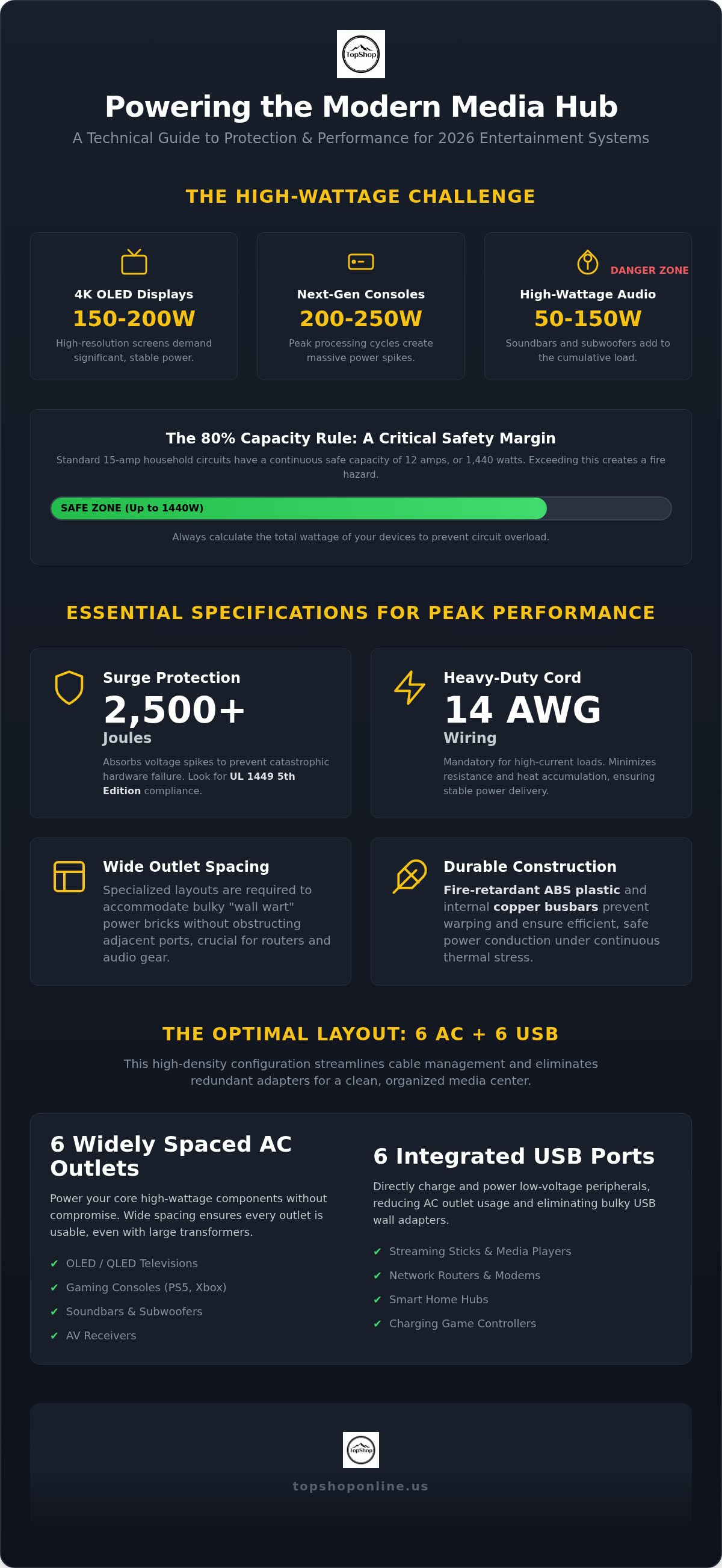
A media hub power strip functions as a centralized distribution point for high-wattage residential electronics, managing the electrical interface between a single wall outlet and multiple hardware components. Modern home theaters utilize high-performance devices with significant power demands, requiring a specialized power strip for entertainment center use that can handle cumulative current loads without thermal degradation. Standard 4K OLED televisions typically exhibit a power draw between 150W and 200W, while next-generation gaming consoles often exceed 200W during peak processing cycles.
Calculating the total amperage load is a critical safety requirement for residential setups to prevent circuit breaker activation. Most US households utilize 15-amp or 20-amp circuits; following the 80% rule, a 15-amp circuit provides a continuous safe capacity of 12 amps or 1,440 watts. Exceeding this threshold with unmanaged daisy-chaining or low-grade extensions creates significant fire hazards. High-density outlet configurations in a power strip for entertainment center applications are necessary to accommodate the physical dimensions of various power adapters while maintaining electrical stability across all connected ports.
Typical Wattage Breakdown by Device
Technical specifications for high-performance gaming hardware indicate peak power draws between 200W and 250W, necessitating stable current delivery to prevent system crashes. Audio-visual equipment, including multi-channel soundbars and powered subwoofers, adds an additional 50W to 150W to the total load. Conversely, low-voltage peripherals such as streaming sticks, network routers, and smart home bridges operate at a much lower range of 5W to 15W. Utilizing a surge protector with integrated USB ports allows these low-voltage devices to draw power directly from the DC bus, reducing the need for bulky AC-to-DC wall adapters.
The Problem of Phantom Power Draw
Standby power consumption, or phantom draw, occurs in "always-on" entertainment devices like smart TVs and consoles that remain in a low-power state for rapid booting. This constant consumption contributes to higher utility costs and can introduce total harmonic distortion into the home circuit. Centralized power strips facilitate easier energy management by providing a single point of disconnection for an entire media stack. Consolidating devices into a high-density strip also mitigates the cumulative heat generation typical of multiple individual power bricks clustered in poorly ventilated media consoles.
Essential Hardware Specifications for Entertainment Power Strips
Physical construction and material composition dictate the operational reliability of a power strip for entertainment center use within high-density media environments. Industrial-grade hardware utilizes fire-retardant ABS plastic housings paired with heavy-duty internal copper busbars to facilitate efficient current conduction. These material choices prevent structural warping and electrical arcing under continuous thermal stress. Integrated mounting slots on the chassis rear allow for secure, concealed installation behind media consoles, ensuring the unit remains stationary during frequent plug cycles.
Outlet Configuration and Layout
Spatial efficiency in media hubs requires specialized outlet spacing to accommodate proprietary "wall wart" power bricks without obstructing adjacent ports. Linear layouts with standard spacing often fail in multi-component setups where large transformers are prevalent. Block designs with widely-spaced receptacles provide the necessary clearance for oversized adapters used by routers and audio equipment. Implementing a structured layout is a foundational step in cable management for home office and media environments, preventing the physical clutter that leads to inadequate ventilation. High-density units featuring a 6 AC outlet and 6 USB port configuration maximize vertical and horizontal space, allowing for simultaneous connection of primary displays and secondary peripherals.
Cord Specifications and Durability
Electrical safety and performance depend heavily on cord gauge and length specifications. Heavy-duty 14 AWG or 12 AWG copper wiring is mandatory for high-current loads to minimize resistance and heat accumulation. Thin 16 AWG or 18 AWG cords are unsuitable for the cumulative draw of 4K TVs and gaming consoles. Equipment protection is further ensured by grounded 3-prong plugs that meet OSHA compliance requirements for relocatable power taps. These standards verify that the hardware adheres to UL 1363 and UL 1449 safety benchmarks for residential and commercial use. Cord length also impacts electrical integrity; excessive length can cause a voltage drop in high-wattage scenarios, potentially affecting device performance. Choosing a unit with a thick, insulated cord ensures stable voltage delivery across the entire media stack. For those seeking optimal hardware density, the Power Strip with 6 AC Outlets & 6 USB Ports provides a balanced solution for modern hardware requirements.
Comparison of Outlet Configurations and USB Port Integration
Selecting a power strip for entertainment center hardware involves evaluating the trade-off between pure AC outlet count and integrated DC charging capacity. Traditional 12-outlet strips provide high receptacle volume but often require the use of individual USB wall adapters that obstruct adjacent ports. A 6 AC outlet and 6 USB port configuration optimizes the electrical circuit by providing direct DC power to low-voltage peripherals. This internal conversion is more efficient than using multiple external transformers, which dissipate energy as heat. By removing individual adapters from the AC circuit, users reduce the physical load on the strip's internal busbars and simplify the overall power management architecture.
USB Port Amperage and Voltage Standards
USB port specifications are critical for maintaining the operational integrity of gaming setup essentials like wireless controllers and streaming peripherals. While standard 1.0A ports are sufficient for low-power sensors, gaming controllers for PS5 and Xbox systems require 2.1A or 2.4A for optimal charging speeds. Integrated USB hubs must provide a high total amperage capacity to prevent current throttling when all six ports are occupied. Understanding these technical nuances is as vital as knowing how to choose a surge protector for high-value displays. Modern hardware typically utilizes smart IC technology to detect the specific voltage requirements of connected devices, ensuring safe current delivery without overcharging sensitive battery components.
Space-Saving Advantages of High-Density Strips
High-density power strips significantly reduce the physical footprint of the cable management system behind media consoles. Eliminating six bulky wall adapters frees up approximately 12 to 18 square inches of space, which is critical for maintaining airflow in enclosed cabinets. Improved thermal management prevents the heat soak that can degrade the lifespan of gaming consoles and audio receivers. Vertical power strip orientations or compact block designs are often superior to long horizontal strips in tight media furniture. These configurations allow for cleaner cable routing and easier access to ports without moving heavy components. The consolidated design ensures that all primary and secondary hardware receive stable power from a single, organized source.
Safety Standards and Surge Protection Requirements
A power strip for entertainment center must be distinguished from a basic relocatable power tap by its integration of transient voltage surge suppression (TVSS) circuitry. While a standard strip merely expands outlet availability, a surge protector utilizes Metal Oxide Varistors (MOVs) to divert excess voltage away from sensitive electronics. UL 1449 5th Edition, published on October 21, 2025, serves as the primary safety benchmark for these devices in North America. This standard ensures that the hardware can withstand specific transient voltage levels without catastrophic failure or fire risk. High-quality units also feature integrated circuit breakers that automatically disconnect power during overcurrent events, preventing thermal damage to internal copper busbars and connected hardware.
Joule Ratings for Media Components
Joule rating is the total energy a surge protector can absorb before failure. For standard television displays, a rating of 1,000 to 1,500 joules is often sufficient; however, high-end home theaters with multiple high-wattage components require significantly more overhead. For gaming and entertainment centers in 2026, a minimum rating of 2,500 joules is suggested to safeguard sensitive OLED panels and processing units. Because MOVs degrade each time they absorb a spike, the presence of status indicator LEDs is mandatory for verifying active protection. Once these indicators extinguish, the surge suppression capacity is exhausted, necessitating immediate hardware replacement to maintain equipment safety.
Overload Protection and Manual Resets
The master switch on a professional-grade strip often doubles as a resettable circuit breaker. This component monitors the cumulative amperage draw and trips if the load exceeds the rated capacity, typically 15 amps for residential units. This mechanism is critical when high-draw devices like subwoofers and gaming consoles operate simultaneously on a single circuit. Manual reset buttons allow users to restore power once the overload condition is resolved, providing a reliable alternative to permanent fuse failure. This level of protection is equally vital when selecting a power strip with usb ports for professional workstations or mixed-use media environments.
Technical performance also depends on clamping voltage and response time. Clamping voltage refers to the threshold at which the MOVs begin to divert electricity, with lower values (such as 330V or 400V) offering superior protection. Response times should ideally be less than one nanosecond to intercept fast-moving transients caused by grid switching or atmospheric interference. To ensure your media stack remains operational during electrical instability, implement high-capacity surge protection hardware that meets these 2026 technical specifications.
Technical Overview: Power Strip with 6 AC Outlets & 6 USB Ports
The 6 AC outlet and 6 USB port configuration represents a specialized hardware solution for high-density media environments. This specific power strip for entertainment center design addresses the physical and electrical constraints of modern console stacks by providing 12 dedicated power points in a singular, compact chassis. This high-density layout eliminates the need for secondary expansion strips or hazardous daisy-chaining. The chassis is constructed from fire-retardant ABS plastic, paired with a heavy-duty 14 AWG copper cable to ensure thermal stability under continuous loads.
Hardware Integration and Capability
This hardware supports simultaneous power delivery for 12 total devices, utilizing a balanced distribution of AC and DC ports to manage diverse hardware requirements. Integrated safety mechanisms include transient voltage surge suppression and an automated circuit breaker to mitigate overcurrent risks. For a deeper analysis of these features, refer to the power strip 6 outlet 6 usb technical reference. The internal architecture uses high-conductivity copper busbars to maintain stable voltage across all six AC receptacles, even under peak loads from 4K displays and gaming hardware. The integrated USB charging hub provides direct DC current, bypassing the need for six individual AC adapters and reducing the overall heat signature of the power management system.
Implementation for Media Centers
Optimizing a 2026 media center requires strategic placement of the power hub to ensure accessibility for transient peripherals. USB ports should remain accessible for charging wireless controllers, remotes, and headsets, while AC cords for permanent hardware like TVs and soundbars are routed through the rear of the console. The heavy-duty cable provides the necessary flexibility for tight clearances while ensuring the unit meets UL 1363 safety standards for relocatable power taps.
Effective management of the 6x6 layout involves segregating high-wattage AC plugs from low-voltage USB cables to prevent physical cord tangling. Using the integrated mounting slots for vertical installation behind a media cabinet further improves airflow and reduces dust accumulation on the receptacles. To upgrade your current configuration and ensure compliance with modern safety standards, the Power Strip with 6 AC Outlets & 6 USB Ports offers the required port density and surge protection for high-value electronics. This configuration supports the 80% load rule while providing the necessary amperage for fast-charging peripherals through its dedicated USB bus.
Optimizing Media Power Infrastructure for 2026
Managing the electrical requirements of modern home theaters necessitates hardware that balances high-wattage AC distribution with efficient DC peripheral charging. Implementing a high-density power strip for entertainment center environments ensures that cumulative loads stay within the 80% safety threshold while providing the physical clearance needed for oversized transformers. Adhering to the latest UL 1449 5th Edition standards and maintaining a minimum surge protection rating of 2,500 Joules provides the necessary technical safeguard for sensitive OLED displays and processing units. This approach replaces redundant wall adapters with integrated charging buses, reducing thermal accumulation and physical clutter behind media consoles.
To consolidate your media hub and ensure stable power delivery, View Technical Specifications for the 6 AC & 6 USB Power Strip. This hardware configuration includes 6 AC Outlets for high-wattage electronics, 6 USB Ports for direct peripheral charging, and Integrated Surge Protection for long-term component safety. Establishing a stable electrical foundation protects your hardware investment and streamlines complex cable organization for a professional-grade setup.
Frequently Asked Questions
What is the minimum Joule rating recommended for an entertainment center?
A minimum rating of 2,500 joules is recommended for modern entertainment centers containing high-value electronics like OLED TVs and gaming consoles. This threshold ensures the hardware can absorb significant transient voltage spikes before the internal components fail. Standard power strips often lack any joule rating, making them unsuitable for sensitive media equipment. Always verify the rating on the manufacturer's specification label to ensure compliance with 2026 safety benchmarks.
Can I plug a soundbar and a 4K TV into the same power strip?
You can plug a soundbar and a 4K TV into the same power strip for entertainment center use provided the total wattage stays below the 80% circuit capacity. A typical 4K OLED TV draws 150W to 200W, while a soundbar adds approximately 50W to 150W. On a standard 15-amp residential circuit, the safe continuous load is 1,440 watts. This leaves ample overhead for additional peripherals such as streaming sticks or network routers.
Do the USB ports on a power strip charge gaming controllers as fast as a wall plug?
Integrated USB ports charge gaming controllers as fast as wall adapters if they provide 2.1A or 2.4A of current. High-quality power strips utilize smart IC technology to match the specific amperage requirements of PS5 or Xbox controllers. This eliminates the need for individual AC adapters, reducing physical clutter behind the media console. Ensure the total USB output capacity of the strip can support multiple devices charging simultaneously without throttling the current.
Is it safe to use a power strip with a 10-foot cord for heavy electronics?
Using a 10-foot cord is safe for heavy electronics if the wire gauge is 14 AWG or 12 AWG. Thicker copper wiring minimizes resistance and prevents voltage drops over longer distances, which is critical for high-wattage components. Avoid using thin 16 AWG or 18 AWG cords for cumulative loads exceeding 1,000 watts. Proper cord management ensures stable power delivery while maintaining flexibility for concealed installations inside media furniture.
What happens if I exceed the total wattage of my power strip?
Exceeding the total wattage of a power strip triggers the integrated circuit breaker to disconnect power immediately. This safety mechanism prevents the internal copper busbars from overheating and creating a fire hazard. To restore power, you must reduce the total load by unplugging high-wattage devices and pressing the manual reset button. Following the 80% load rule prevents frequent tripping and extends the operational lifespan of the hardware.
Does a power strip with USB ports protect against power surges on the USB line?
Surge protectors with integrated USB ports typically include protection for the DC bus, shielding connected peripherals from transient voltage. The internal Metal Oxide Varistors (MOVs) divert excess energy from the AC input before it reaches the USB conversion circuitry. This ensures that low-voltage devices like streaming sticks and controllers are protected alongside primary AC components. Verify that the unit is UL 1449 certified to ensure the surge suppression covers all ports.
How often should I replace the power strip in my media center?
You should replace the power strip for entertainment center equipment every three to five years or immediately after a major surge event. The protective MOVs inside the unit degrade each time they absorb a voltage spike. Once the "Protected" indicator LED extinguishes, the surge suppression capacity is exhausted even if the AC outlets still provide power. Regular replacement ensures that your expensive media hardware remains shielded from grid instability.
What is the difference between a power strip and a surge protector?
A power strip serves exclusively as an outlet expander, while a surge protector includes internal circuitry to defend against voltage spikes. Surge protectors utilize MOVs to clamp excess voltage, measured in Joules, protecting sensitive semiconductor components in modern electronics. A standard power strip offers no protection against electrical transients or lightning strikes. For high-value media hubs, a dedicated surge protector is mandatory for equipment longevity and safety.