

As of the second quarter of 2026, European Union regulations require USB-C ports on all new mobile devices, accelerating the global transition toward high-wattage Power Delivery standards. You likely recognize that standard hardware often fails to maintain peak charging speeds when every connection point is occupied. Users frequently experience slow data transfer or overheating units when using a power strip with multiple usb ports for high-draw laptops and mobile peripherals. Cluttered workspaces and insufficient spacing for bulky AC adapters remain persistent hardware limitations for modern technical environments.
This technical guide analyzes critical hardware specifications, UL 1363 safety standards, UL 1449 surge protection ratings, and efficient amperage distribution metrics. We examine how Gallium Nitride (GaN) technology and USB PD 3.2 integration support extended power ranges up to 240W. You'll learn to evaluate port density, identify adequate spacing for large transformers, and implement streamlined cable management. This analysis specifically reviews the 6 AC outlet and 6 USB port configuration to ensure your hardware meets modern electrical load requirements and safety certifications.
Key Takeaways
- Consolidate individual charging blocks into a high-density power strip with multiple usb ports to streamline DC power distribution and minimize cable clutter.
- Analyze total amperage output versus per-port maximums to verify simultaneous high-speed charging capabilities for tablets and mobile devices.
- Prioritize hardware with high Joule ratings and integrated overload protection to safeguard sensitive electronics from voltage spikes and thermal events.
- Select physical layouts featuring wide-spaced AC outlets to accommodate bulky transformer blocks without obstructing adjacent power connections.
- Conduct a comprehensive wattage audit of all connected hardware to ensure the distribution hub meets the cumulative power draw requirements of your workspace.
Technical Overview of Multi-Port Power Strip Hardware
A power strip with multiple usb ports functions as a centralized power distribution unit, managing both high-voltage alternating current (AC) for appliances and low-voltage direct current (DC) for mobile electronics. This Power Strip Technical Overview identifies these devices as essential infrastructure for consolidating hardware power needs. Replacing individual charging blocks with integrated USB ports reduces socket congestion and eliminates the need for multiple external transformers. This consolidation optimizes the physical footprint on desks and in server cabinets, providing a streamlined cable management solution for home offices and gaming stations.
The Evolution of Integrated USB Charging
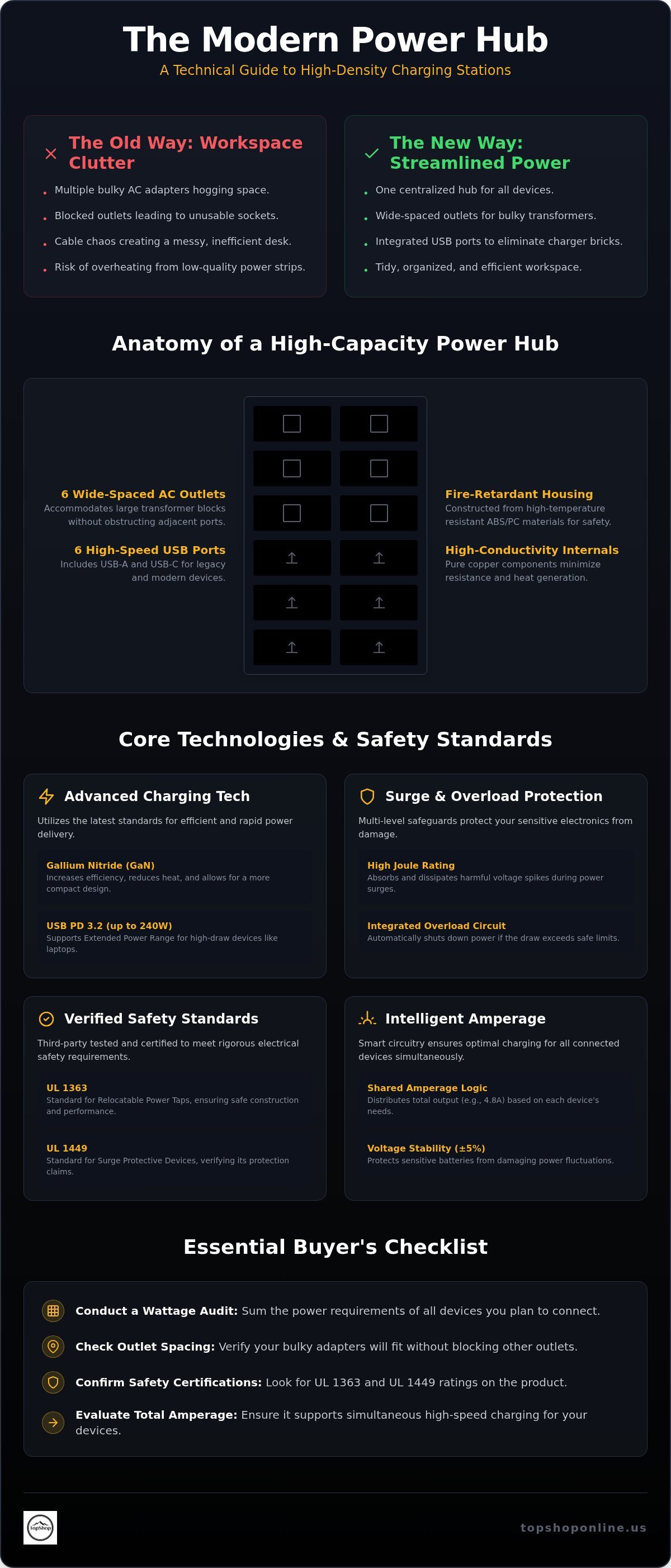
Hardware architecture has progressed from basic low-wattage USB-A ports to sophisticated high-speed charging standards. The Power Strip with 6 AC Outlets & 6 USB Ports represents a high-density configuration designed for modern technical environments. Manufacturers utilize fire-retardant plastics, such as ABS and polycarbonate blends, to ensure thermal stability during peak loads. Internal conduction components consist of high-purity copper busbars to minimize electrical resistance and heat generation across all 12 connection points. The 6x6 layout provides a balanced ratio for users with diverse hardware requirements, supporting a mix of legacy and modern peripherals.
Core Components of High-Density Strips
The internal hardware of a high-capacity power strip includes dedicated AC-to-DC transformer modules. These modules convert standard wall voltage into regulated 5V, 9V, or 12V outputs required by USB-connected peripherals. Managing 12 simultaneous power connections requires advanced PCB layouts to prevent electromagnetic interference and cross-talk between outlets. Integrated voltage regulation components maintain consistent power delivery, protecting sensitive semiconductor chips in smartphones and tablets from fluctuations. Intelligent circuitry within the power strip with multiple usb ports monitors thermal levels to prevent component degradation during continuous operation.
Primary hardware specifications for high-density units include:
- Fire-Retardant Housing: ABS/PC materials rated for high-temperature resistance and structural integrity.
- Copper Conduction: High-conductivity internal wiring and busbars to support maximum load capacity without voltage drops.
- Multi-Port Circuitry: Dedicated chips that distribute amperage based on individual device demand and battery health.
- Space-Saving Dimensions: Compact chassis designs under 12 inches for efficient desktop or under-desk mounting.
These units are specifically engineered for high-draw environments. Gaming setups with multiple monitors and peripherals benefit from the reduced clutter of external bricks. Home office configurations utilize the 6 AC outlets for laptops and printers while the 6 USB ports power mobile devices and desk accessories. The hardware footprint remains compact, making it a practical choice for multi-device hubs where surface area is limited. It's a functional solution for users requiring reliable power distribution without the bulk of traditional extension cords.
Charging Specifications: Amperage and Port Density Analysis
A power strip with multiple usb ports operates as a shared DC power rail where total amperage capacity determines the charging velocity for all connected hardware. Total output capacity represents the cumulative current available from the internal transformer, whereas per-port maximums define the ceiling for an individual connection. For example, a unit with a 4.8A total output can support two tablets at 2.4A each or six smaller peripherals at 0.8A each. Technical requirements for simultaneous charging demand that the internal circuitry maintains voltage stability within a ±5% tolerance range. This prevents "ghost touches" on capacitive touchscreens and protects lithium-ion batteries from premature degradation due to current fluctuations.
Amperage Distribution Logic
Shared amperage logic dictates how power is divided when all 6 USB ports are occupied. High-density strips utilize intelligent IC chips to detect the specific draw of each device. These chips prioritize power delivery based on battery state and hardware requirements. Calculating total wattage involves multiplying the voltage (typically 5V for standard USB) by the total amperage. A 12-device setup requires a power strip with multiple usb ports capable of managing high-draw AC appliances alongside DC peripherals without triggering thermal throttling. For high-volume charging needs, the Power Strip with 6 AC Outlets & 6 USB Ports offers a balanced distribution framework for workstations.
USB-A vs. USB-C Port Configurations
Functional differences between USB-A and USB-C revolve around connector durability and power throughput. USB-A remains the standard for legacy peripherals and low-draw electronics like wireless keyboards or LED string lights. Conversely, USB-C supports the Power Delivery (PD) 3.2 standard, enabling outputs up to 100W in Standard Power Range (SPR) and 240W in Extended Power Range (EPR). As of 2026, the EU mandate for USB-C integration has standardized this connector for most portable electronics. Port density impacts thermal management; GaN (Gallium Nitride) components allow for higher power density in smaller chassis without excessive heat accumulation. Optimizing usage involves placing high-draw devices on dedicated PD ports while utilizing USB-A for consistent, low-amperage hardware.
Safety Standards and Surge Protection Specifications
Safety for a power strip with multiple usb ports depends on the strategic integration of Metal Oxide Varistors (MOVs) and high-speed thermal cutoff fuses. These components provide a defensive barrier against transient overvoltages that can compromise sensitive semiconductor chips in modern mobile devices. High-density units require specific hardware protections to manage the combined thermal load of six AC outlets and six DC charging ports. Overload protection mechanisms utilize integrated circuit breakers to interrupt current flow if the total power draw exceeds the 15-amp or 1875-watt capacity typical of standard residential circuits. Automatic shut-off protocols prevent hardware failure during sustained electrical anomalies, ensuring the structural integrity of the power distribution hub.
Surge Protection Metrics (Joules)
Joule ratings define the total energy absorption capacity of the surge protection circuitry before component failure occurs. Home office hardware requires a minimum rating of 1000 to 2000 Joules to defend against frequent, small-scale voltage spikes common in urban power grids. MOVs within the device detect excess voltage and divert the surplus energy to the grounding wire, preventing it from reaching connected peripherals. A higher Joule rating directly correlates to an increased cumulative lifespan for the surge protector by allowing it to dissipate a greater number of electrical transients over time. This metric is essential for protecting high-value equipment like gaming consoles and workstation laptops.
Certifications and Compliance
Verification of UL 1363 and UL 1449 standards ensures that a power strip with multiple usb ports meets established National Recognized Testing Laboratory (NRTL) safety requirements. ETL certification serves as a legally equivalent mark in the United States, confirming that the hardware has undergone rigorous testing for fire hazards, electrical shock prevention, and structural durability. Internal thermal fuses provide a secondary safety layer, permanently disconnecting the circuit if internal temperatures exceed safe operating parameters. Short-circuit protection protocols monitor for low-impedance faults, providing near-instantaneous current interruption to mitigate fire risks and equipment damage. Continuous high-load operation testing validates the reliability of the copper busbars and internal solder joints under maximum thermal stress.
Fire-resistant housing specifications utilize V-0 rated ABS or polycarbonate materials designed to self-extinguish within 10 seconds during a thermal event. Grounding requirements for 6-outlet AC configurations necessitate a dedicated three-prong plug architecture to provide a safe return path for fault currents. The Power Strip with 6 AC Outlets & 6 USB Ports incorporates these safety features to maintain operational stability in high-density tech environments. Manual reset switches allow users to restore power after a safety-tripped event, while LED indicators provide visual confirmation of active grounding and surge protection status.
Workspace Integration and Cable Management Efficiency
Physical layout strategies for high-density power distribution prioritize the accommodation of oversized AC transformers without obstructing adjacent sockets. A power strip with multiple usb ports often features a linear or matrix-style outlet arrangement with specific center-to-center spacing to handle bulky power bricks. This design is critical for maintaining high-density connectivity in technical environments where standard power strips fail. Chassis dimensions typically range from 10 to 14 inches in length, allowing for discrete placement behind monitor stands or within specialized cable trays. Integrating these units with comprehensive cable management for home office systems reduces the cumulative volume of cable clutter by centralizing DC power distribution. Mounting options include integrated keyhole slots for wall-mounting or under-desk installation using industrial-grade fasteners, ensuring the unit remains stationary during frequent plug cycles.
Hardware Placement and Accessibility
Cord length selection involves a choice between 6ft and 10ft heavy-duty cables to suit standard US architectural layouts. A 10ft cord provides the necessary reach for standing desk configurations where the power source remains static while the desktop height varies. Flat plug orientations feature a 45-degree angled design, allowing the strip to connect to wall outlets behind desks or filing cabinets without requiring excessive clearance. Desktop accessibility for a power strip with multiple usb ports facilitates rapid swapping of mobile devices and peripherals, minimizing the need to reach under furniture for basic charging tasks. Non-slip rubber padding on the base prevents lateral movement on polished surfaces during the insertion or removal of cables.
Consolidating Peripheral Power
Centralizing power for gaming setup essentials like mechanical keyboards, wireless controllers, and headsets through a single hub eliminates redundant wall chargers. The integrated USB rail functions as a dedicated DC bus, providing a consistent current flow that bypasses the need for individual AC-to-DC converters for every peripheral. High-density USB ports also provide a stable 5V source for low-voltage decorative hardware, such as smart led fairy lights for indoor, preserving AC outlets for high-draw hardware like monitors and PC power supplies. This consolidation maximizes the utility of the 6 AC outlets by offloading mobile and peripheral charging to the integrated USB rail. Users can achieve a clean, professional workspace by utilizing the Power Strip with 6 AC Outlets & 6 USB Ports as the primary electrical distribution point.
Selection Framework: Choosing High-Capacity Charging Solutions
Selecting a power strip with multiple usb ports requires a systematic evaluation of electrical load and physical spatial constraints. Users should first conduct a comprehensive audit of all current and planned hardware to determine cumulative wattage and peak amperage requirements. This audit must account for high-draw peripherals like workstation laptops and tablets that require dedicated 2.4A outputs for optimal charging velocity. It's essential to calculate the aggregate power draw in watts; a typical workstation with a 100W laptop, two 30W monitors, and various 10W peripherals can quickly approach circuit limits if not managed correctly. These technical audits prevent circuit overloads and ensure the hardware operates within its rated thermal parameters.
Verification of the physical layout follows the electrical audit. Step two requires measuring the physical width of AC adapters; transformers wider than 2 inches often block adjacent standard-spaced outlets. Step three focuses on the USB controller's ability to maintain 5V stability under full load. High-draw tablets often require 12W to 15W per port to maintain charging speed while in use. The final step necessitates a physical inspection of the chassis for the ETL or UL mark. This confirms independent testing for electrical safety and surge protection reliability in high-density environments. Choosing hardware that meets these four criteria ensures long-term equipment stability and operational safety.
TopShop Power Strip Specifications
The Power Strip with 6 AC Outlets & 6 USB Ports provides a high-density solution for multi-user technical spaces. Its physical architecture includes wide-spaced AC sockets arranged for maximum adapter clearance, preventing the loss of usable outlets due to bulky transformers. Technical dimensions prioritize a compact desktop footprint while maintaining structural integrity through fire-retardant ABS housing. This specific configuration supports 12 simultaneous connections, making it suitable for gaming hubs, corporate workstations, and laboratory environments where equipment variety is high. The integrated copper busbars ensure minimal voltage drop across all connection points, maintaining consistent power delivery to sensitive semiconductor components.
Procurement and Implementation
TopShop facilitates national shipping across the United States with competitive lead times for single units or bulk commercial orders. Implementation for office environments involves standardized hardware deployment to ensure uniform safety compliance and cable management efficiency. Technical teams can integrate these units into existing under-desk trays or wall-mounted configurations using the built-in mounting points. High-volume environments benefit from the reduced need for individual wall chargers, lowering the total cost of ownership for workspace peripherals. View the Power Strip with 6 AC Outlets & 6 USB Ports for high-capacity charging needs and technical hardware specifications.
Optimizing High-Density Power Distribution
Modern technical environments require precise electrical distribution to maintain hardware longevity and operational safety. Implementing a power strip with multiple usb ports facilitates the transition from bulky AC transformers to streamlined DC power rails. Key takeaways from this 2026 guide emphasize the necessity of verifying UL 1363 and UL 1449 certifications to ensure robust surge protection. Additionally, selecting hardware with sufficient AC outlet spacing prevents terminal obstruction and maximizes connectivity for high-draw peripherals.
TopShop provides high-density solutions featuring 6 AC Outlets and 6 USB Ports to support 12 simultaneous power connections. These units incorporate integrated surge protection hardware and heavy-duty internal copper busbars for consistent voltage delivery. We offer direct national shipping across the United States to support immediate workspace upgrades. It's an efficient way to consolidate your charging infrastructure while maintaining strict safety standards.
Shop High-Density Power Strips with 6 USB Ports to achieve a consolidated and secure charging setup. Standardizing your power distribution today ensures your workspace remains compatible with evolving hardware requirements.
Technical Frequently Asked Questions
Can a power strip with 6 USB ports charge 6 tablets at once?
Simultaneous charging capacity depends on the total amperage output of the internal transformer. Most tablets require 2.1A to 2.4A for optimal charging velocity. If a power strip with multiple usb ports has a shared output of 4.8A, it won't support six tablets at full speed. Occupying all six ports with high-draw tablets results in significantly reduced charging speeds for each connected device as the current is divided.
What is the difference between a power strip and a surge protector?
A standard power strip acts as a basic multi-outlet expansion cord without internal protective circuitry. A surge protector includes Metal Oxide Varistors (MOVs) rated in Joules to divert excess voltage away from connected electronics. Verify the presence of a UL 1449 certification to confirm active surge protection. Many integrated units combine both functions to provide a centralized distribution hub with necessary safety hardware.
Is it safe to plug a power strip into another power strip?
Plugging one power strip into another, known as daisy-chaining, is a violation of National Electrical Code (NEC) and OSHA safety standards. This practice can exceed the amperage rating of the wall outlet or the first strip's internal wiring. Overloading the circuit increases the risk of thermal failure and electrical fires. Always connect the unit directly to a permanent wall receptacle to maintain safe current distribution.
How many Joules do I need to protect a high-end gaming PC?
High-end gaming PCs require a surge protector with a minimum rating of 2000 to 3000 Joules. This capacity ensures the hardware can absorb multiple transient voltage spikes before the protective components fail. Using a power strip with multiple usb ports that lacks a high Joule rating leaves sensitive GPU and CPU components vulnerable to grid fluctuations. Check for an LED indicator to verify the protection circuit is active.
Do the USB ports on a power strip provide fast charging?
Fast charging capabilities depend on the specific protocols supported by the internal DC controller. Standard USB-A ports often provide 12W (5V/2.4A), while USB-C ports with Power Delivery (PD) can support up to 100W or more. Check the technical specifications for PD or QC labels to ensure compatibility with your device's fast-charging requirements. Without these protocols, the port defaults to standard 5V charging speeds.
What happens if a power strip is overloaded?
An overloaded power strip triggers the integrated circuit breaker to interrupt the electrical flow. This safety mechanism prevents the internal copper conductors from reaching temperatures that could melt the ABS housing. If the unit lacks a breaker, excessive heat leads to a thermal event or permanent hardware damage. Always ensure the total wattage of connected devices remains below the 1875W limit for standard 15A residential circuits.
Can I use a power strip with USB ports for permanent appliance power?
Power strips are classified as relocatable power taps and aren't designed for permanent installation or high-draw appliances. Large appliances like refrigerators or space heaters should be connected directly to wall outlets to prevent overheating the strip's internal wiring. Use these distribution hubs primarily for low-to-medium draw electronics like computers and mobile peripherals. Permanent use with high-wattage machinery violates standard fire safety recommendations and building codes.
Does the length of the power cord affect charging speed?
Cord length doesn't significantly impact USB charging speed if the internal copper conductors meet standard gauge requirements. However, extremely long AC cords can experience minor voltage drops if the wire gauge is too thin for the total load. The internal transformer regulates the DC output to maintain a consistent 5V. Ensure the unit uses 14 AWG or 12 AWG wiring for stable performance over longer distances without thermal issues.